In the fiercely competitive world of high-end retail in Europe, lighting is no longer merely a practical utility—it has become a strategic asset. As 2026 approaches, the convergence of Ecodesign (ErP) and digital connectivity has made DALI-2 (Digital Addressable Lighting Interface) a mandatory protocol for fashion flagship stores from Paris to Berlin.
- About LED Track Light
- Linear Lighting System
- Retail Projects Design
- Smart Lighting Solution 2026
- 未分类
An APP Framework for Modern Retailers
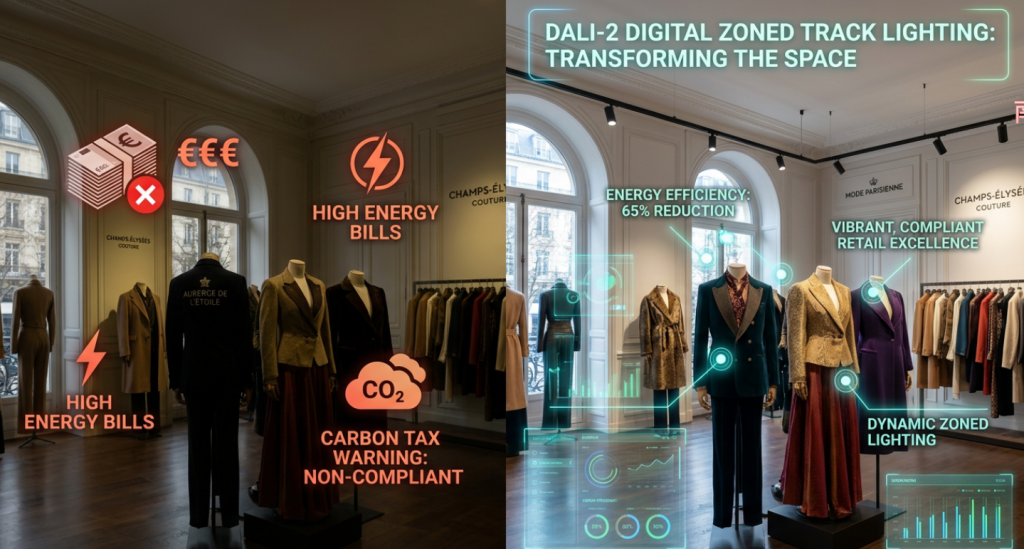
Consensus: If you operate a boutique in high-rent locations such as the Champs-Élysées or Kurfürstendamm, you are well aware that energy costs and carbon footprint taxes are rising steadily. Traditional ‘on/off’ lighting can no longer meet both aesthetic standards and EU climate targets.
Commitment: This guide provides a technical roadmap for building a DALI-2 ecosystem compliant with the EU Ecodesign Directive (2019/2020), whilst delivering the high-contrast, ‘dramatic lighting’ required for high-end fashion displays.
Preview: We will explore the DALI-2 bus architecture, the commercial return on investment from energy-saving dimming, and the ‘circular economy’ requirements that will be crucial for lighting procurement in 2026.
What is DALI-2 track light Architecture? (The Technical Foundation)
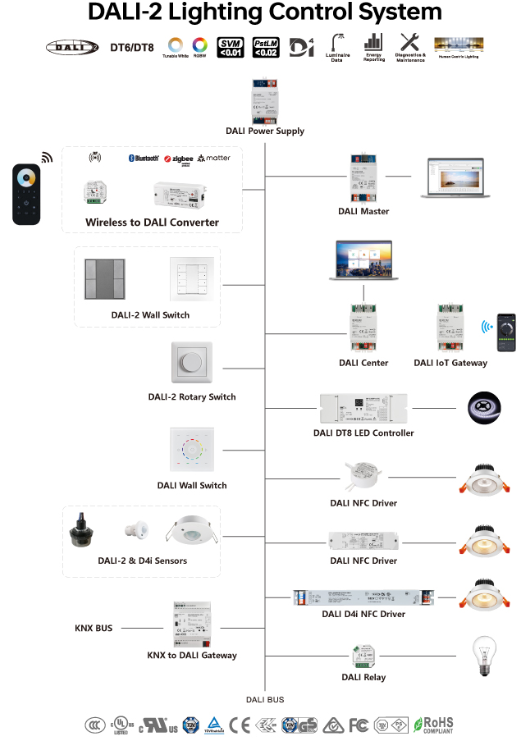
Unlike older analog systems, DALI-2 is an international standard (IEC 62386) that ensures cross-brand interoperability. In a typical European three-phase circuit, DALI-2 systems use a 6-core cable configuration: 3 phase wires + a neutral wire + 2 dedicated data lines (DA+ and DA-).
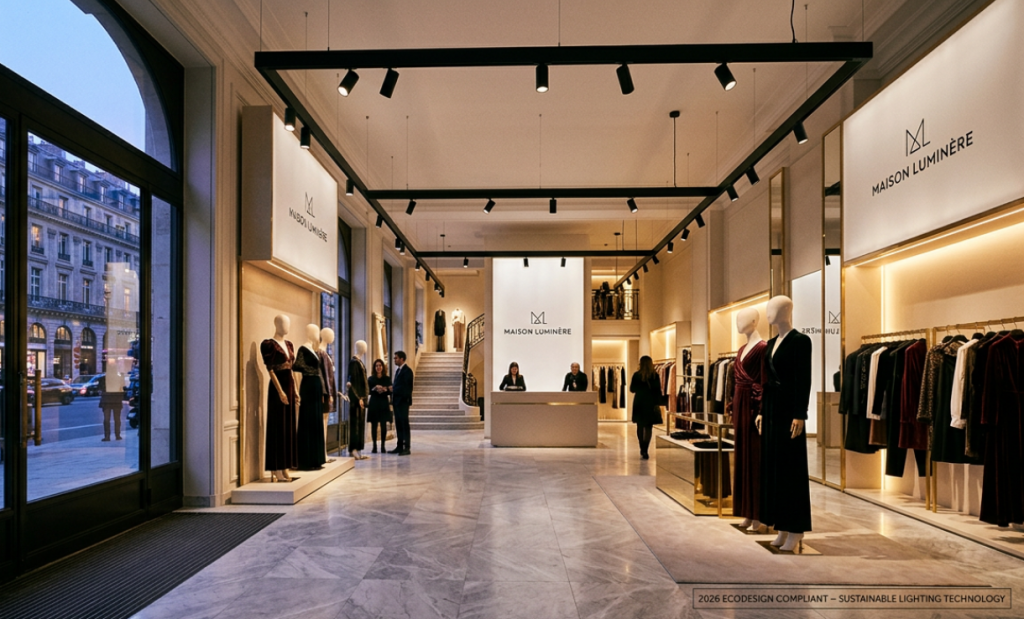
By assigning a unique digital address to each spotlight, lighting designers can create detailed “control zones” without the need for physical rewiring. This is crucial for the fashion retail industry, where store layouts and seasonal collections change every quarter. Unlike the fragmented analog systems of the past, DALI-2 is an international standard (IEC 62386) that ensures cross-brand interoperability. In a typical European three-phase circuit, the DALI-2 system uses a 6-core cable configuration: 3 phase wires + neutral wire + 2 dedicated data wires (DA+ and DA-).
By assigning a unique digital address to each spotlight, lighting designers can create detailed “control zones” without the need for physical rewiring. This is crucial for the fashion retail industry, where store layouts and seasonal collections change every quarter.
Why DALI-2 track light for the European Market? (The Commercial Logic)
For a European fashion brand, the decision to invest in DALI-2 was primarily based on three quantifiable ‘local’ factors:
ErP and natural light utilisation: DALI-2 supports integrated sensors that detect natural light entering the shop front. The system automatically adjusts the brightness of track lighting to maintain a constant illuminance level, ensuring your lighting power density (LPD) remains safely below the strict thresholds set by the EU.
The ‘museum’ effect: High-end retail is moving towards the ‘dark store’ concept, which utilises high-intensity accent lighting. DALI-2 supports logarithmic dimming curves as low as 0.1%, enabling flicker-free transitions that cannot be replicated by traditional analogue triac dimmers.
Preventive Maintenance: Digital feedback mechanisms allow luminaires to report driver status or LED fault information directly to a central facility management dashboard, thereby minimising downtime during peak shopping hours.
3. Technical Benchmark: Analog vs. DALI-2 Digital Control
| Technical Feature | Phase-Cut (Analog) | DALI-2 Digital (Standard) |
| Control Logic | Group-based (Circuit) | Individual Luminaire Control |
| Dimming Quality | Potential 50Hz Flicker | Flicker-Free (IEEE 1789) |
| Smart Integration | Limited / Proprietary | Native Casambi / KNX / DALI-2 |
| Sustainability | Fixed Consumption | Occupancy & Circadian Aware |
Logical consistency check: Although the initial hardware investment for DALI-2 is slightly higher, its total cost of ownership (TCO) is significantly lower over a five-year retail lease period. This is due to a 30% reduction in energy wastage and a substantial decrease in maintenance labour costs.
2026 Procurement Checklist: When evaluating suppliers for high-end European projects, your technical data sheets must confirm the following four core elements:
1.Circular economy compliance: Does the luminaire feature a removable driver and replaceable LED modules? In line with the latest EU ‘right to repair’ trends, non-repairable luminaires are now considered a long-term risk.
2.Colour Rendering for Textiles: Insist on a Colour Rendering Index (CRI) of Ra > 97 . Luxurious fabrics such as silk and leather require full-spectrum lighting to prevent metamerism (colour shift).
3.SDCM / McCardle Ellipse: Step 3 (or Step 2) ratingrating is achieved. In white-walled environments, the uniformity of illumination from fifty spotlights is a hallmark of luxury brands. SDCM<2
4.UGR (Unified Glare Rating): To provide an exceptional customer experience, please select optical systems with a UGR < 16, particularly for luminaires installed in fitting rooms or near mirrors.
Expert Consultation & System Integration
Implementing a DALI-2 system in Europe requires more than high-quality hardware; it requires a partner who understands EN 12464-1 (lighting of work places) and local electrical codes such as DIN VDE in Germany.
Strategic Support: Professional DIALux Consultation .Contact us to discuss more about your next project!https://www.br-lighting.com.cn/contact/