If you are selecting a control system for your track lighting, the wrong choice could cost you in terms of time, budget and flexibility. This guide compares DALI-2, DMX, Casambi and 0-10V to help you choose the most suitable system for your project before selecting any luminaires.
What exactly do these systems control?
Is your lighting system merely for switching lights on and off—or does it need to do more?
Most people assume that any dimmer will do the job. However, in track lighting installations, the control protocol determines everything downstream: how luminaires are grouped, whether colour temperature can be adjusted, how faults are detected, and whether the system can be expanded without a complete rewiring.
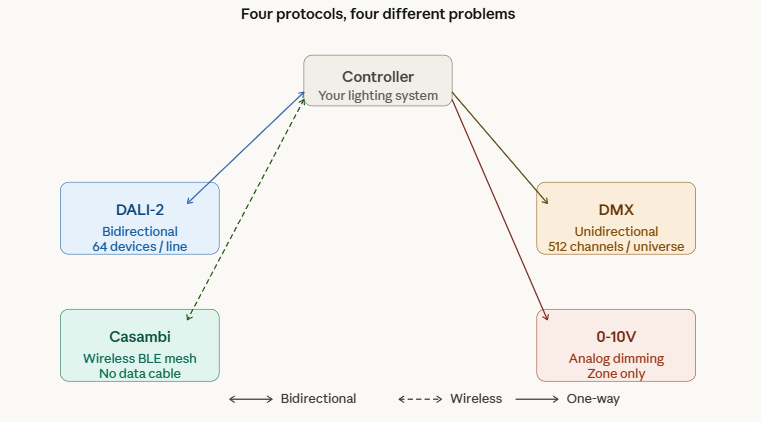
The four protocols introduced in this guide each offer solutions to different aspects of this issue:
DALI-2 (Digital Addressable Lighting Interface 2) is a bidirectional digital protocol that allows individual luminaires to be independently addressed, dimmed and monitored via a 2-wire low-voltage bus.
DMX (Digital Multiplex) is a unidirectional high-speed broadcast protocol, originally developed for stage lighting, capable of controlling up to 512 channels per universe at frequencies of up to 44 Hz.
Casambi is a wireless lighting control protocol based on a Bluetooth Low Energy (BLE) mesh network, enabling full control and commissioning of luminaires via a smartphone app – without the need for any data cabling.
0-10V is an analogue dimming protocol that linearly adjusts light output from off to full brightness by sending a simple voltage signal (0 to 10 volts) to a compatible driver.
Choosing the wrong solution will not only limit your options but may also trap you in a system that causes your project to fail not in the first year, but in the third.
→ Before comparing specifications, ask yourself: what features will this lighting system need to have in five years’ time?
2. How to compare track light with DALI2,DMX,CASAMBE AND 0-10V quickly?
Not sure where to start? Here’s a table that gives you the full picture.
| Feature | DALI-2 | DMX | Casambi | 0-10V |
|---|---|---|---|---|
| Communication | Bidirectional | Unidirectional | Bidirectional (BLE) | Unidirectional |
| Wiring | 6-wire track (L, N, E, emergency L, DA+, DA−) | 3-wire signal (DMX+, DMX−, shield) + separate mains | Wireless — no data cable | 5-wire (L, N, E, dim+, dim−) |
| Max Devices | 64 control gear per line | 512 channels per universe; max 32 fixtures per daisy chain | 250 per network | Unlimited (zone-based) |
| Response Speed | Up to 50 cmd/sec; group broadcast near-instant | Fast (44 Hz refresh) | Medium (BLE mesh) | Instant (analog signal) |
| Fault Feedback | Yes — built-in, per fixture | None | Yes — app alerts | None |
| Color Control | Yes (DT8 — tunable white & RGBWAF) | Yes (full RGB, per channel) | Yes (tunable white / RGB) | Dim only |
| Commissioning | Software required | Console required | App-based, no specialist tools | Manual wiring only, no software |
| Best Environment | Commercial, institutional, museum | Stage, event, broadcast, dynamic retail | Retrofit, hospitality, residential | Budget projects, simple zone dimming |
| Relative Cost | Medium–High | Medium | Low–Medium | Low |
→ Have you found the system you’re interested in in the table? Please go directly to the relevant system below.
3.Which system is right for your project?
In an installation comprising 200 luminaires, what would happen if a luminaire failed and you didn’t discover it for three weeks?
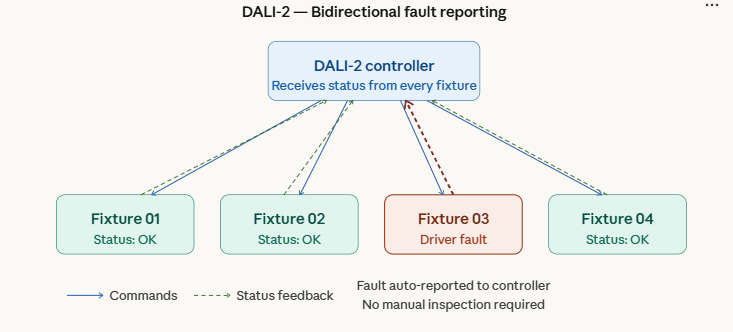
DALI-2 is a bidirectional digital lighting control protocol in which each luminaire has a unique address and reports its status to the controller in real time — including lamp failures, driver faults and energy consumption data. Without the need for manual inspections, the system automatically informs you of the exact location, time and type of fault.
This is the fundamental difference between DALI-2 and the other protocols covered in this guide. It is also why it has become the protocol of choice in venues where operational continuity is paramount, such as commercial buildings, hospitals and art galleries.
The main limitation of DALI-2 lies in its speed. As it can only process 2–3 commands per second, DALI-2 cannot support dynamic colour chases or real-time effects. The protocol is designed with a focus on reliability and diagnostic capabilities, rather than performance.
→ Scenarios where DALI-2 is recommended: In large-scale installations that you manage, luminaire failures directly impact operations—and you require the system to automatically alert you, rather than having to check manually.
DMX — When your lights need to move, change and synchronise
Can your control system keep up with the sudden drop in tempo?
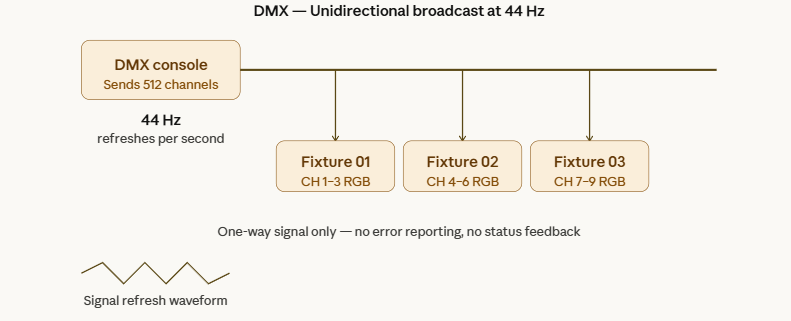
DMX (Digital Multiplexing) is a unidirectional broadcast protocol capable of refreshing up to 512 channels 44 times per second, making it the only protocol in its class specifically designed for real-time lighting performances. RGB colour chases, music-synchronised effects, and pixel-level control over hundreds of lights—none of this would be possible without the speed offered by DMX.
This is precisely why DMX has remained the industry standard for stage lighting for decades, and why it continues to be the preferred choice for concert venues, broadcast studios and high-end retail displays requiring synchronised dynamic lighting.
DMX’s primary limitation lies in reliability feedback. The protocol itself does not incorporate built-in error-checking mechanisms. A single faulty cable connector or instance of radio frequency interference can cause the entire system to flicker—without triggering an automatic alert or being able to recover on its own. In a static commercial environment, this risk is unacceptable; on stage, however, it is manageable.
→ Scenarios where DMX is the right choice: Your lighting requires real-time changes—including colour, movement, or synchronisation with audio-visual systems.
Casambi — When building structures prevent wiring
What if the biggest obstacle to upgrading your lighting isn’t the fixtures, but the walls?
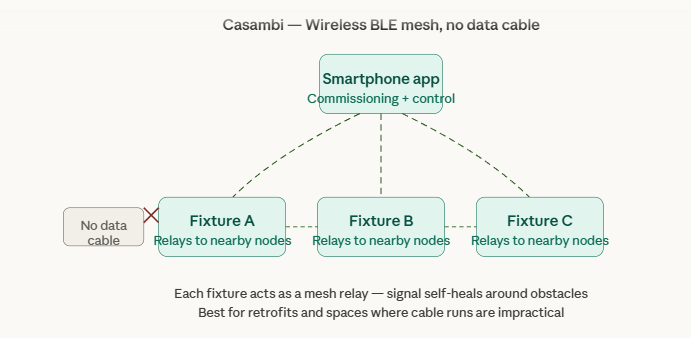
Casambi is a wireless lighting control protocol based on a Bluetooth Low Energy (BLE) mesh network. It requires no dedicated data cabling—the setup, grouping and control of luminaires are carried out entirely via a smartphone app, without the need for specialist software or console programming.
In refurbishment projects, historic buildings and hotel spaces, the cost of laying new data cables for each light fitting can exceed the cost of the luminaires themselves. Casambi solves this problem. For a restaurant group rolling out a new lighting scheme across ten branches, or a hotel refurbishing guest rooms without altering the ceiling structure, Casambi’s cost advantage in installation is unrivalled.
Casambi’s primary limitation lies in signal reliability. Wireless performance is affected by building structures—concrete floors, steel frames and high-density RF environments can all reduce the reliability of the mesh network. In environments where lighting failures could have safety or operational consequences, Casambi is not the ideal choice.
→ Scenarios for choosing Casambi: When the project involves refurbishment, hotels or historic buildings, and laying new data cables is impractical or prohibitively expensive.
0–10V — When simplicity is the best solution
Do you really need to control each light fitting individually? Or is reliable dimming by zone all you need?
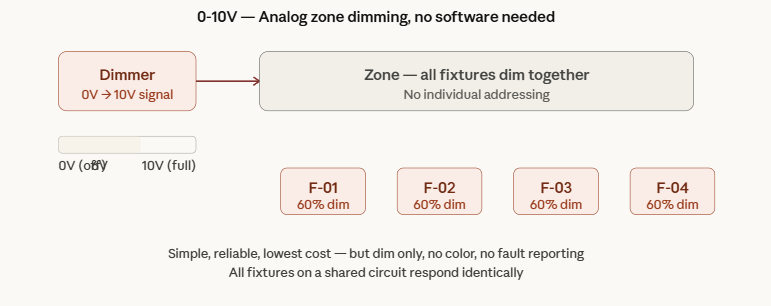
0-10V is an analogue dimming protocol that sends a signal ranging from 0 to 10 volts to compatible LED drivers, allowing the light output to be linearly adjusted from off to full brightness. The protocol requires no address allocation, no mesh networking, no protocol stack, and no debugging software. It is compatible with the widest range of driver models on the market and requires no specialist to set up or maintain.
For warehouses, logistics corridors or commercial refurbishment projects with limited budgets, 0-10V perfectly meets the requirements of these spaces – without any unnecessary features.
The main limitation of 0-10V lies in its functional scope. 0-10V supports dimming only – it does not support colour control, individual luminaire addressing or fault feedback. All luminaires on the same circuit will be dimmed synchronously as a single zone. If project requirements exceed this scope, rewiring will be necessary.
→ When to choose 0-10V: Your project requires reliable zoned dimming on a tight budget, with no need for colour control and no plans for future expansion.
What type of space are you looking to illuminate?
Before finalising the specifications of the lighting fixtures, please select the appropriate solution based on the type of project.
| Project Type | Recommended Protocol | Why |
|---|---|---|
| Corporate office, open plan | DALI-2 | Zone dimming, fault monitoring, daylight harvesting integration |
| Art gallery / museum | DALI-2 | Per-fixture precision, energy reporting, scene memory |
| Concert venue / stage | DMX | Speed, full RGB, real-time sync with AV systems |
| Retail (dynamic displays) | DMX or Casambi | Color effects (DMX) or wireless flexibility (Casambi) |
| Restaurant / hospitality | Casambi | Simple scene setting, wireless deployment, no extra cable runs |
| Heritage / retrofit building | Casambi | No new data wiring required |
| Warehouse / industrial | 0-10V | Low cost, simple zoning, robust analog signal |
| Small residential fitout | 0-10V or Casambi | Budget (0-10V) or app-based convenience (Casambi) |
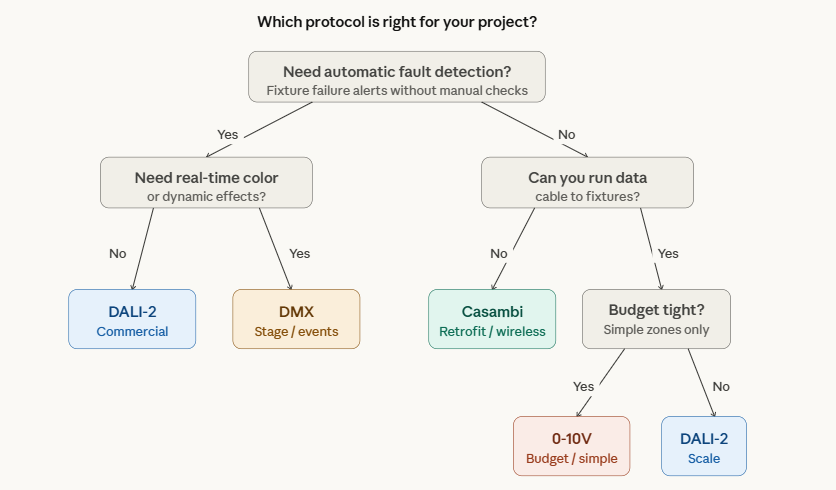
→ Don’t see your project type? Use the decision filter below.
Still undecided? Please answer the following three questions.
Question 1: Do you require automatic fault detection?
If a light fitting fails, should the system alert you—or is a manual check sufficient?
Yes, automatic detection is required → DALI-2 or Casambi
No, a manual check is sufficient → Any protocol will do
Question 2: Does your lighting need to change in real time? Color effects, music sync, dynamic scenes — or static zones held for hours?
- Yes, dynamic → DMX
- No, static → Eliminate DMX
Question 3: Is running new data cable to every fixture practical? Budget, building structure, and timeline all factor in.
- Not practical → Casambi
- Practical, budget is tight → 0-10V
- Practical, scale and diagnostics matter → DALI-2
6. The Bottom Line
| If your priority is… | Choose… |
|---|---|
| Long-term diagnostics and fault monitoring | DALI-2 |
| Dynamic color and real-time performance | DMX |
| Wireless installation and retrofit ease | Casambi |
| Simplicity and lowest upfront cost | 0-10V |
Q: What is the difference between DALI-2 and DMX for track lighting?
DALI-2 is a bidirectional protocol that supports fault reporting and individual fixture addressing, making it suited for commercial installations that require diagnostics and long-term monitoring. DMX is a unidirectional, high-speed protocol designed for real-time color control and dynamic effects, and is best suited for stages, event venues, and performance environments. The two protocols solve fundamentally different problems.
Q: What is the difference between DALI-2 and DMX for track lighting?
DALI-2 is a bidirectional protocol that supports fault reporting and individual fixture addressing, making it suited for commercial installations that require diagnostics and long-term monitoring. DMX is a unidirectional, high-speed protocol designed for real-time color control and dynamic effects, and is best suited for stages, event venues, and performance environments. The two protocols solve fundamentally different problems.
Q: Can DALI-2 and DMX be used together in the same installation?
Yes. Many lighting controllers and protocol gateways — including those from Pharos, Helvar, and KNX-based systems — support both DALI-2 and DMX simultaneously. A common approach is to use DALI-2 for architectural and ambient track lighting, and DMX for feature or accent fixtures that require dynamic color or effects.
Q: Does DALI-2 support color control?
Yes. DALI-2 Device Type 8 (DT8) supports tunable white (color temperature adjustment) and full RGBWAF color mixing. However, DALI-2’s command throughput of 2–3 per second means it cannot achieve the smooth, real-time color transitions that DMX delivers at 44 Hz.
Q: Is Casambi reliable in concrete or steel buildings?
Casambi’s Bluetooth Low Energy mesh can be affected by dense building materials such as reinforced concrete and structural steel. In most standard commercial environments, the mesh self-heals around obstacles. For buildings with very thick concrete floors or high RF interference, a site survey is recommended before committing to a wireless-only solution.
Q: What is the maximum cable run length for DMX?
The DMX512 standard supports cable runs up to 300 meters (approximately 1,000 feet) per segment using standard shielded cable. For longer runs, DMX signal repeaters or boosters are required. Cable quality and termination significantly affect signal integrity at longer distances.
Q: Can 0-10V be upgraded to DALI-2 later?
Not directly. 0-10V and DALI-2 use fundamentally different signal types — analog versus digital. Upgrading from 0-10V to DALI-2 requires replacing drivers with DALI-2-compatible units and adding a DALI-2 controller and data bus wiring. The fixture housings and light sources can typically be retained, but the control infrastructure must be replaced.
Q: Which protocol is easiest to commission on site?
Casambi is the easiest to commission — grouping, scene programming, and scheduling are all handled through a smartphone app with no specialist software. 0-10V requires no commissioning at all beyond physical wiring. DALI-2 and DMX both require dedicated software tools or consoles, and typically need a trained technician for initial setup.