How to creat right lighting for your store?the right retail lighting comes down to colour temperature, CRI, illuminance and beam angle, layered as general, accent and decorative light. Most European shop fit-outs use EN 12464-1 as a rough benchmark for how bright each zone should be.
You can usually tell within a few seconds whether a shop’s lighting was actually planned or just installed. In the good ones, you don’t really notice it — the clothes look the colour they’re meant to be, the till isn’t sitting in a shadow, and there’s some sense of where you’re supposed to look first. In the bad ones, everything’s a bit flat, or there’s one spotlight doing all the work while the rest of the shop fades into the background.
Whether you’re fitting out a clothing shop, a jewellery counter, a pharmacy or a showroom, lighting works best when it’s planned as part of the interior from the start, not added on afterwards. This guide runs through the terms worth knowing, how to combine different types of light, and how to think about a scheme from the shop window through to the till.
Why retail lighting is worth getting right
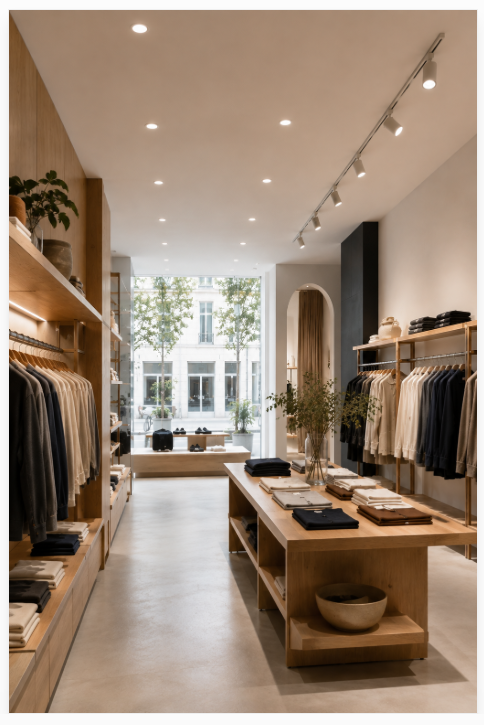
Lighting in a shop is doing several jobs at once. It needs to keep the space comfortable to be in, help people find their way around without thinking about it, and show the merchandise in a way that actually does it justice.
A scheme that’s been properly thought through tends to:
- set the mood before anyone’s picked anything up
- pull attention toward new arrivals or a campaign table
- make the façade and window more visible from the street
- support whatever the shop’s overall look and identity is going for
- give the till, fitting rooms and product areas enough light to actually function
So it’s less about finding attractive fittings and more about building a scheme where general lighting, accent lighting and any decorative pieces are all pulling in the same direction.
Start with what the shop actually needs
Before choosing any fittings, it’s worth working out what the lighting is meant to achieve in that particular space. Should it feel warm and calming, or sharp and modern? Does it need to pick out specific products, or mainly help people navigate a larger floor? Is the layout going to change often, or is this fairly fixed?
A few questions tend to sort this out quickly:
- Which areas need the most attention?
- Where do people naturally walk once they’re through the door?
- Are there corners that tend to get overlooked?
- Should the space feel exclusive, casual, clinical, cosy?
- Does the range change often enough that flexibility matters?
Once that’s clear, choosing between spotlights, track systems, downlights and linear fittings gets a lot more straightforward.
The terms worth actually understanding
A few technical terms come up constantly in retail lighting. None of them are complicated, but they make a real difference to how a space ends up looking.
Lumen is simply how much light a source puts out. Higher lumens, more light — useful to know, but on its own it doesn’t tell you much about how a space will feel.
Lux is what actually lands on a surface — a shelf, a counter, a garment. This is the number that tells you whether something is genuinely well lit, as opposed to just being near a bright fitting.
Kelvin describes how warm or cool the light looks. Lower numbers read warmer, higher numbers read cooler and crisper. Most shops end up somewhere in the warm-to-neutral range, though it really depends on the product.
CRI (or Ra) is how accurately the light renders colour. This matters far more than people expect until they see a garment look slightly wrong under poor lighting and can’t work out why.
Beam angle is how wide the light spreads. A narrow beam picks something out; a wide one fills a space evenly.
Illuminance benchmarks used across Europe
EN 12464-1 covers workplace lighting, retail included, and most European fit-outs land somewhere near these ranges:
- Circulation areas: 150–300 lx
- Shelving and general display: 300–750 lx
- Feature displays, window bays, mannequins: 750–1500 lx, sometimes more for jewellery
- Till points and fitting rooms: around 500 lx, with good colour accuracy
Combine general lighting, accent lighting and decorative lighting
Good retail lighting is rarely one type of fitting doing everything. It’s usually a few layers working together.
General lighting keeps the shop evenly and comfortably lit overall, and gives people a clear sense of the space. This is where recessed or surface-mounted LED downlights tend to do most of the work — they’re the fitting nobody’s really supposed to notice, and when they’re specified properly, nobody does.
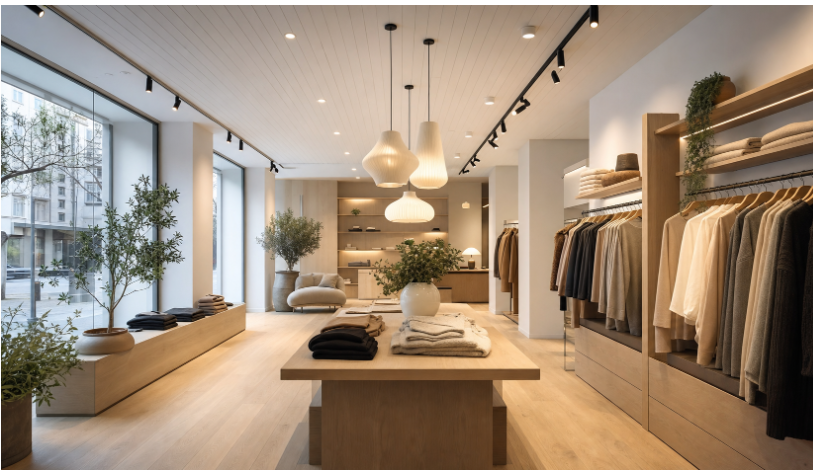
Accent lighting picks out whatever needs attention — new arrivals, a campaign table, mannequins, shelves, a window display. Track-mounted spotlights are particularly well suited to this, since they can be aimed precisely and repositioned whenever the merchandise changes. The contrast between general and accent light matters here — too little and nothing stands out, too much and the space starts to feel harsh.
Decorative lighting supports the shop’s overall style — a pendant above a counter, a wall light in a seated area. Fittings like this rarely work well on their own; they’re most effective layered on top of good general and accent lighting rather than carrying a scheme by themselves. Linear LED fittings sit somewhere between decorative and functional here — a run of light under a shelf edge or along a counter face reads as considered, without being purely ornamental.
Plan from the façade to the till
A customer’s experience of a shop starts before they walk in, which is why lighting shouldn’t stop at the front door.
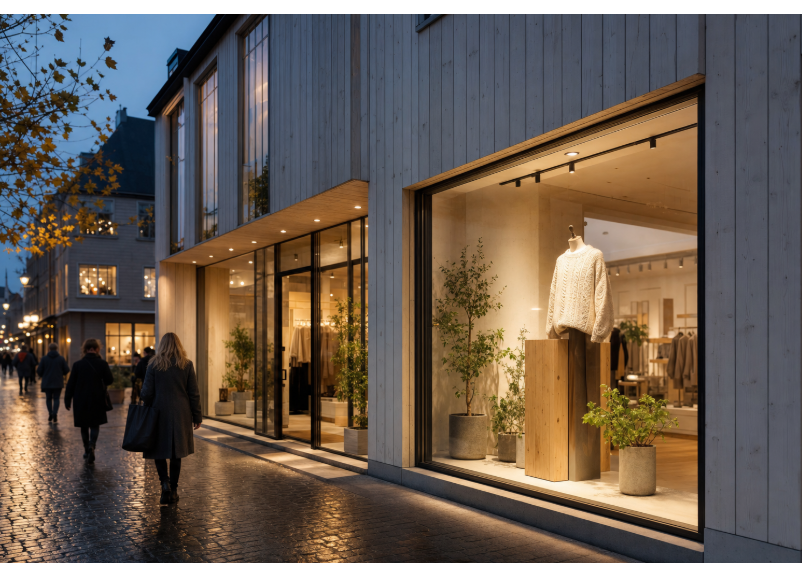
Façade and shop window. This is often the first, and sometimes the only, encounter someone has with the shop. Directed light can pull attention toward a display or a featured piece, and a well-lit window after dark does more for footfall than most people give it credit for.
Show Image <!– IMAGE 3 — façade / shop window at dusk, 16:9 –>
Entrance and circulation. A touch more brightness near the entrance, tapering back to a normal level further in, tends to give people an intuitive sense of where to walk without needing signage to explain it.
Shelves and product areas. Products need to be clearly lit without being overlit — a balance of brightness, colour temperature, CRI and beam angle that’s easy to get wrong if it’s not planned properly. Linear lighting along shelf edges is a small detail that tends to make a bigger difference than expected.
Show Image <!– IMAGE 4 — linear lighting detail, 4:3 or 1:1 –>
Till and counter. This area needs to be functional and reasonably atmospheric at the same time. A mix of good task lighting with something a bit warmer above the counter usually covers both.
Fitting rooms. Arguably the part of the shop under the most scrutiny, since customers are judging colour and fit right there. The light needs to be even, comfortable and high in colour rendering — a single strong side light is the classic mistake, and it distorts both skin tone and garment colour.
Choosing the right colour temperature
Colour temperature has a bigger effect on mood than most other single decision in a lighting scheme, which is why it’s worth choosing based on the product and the shop concept rather than habit.
Warmer light tends to feel cosy and inviting; more neutral or cooler light reads as clearer and more functional. Some shops mix temperatures across zones rather than lighting everything the same way.
As a rough guide:
- Clothing shops often do well with warm-to-neutral light and high colour rendering.
- Jewellery and design shops can use focused accent lighting to bring out detail and material.
- Clinics and showrooms tend to want something clearer and more precise.
- Lifestyle and homeware shops often lean warmer, for atmosphere.
The main thing is that the colour temperature actually suits what’s being sold, not just what looks nice on a spec sheet.
Prioritise good colour rendering
Colour rendering is one of the easiest things to underspend on, and one of the most noticeable when it’s wrong. If the light doesn’t render colour accurately, products can look different in the shop than they do in daylight or, worse, once the customer gets them home.
This matters especially for:
- clothing
- shoes
- bags
- jewellery
- cosmetics
- furniture
- interior products
- anything with texture or subtle colour variation
A high CRI is worth the extra cost wherever products need to look genuinely accurate rather than just adequately lit.
Create focal points with spotlights
Most shops have something that deserves more attention than the rest — new arrivals, a seasonal range, a display table, a campaign. This is what accent spotlights are for, and it’s where a track lighting system tends to earn its keep, since fittings can be aimed precisely at whatever needs it right now.
Worth thinking about when specifying spotlights:
- brightness
- beam angle
- placement
- distance to the product
- colour temperature
- how easily it can be readjusted later
The point isn’t for the fitting itself to be noticed. It’s for the product to look better than it would under flat, even light.
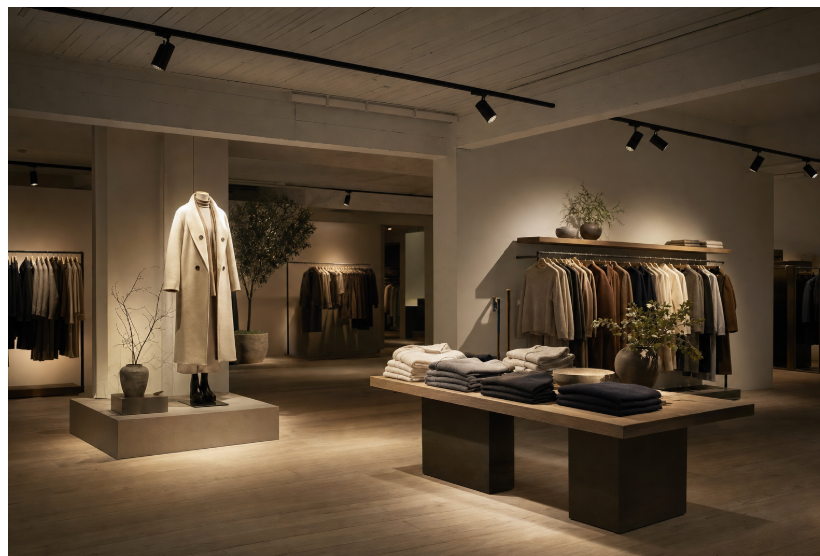
Choose lighting that can actually adapt
Shops change. New stock arrives, displays move, campaigns come and go, and the layout gets adjusted more often than most fit-outs plan for. That’s the case for building flexibility into the lighting from the start.
A track system, magnetic or conventional, is the most common way to do this. Fittings can be repositioned, re-angled or swapped without touching the ceiling or the wiring, which matters a great deal in:
- shops with a changing product range
- showrooms
- clothing shops
- interior and homeware shops
- shops running frequent campaigns
- any space where the layout gets adjusted regularly
It costs a little more upfront than fixed downlights. Most retailers find that difference disappears fairly quickly once they factor in what it would otherwise cost to re-fit the ceiling every time the layout changes.
Get help with a proper lighting plan
Retail lighting gets complicated quickly once you’re weighing up technical specifications, interior design, how customers actually move through a space, and the shop’s visual identity all at once. That’s usually the point where it’s worth bringing in someone who does this for a living.
BR Lighting supplies LED track lights, LED downlights and LED linear lights for commercial and retail projects across Europe, and can advise on fixture placement, track layout, colour temperature and illuminance for individual store concepts.
Working on a retail lighting scheme? Get in touch with BR Lighting and we’ll talk through what actually fits the project.
Checklist: choosing the right retail lighting
- What mood should the shop actually create?
- Which products need to be highlighted?
- Where do customers need a clear sense of direction?
- What colour temperature suits the products?
- Is the colour rendering good enough?
- Does the lighting need to adapt over time?
- Is there a need for spotlights, a track system, pendants or downlights?
- Have the window and façade been included in the plan?
- Are the fitting rooms, till and product areas properly lit?
- Would the project benefit from a full lighting plan rather than picking fittings one at a time?
Questions we get asked a lot
What is good retail lighting?
A scheme that keeps the shop comfortable, makes it easy to find your way around, and shows the products properly. Usually that means combining general lighting, accent lighting and a flexible spotlight system rather than relying on one type of fitting.
Which lighting is best for a shop?
It depends on the size, the products and the interior. Many shops do well with a flexible track system and adjustable spotlights, since the lighting can be adapted whenever displays or ranges change.
What colour temperature should I choose?
That depends on the mood the shop’s going for. Warm light tends to feel cosier, while neutral or cooler light reads as clearer and more functional. The main thing is that it suits the products and the shop’s style.
Why does CRI matter in a shop?
CRI, or the Ra value, shows how accurately the light renders colour. In retail, that matters because customers need to see the actual colour, material and detail of a product, not a slightly off version of it.
Why choose a track system for a shop?
Because it’s flexible. Spotlights can be moved, adjusted or aimed at something new whenever the layout changes, which makes track systems a good fit for shops and showrooms with ranges that don’t stay still.
How should a shop window be lit?
With directional spotlights on the pieces or displays that need to catch attention, ideally with enough contrast to give the display some depth.
What’s the difference between general lighting and accent lighting?
General lighting is the overall light level in the shop. Accent lighting picks out specific products, displays or areas. Most good retail schemes use both.