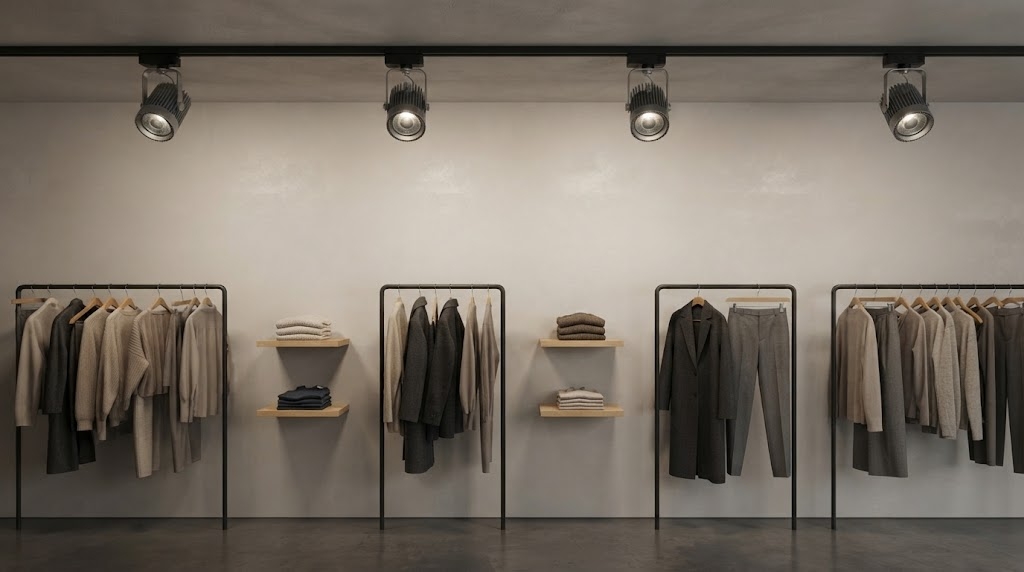
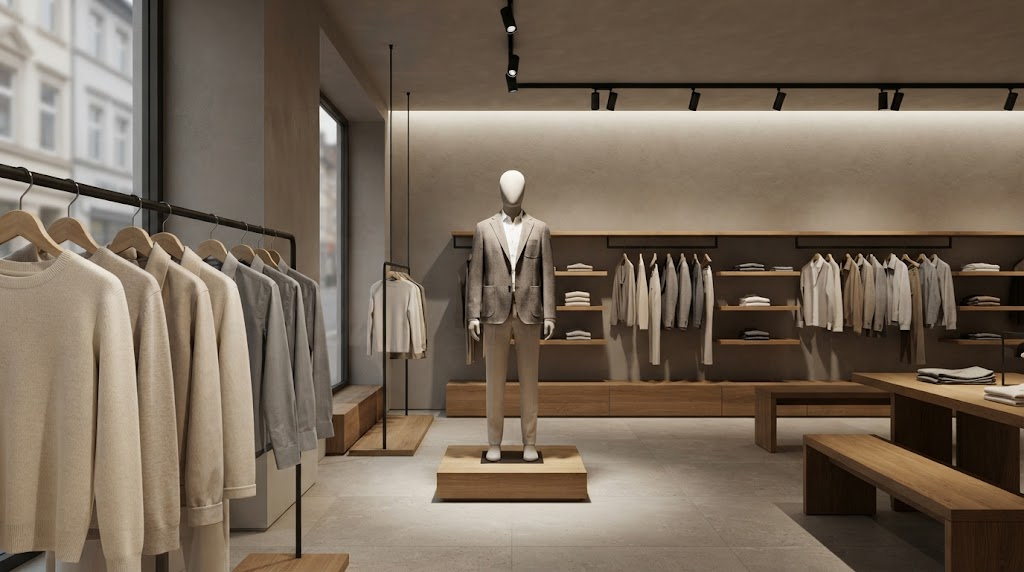
Good lighting for a fashion store should make clothes look accurate, guide attention and create a comfortable atmosphere. The most effective approach combines ambient light, controlled accent lighting and vertical illumination, with high colour quality, low glare and flexible luminaires that can adapt as the store changes.
Why lighting matters so much in fashion retail
People do not experience a clothing store as a collection of light fittings.
They notice the clothes.
They notice the colour of a jacket, the texture of a fabric, the way a mannequin looks from a distance and whether a fitting room feels comfortable. Lighting affects all of these things, often without the customer consciously noticing it.
That is why good fashion retail lighting is less about making the entire store equally bright and more about deciding where the eye should go.
A well-designed lighting scheme usually creates a visual hierarchy:
- merchandise receives the right amount of attention
- feature displays stand out from the background
- walls do not disappear into darkness
- circulation areas remain comfortable
- fitting rooms have flattering, balanced light
- decorative elements support the identity of the store
This approach is increasingly visible in professional retail and architectural lighting design, where precise optics and controlled distributions are used to create focal points rather than simply increasing overall illuminance.
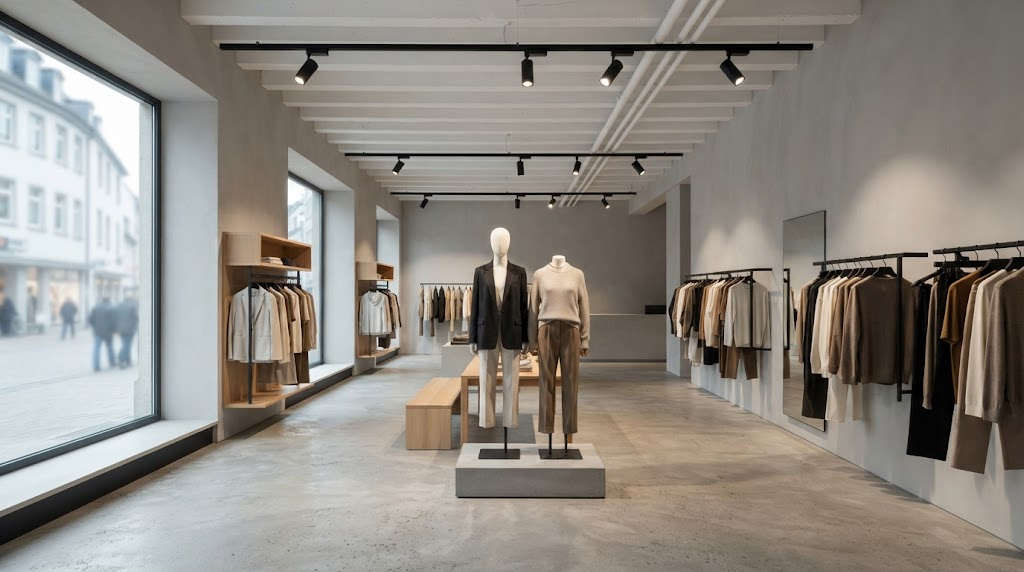
The three layers of fashion store lighting
A successful clothing store rarely relies on one type of luminaire.
A more useful way to plan the lighting is to think in layers.
1. Ambient lighting
Ambient lighting establishes the overall brightness of the store.
It helps customers move through the space and understand the layout without creating excessive contrast.
Recessed downlights, track-mounted floodlights, linear luminaires or other broad distributions can be used depending on the ceiling and architectural concept.
The important point is that ambient lighting should provide a comfortable base rather than compete with the merchandise.
2. Accent lighting
Accent lighting creates visual emphasis.
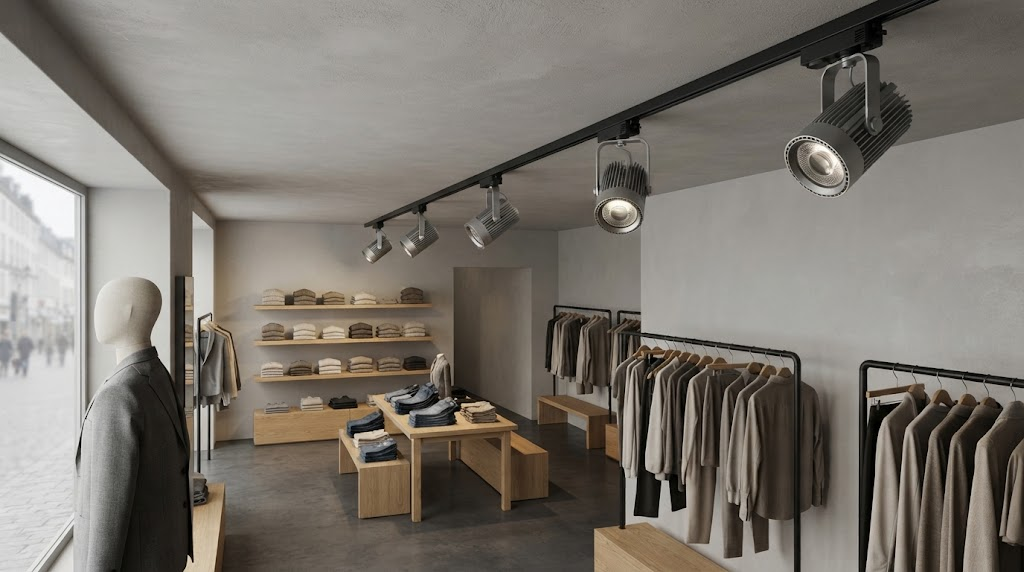
Track spotlights are particularly useful here because their position and aiming direction can be changed when displays move.
A narrow beam can highlight:
- mannequins
- new collections
- individual garments
- entrance displays
- premium products
- promotional areas
The goal is not to put every product under a narrow spotlight.
It is to create enough contrast for the important products to be noticed.
3. Vertical lighting
This is often overlooked in retail projects.
Customers see a large amount of vertical surface in a store: clothing rails, shelving, display walls, mirrors and architectural features.
Lighting these surfaces properly can make the shop feel brighter and more spacious without simply increasing the amount of light on the floor.
Wallwashing and controlled wide-beam distributions are therefore useful tools for fashion retail.
Professional architectural lighting practice increasingly treats vertical surfaces as an important part of the visual environment rather than an afterthought.
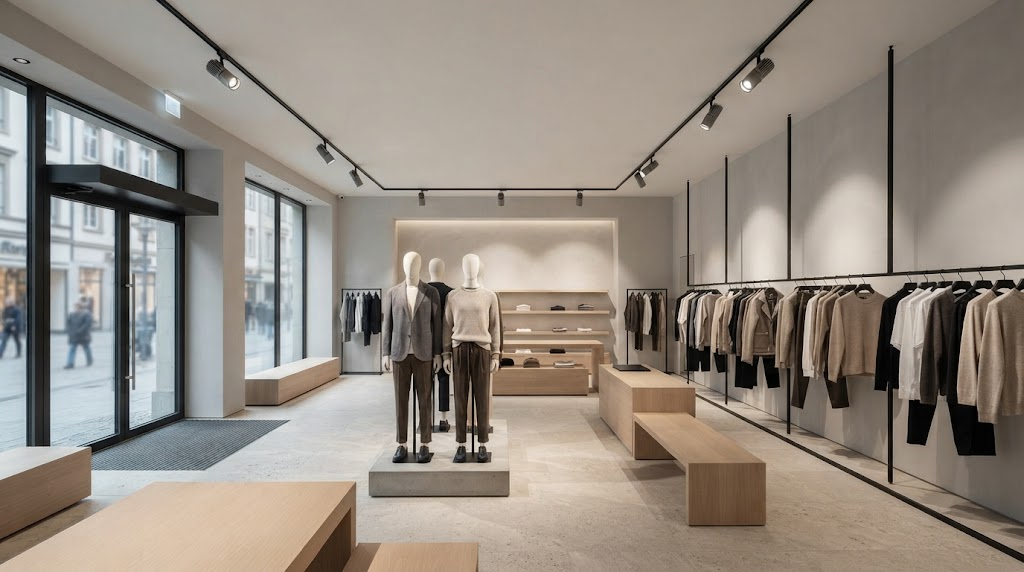
Why track lighting works well in clothing stores
Fashion stores change.
Collections change. Window displays change. Furniture moves. Shelving layouts are updated. Seasonal campaigns introduce new focal points.
A fixed lighting layout can quickly become restrictive.
Track lighting provides a practical solution because luminaires can be repositioned and redirected without rebuilding the ceiling.
This gives the lighting system a useful degree of flexibility:
Move the fitting → change the aiming direction → adjust the visual emphasis.
That flexibility is one of the main reasons track spotlights remain a core tool in retail lighting.
The track itself becomes part of the infrastructure, while the individual luminaires provide the flexibility needed for different displays and merchandising layouts.
Beam angle matters more than simply choosing a powerful spotlight
One common mistake is choosing a high-output spotlight and assuming that more light will produce a better display.
It often does the opposite.
If the beam is too wide, the visual impact of the product can disappear.
If it is too narrow, the result can look harsh and uneven.
As a practical starting point, retail projects may consider:
| Beam angle | Typical application |
|---|---|
| 10–15° | Small displays, mannequins and strong focal points |
| 20–24° | Individual products and medium-size displays |
| 30–36° | Clothing rails and general accent lighting |
| 40–60° | Larger displays and broader surfaces |
These are starting points rather than universal rules.
The correct beam depends on mounting height, distance to the merchandise, display size and the visual effect required.
A useful lighting specification should therefore describe the distribution of light, not just the lumen output of the luminaire.
Modern retail spotlights increasingly use carefully developed optical systems to control beam shape and improve the relationship between efficiency and visual quality.
Use different beam angles in the same store
There is no reason for every track spotlight to have the same optical distribution.
In fact, mixing distributions can create a much more natural lighting hierarchy.
For example:
15° spotlight
A mannequin or hero product.
24° spotlight
A clothing rail or selected product group.
36° spotlight
A larger merchandising zone.
Wide distribution
A feature wall or general background area.
This creates variation without requiring different lighting systems throughout the store.
It also makes future changes easier because the lighting infrastructure remains consistent while the optical tools can be selected according to the display.
Colour temperature: 3000K, 3500K or 4000K?
There is no single colour temperature that works for every fashion brand.
The right choice depends on the brand identity, materials, architecture and merchandise.
| Colour temperature | Typical impression |
|---|---|
| 2700–3000K | Warm, intimate and premium |
| 3000–3500K | Warm-neutral and versatile |
| 3500–4000K | Cleaner and more contemporary |
| 4000K+ | Cooler and more energetic |
A luxury boutique with timber, stone and warm finishes may benefit from a warmer lighting atmosphere.
A minimalist contemporary fashion store with white surfaces, concrete and metal may work better with a neutral 3500–4000K approach.
The important point is consistency.
The colour temperature should support the materials and brand rather than being selected simply because one value is considered “best”.
Colour rendering is critical for clothing
Fashion retail has a simple problem that other retail environments may not face as strongly:
customers care about colour.
A shirt that looks slightly different under the store lighting can look different again in daylight.
For this reason, high colour rendering should be a priority.
CRI 90+ is a sensible starting point for many fashion retail projects, but CRI alone does not tell the whole story.
For more demanding projects, it can also be useful to look at:
- R9 performance
- TM-30 metrics
- colour consistency
- SDCM
- spectral characteristics
- performance at different dimming levels
Colour consistency is particularly important when many luminaires are installed across a large sales floor.
A technically good luminaire should produce a consistent appearance from one fitting to another rather than creating noticeable colour differences across the store.
Do not make the whole store equally bright
Uniform brightness sounds safe, but it can make a fashion store visually flat.
A better approach is to create a relationship between brighter and quieter areas.
For example:
Background → comfortable ambient illumination
Clothing rails → stronger product emphasis
Feature display → higher visual priority
Mannequin → focused accent
Decorative elements → controlled secondary accents
This creates depth.
It also means the customer can understand the store more easily without consciously analysing the lighting.
The lighting leads the eye.
That principle is central to good retail lighting design: the luminaire is not the visual destination. The merchandise is.
Vertical lighting can make a store feel brighter
One of the most effective techniques in a clothing store is to illuminate walls and vertical merchandise.
A dark wall can make an otherwise well-lit shop feel smaller.
A properly illuminated wall can make the same space feel more open and visually comfortable.
Wallwashing can be useful for:
- clothing displays
- shelving
- brand walls
- textured surfaces
- architectural backgrounds
- large promotional graphics
The distribution should be controlled carefully.
Simply pointing several powerful spotlights at a wall can create bright patches and dark gaps.
A dedicated wallwashing optic or a suitable wide distribution can provide a much more even result.
Lighting mannequins is about modelling, not just brightness
A mannequin is three-dimensional.
It should not be treated like a flat product display.
Light from one direction can create strong shadows and make clothing textures appear dramatic. Too much frontal light, on the other hand, can flatten the form.
A useful approach is to create directional contrast while maintaining enough fill light from the surrounding environment.
The result should show:
- garment colour
- fabric texture
- body shape
- folds and details
- facial features
- accessories
The objective is controlled modelling rather than maximum brightness.
Fitting room lighting needs a different approach
The fitting room is one of the most sensitive areas in a fashion store.
A strong spotlight directly above a customer’s face can create deep shadows and an unflattering appearance.
Lighting from only one direction can also make the customer see the clothing differently from how it appears on the sales floor.
A better approach is balanced illumination, with attention to vertical light and facial appearance.
Where mirrors are used, the surrounding light should help reduce harsh shadows rather than creating a bright hotspot directly above the head.
For fashion retailers, the fitting room should be treated as part of the customer experience rather than simply another area requiring general illumination.
Control glare before increasing light output
A bright store is not necessarily a comfortable store.
Glare can come from:
- exposed LED sources
- poorly shielded spotlights
- highly reflective surfaces
- incorrect aiming
- excessive contrast
- luminaires positioned within the customer’s direct field of view
Good optical design can reduce these problems without sacrificing the intended lighting effect.
This is one reason professional lighting specifications should look beyond lumens and efficacy.
The question is not simply:
How much light does the luminaire produce?
It should also be:
Where does the light go, and what does the customer actually see?
Flexible lighting is becoming more important
Retail interiors are not static.
A store may change its product layout several times during the year.
A flexible lighting system therefore has value beyond the initial installation.
Look for systems that allow:
- easy repositioning
- reliable mechanical aiming
- different beam distributions
- accessories for glare control
- replaceable components where appropriate
- dimming
- scene setting
- straightforward maintenance
Current professional lighting development is also putting more attention on durability, repairability and circularity rather than treating the luminaire as a disposable product.
That matters for retailers operating multiple stores, where maintenance and replacement can become a significant part of the lifetime cost.
Smart lighting control for fashion stores
Smart control does not necessarily mean that every light needs to be connected to the cloud.
For many retail projects, the most useful functions are quite practical:
- dimming
- lighting scenes
- zoning
- scheduling
- daylight response
- occupancy sensing in selected areas
- energy monitoring
- centralised control for multiple stores
DALI-2 can be considered when individual addressing, grouping, dimming and integration with sensors or building systems are required.
Wireless systems can also be useful, particularly where rewiring is difficult or flexibility is a priority.
The control system should follow the store’s operational requirements rather than being added simply because it is described as “smart”.
Daylight should be part of the lighting design
Many fashion stores have large shopfront windows.
During the day, daylight can contribute significantly to the visual environment.
The artificial lighting system should therefore be designed with the façade and daylight conditions in mind.
A practical strategy is to divide the store into zones.
Fixtures close to the windows can be dimmed when sufficient daylight is available, while deeper areas of the store maintain the required lighting level.
This can reduce unnecessary energy use while keeping the visual hierarchy intact.
At night, the same system can return to a different lighting scene.
Energy efficiency is about the whole lighting system
A high lm/W figure is useful, but it should not be the only number considered.
Two luminaires can have similar efficacy while producing very different results on the merchandise.
For retail, useful questions include:
- How efficiently does the optic place light on the target?
- How much light is wasted on surrounding surfaces?
- Can the luminaire be dimmed?
- Can different zones operate at different levels?
- Can daylight reduce output when appropriate?
- How long will the system remain useful as the store changes?
- How easy is maintenance?
- Can components be replaced rather than replacing the complete fitting?
This is a more realistic way to think about lighting efficiency.
The most efficient luminaire is not necessarily the one with the highest headline efficacy. It is the one that delivers the required visual result with the right amount of light, in the right place, for the required operating hours.
A practical lighting strategy for a modern fashion store
For a typical contemporary clothing store, a good starting concept could look like this:
Ceiling: approximately 3.5–4.5 m
General lighting: broad, comfortable distribution
Track lighting: flexible black or dark-grey track system
Accent lighting: adjustable LED spotlights
Beam angles: mixed according to display size
Colour quality: CRI 90+ as a starting target
Colour temperature: approximately 3000–4000K depending on the brand and materials
Vertical lighting: wallwashing or wide distribution on important display walls
Fitting rooms: balanced vertical and facial illumination
Controls: dimming and zoning, with DALI-2 or wireless control where appropriate
Glare: controlled through luminaire optics, shielding and positioning
The exact values should still be confirmed through a lighting calculation and, ideally, a physical sample.
Common mistakes in fashion store lighting
Using the same spotlight everywhere
One beam angle rarely works equally well for mannequins, shelves, clothing rails and walls.
Choosing lumens before optics
A powerful fitting with poor beam control can produce less useful light than a lower-output fitting with better optics.
Ignoring vertical surfaces
A bright floor with dark walls can make the store feel visually unbalanced.
Over-lighting everything
If everything is bright, nothing becomes a focal point.
Choosing colour temperature without considering materials
The same 4000K lighting can feel very different in a concrete interior compared with a warm timber boutique.
Treating fitting rooms as ordinary areas
Poor facial illumination can negatively affect the customer’s experience even when the sales floor looks excellent.
Installing a fixed lighting layout for a changing store
If the merchandising concept changes regularly, flexibility should be considered from the beginning.
What should you specify when buying LED track lights for fashion retail?
Instead of asking only for wattage and lumens, a professional specification should include:
- LED power and lumen output
- delivered lumens
- efficacy
- beam angle or distribution
- colour temperature
- CRI and colour quality information
- SDCM / colour consistency
- glare performance
- dimming compatibility
- DALI-2 compatibility where required
- track system compatibility
- mechanical adjustment range
- accessory options
- lifetime and lumen maintenance
- driver information
- replaceability and maintenance
- product compliance documentation
This makes it much easier to compare products from different manufacturers on the same basis.
FAQ: Fashion Retail Lighting
A combination of ambient lighting, adjustable accent lighting and vertical illumination is usually the most effective approach. High colour quality, controlled beam angles and good glare control are particularly important for fashion retail.
Yes. Track lights are especially useful because individual spotlights can be moved and redirected as merchandise and displays change.
There is no universal answer. 3000K–3500K often creates a warm-neutral retail atmosphere, while 3500K–4000K can suit contemporary stores with cleaner materials and architecture.
CRI 90+ is a sensible starting point for many fashion applications. For higher-end projects, R9, TM-30, SDCM and overall colour consistency should also be considered.
Approximately 20–36° is a useful starting range for many clothing displays, while narrower beams can be used for stronger focal points and wider distributions for larger surfaces. The correct choice depends on mounting height and display size.
DALI-2 can be useful when a project requires addressable dimming, zoning, scenes, sensor integration or more advanced control. It is not necessary for every store.
Use efficient LED luminaires together with appropriate optical control, zoning, dimming, daylight response and sensible operating schedules. Energy performance depends on how the complete lighting system is operated, not just luminaire efficacy.
Final takeaway
The best fashion retail lighting does not try to make every part of the store equally bright.
It creates a visual hierarchy.
Products receive attention. Walls provide brightness and depth. Mannequins have enough modelling to look natural. Fitting rooms remain comfortable. The lighting system can adapt when the merchandise changes.
That is where a good track lighting system becomes valuable.
The track provides the infrastructure.
The optics control the light.
The lighting layout creates the hierarchy.
And the store itself remains the focus.