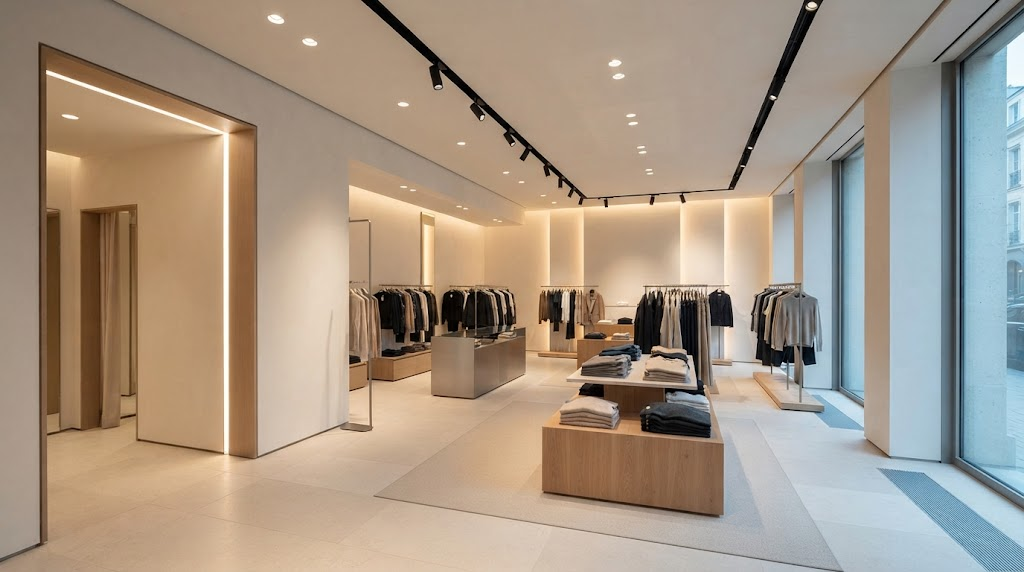
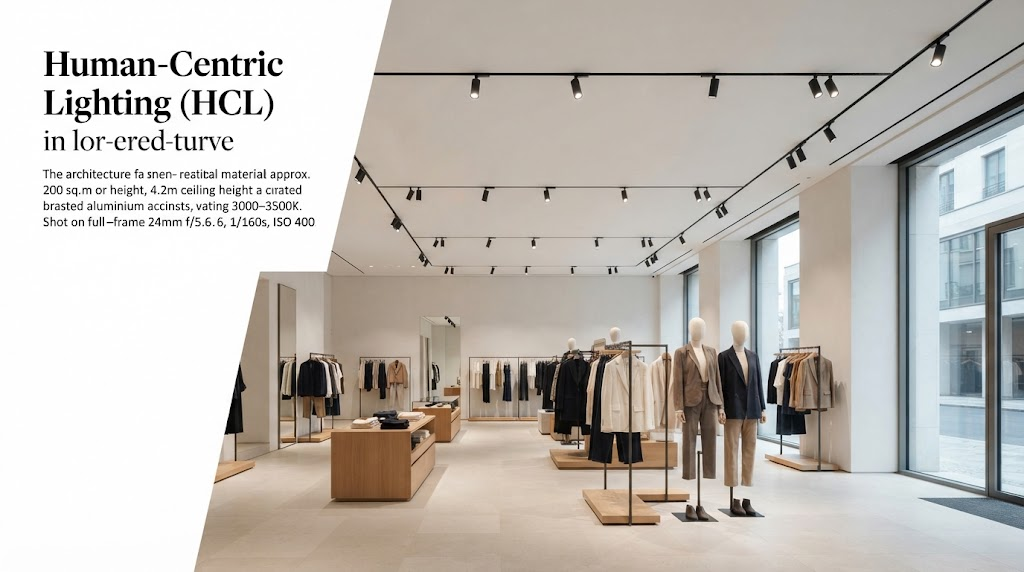
Human-centric lighting (HCL) in retail means designing light around people, products and the way a store is used. It goes beyond brightness and colour temperature to consider visual comfort, colour quality, vertical illumination, daylight, atmosphere and how lighting changes throughout the day.
What Is Human-Centric Lighting in Retail?
Human-centric lighting is a lighting design approach that considers how people experience a space.
In a retail environment, this includes three closely related areas:
- Visual experience — how clearly customers see products and the store
- Biological response — how light exposure relates to the natural day-night cycle
- Emotional experience — how the atmosphere makes people feel
These areas should not be treated separately.
A store can have excellent technical illumination and still feel uncomfortable. It can also have attractive decorative lighting while making products difficult to see.
Good HCL brings these requirements together.
The objective is not to make the lighting noticeable. The objective is to create an environment where customers can see comfortably, understand the space and feel good while they are there.
Why Does Human-Centric Lighting Matter in Retail?
Retail lighting has two jobs at the same time.
It has to present merchandise properly, while also creating an environment in which people want to stay.
This makes lighting different from simply providing enough illumination for a task.
Customers respond to:
- brightness and contrast
- glare
- colour appearance
- illuminated walls
- shadows
- spatial depth
- daylight
- changes in atmosphere
These details influence how a store is perceived.
A well-designed lighting scheme can make the entrance feel welcoming, direct attention towards important displays and make deeper areas of the store easier to discover.
The effect does not have to be dramatic.
In many successful retail environments, the lighting works quietly in the background.
HCL Starts With Visual Comfort
The first requirement is still simple:
People need to see comfortably.
This means looking beyond average illuminance.
A useful retail lighting concept considers where customers look and what they need to recognise.
For example:
Entrance: clear orientation and a welcoming transition
Sales floor: comfortable general illumination
Product displays: stronger visual emphasis
Feature merchandise: controlled accent lighting
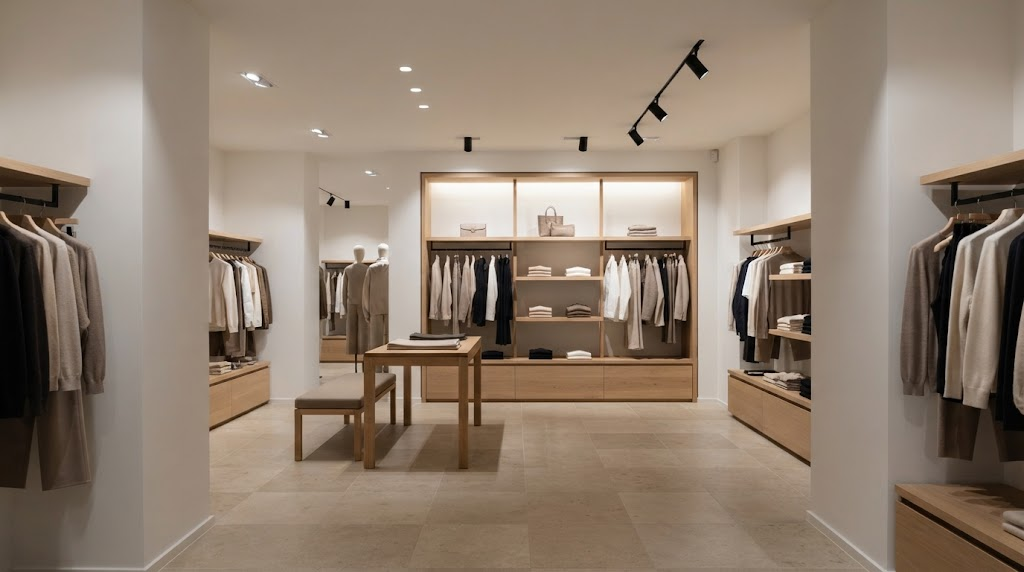
Walls: sufficient vertical illumination
Fitting rooms: balanced light around the face and clothing
This creates a visual hierarchy.
Instead of making every area equally bright, lighting is distributed according to the importance of each space.
That approach can also reduce unnecessary energy use because light is directed towards surfaces and products that actually need it.
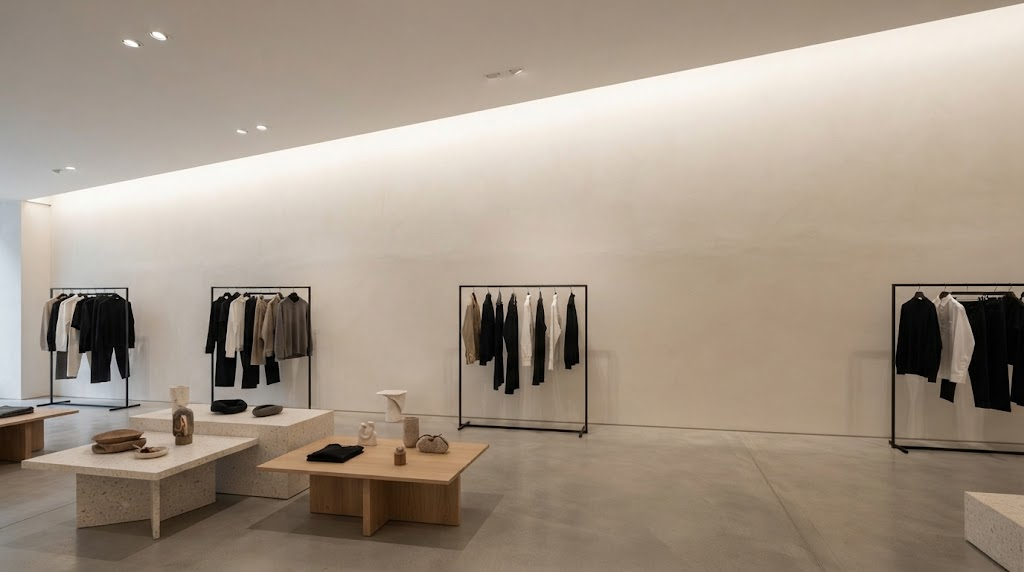
Why Vertical Lighting Is So Important
One of the most useful principles in modern retail lighting is to pay attention to vertical surfaces.
Customers naturally look towards walls, shelving, clothing rails, displays and other vertical elements.
A store with a bright floor and dark walls can therefore feel less bright than expected.
Illuminating vertical surfaces changes the perception of the entire space.
Wallwashing can be used for:
- clothing displays
- shelving
- architectural walls
- feature materials
- merchandise backgrounds
- entrance areas
It also helps create depth.
A brighter rear wall can make a customer look further into the store. A well-lit display wall can give merchandise more visual presence without simply increasing the general lighting level.
This is one reason professional lighting design increasingly treats vertical illumination as a fundamental part of retail lighting rather than an optional decorative effect.
HCL Is More Than Changing Colour Temperature
This is probably the most important point to clarify.
Human-centric lighting is not the same as tunable white lighting.
Tunable white technology allows the colour temperature of a luminaire to change.
HCL is the broader design concept.
A complete dynamic lighting system may consider:
- time of day
- illuminance
- colour temperature
- spectral characteristics
- daylight
- light direction
- distribution
- activity
- atmosphere
Changing from 4000K to 3000K does not automatically create a human-centric environment.
The lighting needs to change for a reason.
Current professional HCL systems increasingly combine tunable white with dimming, different light distributions, glare control and networked control rather than treating colour temperature as a standalone feature.
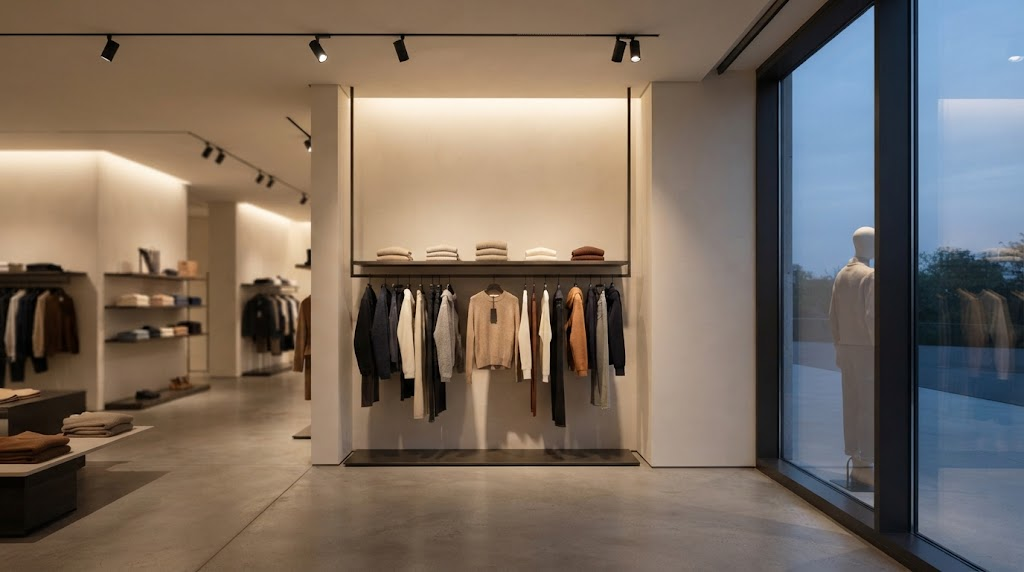
How Should Retail Lighting Change During the Day?
There is no universal HCL schedule for every store.
The right sequence depends on opening hours, daylight, architecture and the type of retail environment.
A simple concept could be:
Morning
Use a clearer, brighter lighting scene as the store begins operation.
Daytime
Allow daylight to contribute where available and maintain comfortable, stable illumination.
Late afternoon
Gradually adjust the lighting as natural daylight decreases.
Evening
A slightly warmer and more atmospheric scene can create a different retail mood while maintaining product visibility.
The changes should be gradual.
Customers should experience a comfortable transition rather than notice that the lighting system is actively changing.
Should Every Retail Store Use Tunable White?
No.
Tunable white is useful when dynamic colour temperature has a genuine role in the lighting concept.
It can be particularly relevant for:
- large stores
- stores with long operating hours
- spaces with strong daylight variation
- premium retail environments
- projects requiring different lighting scenes
- stores where atmosphere changes between daytime and evening
For a small shop with stable operating conditions, a carefully selected fixed colour temperature may be the better solution.
The important question is not:
“Does this luminaire have tunable white?”
It is:
“What will changing the light achieve in this space?”
The Emotional Side of Retail Lighting
Light also changes how a store feels.
Warm, low-contrast lighting can create an intimate atmosphere.
Higher brightness and clearer illumination can make a space feel energetic and open.
Strongly controlled accent lighting can create drama around selected products.
Soft vertical illumination can make an interior feel calm and spacious.
There is no correct atmosphere for every retailer.
A fashion boutique, sports store, supermarket and electronics showroom may all require completely different lighting strategies.
This is where lighting becomes part of the retail identity.
The light should support the architecture and brand rather than compete with them.
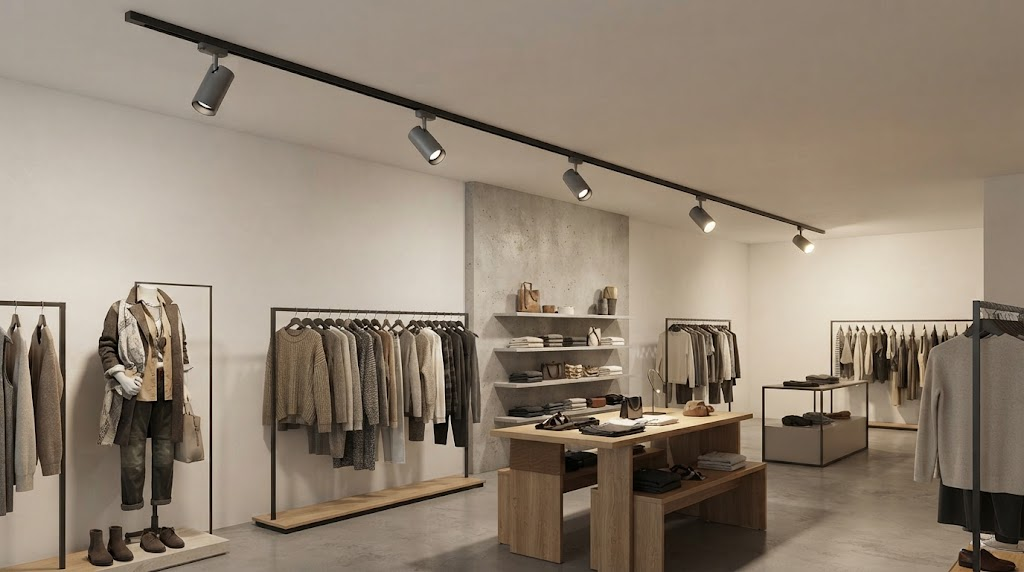
Use Light to Guide Customers
Lighting can help customers understand where to go.
A darker circulation area leading towards a brighter feature display creates a natural visual direction.
A brighter rear wall can encourage customers to explore deeper into the store.
A strongly illuminated entrance display can attract attention from outside.
A focused spotlight can establish a clear destination inside the sales floor.
This does not require theatrical lighting.
Small differences in brightness, contrast and vertical illumination can be enough.
Good retail lighting often works through these subtle visual cues.
Track Lighting Fits Naturally Into HCL Retail Design
Track lighting is particularly useful when the store needs flexibility.
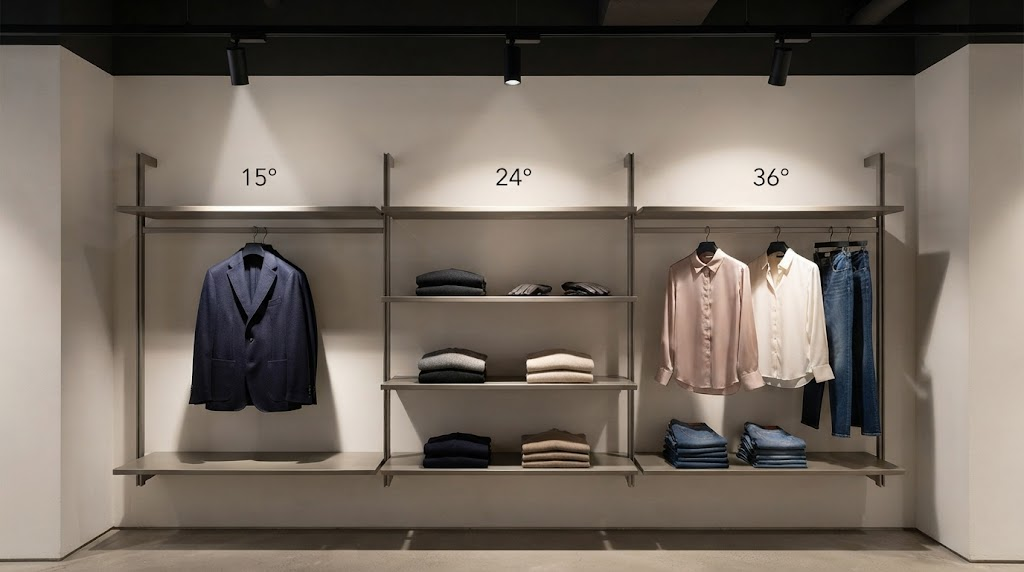
The same track infrastructure can support different lighting tasks through different luminaires, beam angles and aiming positions.
For example:
Narrow distribution
For mannequins and hero products.
Medium distribution
For clothing rails and product groups.
Wide distribution
For larger displays.
Wallwashing
For vertical surfaces.
This gives retailers more freedom when merchandising changes.
A clothing store may move a display several times during a season. With a flexible track system, the lighting can be redirected rather than redesigned from scratch.
Modern professional track systems also increasingly combine precise optics with dimming, different distributions and digital or wireless control.
Good Optics Matter More Than High Lumen Output
A common approach to retail lighting is to compare luminaires mainly by wattage and lumens.
That is not enough.
The more useful question is:
How much useful light reaches the surface that needs to be illuminated?
A high-output spotlight with poor control can waste light outside the target area.
A carefully designed optic can place light more precisely on merchandise, walls or displays.
This affects:
- visual contrast
- accent intensity
- energy consumption
- glare
- product appearance
- overall lighting quality
Professional lighting systems therefore increasingly use different distributions rather than one universal beam angle for every application. Current products include everything from narrow accent distributions to wide flood and wallwash options.
Glare Control Is Part of Human-Centric Lighting
A store can look impressive in a photograph and still be uncomfortable to visit.
Glare is one of the reasons.
Potential sources include:
- exposed LED sources
- badly positioned spotlights
- high luminance contrast
- reflections in mirrors
- shiny merchandise surfaces
- incorrect aiming angles
Good HCL therefore requires control over what people actually see.
This can involve:
- optical shielding
- appropriate cut-off
- precise beam control
- careful luminaire positioning
- correct mounting angles
- suitable brightness levels
The goal is not simply to hide the light source.
It is to make the lighting comfortable while maintaining the desired visual effect.
Colour Quality Still Matters
Human-centric lighting does not change the basic requirements of retail lighting.
Products still need to look right.
This is especially important for:
- clothing
- cosmetics
- jewellery
- food
- furniture
- lifestyle products
CRI 90+ is a useful target for many quality-focused retail applications.
For more demanding projects, it is also worth reviewing:
- R9 performance
- TM-30
- SDCM
- colour consistency
- spectral characteristics
For fashion retail, colour consistency is particularly important.
If several luminaires illuminate the same clothing area, noticeable differences in white point can make the merchandise look inconsistent.
Daylight and Artificial Light Should Work Together
Daylight is not simply another light source.
It changes continuously.
Its intensity and colour vary with:
- time
- weather
- season
- window orientation
- surrounding buildings
Retail lighting should respond to this environment where practical.
Large windows may provide sufficient illumination near the façade during part of the day, while areas deeper inside still require artificial light.
This makes zoning useful.
For example:
Window zone → lower artificial output when daylight is strong
Middle zone → stable controlled illumination
Interior zone → maintain required lighting level
The same principle can be used for evening scenes.
This improves both comfort and operational efficiency.
HCL and Energy Efficiency Can Work Together
Human-centric lighting does not automatically save energy.
But a well-designed HCL system can provide more opportunities for efficient operation.
Useful functions include:
- daylight dimming
- scheduled lighting scenes
- zoning
- occupancy detection in suitable areas
- individual luminaire control
- reduced output outside peak periods
- centralised energy monitoring
The important distinction is that energy efficiency comes from the way the lighting system is designed and operated.
A high-efficiency LED luminaire operating unnecessarily at full output is still an inefficient lighting strategy.
A better approach is:
Efficient LED technology + precise optics + appropriate light levels + controls + sensible operating hours.
What About Employees?
Retail HCL should not focus only on shoppers.
Employees may spend most of their working day under the same lighting conditions.
Their needs can be different from customers.
Staff areas, offices, stockrooms and checkout positions may require longer-duration visual comfort.
For these areas, consider:
- glare
- task requirements
- vertical illumination
- daylight access
- brightness
- colour quality
- duration of exposure
The lighting strategy should therefore consider everyone who uses the building.
Smart Controls Make HCL Easier to Manage
A human-centric lighting concept becomes much more practical when the lighting system can be controlled by zone and time.
Depending on the project, this may include:
- dimming
- scene control
- scheduling
- daylight sensing
- occupancy sensing
- tunable white
- energy monitoring
- centralised management
DALI-2 is one option for projects requiring addressable control, grouping, dimming and integration with compatible sensors and systems.
Wireless control can be useful for retrofit projects or installations where additional cabling is difficult.
But the control platform should be selected after the lighting strategy is defined.
Technology should support the design.
It should not become the design.
A Practical HCL Lighting Strategy for Retail
For a new retail project, the process can be kept relatively straightforward.
Step 1: Study the architecture
Look at ceiling height, walls, materials, windows and customer circulation.
Step 2: Identify important visual surfaces
Decide which walls, displays and products should attract attention.
Step 3: Plan vertical illumination
Do not wait until the end of the design to consider walls.
Step 4: Build the lighting hierarchy
Separate general lighting from accent lighting and feature areas.
Step 5: Select suitable optics
Choose distributions according to mounting height, target size and desired effect.
Step 6: Check colour quality
Consider CRI, R9, TM-30 and SDCM where appropriate.
Step 7: Control glare
Evaluate the lighting from normal customer viewpoints.
Step 8: Add daylight response
Use the available natural light instead of fighting it.
Step 9: Define lighting scenes
Only introduce dynamic changes where they serve a clear purpose.
Step 10: Commission the system
Aim the luminaires, set scenes and adjust lighting levels after installation.
The final stage matters.
Even a high-quality lighting system can produce a poor result if luminaires are badly aimed or control scenes are never properly commissioned.
Common Human-Centric Lighting Mistakes
1. Thinking HCL means colour-changing lights
Tunable white can support HCL, but it is only one part of the system.
2. Making the whole store equally bright
Retail needs visual hierarchy.
3. Ignoring vertical surfaces
Walls strongly influence how customers perceive the brightness and depth of a space.
4. Using too much accent lighting
If every product is a focal point, there is no focal point.
5. Choosing luminaires only by lumens
Optics, glare and light distribution matter just as much.
6. Changing colour temperature too aggressively
Dynamic lighting should feel natural rather than become a visual effect.
7. Adding smart control without a lighting strategy
A connected lighting system is not automatically a better lighting system.
8. Forgetting employees
Staff experience the lighting for much longer than most customers.
FAQ: Human-Centric Lighting in Retail
Human-centric lighting is a design approach that considers the visual, biological and emotional effects of light on people. In retail, it combines visual comfort, colour quality, light distribution, daylight and atmosphere.
No. Tunable white allows colour temperature to change, while HCL is a broader approach that also considers brightness, timing, spectrum, distribution, daylight and user needs.
Vertical lighting helps illuminate walls, shelving and merchandise displays. It can improve spatial perception and make a store feel brighter and more visually balanced.
No. A store can have a human-centric lighting strategy using fixed colour temperature. Dynamic colour temperature is useful when it serves a clear purpose.
Yes. Track lighting provides flexible positioning, adjustable aiming and different optical distributions, making it useful for changing retail displays and layered lighting concepts.
It can when combined with daylight response, zoning, dimming, scheduling and appropriate operating levels. HCL itself is not an automatic energy-saving technology.
No. DALI-2 is one possible control platform. It becomes useful when a project needs addressable dimming, zoning, scenes or compatible sensor integration.
There is no universal value. The choice depends on the merchandise, architecture, daylight, brand identity and desired atmosphere. Fixed 3000K–4000K lighting can work well in many retail environments, while tunable white provides additional flexibility.
Final Takeaway
Human-centric lighting in retail is not about adding more technology.
It starts with understanding how people experience the store.
They need to see products clearly.
They need comfortable light without excessive glare.
They need enough brightness on walls and displays to understand the space.
They need visual cues that help them navigate.
And the atmosphere may need to change as daylight and store activity change.
The lighting system should support all of this quietly.
That means choosing the right distribution, placing light where it is useful, controlling glare, considering vertical surfaces, working with daylight and adding dynamic control only where it makes sense.
For retailers, the result is more than a technically illuminated store.
It is a space that feels considered, comfortable and easy to experience.