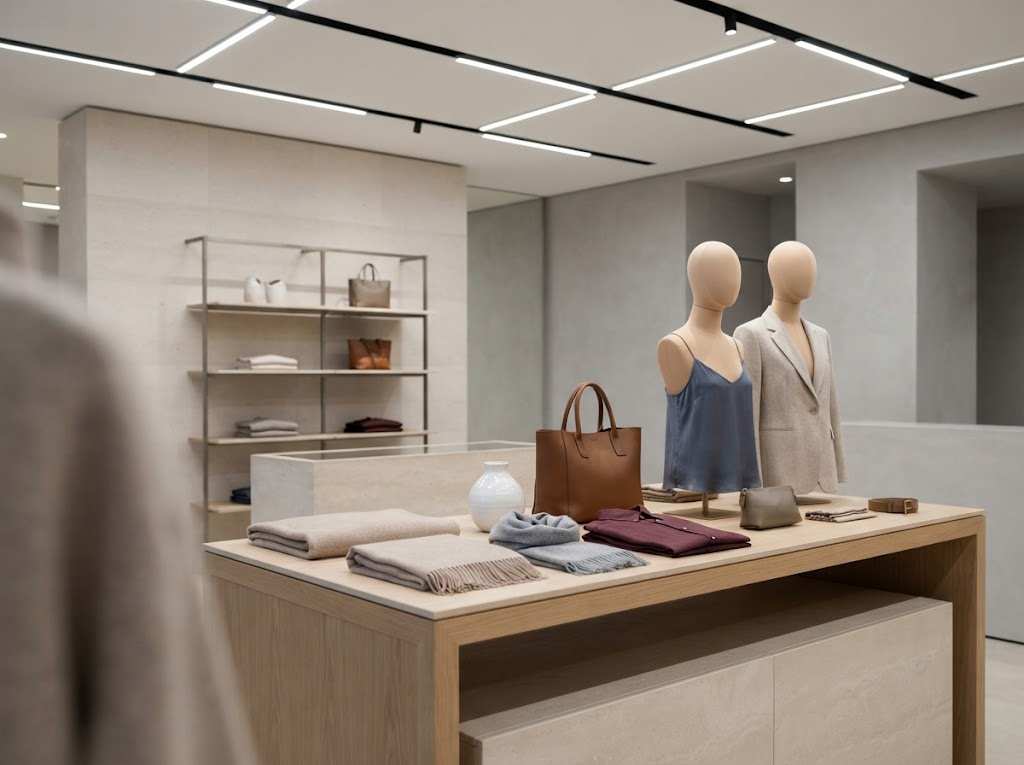
LED linear track lighting gives retail stores a flexible way to combine general illumination, product lighting and a clean architectural ceiling. For European retail projects in 2026, the right system is not simply the one with the highest lumen output. Track compatibility, optical control, colour quality, glare, energy performance and lighting controls all need to work together.
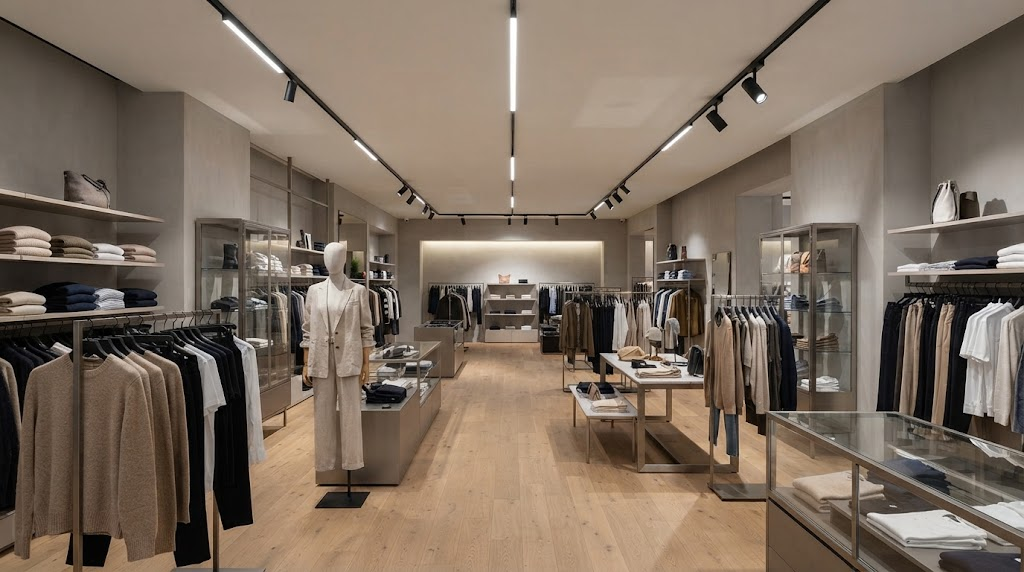
Retail lighting is having a small but important shift.
The question is no longer simply, How bright should the store be?
Retailers and lighting designers are looking more closely at how light supports the products, how easily the system can adapt when a store is refurbished, how much energy the installation uses, and whether the lighting can be controlled as part of a wider building system.
That is where LED linear track lighting has become increasingly interesting.
Instead of treating the ceiling as a fixed lighting grid, a track system allows lighting to follow the retail concept.
A fashion display can be changed. A shelving run can move. A new collection can be introduced. The lighting can often be adjusted with it.
What Is LED Linear Track Lighting?
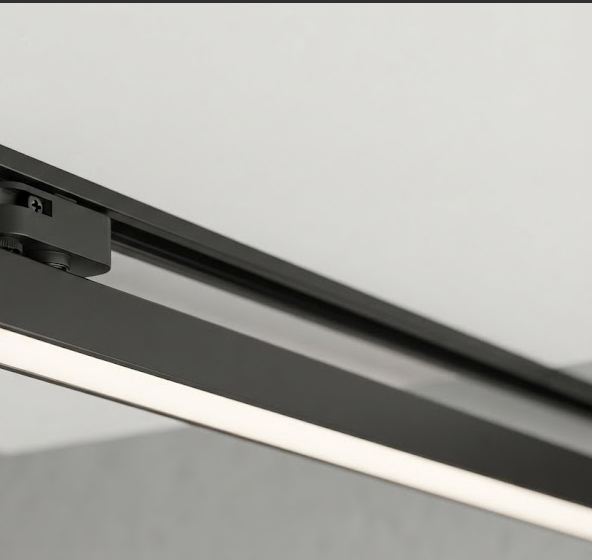
LED linear track lighting is a linear LED luminaire installed on an electrified lighting track.
The track provides both the mechanical mounting point and, depending on the system, the electrical connection. The linear module can then be positioned along the track according to the lighting layout.
Compared with a conventional fixed linear luminaire, the main difference is flexibility.
A typical system includes:
- Electrified track
- Track adapter
- Linear LED module
- LED driver
- Optical system
- Mechanical housing
- Optional dimming or control interface
Some systems are designed specifically for three-phase tracks, while others use magnetic or low-voltage track systems.
These systems should not be treated as interchangeable. Mechanical dimensions, electrical configuration and adapter design need to be checked before specification.
Why Are Retailers Choosing Linear Track Lighting?
The appeal is less about the shape of the luminaire and more about what the system allows the store to do.
A Flexible Ceiling
Retail stores change.
Displays move. Shelves are replaced. Seasonal campaigns come and go. A lighting layout that works perfectly on opening day may not work as well after the first refurbishment.
A track system gives designers more freedom to reposition luminaires without rebuilding the entire ceiling.
That flexibility can be particularly useful for:
- Fashion stores
- Department stores
- Supermarkets
- Showrooms
- Furniture stores
- Electronics retailers
- Lifestyle stores
- Multi-brand retail spaces
A Cleaner Alternative to a Ceiling Full of Spotlights
Track spotlights are excellent at creating accents.
But using individual spotlights everywhere can make a ceiling visually busy.
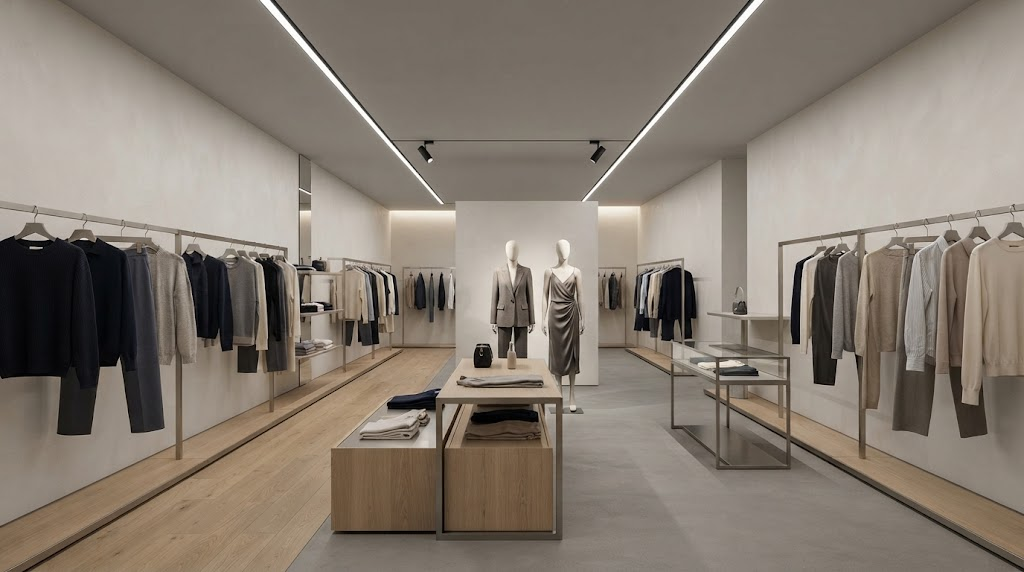
Linear track lighting provides another option: a longer, more continuous light distribution with fewer visible fixture interruptions.
This can work particularly well in modern retail interiors where the ceiling is intended to remain visually simple.
The result is not necessarily more dramatic.
Often, it is the opposite.
The lighting becomes part of the architecture rather than becoming the architecture.
The 2026 European Retail Lighting Perspective
European retail lighting is increasingly being discussed in terms of experience, efficiency and adaptability, rather than illumination alone.
EuroShop 2026 placed considerable attention on lighting as part of the customer experience and store atmosphere. At the same time, energy efficiency remains a major consideration for European commercial buildings and retailers.
For LED linear track lighting, this changes the specification conversation.
A buyer may now ask:
Can the light be dimmed?
Can different zones be controlled separately?
Can the system work with the existing track?
What happens when the store layout changes?
How much light is actually reaching the merchandise?
Is the colour consistent from one fitting to another?
Those questions are often more useful than simply asking whether a fitting is 30 W, 40 W or 50 W.
Where Does LED Linear Track Lighting Work Best?
There is no single retail application where linear track lighting is automatically the best choice.
Its value depends on the layout.
Fashion Stores
Fashion retail is one of the more demanding applications because customers need to see colour, texture and material clearly.
A common approach is to use linear lighting as part of the general lighting layer and directional track spotlights for mannequins, feature products and promotional displays.
For these applications, colour quality matters.
CRI is useful as a first specification, but it should not be the only one. For colour-sensitive products, buyers may also want to examine R9, TM-30 data and colour consistency.
For many fashion and premium retail projects, CRI 90+ is a sensible starting point, but the final requirement should come from the merchandise and lighting brief rather than from a universal rule.
Supermarkets
Supermarket lighting has a different priority.
The lighting needs to cover relatively large areas while maintaining good visibility of products and avoiding unnecessary light outside the target zone.
Linear track lighting can be considered for:
- Main aisles
- Shelving
- Promotional areas
- Circulation zones
- Selected product departments
The optical distribution is particularly important.
A narrow beam that works well on a feature display may be completely unsuitable for a long supermarket aisle.
Department Stores
Department stores often combine very different merchandise categories.
One area may require general illumination, while another may need more focused lighting.
This is where a track-based system can be useful.
Linear modules can establish the general lighting layer, while adjustable spotlights can be added where visual emphasis is needed.
The result is a lighting system that can be changed without completely changing the ceiling infrastructure.
Furniture and Home Retail
Furniture stores depend heavily on the appearance of materials.
Wood, textiles, stone, leather and painted surfaces can all react differently to light.
In these environments, vertical illumination is often just as important as lighting the floor.
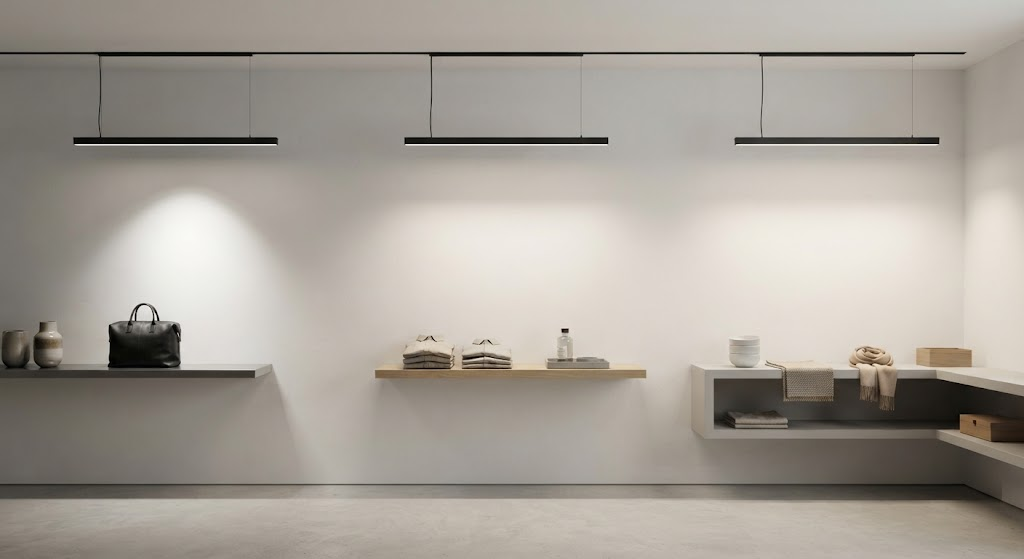
A good linear track system should therefore be evaluated according to where the light actually lands, not simply how bright the fixture appears when viewed from below.
How to Choose LED Linear Track Lighting
The best way to select a linear track light is to work backwards from the retail application.
Start with the merchandise.
Then consider the layout.
Then determine the optical requirements.
Only after that should the luminaire specification be finalised.
1. Lumen Output
Lumen output tells you how much visible light a luminaire produces.
It does not tell you how effectively that light reaches the merchandise.
Two fittings with similar lumen output can produce very different results because of differences in:
- Optical efficiency
- Beam distribution
- Mounting height
- Reflector design
- Lens design
- Spacing
- Target surface
This is why professional projects should be checked using photometric data rather than comparing wattage alone.
IES or LDT files can be particularly useful during lighting calculations.
2. System Efficacy
LED efficacy is normally expressed in lumens per watt.
It is an important number, but it should be treated as part of the complete system.
For example, a fitting with very high lm/W may not be the best choice if its distribution produces excessive light outside the intended area.
For retail projects, a more useful comparison is:
Useful illumination + optical control + colour quality + operating power
rather than:
Highest lm/W = best product
This becomes increasingly relevant as European retailers continue to look for lower operating costs and more efficient lighting systems. The EU’s energy-efficiency framework has strengthened the focus on reducing final energy consumption by 2030.
3. Colour Rendering
Retail lighting should allow products to look like the products customers expect to see.
For fashion, cosmetics, furniture and food, poor colour rendering can be particularly noticeable.
CRI remains a familiar benchmark.
However, a specification such as CRI 90 does not tell the whole story.
For demanding retail applications, consider:
- CRI
- R9
- TM-30
- CCT
- SDCM
- LED spectrum
- Batch-to-batch consistency
The important point is not simply to specify a high number.
It is to make sure the number is supported by reliable technical data.
4. Colour Temperature
There is no single “European retail colour temperature”.
The appropriate CCT depends on the store concept.
2700K–3000K
Often considered for:
- Luxury stores
- Jewellery
- Premium fashion
- Boutique interiors
3500K–4000K
Often considered for:
- General retail
- Fashion
- Department stores
- Supermarkets
- Modern commercial spaces
5000K+
Used selectively where a cooler appearance is appropriate.
The important issue is consistency.
If one part of a store appears noticeably warmer than another without a deliberate design reason, the lighting can make the interior feel visually disconnected.
5. Beam Angle
Beam angle is often misunderstood in linear lighting.
A track spotlight may be specified at 15°, 24° or 36°.
A linear fixture works differently because the optical system is normally designed to create a longer distribution.
Instead of asking:
“What is the beam angle?”
it can be more useful to ask:
“What area does the luminaire illuminate at the actual mounting height?”
For example:
- Narrow distribution → focused merchandise
- Medium distribution → shelving and display zones
- Wider distribution → general area lighting
The correct choice depends on ceiling height, spacing and the target surface.
6. Glare Control
A store can be brightly lit and still feel uncomfortable.
This usually happens when the luminaires create excessive brightness in the customer’s field of view.
Potential glare sources include:
- Exposed LED sources
- Highly reflective optics
- Incorrect track positioning
- Glass displays
- Mirrors
- Glossy floors
- Screens
- Reflective packaging
For this reason, glare should be considered during both product selection and layout design.
Features such as recessed LED sources, controlled optics, reflectors, baffles and anti-glare accessories can help, but the final result still depends on installation.
A luminaire with good glare control can produce poor results if it is positioned directly in a customer’s line of sight.
7. Track Compatibility
For European projects, this is one of the first things that should be checked.
“Track light” is not a universal electrical standard.
Before placing an order, confirm:
- Track type
- Number of circuits
- Electrical configuration
- Adapter design
- Mechanical dimensions
- Input voltage
- Earthing arrangement
- Driver requirements
- Dimming compatibility
Three-phase track systems are common in European commercial lighting, but a three-phase designation alone does not prove compatibility.
For refurbishment projects, the safest approach is to identify the existing track system before selecting the new luminaire.
8. DALI and Smart Lighting Control
Lighting control is becoming more relevant to retail projects.
DALI is an internationally standardised digital lighting-control protocol and allows individual or grouped control of compatible lighting equipment.
For a retail store, this can be useful when different areas require different lighting levels.
For example:
- Sales floor
- Window display
- Fitting rooms
- Back-of-house
- Promotional areas
- Cleaning mode
A DALI-compatible LED linear track system can therefore provide more flexibility than simply switching an entire circuit on or off.
But the luminaire, driver and control system must be specified as one system.
9. Flicker
Flicker is another specification worth checking, particularly in modern retail environments.
It can become more noticeable when customers spend long periods in a store or when cameras and video equipment are used.
Rather than relying on the marketing phrase “flicker-free”, professional buyers should request relevant driver or measurement information.
The driver is an important part of the final lighting performance.
10. SDCM and Colour Consistency
A store may contain dozens or hundreds of LED luminaires.
If adjacent fixtures have visibly different white tones, the difference can be surprisingly distracting.
SDCM is commonly used to describe colour consistency.
Tighter colour consistency can be particularly valuable for:
- Long linear installations
- White walls
- Premium fashion stores
- Large open retail spaces
- Repeated lighting modules
The requirement should be agreed during specification and controlled during production.
LED Linear Track Lighting vs Track Spotlights
These products should not necessarily be treated as competitors.
They solve different problems.
| LED Linear Track Light | Track Spotlight | |
|---|---|---|
| Main role | General / linear illumination | Accent illumination |
| Light pattern | Continuous / elongated | Focused / directional |
| Best for | Aisles, shelves, open areas | Displays, mannequins, feature products |
| Ceiling appearance | Clean and continuous | More visually articulated |
| Adjustment | Track position | Track position + aiming |
| Typical strategy | Base lighting layer | Accent lighting layer |
For many retail stores, the strongest solution is a combination of both.
Linear lighting provides the structure. Spotlights provide the emphasis.
How Should Linear Track Lights Be Positioned?
The track should follow the merchandise layout, not simply the ceiling grid.
This sounds obvious, but it is one of the most common differences between an average lighting installation and a well-designed one.
Consider:
- Customer viewing direction
- Shelf height
- Display depth
- Ceiling height
- Track distance from the wall
- Luminaire spacing
- Beam distribution
- Reflections
For wall displays, the track may need to be positioned so that light reaches the vertical merchandise surface effectively.
For central aisles, the track layout may follow the shelving arrangement.
The best position is the one that supports what customers actually see.
How Many Linear Track Lights Does a Retail Store Need?
There is no reliable universal rule such as “one fitting per X square metres”.
Fixture quantity depends on the complete lighting design.
Important variables include:
- Floor area
- Ceiling height
- Target illuminance
- Luminaire output
- Optical distribution
- Spacing
- Surface reflectance
- Maintenance factor
- Required uniformity
A professional project should therefore be calculated using the actual photometric file of the selected luminaire.
This is much more reliable than estimating the number of fixtures from floor area alone.
Energy Efficiency in European Retail Projects
Energy efficiency is no longer only a technical specification.
For retailers operating dozens or hundreds of stores, lighting becomes an operating-cost issue.
A relatively small difference in installed power can become significant when multiplied by:
store count × operating hours × years of operation
This is why the following should be considered together:
- Luminaire efficacy
- Lighting density
- Operating hours
- Dimming
- Zoning
- Occupancy control where appropriate
- Daylight response where appropriate
- Maintenance
The EU regulatory environment also continues to emphasise energy efficiency and product sustainability. Lighting products placed on the EU market can be subject to Ecodesign and energy-labelling requirements depending on how the product is classified.
For buyers, this means technical documentation matters.
Do not rely only on a product catalogue.
What Should European Buyers Ask a Manufacturer?
Before approving an LED linear track light for a retail project, ask for the actual technical information.
Photometric
- Lumen output
- Beam distribution
- Photometric file
- CRI
- R9 where relevant
- CCT
- SDCM
- Glare information
Electrical
- Rated power
- Input voltage
- Power factor
- Driver manufacturer
- Dimming method
- DALI compatibility
- Flicker information
Mechanical
- Dimensions
- Housing material
- Surface finish
- Track adapter
- Track compatibility
- Installation method
Performance
- Rated lifetime
- Ambient temperature range
- IP rating where relevant
- Warranty
- Thermal performance
Compliance
For EU projects, the manufacturer should be able to provide the documentation applicable to the specific product and market, rather than simply stating “CE certified”.
The exact compliance route depends on the product configuration and applicable legislation.
New Build or Retail Renovation?
The choice of track lighting also depends on the project stage.
New Store
A new store provides much more freedom.
Track position, electrical circuits, ceiling design, lighting controls and display layout can be coordinated from the beginning.
This is the ideal situation for creating a complete lighting concept.
Renovation
Renovation projects are different.
The existing track may already be installed, which means compatibility becomes a major consideration.
Before replacing the luminaires, check:
- Existing track manufacturer
- Track type
- Circuit configuration
- Mechanical condition
- Adapter compatibility
- Driver arrangement
- Existing controls
In many refurbishment projects, the best solution is not necessarily a completely new track system.
It may simply be a better luminaire on the existing infrastructure.
Common Mistakes When Buying LED Linear Track Lighting
Choosing the Highest Lumen Output
More light is not automatically better.
The light needs to reach the right surface.
Comparing Only Wattage
Two fittings with the same wattage can have very different optical performance.
Ignoring Track Compatibility
A product can look mechanically similar and still be electrically incompatible.
Using the Same Distribution Everywhere
A feature display and a supermarket aisle do not need the same lighting distribution.
Treating CRI as the Whole Colour Story
Colour quality involves more than one number.
Forgetting Glare
Customers notice uncomfortable lighting even when they cannot explain why.
Installing Without Photometric Planning
Good products can still produce poor results when spacing and positioning are wrong.
A Practical Specification Checklist
Before approving an LED linear track light for a European retail project, check these questions:
Application
- What merchandise is being illuminated?
- Is the light general, display or accent lighting?
- What is the ceiling height?
Optical
- What is the actual lumen output?
- How is the light distributed?
- Is the distribution appropriate for the mounting height?
- Is glare adequately controlled?
Colour
- What CCT is required?
- What CRI is required?
- Is R9 important?
- What SDCM is specified?
Electrical
- What voltage is required?
- Which driver is used?
- Is dimming required?
- Is DALI required?
- What is the power factor?
Track
- Which track system is being used?
- Is the adapter mechanically compatible?
- Is the electrical configuration compatible?
Documentation
- Is a photometric file available?
- Are test reports available?
- Are relevant compliance documents available?
- Does the documentation correspond to the exact production model?
FAQ: LED Linear Track Lighting for Retail
Yes. It is particularly useful where a store needs a clean linear appearance together with the flexibility to reposition lighting as displays change.
There is no single best choice. Around 3000K can suit warmer premium environments, while 3500K–4000K is commonly considered for many modern retail applications. The final choice should reflect the merchandise, architecture and brand concept.
CRI 90+ is a reasonable starting point for many retail applications where colour appearance matters. More demanding projects should also consider R9, TM-30 and colour consistency.
Yes, products are available for three-phase track systems. However, the exact track, adapter and electrical configuration must be checked.
Some systems can. The luminaire, LED driver and control infrastructure need to be specified for DALI compatibility.
Not automatically.
Energy performance depends on luminaire efficacy, optical distribution, lighting levels, operating hours and controls. The correct comparison is the energy required to achieve the intended lighting result.
There is no universal fixture-per-square-metre number. The required quantity should be determined from the store layout, mounting height, target illuminance, photometric data and desired uniformity.
At minimum, check the photometric data, lumen output, efficacy, CCT, CRI, SDCM, track compatibility, driver, dimming options, lifetime, warranty and applicable compliance documentation.
Final Takeaway
LED linear track lighting is not simply a linear version of a track spotlight. It is a flexible lighting system that can form the general lighting layer of a retail environment while remaining adaptable to future merchandising changes.
For European retail projects in 2026, the strongest specifications are increasingly built around the complete system:
flexibility + optical control + colour quality + visual comfort + energy performance + smart control + track compatibility.
The right product is not the one with the longest specification sheet.
It is the one that performs properly in the actual store.
That means looking beyond watts and lumens and asking a more useful question:
Does this lighting system make the products look right, keep the space comfortable, use energy sensibly, and remain flexible when the store changes?
If the answer is yes, LED linear track lighting can be a very effective foundation for a modern retail lighting scheme.