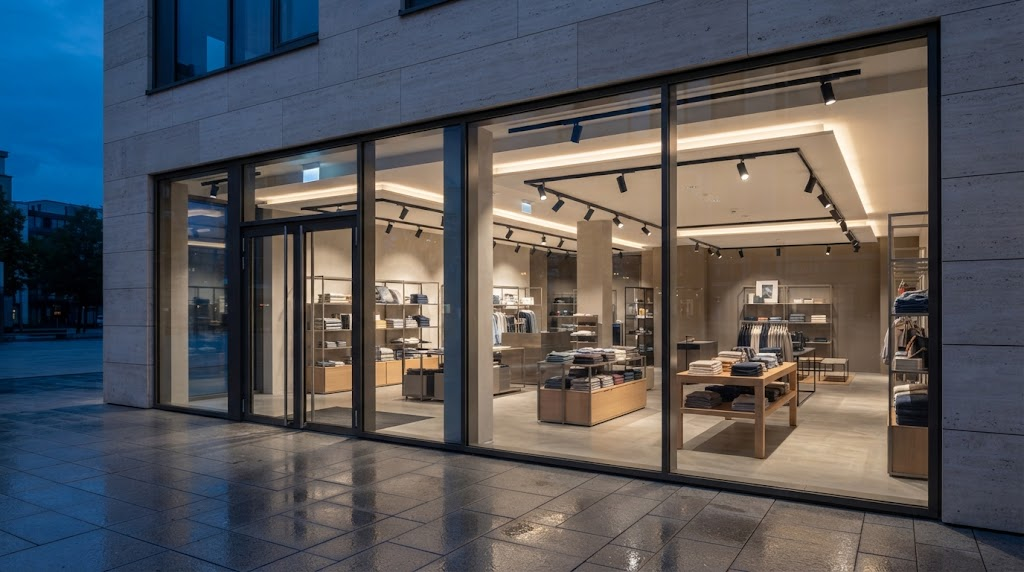
Smart retail lighting reduces energy use by combining efficient LED luminaires with dimming, zoning, sensors, daylight control and intelligent scheduling. The aim is to cut wasted lighting hours and output while keeping products, displays and customer areas properly illuminated.
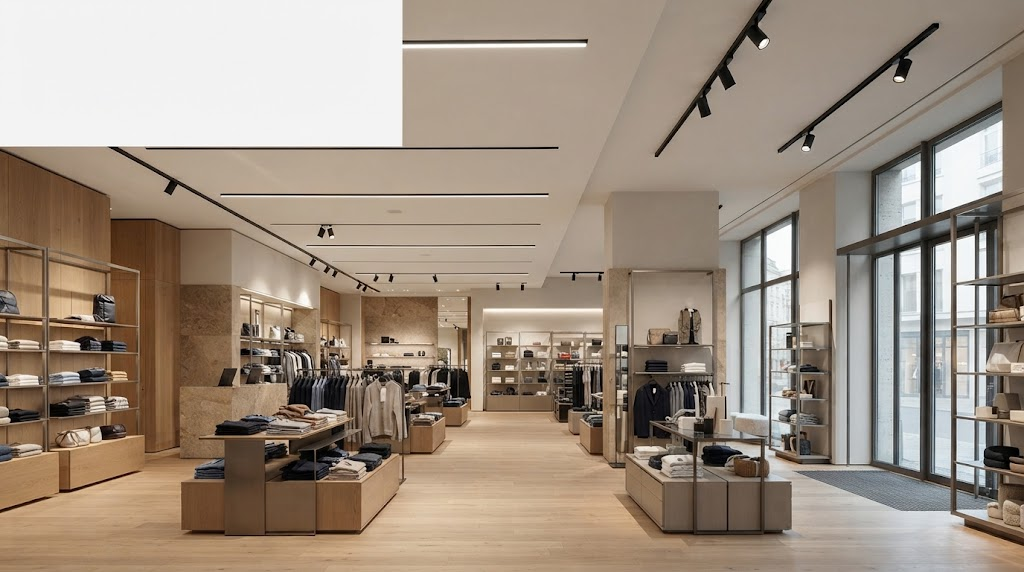
What Is Smart Retail Lighting?
Smart retail lighting is a lighting system that adjusts light output according to how a store is being used.
A conventional lighting system may operate most fixtures at full power for the entire opening period. A smart system can divide the store into zones and adjust each zone according to its purpose, occupancy, daylight and schedule.
Typical functions include:
- LED lighting
- Dimming
- Lighting zones
- Occupancy detection
- Daylight response
- Time schedules
- Scene control
- Digital lighting management
- Building-management integration
- In some larger projects, AI-assisted control
The important difference is that the lighting output follows the needs of the store instead of remaining fixed all day.
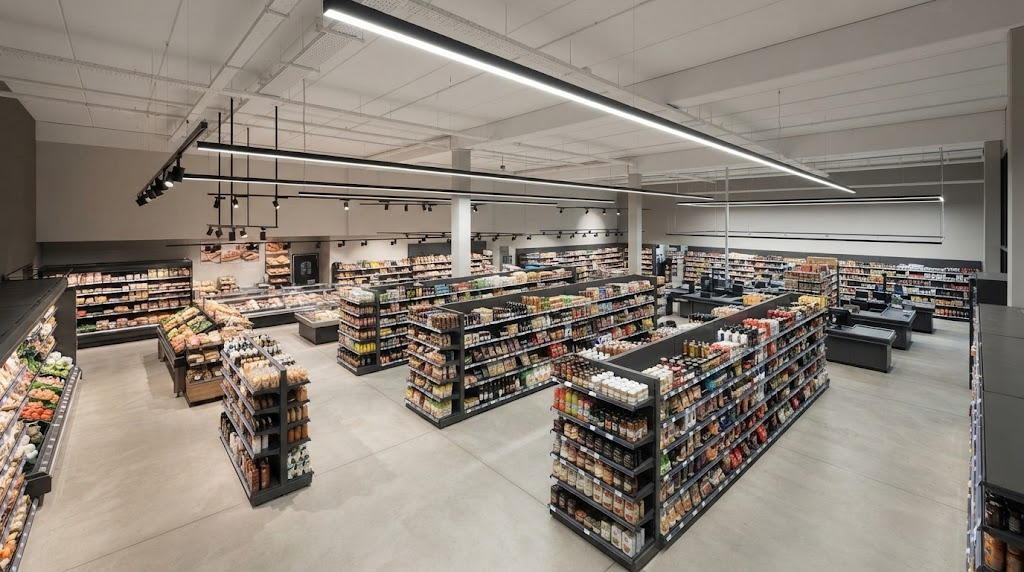
How Can Retail Stores Reduce Lighting Energy Consumption?
There are several practical ways to reduce lighting energy use. The best results usually come from combining them rather than relying on one technology.
1. Choose Efficient LED Lighting First
Smart controls cannot compensate for an inefficient lighting system.
The starting point should be an LED luminaire with suitable optical performance, system efficacy, thermal management and driver efficiency.
When comparing products, do not look only at wattage.
A more useful comparison includes:
- Delivered lumens
- Luminaire efficacy
- Beam angle
- Colour rendering
- Colour consistency
- Glare control
- Driver efficiency
- Dimming performance
- Expected service life
A 20W luminaire is not automatically more efficient than a 25W product.
If the 20W fixture needs twice as many units to achieve the required lighting result, the overall installation may consume more energy.
Retail lighting should therefore be evaluated at system level, not by wattage alone.
2. Divide the Store Into Lighting Zones
A retail store rarely needs the same lighting level everywhere.
A fashion store, for example, may have:
- Main sales areas
- Clothing displays
- Feature walls
- Fitting rooms
- Window displays
- Checkout areas
- Staff areas
- Storage rooms
These spaces have different lighting requirements.
Separating them into independent zones allows the retailer to control each area according to its function.
For example, a storage room does not need the same lighting strategy as a product display.
A feature wall may need focused accent lighting, while the surrounding circulation area can use a lower general-lighting level.
This is one of the simplest ways to avoid unnecessary energy consumption.
Typical Retail Lighting Zones
| Zone | Main Lighting Purpose | Possible Control |
|---|---|---|
| Sales floor | General visibility and comfort | Dimming / scheduling |
| Product display | Product emphasis | Scene control |
| Feature wall | Visual focus | Independent dimming |
| Window display | Attract attention | Time scheduling |
| Fitting room | Colour and appearance | Dedicated control |
| Checkout | Clear task visibility | Schedule / dimming |
| Storage | Short-duration use | Occupancy sensor |
| Staff area | Functional lighting | Occupancy / schedule |
The exact lighting levels should always be determined by the space, merchandise, architecture and applicable project requirements.
3. Use Dimming Instead of Running Everything at Full Output
A lighting system does not have to operate at 100% output throughout the day.
Dimming allows retailers to adjust light according to operating conditions.
For example:
Store opening → higher output
Strong daylight → reduced output in selected zones
Quiet periods → adjusted output where appropriate
Closing period → lower output or scheduled shutdown
The saving comes from reducing unnecessary output and operating hours.
This is different from simply switching lights off.
A store can maintain the lighting needed for important displays while reducing output in areas where full power is not necessary.
4. Use Daylight When the Building Allows It
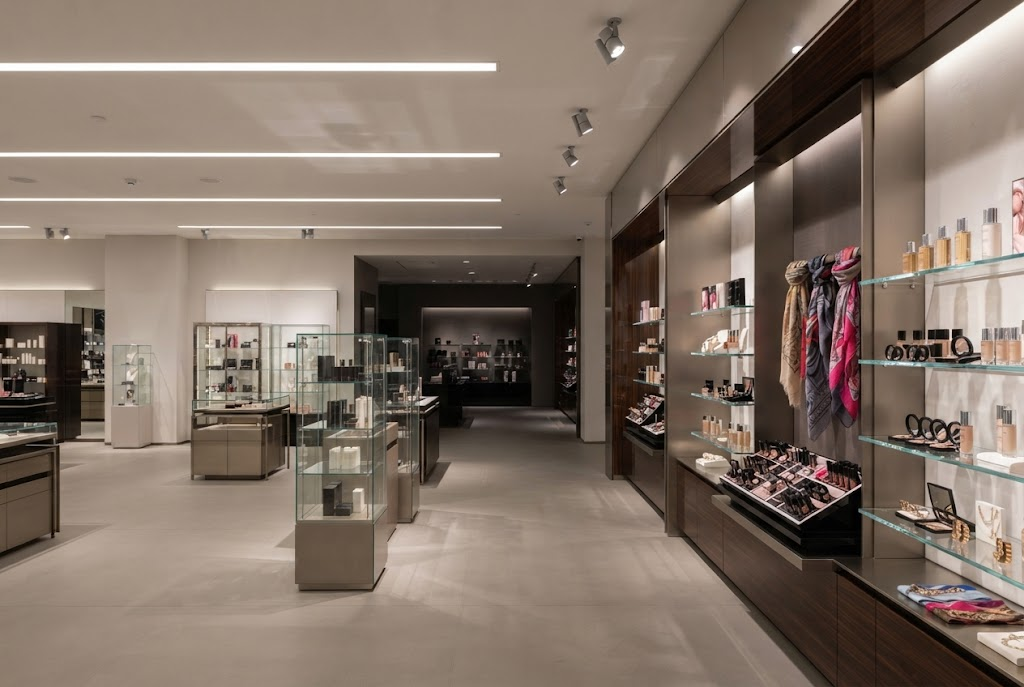
Natural light can reduce the amount of artificial lighting required, especially close to windows and glazed façades.
A daylight-responsive control system measures available natural light and adjusts selected LED zones accordingly.
This can work well in:
- Street-facing retail stores
- Shopping-centre units with glazed fronts
- Large department stores
- Supermarkets
- Showrooms
- Stores with skylights
However, daylight should not be treated as a direct replacement for artificial lighting.
The amount of daylight changes during the day. It can also create reflections, shadows and strong contrasts.
The objective is to maintain a comfortable visual environment while reducing artificial light where daylight is already doing part of the job.
5. Use Occupancy Sensors in the Right Areas
Occupancy detection can reduce lighting operation in spaces that are not continuously occupied.
It is particularly useful for:
- Storage rooms
- Staff rooms
- Service corridors
- Toilets
- Meeting rooms
- Back-of-house areas
The main sales floor requires more careful treatment.
Lighting that suddenly switches off or changes noticeably while customers are shopping can be distracting.
For customer-facing areas, scheduled dimming or carefully configured sensor control is often more appropriate than aggressive on/off switching.
Smart control should be noticeable to the energy meter, not to the customer.
6. Separate General Lighting From Accent Lighting
Retail lighting has different visual jobs.
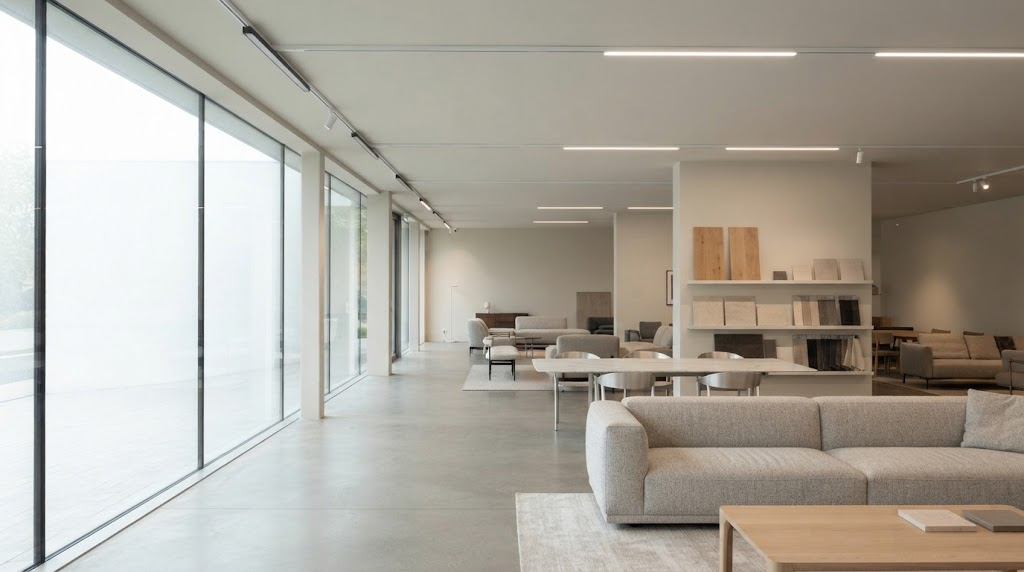
General lighting provides overall visibility.
Accent lighting draws attention to selected products, displays or architectural features.
If both are controlled together, the store may have to increase the output of the entire lighting system just to make one display stand out.
A better approach is to control them separately.
For example:
- LED linear lighting for general illumination
- Track spotlights for merchandise
- Wall-mounted lighting for vertical displays
- Dedicated display lighting for key products
- Decorative lighting for atmosphere
This gives the retailer more control over the visual hierarchy of the store without increasing the lighting output everywhere.
What Is the Best Smart Lighting Strategy for a Retail Store?
There is no single control system that suits every store.
A small boutique may only need efficient LEDs, dimming and time scheduling.
A supermarket may benefit from zoning, daylight control and occupancy detection in selected areas.
A large department store may require networked controls, scene management and integration with wider building systems.
The control strategy should match the size and complexity of the project.
| Store Type | Useful Smart Lighting Functions |
|---|---|
| Small boutique | Dimming, scheduling, simple zones |
| Fashion store | Zoning, scenes, dimming, accent control |
| Supermarket | Zoning, scheduling, daylight control |
| Department store | Networked control, scenes, sensors |
| Large retail chain | Central monitoring, data, advanced automation |
More technology does not automatically mean a better lighting system.
Smart Retail Lighting and Customer Experience
Energy saving is only one part of retail lighting.
Customers still need to see products clearly and comfortably.
Lighting affects:
- Product colour
- Material appearance
- Facial appearance
- Visual comfort
- Spatial orientation
- Product hierarchy
- Store atmosphere
- Brand perception
This is particularly important in fashion, cosmetics, jewellery, furniture and lifestyle retail.
For many premium retail applications, CRI 90+ can be a useful starting point, especially where accurate colour appearance matters. It is not a universal requirement for every retail space, however. The appropriate colour-rendering specification depends on the merchandise and project brief.
The same applies to colour temperature.
There is no single CCT that works for every European retail concept.
Typical specifications may include:
- 3000K for warmer, more atmospheric environments
- 3500K for a balanced retail appearance
- 4000K for cleaner, neutral environments
The right choice depends on the products, materials, architecture and desired atmosphere.
Does Smart Lighting Make a Store Look Darker?
Not when it is properly designed.
The purpose of smart lighting is to reduce unnecessary light output, not useful illumination.
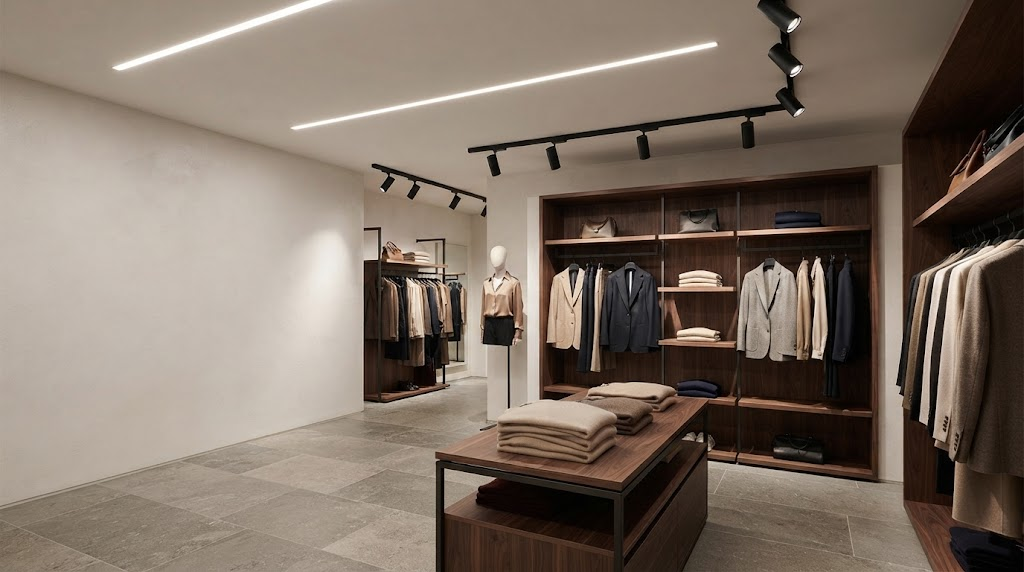
For example, a store may reduce general lighting output while maintaining stronger accent lighting on:
- Mannequins
- New collections
- Promotional displays
- Feature walls
- Key products
This can actually improve the visual hierarchy of the store.
Instead of making everything equally bright, lighting becomes more selective.
LED Linear Lighting and Smart Retail Applications
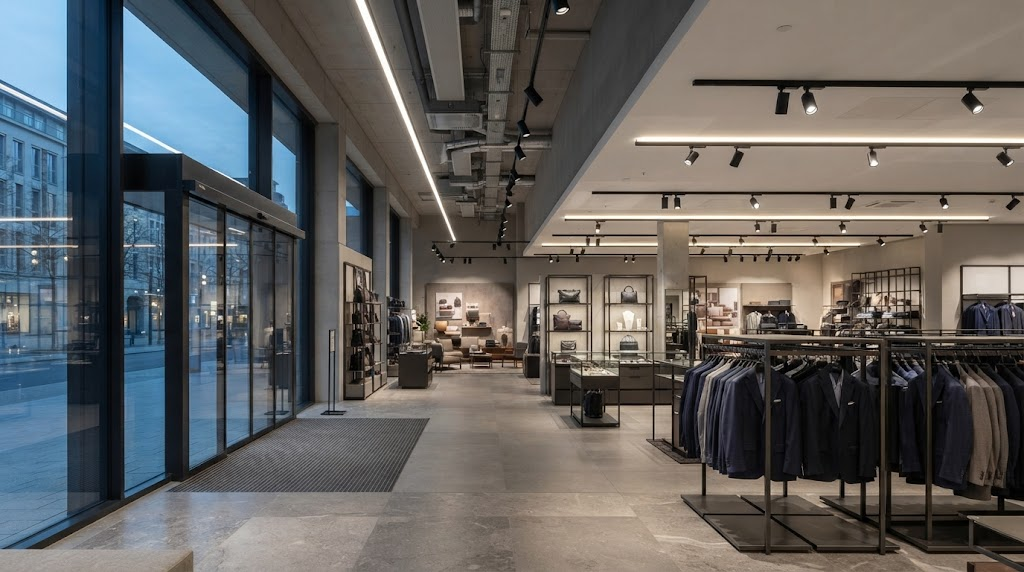
LED linear track lighting is becoming useful in retail spaces where continuous illumination and flexible positioning are both required.
It can provide general illumination along:
- Sales aisles
- Clothing displays
- Shelving
- Long circulation areas
- Furniture displays
Track spotlights can then be added where stronger visual emphasis is required.
This combination is particularly useful when store layouts change regularly.
A lighting system can be repositioned or reconfigured without redesigning the entire ceiling.
For this reason, flexible track systems can work well with smart retail lighting strategies.
Where Does AI Fit Into Retail Lighting?
AI is becoming part of the discussion around intelligent retail lighting, particularly in larger commercial buildings.
The basic idea is straightforward.
Instead of relying only on fixed schedules, an intelligent system can analyse information such as:
- Occupancy
- Daylight
- Time
- Lighting demand
- Store operating patterns
- Sensor data
- Building-management data
The system can then adjust lighting according to actual conditions.
This is a step beyond a basic timer.
However, AI is not necessary for every retail project.
A well-designed system using efficient LEDs, zoning, dimming, sensors and scheduling may already provide most of the practical benefits required by a small or medium-sized store.
AI becomes more interesting when the project involves large floor areas, multiple zones, multiple stores or integration with wider building-management systems.
How Much Energy Can Smart Retail Lighting Save?
There is no reliable single percentage for every retail store.
Actual savings depend on:
- Existing lighting technology
- Installed lighting load
- Operating hours
- Store size
- Daylight availability
- Occupancy patterns
- Dimming levels
- Control strategy
- Existing building systems
EuroShop’s 2026 coverage reported potential savings of approximately 8%–30% for AI-powered lighting controls compared with simpler rule-based systems, while also noting that actual performance depends heavily on the building and its existing infrastructure.
That figure should be treated as a reference range rather than a guaranteed saving.
For a real retail project, energy performance should be calculated from the actual installation.
A simple starting point is:
Annual lighting energy = connected lighting load × operating hours × average operating output
This gives a much more realistic basis for calculating energy savings.
Why the LED Driver Matters
The LED driver is an important part of a smart lighting system.
It affects:
- Electrical efficiency
- Dimming behaviour
- Flicker performance
- System reliability
- Control compatibility
- Scene control
- Communication with lighting-management systems
A high-quality LED module does not automatically create a high-quality lighting system if the driver is poorly matched.
For smart retail applications, buyers should check whether the driver supports the required control method before selecting the luminaire.
This is especially important for projects using:
- DALI or DALI-2
- Digital dimming
- Scene control
- Centralized lighting management
- Sensor-based control
DALI vs Sensors vs AI: Which One Should Retailers Choose?
These technologies solve different problems.
Dimming controls light output.
Sensors provide information about occupancy or daylight.
DALI provides digital control and communication between compatible lighting components.
AI-assisted systems can use multiple sources of information to make more adaptive control decisions.
They are not necessarily competing technologies.
A larger retail project may use several of them together.
For example:
LED luminaires → DALI drivers → lighting zones → sensors → central control
AI can potentially be added at the management level when there is enough data and a clear business reason to do so.
Smart Lighting and Store Operating Hours
Retailers should also consider when lighting is actually needed.
A store may operate for ten or twelve hours a day, but different areas may have different schedules.
For example:
- Before opening: staff and preparation areas
- Opening hours: customer-facing lighting
- Evening: different lighting scenes
- After closing: security or cleaning lighting
- Overnight: selected areas only
Scheduling can therefore reduce energy consumption without changing the customer’s experience during normal trading hours.
This is a relatively simple function, but it can have a meaningful effect across stores with long operating hours.
Smart Lighting for Retail Chains
For a single store, lighting control is mainly about local operation.
For a retail chain, the opportunity is larger.
A centralized system can potentially help operators compare:
- Energy consumption
- Operating schedules
- Lighting faults
- Control settings
- Store performance
- Maintenance requirements
This can make lighting part of a wider energy-management strategy.
The value becomes particularly clear when a retailer operates dozens or hundreds of locations.
Small improvements at individual stores can become significant when applied across the entire portfolio.
What Should Retailers Check Before Buying Smart Lighting?
A good specification should cover both the luminaire and the control system.
Lighting Performance
Check:
- Delivered lumens
- System efficacy
- CRI
- Colour consistency
- Beam angle
- Glare
- Flicker
- Thermal performance
Control
Check:
- Dimming range
- Control protocol
- Sensor compatibility
- Zoning
- Scene control
- Scheduling
- Daylight response
- Integration options
Track Lighting
For track-based retail projects, also confirm:
- Track type
- Electrical configuration
- Adapter compatibility
- Mechanical connection
- Driver specification
- Circuit arrangement
Technical Documentation
Professional projects may require:
- Photometric files
- Electrical data
- Driver information
- Control compatibility
- Installation instructions
- Product compliance documentation
- Maintenance information
The exact documentation depends on the project, product and applicable European requirements.
Common Smart Retail Lighting Mistakes
1. Choosing the Lowest Wattage
Low wattage does not necessarily mean better system efficiency.
Look at the light delivered to the required area.
2. Using One Lighting Level Throughout the Store
Different areas have different visual tasks.
Zoning gives the lighting system more flexibility.
3. Making the Store Too Bright
More illumination does not automatically improve the shopping experience.
Excessive brightness can increase energy use and reduce visual contrast.
4. Installing Smart Controls Without Commissioning
Sensors need correct positioning.
Schedules need correct configuration.
Scenes need to reflect actual store operation.
A sophisticated control system can still perform badly if it is not commissioned properly.
5. Adding Technology Without a Clear Purpose
Not every store needs AI, cloud monitoring or complex automation.
The simplest system that solves the actual problem is often the better choice.
A Practical Smart Retail Lighting Specification
For a new retail project, the following sequence provides a useful starting point.
Step 1: Define the retail concept
Determine what customers need to see and which products require emphasis.
Step 2: Divide the store into zones
Separate general lighting, displays, windows, service areas and back-of-house spaces.
Step 3: Select the LED luminaires
Compare efficacy, optical performance, colour quality, glare and driver performance.
Step 4: Select the optics
Choose beam angles according to the application rather than using one distribution everywhere.
Step 5: Add dimming
Make sure the lighting system can operate below full output when conditions allow.
Step 6: Add sensors where useful
Use occupancy and daylight detection in areas where they can provide a practical benefit.
Step 7: Select the control protocol
Choose the control architecture according to the size, flexibility and future requirements of the project.
Step 8: Create lighting scenes
Define practical scenes for opening, daytime, evening, promotional periods and closing where required.
Step 9: Commission the system
Check sensors, dimming levels, schedules and scenes after installation.
Step 10: Measure performance
Compare actual energy use with the original operating assumptions.
This final step turns a theoretical energy-saving strategy into measurable performance.
Smart Retail Lighting in 2026
The direction of retail lighting is moving toward systems that combine energy efficiency, flexible lighting design, digital control and customer experience.
The luminaire is still important, but it is no longer the entire story.
A modern retail lighting system may combine:
Efficient LEDs
Good optical design
Lighting zones
Dimming
Sensors
Daylight response
Digital control
Appropriate commissioning
AI can add another layer of intelligence, particularly for larger and more complex retail environments.
But the basic principle remains simple:
Use light where it matters, reduce it where it does not, and keep the customer experience intact.
FAQ: Smart Retail Lighting
Smart retail lighting combines efficient LED luminaires with controls such as dimming, zoning, sensors, scheduling and digital management to adjust lighting according to store conditions.
The main methods are efficient LED luminaires, zoning, dimming, daylight control, occupancy detection where appropriate, and optimized operating schedules.
It should not. A properly designed system reduces unnecessary lighting output while maintaining appropriate illumination for products, displays and customer areas.
No. Many stores can achieve practical energy savings with LED lighting, dimming, zoning and sensors. AI is more relevant to large or complex environments where adaptive control and operational data can provide additional value.
DALI and DALI-2 can provide digital control and dimming for compatible lighting systems. The appropriate solution depends on the project’s control requirements and system architecture.
There is no universal answer. 3000K, 3500K and 4000K are all used in retail environments. The choice should consider the merchandise, materials, architecture and desired atmosphere.
Not for every retail application. High colour rendering, including CRI 90+, is often useful where accurate product and material colours are important, particularly in fashion and premium retail.
There is no universal saving percentage. Results depend on the existing lighting system, operating hours, daylight, occupancy, control strategy and store layout. Published estimates should therefore be treated as project-specific reference points rather than guarantees.
There is no single component. Good results depend on the combination of efficient luminaires, appropriate optics, drivers, zoning, controls and commissioning.
Conclusion
Smart retail lighting is not about making a store use as little light as possible.
It is about controlling light more intelligently.
Efficient LED luminaires reduce the basic lighting load. Zoning determines where light is needed. Dimming controls output. Sensors and daylight response adjust the system to changing conditions. Digital controls make the system easier to manage, while AI may add further automation in larger projects.
The best retail lighting system balances three things:
energy efficiency, operational flexibility and customer experience.
When these elements are designed together, retailers can reduce unnecessary energy consumption without compromising how products look or how customers experience the store.