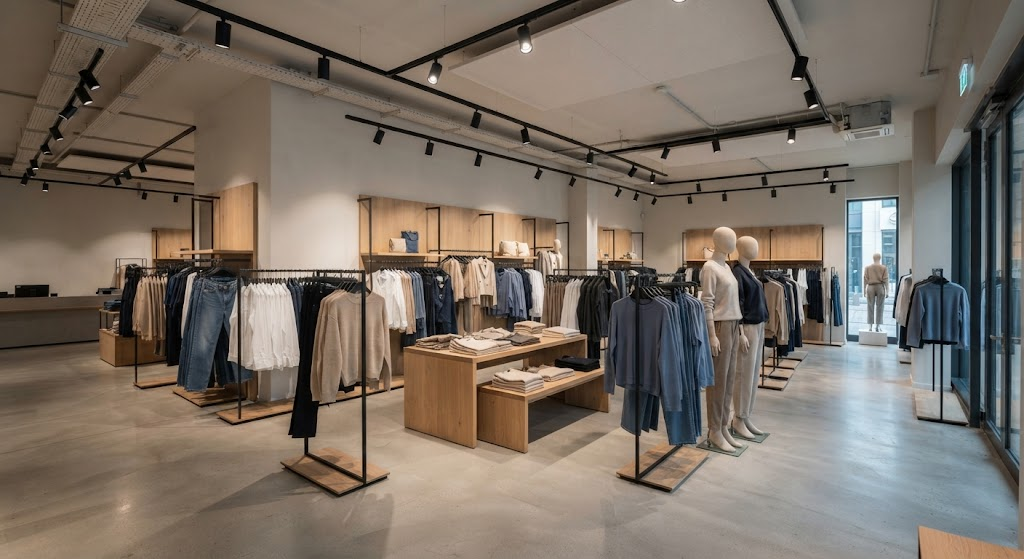
A good starting point for fashion retail is around 300 lux for the general sales area, 500 lux at checkout, and CRI 90+ where accurate colour appearance matters. The rest of the lighting should be adjusted around the merchandise, fitting rooms, displays and store layout.
What Makes Lighting Work Well in a Fashion Store?
Fashion-store lighting has to do more than make the room bright. It needs to make clothing easy to judge while giving the store a clear visual structure.
Customers are looking at colour, fabric, texture, shape and fit. At the same time, the lighting has to make new collections, mannequins and feature displays stand out without making the whole shop feel over-lit.
This is why most successful schemes use several layers of light rather than one lighting type throughout the store.
- General lighting for circulation
- Vertical lighting for clothing and display walls
- Accent lighting for mannequins and key products
- Mirror and fitting-room lighting
- Feature lighting for architectural elements
- Controlled lighting for windows and promotional areas
CIBSE’s Lighting Guide 17: Lighting for Retail Premises treats retail lighting as a specialist application because the requirements change considerably between different store types, products and interior environments.
How Bright Should a Fashion Store Be?
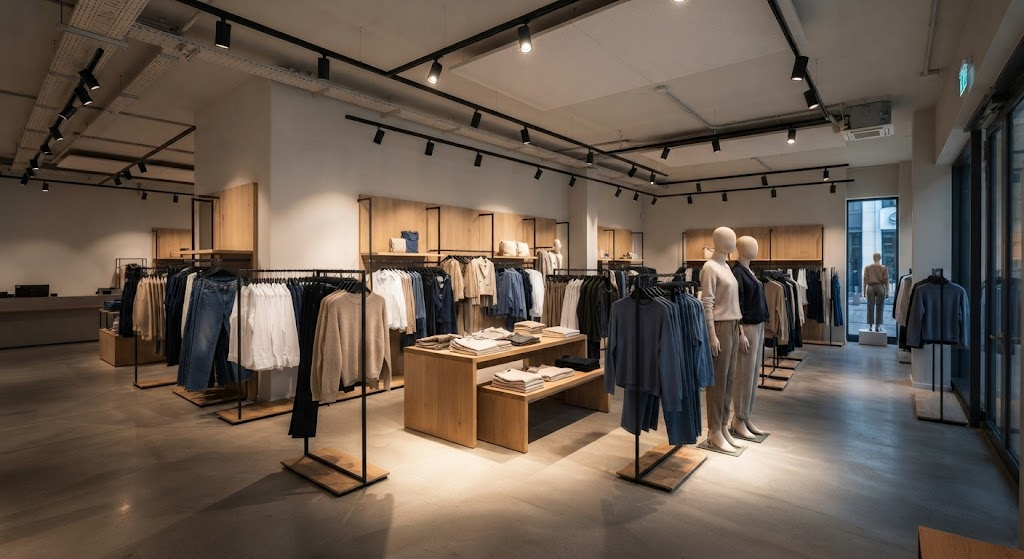
For many fashion stores, 300 lux maintained is a useful reference for the general sales area, but it should not be applied as a target for every part of the shop.
EN 12464-1:2021 gives different reference requirements for retail activities. A checkout area, for example, has a higher maintained illuminance requirement than a general sales area.
| Area | Reference illuminance | Lighting purpose |
|---|---|---|
| General sales area | 300 lux | General visibility and circulation |
| Checkout | 500 lux | Transaction and task visibility |
| Fitting room | 300 lux | Garment and appearance evaluation |
| Clothing displays | Often above ambient | Product emphasis |
| Feature displays | Project dependent | Visual focus |
| Shop window | Project dependent | Strong visibility and attraction |
The important distinction is between ambient illuminance and display illuminance.
A store with 300 lux everywhere can look flatter than a store with moderate ambient light and carefully positioned brighter areas.
The actual design should also check uniformity, glare and vertical illumination rather than relying on one lux number.
Why Does Vertical Lighting Matter So Much for Clothing?
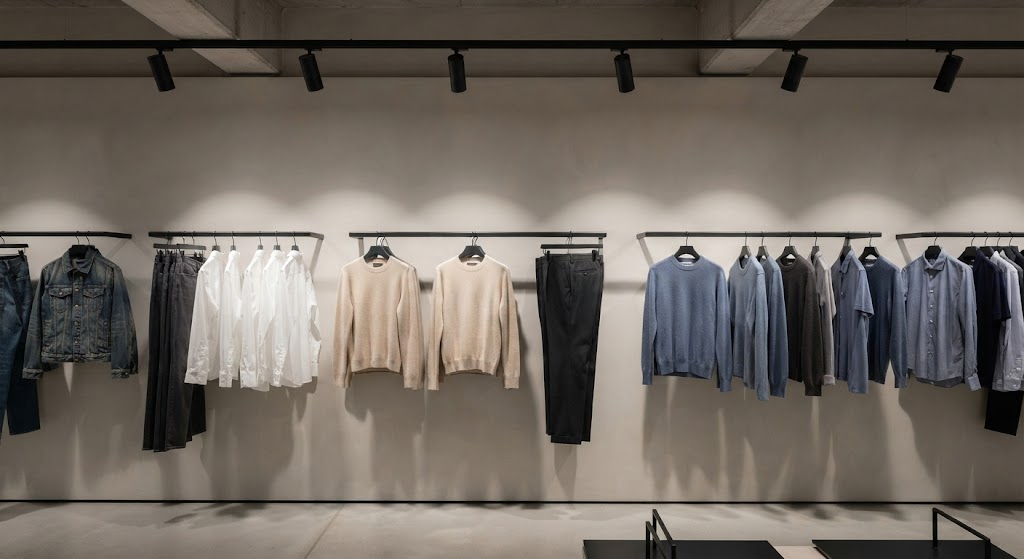
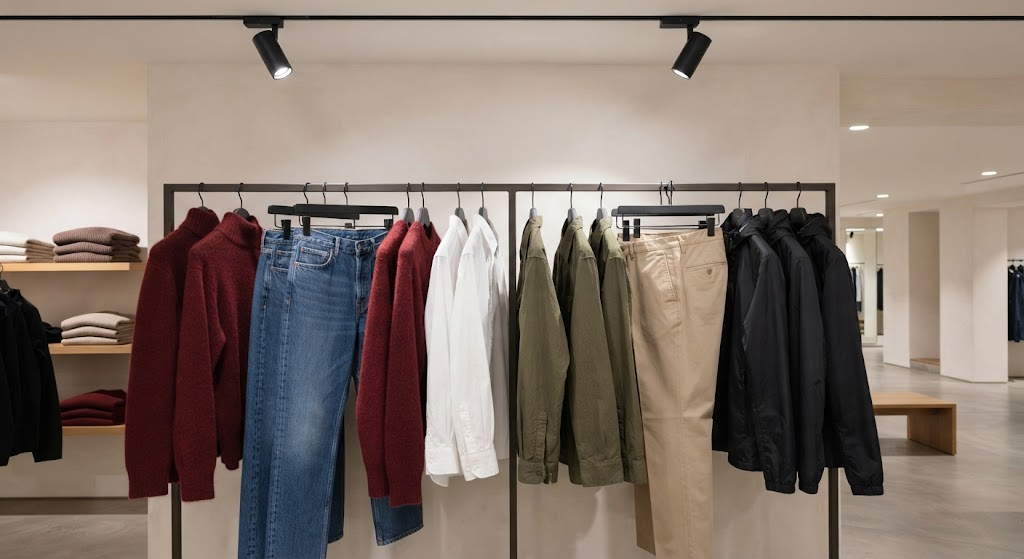
Clothing is normally displayed vertically, so lighting the floor well does not necessarily mean the clothes are being lit well.
This is one of the easiest details to miss when a lighting plan is based mainly on horizontal lux.
A customer sees:
- Garments hanging on rails
- Shelves against walls
- Mannequins
- Posters and graphics
- Mirrors
- Other customers
Most of these are vertical targets.
For wall-mounted clothing, a properly positioned wall-washing or directional system can produce a much more even appearance than simply adding more downlights.
EN 12464-1:2021 also considers vertical illumination for retail shelving and fitting-room applications.
What Happens When Vertical Lighting Is Too Weak?
Clothes can appear dark even when the floor has plenty of light.
Dark garments become difficult to read, textures disappear and displays lose some of their visual presence.
Increasing the total number of downlights is not necessarily the solution. In many cases, changing the direction and distribution of the light works better.
What Colour Temperature Should Fashion Store Lighting Use?
There is no single CCT that works for every fashion brand. 2700K, 3000K, 3500K and 4000K can all work when the colour temperature is consistent with the brand, merchandise and interior materials.
| CCT | General appearance | Typical application |
|---|---|---|
| 2700K | Warm | Luxury / intimate retail |
| 3000K | Warm white | Boutique and premium fashion |
| 3500K | Balanced | Contemporary fashion |
| 4000K | Neutral white | Minimalist / modern / sportswear |
The interior should be considered together with the light.
A store with dark timber, brass and textured materials may suit a warmer source. A white, concrete and metal interior may look cleaner under 3500K or 4000K.
The colour temperature should also remain consistent between different areas unless there is a deliberate reason to create a contrast.
Is CRI 90 Enough for Fashion Retail?
CRI 90+ is a sensible starting point for fashion stores, but CRI alone does not tell the whole story about colour quality.
Colour is particularly important for fashion because customers may compare different shades of the same garment under the store lighting and later under daylight.
A practical specification may include:
- CRI / Ra ≥90 for general fashion applications.
- Higher colour-quality requirements for premium merchandise.
- R9 performance when reds and skin tones are important.
- Tight colour consistency between luminaires.
- TM-30 data when a more detailed colour evaluation is required.
CIE has continued to point out limitations in traditional colour-rendering measurements. Its 2025 position statement supports the wider use of newer colour-fidelity metrics while the industry continues to use Ra alongside them.
For a lighting specification, that means “CRI 90” should be treated as a starting requirement rather than the complete definition of good colour quality.
Are Track Lights Suitable for Fashion Stores?
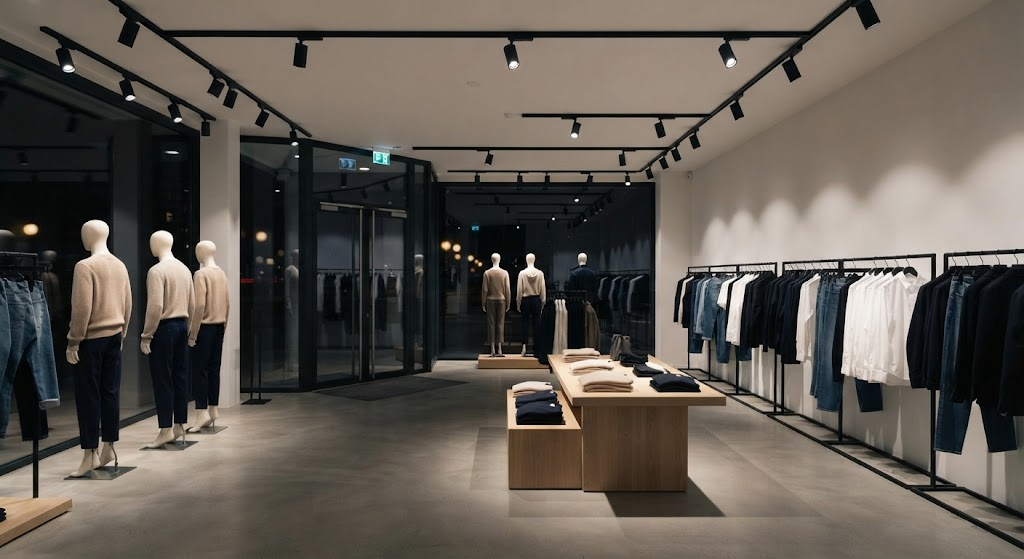
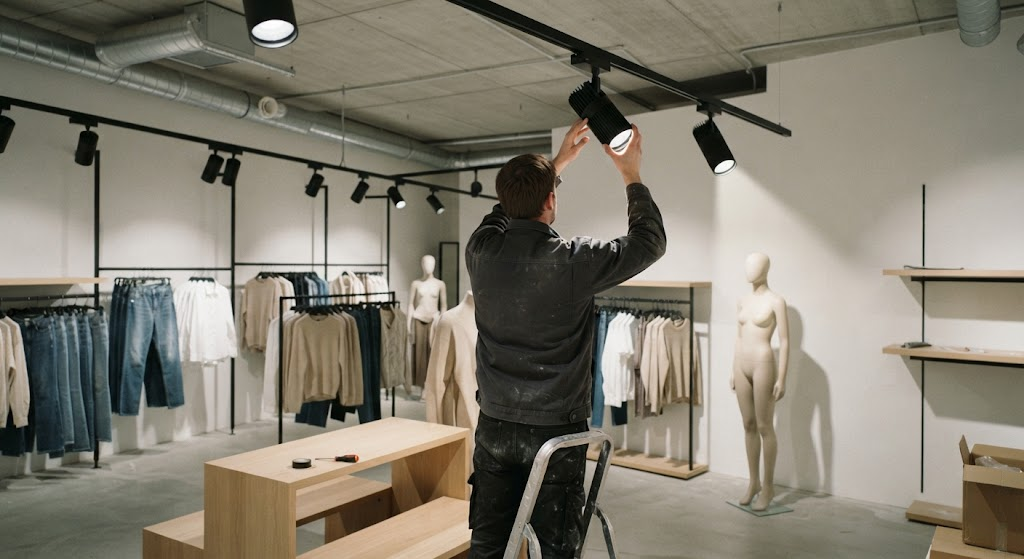
Track lighting is widely suited to fashion retail because the light can be redirected when the merchandise moves.
This matters more than it may initially appear.
Fashion stores regularly change:
- Window displays
- Seasonal collections
- Product launches
- Mannequin positions
- Clothing rails
- Promotional displays
- Store layouts
A fixed downlight layout becomes less useful when the products move away from the original lighting positions.
With track lighting, individual fixtures can normally be adjusted without changing the complete ceiling installation.
Which Beam Angle Should Be Used?
The beam angle should follow the size and distance of the target.
| Beam angle | Common use |
|---|---|
| 15° | Small feature / mannequin / hero product |
| 24° | Individual garment group |
| 36° | Clothing rail / medium display |
| 50°–60° | Broad merchandising area |
These are useful starting points rather than fixed rules.
A 15° beam can work very well on a mannequin several metres away but may create an obvious hot spot on a large wall.
Conversely, a 60° beam may cover a large display evenly but provide little visual emphasis on a small product.
The mounting height, luminaire output, optic and target size should therefore be considered together.
Should Fashion Stores Use Downlights or Track Spotlights?
Both can be useful, but they solve different problems.
Downlights are generally better suited to providing a consistent background level, while track spotlights provide greater control over merchandise and visual accents.
| Requirement | Downlight | Track spotlight |
|---|---|---|
| General illumination | ✓ | ✓ |
| Flexible aiming | Limited | ✓ |
| Changing displays | Limited | ✓ |
| Accent lighting | Moderate | ✓ |
| Clothing rails | Depends on optic | ✓ |
| Architectural integration | ✓ | ✓ |
| Easy repositioning | Limited | ✓ |
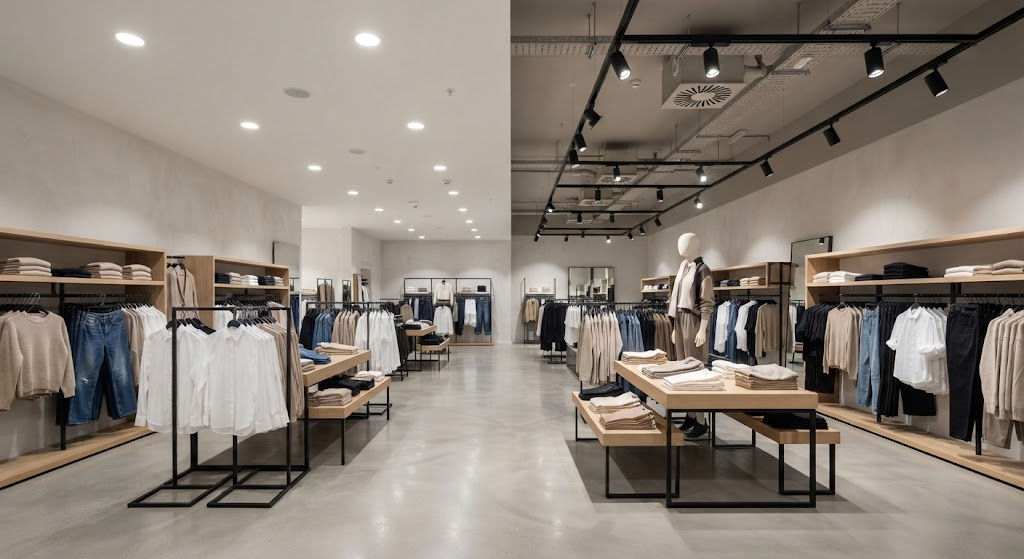
A practical fashion-store scheme often combines the two rather than choosing only one.
For example, downlights can establish the general environment while track spotlights handle mannequins, rails and feature displays.
How Should Lighting Be Layered in a Fashion Store?
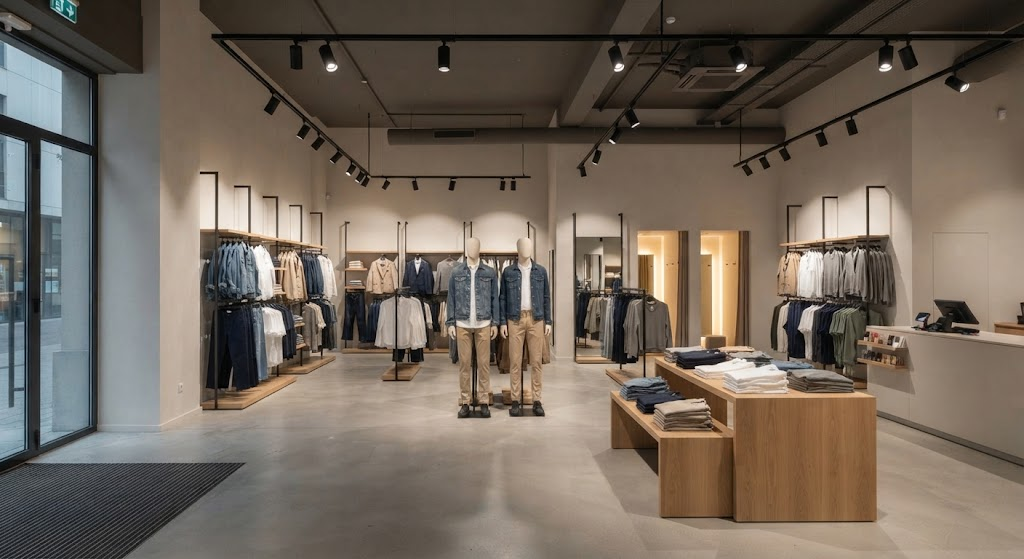
A useful lighting scheme normally starts with three basic layers: ambient light, vertical light and accent light.
1. Ambient Lighting
Ambient lighting gives customers enough general illumination to move through the store comfortably.
It should not necessarily be the brightest element in the room.
2. Vertical Lighting
Vertical lighting gives clothing walls, shelving and displays enough presence.
This is particularly important in stores where a large proportion of the merchandise is displayed along walls.
3. Accent Lighting
Accent lighting creates contrast.
A brighter mannequin or product display naturally attracts more attention than a uniformly illuminated background.
The goal is not to make everything bright. It is to decide what should attract attention and what should remain secondary.
How Should Fitting Rooms Be Lit?
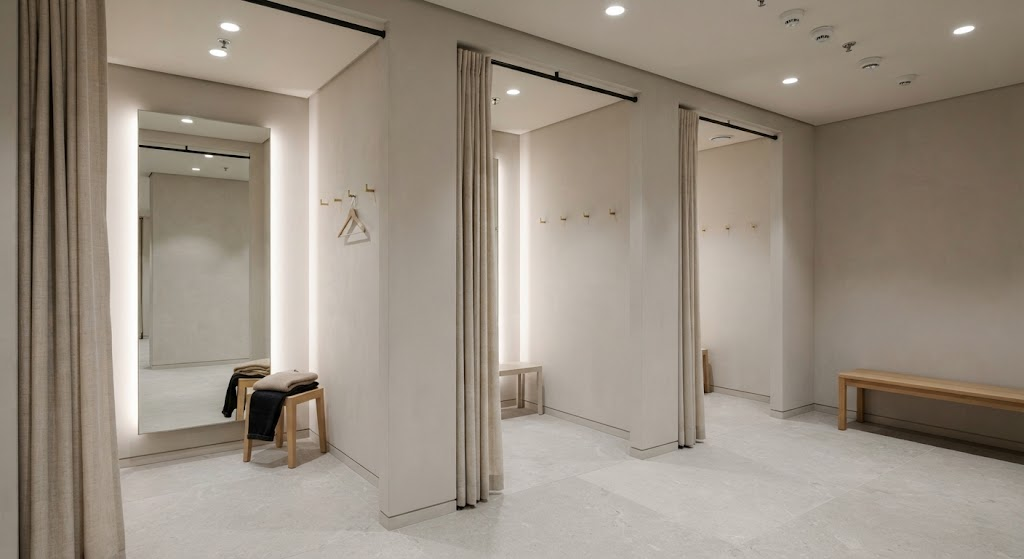
Fitting rooms need more careful lighting than many sales-floor areas because customers are evaluating both the clothing and their own appearance.
A ceiling light directly above the customer can create strong shadows around the eyes, nose and chin.
It can also make the garment look different from how it appears under more balanced lighting.
A better approach usually combines:
- Controlled overhead light
- Vertical or frontal illumination
- High colour rendering
- Comfortable brightness
- Good mirror illumination
- Limited glare
EN 12464-1:2021 specifically addresses vertical illumination and modelling around mirrors in fitting-room applications.
This is an area where lighting quality can have a very noticeable effect on the customer’s experience.
How Can Fashion Stores Reduce Lighting Energy Use?
Energy savings do not have to come from making the entire store darker. Better zoning and optical control can reduce unnecessary light while keeping merchandise properly illuminated.
The European Commission identifies efficient light sources and controls such as dimming, timers and sensors as important ways of reducing lighting energy consumption.
For a fashion store, practical measures include:
1. Use Efficient LED Fixtures
Choose the required light output and optical distribution rather than simply selecting the highest-lumen fixture.
2. Create Lighting Zones
Separate the controls for:
- Window displays
- Main sales floor
- Feature displays
- Fitting rooms
- Checkout
- Back-of-house areas
Different areas do not necessarily need to operate at the same level.
3. Use Dimming
Daytime, evening and promotional scenes can use different lighting levels.
4. Use the Optic Correctly
If a spotlight puts most of its light outside the merchandise, part of the installed energy is effectively being wasted.
5. Maintain the Installation
Dirty optics, ageing components and poorly maintained surfaces can gradually reduce the useful light reaching merchandise.
What Should Be Specified When Buying LED Track Lights for a Fashion Store?
The product specification should go beyond wattage and lumen output.
At minimum, check:
- Power and delivered lumens
Compare useful light output rather than wattage alone. - CRI and colour-quality data
Look at Ra and, where appropriate, R9 or TM-30 information. - CCT
Make sure different batches and fixtures remain consistent. - Beam angle
Choose the optic according to the merchandise and mounting distance. - Glare control
A bright LED source visible from the customer viewpoint can create discomfort even when the average lux level is acceptable. - Thermal management
Stable thermal performance helps maintain light output and colour characteristics. - Driver and dimming compatibility
Check the actual control protocol rather than assuming compatibility. - Mechanical adjustment
The fixture should hold its aiming position after adjustment. - Colour consistency
Low SDCM variation is useful when many luminaires are installed in the same visual field. - Photometric data
IES/LDT files allow the lighting designer to test the actual fixture in a project calculation.
What Are the Most Important Numbers in Fashion Store Lighting?
The following figures are useful as a starting reference, not as a substitute for a project-specific lighting calculation.
| Parameter | Practical reference |
|---|---|
| General sales area | 300 lux maintained |
| Checkout | 500 lux maintained |
| Fitting room | 300 lux maintained reference |
| CRI | 90+ |
| CCT | 2700K–4000K depending on concept |
| Accent level | Above surrounding ambient level |
| Beam angle | Approx. 15°–60% depending on target |
| Colour consistency | Preferably tight SDCM |
| Controls | Dimming / zoning where useful |
| Photometric planning | Recommended |
The actual lighting specification should always be checked against the applicable local standard, project brief and lighting calculation.
How Do You Plan Lighting for a New Fashion Store?
The lighting design should be developed alongside the merchandising and interior layout, not added after the ceiling plan is finished.
1. Map the Merchandise
Mark clothing rails, mannequins, feature displays, checkout counters, fitting rooms and important walls.
2. Identify the Visual Priorities
Decide which products should attract attention first.
New collections, mannequins and promotional areas may require stronger accents than standard merchandise.
3. Establish the Ambient Level
Set a reasonable background illuminance for circulation and general visibility.
4. Add Vertical Illumination
Check the brightness of clothing walls and merchandise displays rather than looking only at the floor lux.
5. Add Accent Lighting
Use appropriate beam angles and aiming positions for mannequins and feature products.
6. Design the Fitting Rooms Separately
Check mirror lighting, vertical illumination, colour quality and glare.
7. Run the Lighting Calculation
Review maintained illuminance, uniformity, glare, vertical illumination and energy consumption.
8. Aim the Fixtures After Installation
Final aiming should be carried out after rails, displays and mannequins are installed.
This last step is often underestimated. A technically correct lighting plan can still look wrong if the fixtures are pointing at positions that no longer contain the merchandise.
Which Fashion Stores Can Use This Approach?
The same basic principles can be adapted to different retail formats.
1. Luxury Fashion
Warm CCT, high colour quality and controlled accent lighting can work well with premium materials and carefully staged displays.
2. High-Street Fashion
Flexible track lighting is useful where collections and merchandising positions change frequently.
3. Sportswear
Neutral white light and stronger vertical illumination can support a clean, active retail environment.
4. Denim Stores
Good colour quality and controlled directional light help customers distinguish different washes and fabric textures.
5. Department Stores
Lighting zones can help separate different brands and product categories across a large floor.
6. Pop-Up Stores
Modular track systems are useful where the layout may change during a short operating period.
What Are the Most Common Fashion Store Lighting Mistakes?
Most problems are not caused by a lack of light. They are usually caused by putting the light in the wrong place or using the wrong quality of light.
1. Lighting the Floor Instead of the Merchandise
A high horizontal lux reading does not guarantee that clothing looks good.
2. Using the Same Fixture Everywhere
General areas, walls, mannequins and fitting rooms have different lighting requirements.
3. Choosing CCT by Habit
“3000K is always best” or “4000K is always more modern” is too simplistic.
4. Ignoring Fitting-Room Lighting
The fitting room is one of the places where customers interact directly with the lighting.
5. Using Poor Colour Consistency
Different-looking luminaires can become obvious across a large ceiling.
6. Using Excessively Narrow Beams
Small, intense pools of light can make a display look patchy.
7. Installing Without Final Aiming
The lighting plan reflects the drawing; the finished store reflects the actual merchandise.
FAQ: Lighting for Fashion Stores
A general sales area can use 300 lux maintained as a reference, while checkout areas are commonly specified at 500 lux maintained under EN 12464-1:2021.
CRI 90+ is a practical starting point for fashion retail. For projects where colour appearance is especially important, additional metrics such as R9 and TM-30 can provide more information.
Yes. 3000K is commonly suitable for boutique and premium environments, but the right CCT depends on the interior, merchandise and brand identity.
Yes. 4000K can work particularly well in clean, contemporary or sportswear environments, provided the overall colour strategy is consistent.
There is no single answer. 15°–24° is useful for focused accents, around 36° works well for many medium-sized displays, while 50°–60° can cover larger areas.
They are designed for different roles. Downlights are useful for general illumination, while track lights provide greater flexibility for merchandise and accent lighting. Many fashion stores benefit from using both.
The spectral characteristics of the light source affect colour appearance. Daylight and artificial lighting have different spectral distributions, so colour can change between environments.
No. CRI is useful but incomplete. CIE’s recent work recommends considering broader colour-quality metrics rather than treating Ra as the only measure of colour performance.
Not necessarily. Contrast and distribution are often more important than simply increasing the overall lux level.
Use efficient LEDs, appropriate optics, zoning and dimming. The objective is to reduce light that does not contribute to the customer experience rather than simply reducing useful illumination.
Final Takeaway
Good fashion-store lighting starts with the merchandise.
The basic requirements are relatively straightforward: establish an appropriate ambient level, use high-quality light for colour-critical products, illuminate vertical displays, control glare and use directional light where the store needs emphasis.
The more difficult part is putting those elements together.
A well-designed fashion store usually does not look uniformly bright. Instead, the customer moves through a space where clothing, mannequins, displays and architectural features have different levels of visual importance.
That is what makes lighting useful in fashion retail: it helps customers see the product clearly while quietly guiding their attention through the store.
Technical references
- CIBSE, Lighting Guide 17: Lighting for Retail Premises
- CIE, Position Statement on Colour Quality Metrics, 2025
- CIE, Colour Fidelity Index
- EN 12464-1:2021, Light and Lighting — Lighting of Work Places — Indoor Work Places
- European Commission, Light Sources / Ecodesign and Energy Efficiency
- Professional retail-lighting guidance from major European lighting manufacturers and design organizations