High R9 lighting can reduce luminous efficacy because stronger red rendering often requires more spectral energy in red wavelengths, where human photopic sensitivity is lower. But high R9 does not automatically mean low-efficiency lighting—the actual result depends on the complete spectrum and LED technology.
This distinction is particularly important in fashion retail.
A clothing store does not need the highest possible lumen output alone. The light also needs to show fabrics, skin tones, leather, red garments and other materials in a convincing way.
That is why a professional comparison should look beyond lm/W and consider R9, CRI, TM-30 and the spectral power distribution (SPD) together.
Why is R9 important for clothing stores?
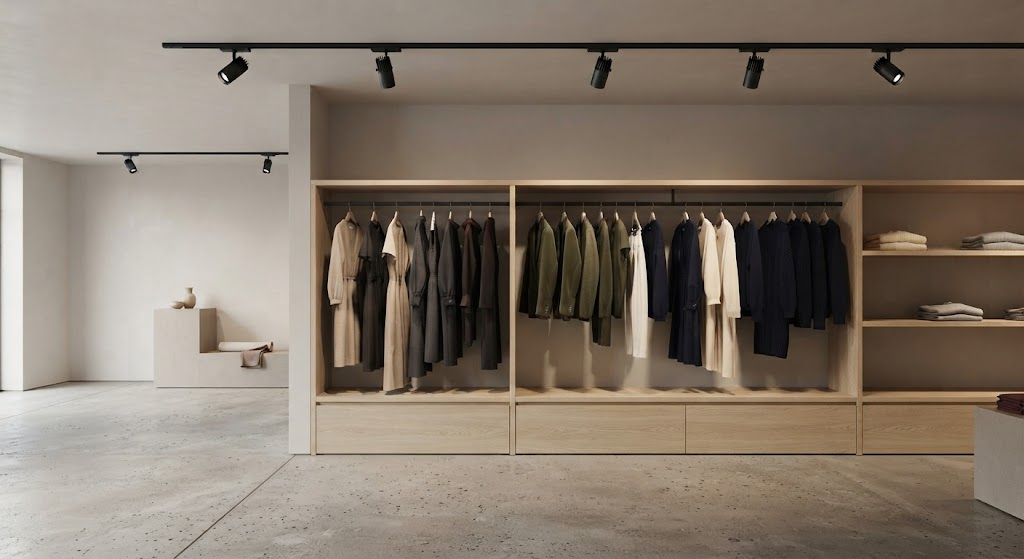
R9 is particularly relevant to fashion lighting because many garments contain red and warm-color information that depends on sufficient red spectral energy.
Red, burgundy, orange, coral, brown and many skin-related colors can respond noticeably differently under different LED spectra.
For a fashion retailer, this matters because customers are not looking at the light source itself.
They are looking at:
- clothing
- fabric texture
- skin
- leather
- accessories
- shoes
- bags
- product displays
If the spectrum is weak in the red region, some of these colors may appear duller or less natural than expected.
However, R9 is not a complete measure of fabric quality.
A good fashion-lighting specification should consider R9 together with broader color metrics and the actual SPD.
Does high R9 make clothes look better?
High R9 can improve the reproduction of red-rich clothing, but it does not automatically make every garment look better.
This is an important distinction.
A high R9 indicates stronger performance for saturated red, but clothing contains many different colors.
A fashion store may display:
| Clothing type | Particularly relevant considerations |
|---|---|
| Red / burgundy | R9, red hue fidelity |
| Orange / coral | R9, overall spectrum |
| Skin-colored garments | Red and adjacent spectral regions |
| Blue clothing | Broader spectral balance |
| Green clothing | Green-region performance |
| Black / gray | Spectrum, contrast and illuminance |
| White clothing | CCT, spectrum and visual contrast |
| Mixed-color collections | Overall TM-30 performance |
So the goal is not simply “maximum R9.”
The goal is a spectrum that reproduces the complete product range convincingly.
Why does higher R9 sometimes reduce lm/W?
Higher R9 can reduce lm/W because additional optical power is often allocated to red wavelengths that contribute fewer photopic lumens than wavelengths near the eye’s sensitivity peak.
Human photopic vision is most sensitive around 555 nm.
Sensitivity decreases toward the longer red wavelengths.
This means that two sources can consume the same electrical power but produce different numbers of photopic lumens because their spectral distributions are different.
A simplified relationship is:
More red spectral energy → stronger red rendering
but potentially:
More deep-red energy → fewer photopic lumens per watt
This is a spectral issue, not simply an electrical one.
Is high R9 itself inefficient?
No. The efficiency penalty depends on how the high-R9 spectrum is produced.
This is one of the most important corrections to the common explanation.
It is too simplistic to say:
High R9 = low lm/W.
A more accurate statement is:
A spectrum designed for high R9 can have lower luminous efficacy if it places excessive optical energy in wavelengths with low photopic sensitivity or relies on inefficient wavelength conversion.
Two LED sources can have similar:
- CCT
- CRI
- R9
but different lm/W because their spectral power distributions are different.
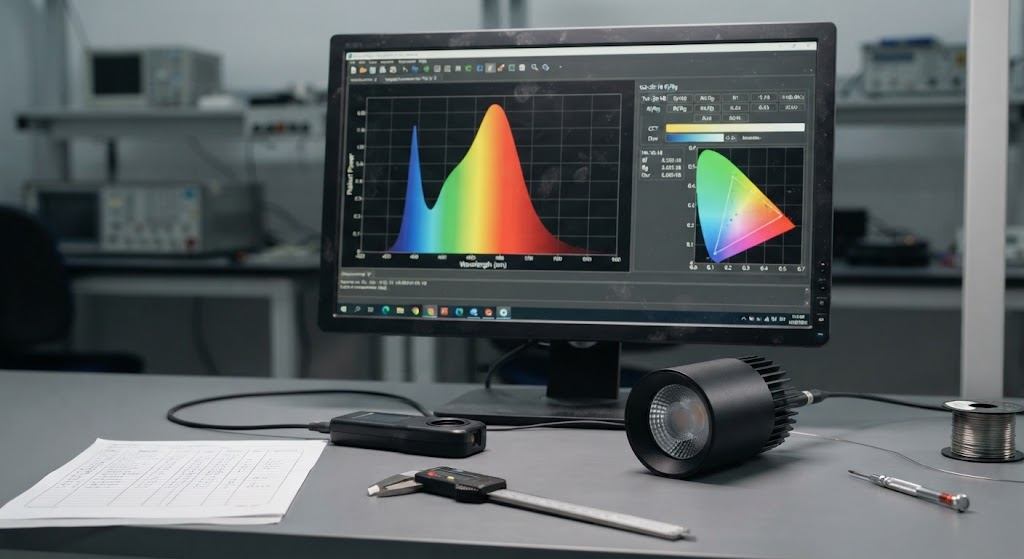
This is why the SPD is so useful when comparing professional LED products.
Why does the red phosphor affect LED efficiency?
In phosphor-converted white LEDs, converting blue LED energy into longer red wavelengths introduces energy losses as well as a change in photopic weighting.
The simplified process is:
Electrical energy → blue LED emission → phosphor conversion → white-light spectrum
When a blue photon is converted into a longer-wavelength photon, the energy difference is not retained as useful visible radiation.
Part of it becomes heat.
This is known as the Stokes shift.
There are therefore two separate efficiency considerations:
1. Spectral efficiency
Red wavelengths produce fewer photopic lumens per watt than wavelengths closer to the peak of human visual sensitivity.
2. Conversion efficiency
The phosphor itself does not convert all incoming energy into useful visible output.
A good high-R9 LED therefore needs to control both.
Why doesn’t every high-R9 LED have the same efficiency?
Because R9 describes a color-rendering result, not the complete spectral design behind it.
For example:
| Characteristic | LED A | LED B |
|---|---|---|
| CCT | 3000K | 3000K |
| CRI | ≥90 | ≥90 |
| R9 | 60 | 90 |
| Red emission | Broad | More controlled |
| SPD | Different | Different |
| lm/W | Product dependent | Product dependent |
LED B may have a higher R9 without necessarily suffering the same proportional efficacy penalty that an older broad-spectrum design would have experienced.
Modern LED development has focused heavily on improving the efficiency of red emission.
This is why the quality of the spectrum matters more than the R9 number by itself.
Can high R9 and high lm/W exist together?
Yes, modern LED technology can achieve a better balance between red rendering and efficacy than earlier high-CRI designs.
One important development has been the use of more efficient and narrower red-emitting phosphor systems.
A broad red emission can extend into wavelengths where photopic sensitivity is already very low.
A more controlled red emission can provide the required red response without putting as much energy into inefficient parts of the spectrum.
DOE solid-state-lighting research has reported substantial modeled spectral-efficiency improvements from narrower red-emitting phosphor approaches under high-color-quality conditions.
The important point is not that every commercial LED will achieve the same improvement.
The engineering principle is:
Better spectral control can reduce the efficacy penalty associated with high color rendering.
What does this mean for fashion retail?
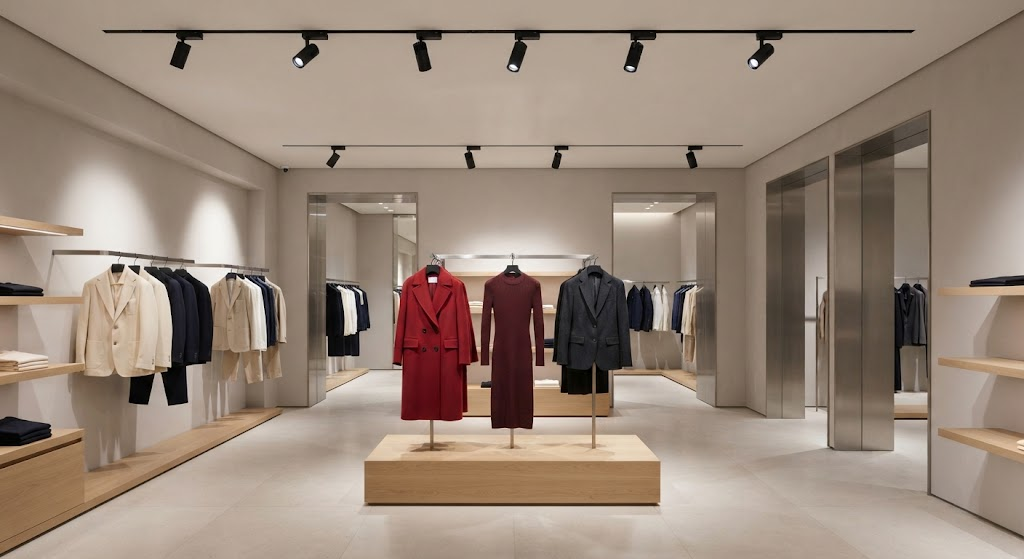
For fashion stores, the right target is not maximum R9 or maximum lm/W, but sufficient color quality with efficient spectral performance.
This changes how a lighting specification should be written.
Instead of:
“We need the highest possible R9.”
A better requirement is:
“The lighting should reproduce clothing colors accurately and attractively while maintaining strong luminaire efficacy.”
That gives the LED manufacturer a much more useful engineering target.
Which clothing colors benefit most from strong R9?
Red-rich and warm-colored garments generally benefit most directly from strong R9 performance.
1. Red clothing
Strong R9 can help saturated red garments appear more faithfully.
This is one of the clearest applications for R9.
2. Burgundy and wine colors
Dark red fabrics can be particularly sensitive to the spectral distribution of the light source.
A weak red component can make these colors appear less rich.
3. Orange and coral
These colors depend on a combination of red and other longer visible wavelengths, so the overall spectrum matters rather than R9 alone.
4. Brown and leather
Red spectral content can influence the appearance of brown, leather and warm natural materials.
5. Skin tones
Fashion lighting also needs to make the people wearing the clothing look natural.
This is one reason high-quality fashion lighting cannot be judged solely by product color.
Is R9 enough to evaluate clothing lighting?
No. R9 is useful for fashion lighting, but it only describes one part of the color-rendering picture.
This is where TM-30 becomes important.
The current IES approach is much broader than a simple CRI/R9 specification. ANSI/IES TM-30-24 evaluates overall color fidelity, gamut and hue-specific characteristics, while the 2026 IES lighting practice guidance provides a framework for applying color-rendering metrics during the design process.
For fashion retail, useful information includes:
- Rf — overall color fidelity
- Rg — overall gamut
- Rcs,h1 — red chroma shift
- Rf,h1 — red color fidelity
- R9 — saturated-red rendering
- SPD — complete spectral distribution
IES specifically notes that retail can be an application where color preference is important, and that red chroma behavior provides information that average fidelity alone cannot capture.
Why can a high-CRI LED still make clothing look dull?
Because a high average CRI does not guarantee strong red rendering or the preferred color appearance of every hue.
This is a common misunderstanding.
Two LEDs can both be labeled:
CRI 90+
while producing different visual results on clothing.
One may have:
- stronger red content
- better red fidelity
- different gamut behavior
- different hue shifts
The other may have a higher theoretical lm/W but weaker red rendering.
This is one reason IES has continued moving toward TM-30 rather than relying on a single average color-rendering number.
Why shouldn’t retailers simply choose the highest R9?
Because excessive emphasis on one color metric can produce a poorly balanced spectrum.
Imagine a store selling a mixture of:
- red dresses
- blue shirts
- green jackets
- white sneakers
- black trousers
- beige coats
Optimizing only for red would not necessarily optimize the appearance of the entire collection.
The better approach is to evaluate the complete spectrum.
A practical hierarchy
Product requirements → CCT → overall color quality → red performance → SPD → efficacy → optical performance
This gives the designer more control over the final result.
How should a fashion retailer specify LED track lighting?
The specification should define color performance and luminaire performance together.
A practical specification can include:
| Parameter | What to evaluate |
|---|---|
| CCT | Match the brand atmosphere and merchandise |
| CRI / Ra | Establish minimum general color fidelity |
| R9 | Set according to red-rich merchandise |
| TM-30 Rf | Evaluate overall fidelity |
| TM-30 Rg | Check overall gamut behavior |
| Rcs,h1 | Check red saturation behavior |
| SPD | Confirm the actual spectrum |
| Luminaire efficacy | Evaluate complete fixture lm/W |
| Beam angle | Match display geometry |
| Glare | Check customer viewing positions |
| Color consistency | Check fixture-to-fixture variation |
This is much more useful than specifying:
“CRI 90, R9 90, highest lm/W.”
What is the right R9 for fashion stores?
There is no single R9 value that should be applied to every fashion store.
R9 ≥50 is commonly used as a reference for higher-quality LED color rendering, but the appropriate target depends on the merchandise and the intended visual effect.
A premium fashion store with extensive red and warm-colored merchandise may justify a more demanding color specification.
A store dominated by neutral clothing may not gain the same benefit from pushing R9 extremely high.
IES’s current guidance also supports an application-specific approach rather than a universal color-rendering value.
How should manufacturers improve high-R9 efficiency?
The solution is to optimize the red component rather than simply increasing the amount of red emission.
1. Start with the application
First determine what colors and materials the lighting needs to reproduce.
For fashion retail, identify the dominant product colors and finishes.
2. Set a realistic color target
Define CRI, R9 and, where appropriate, TM-30 requirements before optimizing efficacy.
This prevents the design from chasing lm/W at the expense of the visual objective.
3. Examine the SPD
Use actual spectral data to determine how the LED achieves its color performance.
A numerical R9 value alone cannot show the shape of the spectrum.
4. Optimize the red emission
Use efficient red-emitting materials and avoid unnecessary long-wavelength output.
The objective is not simply more red.
It is useful red in the right spectral range.
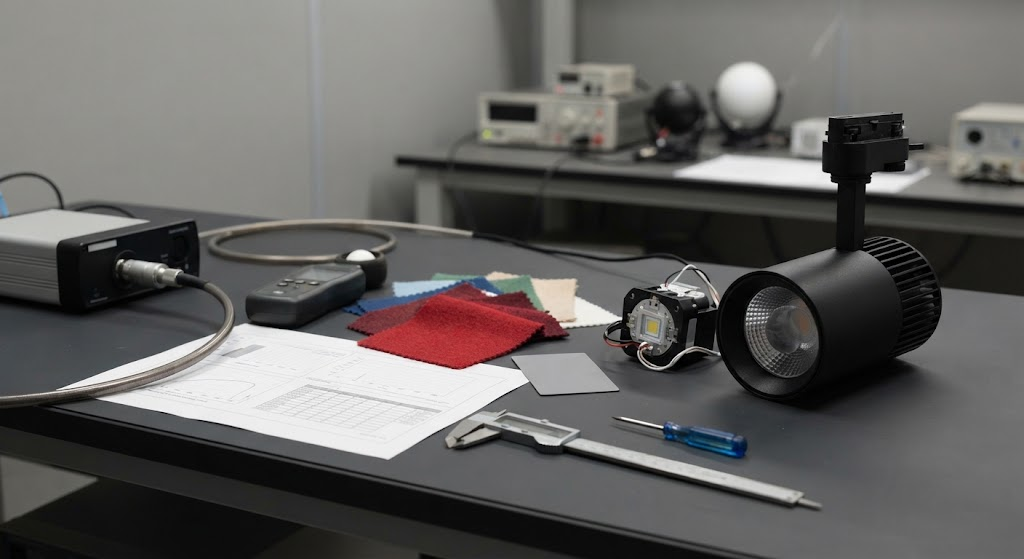
5. Test the complete luminaire
Final efficacy should be measured at luminaire level because optics, driver and thermal conditions all affect delivered performance.
What are the advantages of high-R9 lighting in fashion stores?
The main advantage is better control over the appearance of red-rich products and other materials that depend on the red portion of the spectrum.
- Better red clothing appearance
Saturated red garments can look more natural. - Better burgundy and warm-color reproduction
Dark reds and warm fashion colors can retain more visual richness. - Better skin appearance
This can be important when customers try clothing in front of mirrors. - Better leather appearance
Bags, shoes and accessories can benefit from appropriate red spectral content. - More controlled product presentation
Color quality becomes part of the merchandising strategy rather than an afterthought.
What is the efficiency trade-off?
The trade-off is mainly between allocating more optical energy to color-critical wavelengths and maximizing photopic lumens per electrical watt.
| Design priority | Typical consequence |
|---|---|
| Maximum lm/W | Spectrum may be optimized toward photopic efficiency |
| Higher R9 | More red spectral content may be required |
| High CRI + high R9 | Greater spectral optimization is needed |
| High R9 + optimized red phosphor | Better balance is possible |
| High color quality + retail optics | Total system performance becomes more important |
This is why comparing two retail spotlights only by lm/W can be misleading.
What should buyers ask an LED manufacturer?
A professional buyer should ask for spectral and luminaire data rather than relying only on CRI and R9 printed on a product sheet.
A useful request is:
- CCT
- CRI / Ra
- R9
- TM-30 report
- SPD data
- Luminaire efficacy
- LED operating current
- Driver efficiency
- Beam angle
- Photometric test report
If TM-30 information is not available, the SPD is particularly useful because TM-30 calculations can be derived from spectral data. IES specifically recommends requesting the actual SPD when complete TM-30 information is unavailable.
Yes, especially for red, burgundy, orange, coral and other warm-colored clothing.
But R9 should not be used as the only measure of clothing appearance.
For a fashion store, R9 + TM-30 + SPD gives a much more useful picture.
It can improve red color rendering, but higher R9 does not automatically mean higher brightness or saturation.
The actual appearance depends on the complete spectrum, illuminance, material properties and surrounding colors.
R9 specifically relates to saturated red rendering.
For a store with a wide product palette, overall color fidelity and gamut behavior are also important.
Because CRI 90 does not define the complete spectral power distribution.
Two sources can have similar average color-rendering scores while producing different hue and saturation behavior.
This is exactly why broader TM-30 information can be useful for retail lighting.
No.
High R9 can reduce efficacy when it requires inefficient spectral output, but better red-emitting materials and spectral optimization can reduce the penalty.
The relationship is not a fixed percentage
Neither should be considered separately.
R9 addresses an important part of color rendering, while lm/W describes electrical-to-photopic efficiency.
Fashion lighting needs both:
accurate product appearance + efficient energy use.
CRI 90+ is often a sensible starting point for color-sensitive fashion retail, but it should not be the end of the specification.
R9, TM-30 and SPD can reveal differences between products that a single CRI value cannot.
No.
Higher R9 can be useful, but the goal is not to maximize one number.
A balanced spectrum that reproduces the complete merchandise range naturally is usually more meaningful than an extremely high R9 achieved at the expense of other aspects of color performance
Final answer: Why does high R9 reduce overall lumen efficiency?
High R9 can reduce luminous efficacy because stronger red rendering may require more optical energy in red wavelengths where human photopic sensitivity is lower. In phosphor-converted LEDs, wavelength conversion can add another efficiency loss.
But high R9 does not automatically mean low-efficiency lighting.
The actual result depends on:
red-emission design + phosphor efficiency + complete SPD + CCT + LED architecture + luminaire design.
For fashion retail, this distinction is especially important.
A clothing store needs more than high lumen output. It needs light that reproduces red garments, burgundy fabrics, warm colors, skin, leather and other materials convincingly.
That is why the most useful specification is not:
“Give me the highest R9.”
It is:
“Give me the required color performance with the most efficient and balanced spectrum.”
In 2026, a more complete retail-lighting evaluation should therefore move from:
CRI → R9 → lm/W
toward:
Application → SPD → TM-30 → R9 → optical performance → luminaire efficacy
That approach is closer to how professional color-rendering specifications are now being developed and applied. The IES’s 2024 TM-30 method and 2026 lighting-practice guidance both support a more application-specific, multi-metric approach rather than relying on one color number.
For fashion lighting, R9 matters. But the spectrum matters more.