What Are Energy Efficient Track Lights?
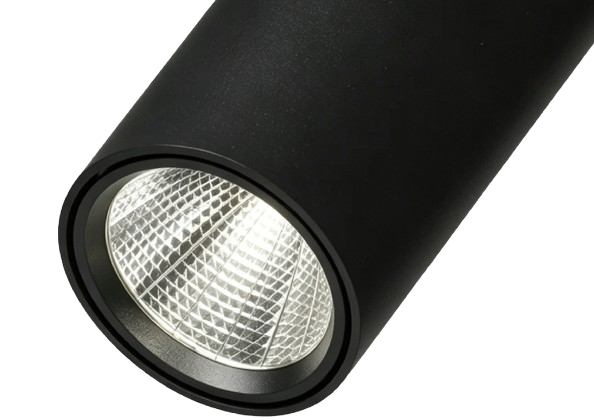
Track lights are directional fixtures mounted on an electrified rail. Individual heads clip onto the busbar and can be repositioned without rewiring. The efficiency case is straightforward: swap halogen for LED and energy consumption drops 60–80% for the same lumen output.
Most commercial track systems now run on LED with some form of dimming control. The fixture, the driver, and the control layer each contribute to the overall efficiency figure.
| Layer | Technology | Efficiency Contribution |
|---|---|---|
| Light source | LED vs halogen | 60–80% reduction |
| Driver | Constant-current, >90% efficiency | 5–10% reduction |
| Controls | Dimming + sensors + scheduling | 30–50% further reduction |
Specifications That Matter
Luminous Efficacy (lm/W)
How much light per watt. Higher is better.
| Product tier | Efficacy |
|---|---|
| Standard LED track | 80–100 lm/W |
| High-efficiency LED | 110–140 lm/W |
| Premium (2025–2026) | 150–180 lm/W |
| Halogen (reference) | 15–25 lm/W |
CRI (Color Rendering Index)
- Retail / display: ≥ 90
- Museum / gallery: ≥ 95 (Ra9 extended)
- General commercial: ≥ 80
Color Temperature (CCT)
- 2700–3000K — warm white; hospitality, restaurants
- 3500–4000K — neutral; offices, retail, showrooms
- 5000–6500K — cool/daylight; warehouses, workshops
Wattage vs Output
| Wattage | Lumens | Typical use |
|---|---|---|
| 7–12W | 700–1,200 lm | Accent, display cases |
| 15–25W | 1,500–2,500 lm | Retail shelving |
| 30–50W | 3,000–5,500 lm | High-bay retail, galleries |
| 60–100W | 6,000–12,000 lm | Warehouse, industrial |
Beam Angle
- 10°–20°: Spot accent
- 25°–40°: Display illumination
- 45°–60°: Ambient fill
Energy Savings in Practice
50 × 50W halogen heads → 50 × 12W LED (same output):
- Load drops from 2,500W to 600W — 76% reduction
- Annual saving at 12 hrs/day, $0.15/kWh: ~$1,246
Smart controls compound that further:
| Control type | Additional saving |
|---|---|
| Occupancy sensors (PIR/microwave) | 20–40% |
| Daylight harvesting | 15–35% |
| Scheduling | 10–20% |
| Combined | 40–60% on top of LED baseline |
5-year operating cost, 100 heads, 3,000 hrs/year:
| 50W Halogen | 12W LED | |
|---|---|---|
| Annual energy | $2,250 | $540 |
| Annual lamp replacement | ~$500 | ~$20 |
| Annual total | ~$2,750 | ~$560 |
| 5-year savings | — | ~$10,950 |
Track System Types
Single-circuit (H-track): All heads share one circuit. Simple, low cost. Standard for residential and small retail.
Two/three-circuit: Multiple independent circuits in the same track body. Different zones switch or dim independently without running extra track.
12V DC (low-voltage): MR16-type heads for jewelry cases or museum display. Requires a remote transformer.
Smart/DALI-2 track: Each head is individually addressable. Supports per-fixture dimming, energy metering per head, and BMS integration.
Dimming and Control Protocols
DALI-2 — Digital, bidirectional, individually addressable. 256 dimming levels (0.1–100%). Each fixture reports status and energy data back to the controller. The default choice for commercial projects with monitoring requirements.
0–10V — Analog, zone-level control. All heads on the same loop respond identically. Lower cost, no individual addressability.
Bluetooth Mesh / Zigbee — Wireless. Useful for retrofits where running control cable isn’t practical.
Occupancy integration — Heads with integrated PIR or microwave sensors trigger automatic on/off or dim-to-setpoint without separate sensor hardware.
Zone Management
Divide the track installation into zones based on:
- Task type (accent / ambient / task)
- Occupancy pattern (high-traffic vs low-traffic)
- Daylight exposure (window-adjacent vs interior)
Each zone gets its own scene settings, dimming level, schedule, and sensor response. A retail fit-out typically runs: Open / After Hours / Cleaning / Security as its four base scenes.
Lighting Schedules
A basic retail schedule that cuts operating costs without visible impact:
| Period | Setting |
|---|---|
| 30 min pre-open | Ramp 50% → 100% |
| Trading hours | 100% |
| Low-traffic window | 70% |
| Post-close | 10–20% (security) |
| Overnight | Off / 0–5% |
Systems with an astronomical clock calculate local sunrise/sunset from coordinates — exterior-facing zones adjust automatically through the year without manual edits.
Dynamic Damping
Damping sets the transition speed between lighting states. Without it, heads snap on/off instantly — uncomfortable for occupants and harder on drivers.
| Parameter | Range | Notes |
|---|---|---|
| Fade-up | 0.5s–60s | Faster in safety areas, slower in hospitality |
| Fade-down | 5s–300s | Long delay prevents false “unoccupied” trips |
| Debounce | 30s–5 min | Absorbs brief sensor absences |
| Daylight step | 1–5% per sample | Keeps lux compensation smooth |
Damping also applies at cold start, limiting inrush current to the driver and extending hardware life.
Energy Consumption Monitoring
Track systems with DALI-2 or smart drivers report energy data at the fixture level. Key metrics to capture:
- Real-time power draw (W) — per head, zone, circuit
- Cumulative energy (kWh) — hourly through monthly
- Operating hours per luminaire — for maintenance scheduling
- Average dimming ratio — indicates how effectively the control system is harvesting
KPIs:
| KPI | Formula | Benchmark |
|---|---|---|
| Lighting Power Density | W ÷ m² | Retail: ≤ 15 W/m² |
| Savings vs baseline | (Baseline − Actual) ÷ Baseline | ≥ 50% vs halogen |
| Average dimming ratio | Σ(% dim × hrs) ÷ total hrs | >70% = good daylight harvest |
This data feeds directly into LEED v4.1, BREEAM Ene 01, ISO 50001, and ASHRAE 90.1 reporting.
Installation
Mounting options: Surface-mount (most common), suspended pendant (high ceilings), recessed (flush finish), wall-mount (gallery/vertical accent).
Circuit loading: Stay below 80% of rated track capacity. Residential track: typically 15A / 1,800W. Commercial: 20–32A.
Head spacing by ceiling height:
| Ceiling height | Track from wall | Head spacing |
|---|---|---|
| 2.7–3.0m | 1.2–1.5m | 0.6–0.9m |
| 3.0–4.5m | 1.5–2.0m | 0.9–1.2m |
| 4.5m+ | Per photometric design | Per photometric design |
Certifications
| Standard | Region | Scope |
|---|---|---|
| ENERGY STAR | USA | Efficacy, quality, lifespan |
| DLC QPL | USA / Canada | Utility rebate eligibility |
| CE | EU | Safety, EMC, LVD |
| IEC 62722 | International | Luminaire performance |
| IEC 62778 | International | Blue light hazard |
| IP (IEC 60529) | International | Ingress protection |
How long do LED track lights last?
L70 lifespan of 35,000–50,000 hours. At 12 hours/day, that’s 8–11 years before lumen output drops to 70% of initial.
Can I use existing dimmer switches? Not always. LED drivers need a dimmer rated for LED loads — trailing-edge or ELV type. Check the fixture’s compatibility list.
What beam angle for retail? 24°–36° covers most shelving and product display. Use 10°–15° for tight accent on hero products, 45°–60° for aisle fill.
Running cost for a 15W head?
15W × 12h × 365 = 65.7 kWh/year. At $0.15/kWh: ~$9.86/year per head.
Do they qualify for utility rebates?
DLC-listed products are eligible for most US and Canadian utility rebates. Typical range: $5–$50 per fixture for commercial LED track.
DALI vs 0–10V — which to choose? DALI for any project that needs individual fixture control, energy reporting, or BMS integration. 0–10V where zone-level dimming is enough and budget is the priority.
BMS compatibility?
DALI-2 systems connect to BMS via gateways with KNX or BACnet output — lighting sits in the same platform as HVAC and access control.