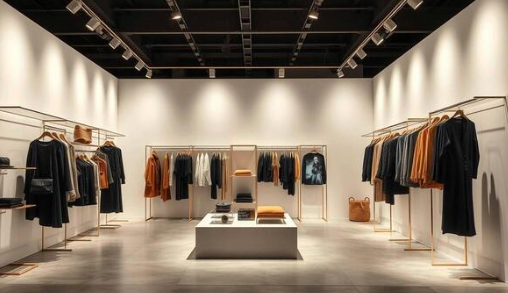
Most lighting specs for fashion retail look the same on paper. CRI 90+, 3000K, beam angle 24°. Done.
But walk into two stores with identical specs and they can feel completely different. One makes the clothes look like they belong there. The other makes everything look slightly off — not wrong enough to complain about, just not quite right.
A lot of that difference comes down to two numbers almost nobody talks about in the brief: CCT and Duv.
This article is specifically about 930 with negative Duv versus 935 with Duv at zero — what each one actually does to clothes, and which types of stores should be using which.
First, what Duv actually means in plain terms
Duv measures how far a light source sits from the blackbody locus — the theoretical curve that describes “pure” white light at any given color temperature.
Negative Duv means the source sits slightly below that line. Positive Duv means above it (toward green-white — avoid this in retail). Zero means you’re sitting exactly on it.
Here’s the part that matters for retail: research from the CIE 2016 conference showed that light sitting slightly below the blackbody locus is consistently perceived as whiter and more brilliant than light sitting exactly on it, even at the same CCT. The human eye reads the slight shift as a signal of extra brightness and purity.
That’s not a flaw. It’s a property. Whether it’s useful depends entirely on what you’re selling.
What 930 with negative Duv does in a store
Standard 930 — which most suppliers ship with Duv somewhere between −0.003 and −0.006 — has been the default for fashion retail for years. There are good reasons for that.
White merchandise looks better than it is.
This sounds like a criticism. It isn’t. A white cotton shirt on a rail at 3000K with negative Duv looks crisp, clean, and luminous in a way that draws the eye from across the store. The fabric isn’t better than it was. The light is doing work that the product can’t do on its own. For fast fashion where white basics are high-volume, high-turnover, that’s commercially useful.
Black is genuinely good.
Deep, rich, no grey cast. If a significant part of the collection is black — and in most European and Asian fast fashion it is — 930 negative Duv handles it well.
Warm tones are natural.
Camel, rust, terracotta. At 3000K these sit in their natural spectral range. Nothing feels forced.
Denim is the problem.
3000K with negative Duv is not great for denim. The warmth suppresses blue, and the indigo that makes good denim look like good denim gets flattened. It’s wearable but it’s not at its best. If denim is central to the store’s identity, this is a real limitation.
Fitting rooms need a second look.
Negative Duv at 3000K can make skin appear slightly cool. Customers notice this even when they can’t name it — they just feel less certain about how they look. If the fitting room runs the same spec as the main floor, this is worth addressing. A higher R13 value (skin tone index above 85) helps. So does pulling Duv slightly closer to zero in the fitting room zone specifically.
What 935 with Duv=0 does in a store
935 at Duv=0 is a different proposition. It’s not a premium upgrade on 930 — it’s a different tool for a different job.
Denim is where it wins clearly.
At 3500K sitting exactly on the blackbody locus, denim indigo renders at full saturation. The blue is genuine. The contrast between dark and light wash reads properly. For a brand where denim is a defining category — not just something that hangs on one rail — this is a meaningful difference that customers will respond to without knowing why.
Earth tones and naturals are as good as it gets.
Sand, stone, greige, olive, khaki. The subtle color relationships between these tones — the thing a designer spent months getting right — are rendered accurately. At 3000K, there’s a warm bias that slightly compresses the differences between adjacent neutrals. At 935 Duv=0, those differences read clearly.
White is clean but not boosted.
This is the trade-off. White at 935 Duv=0 looks accurate and pure. It does not look enhanced. For brands where authenticity is the message, this is correct. For brands competing on visual impact where the extra pop of negative Duv helps move volume, it’s a real sacrifice.
Fitting rooms are better here.
3500K at Duv=0 with R13 above 85 is the most reliable fitting room specification across the widest range of skin tones. Customers see themselves accurately. They make better decisions. Conversion goes up.
The store feels slightly different.
500K of CCT shift is perceptible. A 935 store reads as cleaner, more contemporary, slightly more energetic than a 930 store. Neither is correct or incorrect — they serve different brand languages.
Side by side
| 930 Negative Duv | 935 Duv=0 | |
|---|---|---|
| CCT | 3000K — warm | 3500K — neutral warm |
| White garments | Enhanced beyond reference | Accurate and clean |
| Denim | Suppressed — not optimal | Full saturation — optimal |
| Earth tones | Natural with slight warmth | Highest fidelity |
| Black | Deep and rich | Clean and accurate |
| Fitting room skin | Can run cool; watch R13 | Natural across most skin tones |
| Store feeling | Warm, intimate | Clean, contemporary |
| Best for | Fast fashion, white-heavy, warm luxury | Denim, naturals, casualwear, outdoor |
Which stores should be using which
Which stores should be using which
Use 930 negative Duv when:
Fast fashion with high white and black turnover. H&M, Zara, ONLY, Mango. The whiteness boost earns its place when white basics are moving volume. The warm ambiance supports dwell time.
Warm-positioned luxury. Massimo Dutti, Max Mara. The 3000K warmth is part of the brand experience. Changing it would feel wrong to anyone who knows these stores.
Lingerie and sleepwear. White, blush, pastel. Negative Duv makes these categories look compelling. Warm CCT is flattering in a category where the fitting room experience is high-stakes.
Accessories and leather goods. Neutral leathers, metallics, and mixed palettes render well at 3000K. The warmth flatters natural materials.
Use 935 Duv=0 when:
Denim-focused retail. If denim is a primary category — not just present but defining the store’s identity — 935 Duv=0 is the correct call. Levi’s, G-Star, Lee, Jack & Jones denim sections, any store where the denim wall is the first thing you see walking in.
German and Scandinavian mid-market casualwear. s.Oliver, Esprit, Tom Tailor, Marc O’Polo, Brax. These brands share a common palette: earth tones, naturals, muted colours, quality fabrics. 935 Duv=0 renders this palette better than anything else. The slightly higher CCT also aligns with the clean, considered store aesthetic these brands typically pursue.
Outdoor and performance retail. The North Face, Patagonia, Mammut, Salomon. Technical fabrics and functional colors — the specific greens, greys, and earth tones of outdoor collections — render accurately at 3500K without the warm bias of 3000K distorting the palette.
Contemporary minimalist brands. COS, Arket, & Other Stories. The quiet luxury aesthetic requires accurate color rendering above atmospheric enhancement. Negative Duv’s whiteness boost reads as too aggressive against a carefully considered minimal collection.
Multi-brand department store floors. When one specification has to work across diverse merchandise from multiple brands, Duv=0 is the safer neutral reference. It doesn’t favor any one category at the expense of another.
The fitting room question
Fitting rooms should be specified separately. Always.
The fitting room is where the purchase decision is made. Every other lighting choice in the store is about getting the customer to that moment. The fitting room’s job is to close.
Regardless of whether the main floor runs 930 negative Duv or 935 Duv=0, the fitting room specification should be:
- CCT: 3500K
- Duv: 0 to −0.003
- CRI: 93+
- R13: above 85
- Illuminance: 800–1200 lux, from front and slight elevation — not overhead only
The customer’s eye adapts within seconds of entering. They won’t notice the CCT shift from the main floor. They will notice — again, without being able to say why — that they look better or worse. The specification above performs well across the widest range of skin tones and fabric types.
If a project has budget constraints and only one zone can be upgraded, upgrade the fitting room.
Can you mix both in the same store?
Yes, and sometimes this is the right answer.
A configuration that works for denim-dominant casualwear brands: 930 negative Duv for general ambient and non-denim zones (maintaining warmth and the whiteness boost for basics), 935 Duv=0 for denim walls, featured display zones, and fitting rooms.
The customer won’t notice the transition. They’ll just notice that the denim looks better over there, and that they look good in the mirror.
A note on what the spec sheet doesn’t tell you
Duv is rarely stated on retail lighting spec sheets. CRI and CCT are standard. Duv is an afterthought, or it’s buried in the photometric report if it appears at all.
This is a problem, because two products with identical CCT and CRI can have meaningfully different Duv values and produce visibly different results on merchandise. The difference shows up in the store. It doesn’t show up in the comparison table.
If you’re specifying lighting for a fashion project and Duv isn’t on the datasheet, ask for it. If the supplier can’t provide it, that tells you something too.
Frequently Asked Questions
Is 935 Duv=0 always better than 930 negative Duv?
No. It depends on the merchandise. For white-dominant and black-dominant fast fashion, 930 negative Duv has real commercial advantages. For denim and earth-tone casualwear, 935 Duv=0 is the stronger specification. There’s no universal answer.
Does Duv affect CRI?
They’re related but distinct. CRI is calculated against a reference illuminant that sits on the BBL. A source with negative Duv will show a slightly different CRI than the same source at Duv=0, even at the same CCT. This is one reason IES TM-30 (Rf and Rg reported together) gives a more complete picture than CRI alone.
What if the brand has a global lighting standard I can’t change?
Respect the standard. Global brands build visual identity across hundreds of stores — the lighting is part of that. If you’re working within a specified 930 environment and you have concerns about denim rendering, raise it with the brand’s store development team with evidence. Don’t unilaterally substitute.
What about R9?
For any fashion application, R9 (deep red rendering) should be above 70. If a supplier quotes CRI 93 but can’t provide R9, ask specifically. R9 > 50 is the minimum for general retail. R9 > 70 is professional standard for fashion. If the spec sheet doesn’t include it, request the full spectral data report.
References
- IES TM-30-20 — IES Method for Evaluating Light Source Color Rendition. Illuminating Engineering Society, 2020. Available via ANSI Webstore (registration required, free download): https://webstore.ansi.org/standards/iesna/ansiiestm3020 Note: The standard has since been updated to TM-30-24, available at: https://webstore.ansi.org/standards/iesna/ansiiestm3024
- Perz M, Baselmans R, Sekulovski D. (2016). Perception of illumination whiteness. Proceedings of the 4th CIE Expert Symposium on Colour and Visual Appearance, Prague. CIE Publication x043, pp. 5–9. Conference proceedings available via CIE Webshop: https://cie.co.at/publications/proceedings-cie-2016-lighting-quality-energy-efficiency-march-2016-melbourne-australia (Paper cited extensively in peer-reviewed literature; see also ScienceDirect DOI: 10.1016/j.optlastec.2021.107090 for a study that references and validates this work.)
- CIE 224:2017 — CIE 2017 Colour Fidelity Index for Accurate Scientific Use. Commission Internationale de l’Eclairage. ISBN 978-3-902842-61-9. Official CIE publication page: https://cie.co.at/publications/colour-fidelity-index-accurate-scientific-use
- Fairchild M, Reniff L. (1995). Time course of chromatic adaptation for color-appearance judgments. Journal of the Optical Society of America A, Vol. 12, No. 5. Available via the Optical Society (OSA) digital library. No open-access version; institutional access or purchase required.
- IES TR-2-19 — Color in Retail Environments. Illuminating Engineering Society, 2019. IES members-only publication. Access via: https://www.ies.org (Non-members may purchase individual documents through the IES store.)