DALI-2 is not just an upgraded DALI — it requires mandatory third-party certification. DALI allows self-declaration. DALI-2 does not. For buyers, this single difference determines whether a multi-brand lighting control system works on day one or causes expensive on-site integration failures.
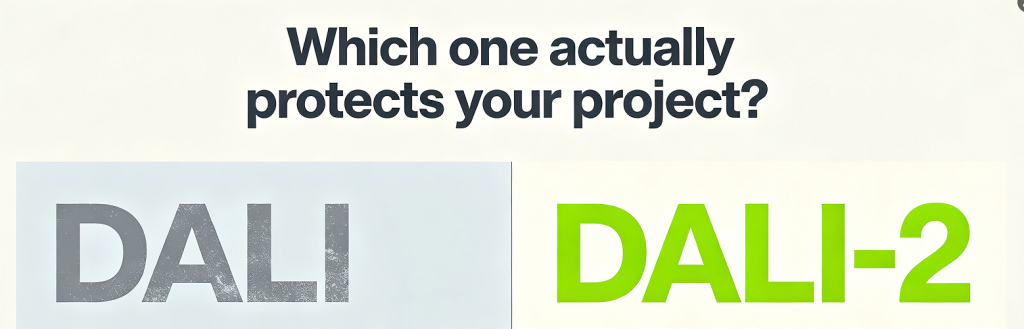
DALI vs DALI-2: Direct Comparison
| Feature | DALI (original) | DALI-2 |
|---|---|---|
| Certification | Self-declaration permitted | Mandatory third-party (DiiA) |
| Interoperability across brands | Not guaranteed | Guaranteed for certified devices |
| Sensor support | Non-standardised | Standardised (device types 303, 304) |
| Input devices | Inconsistent | Fully standardised |
| Energy monitoring | Not standardised | Built into protocol |
| Emergency lighting | Basic | Fully standardised (IEC 62386-202) |
| Tunable white | Inconsistent (device type 8) | Standardised |
| Backward compatibility | — | DALI-2 drivers work with DALI controllers |
| Recommended for | Legacy retrofit | All new commercial installations |
What DALI Does
DALI (Digital Addressable Lighting Interface) controls LED lighting over a two-wire bus. It supports up to 64 individually addressed devices, 16 groups, and 16 scenes per bus. Two-way communication means each fixture can report its status — dimming level, fault condition, energy consumption — back to the control system.
This is why DALI became the commercial standard across Europe for office, retail, and hospitality lighting.
What DALI-2 Adds
1. Mandatory certification Every DALI-2 device is tested by a DiiA-accredited laboratory. Self-declaration is not permitted. This is the only way to guarantee that products from different manufacturers will communicate reliably on the same bus.
2. Native sensor and input device support Original DALI was designed for drivers only. DALI-2 defines standardised device types for occupancy sensors (type 303), daylight sensors (type 304), and push-button inputs — ensuring they work with any certified control gear regardless of brand.
3. Energy monitoring DALI-2 includes built-in commands for reading energy consumption per device. For CSRD Scope 2 reporting, this means zone-level energy data is available directly from the control system — no additional metering hardware required.
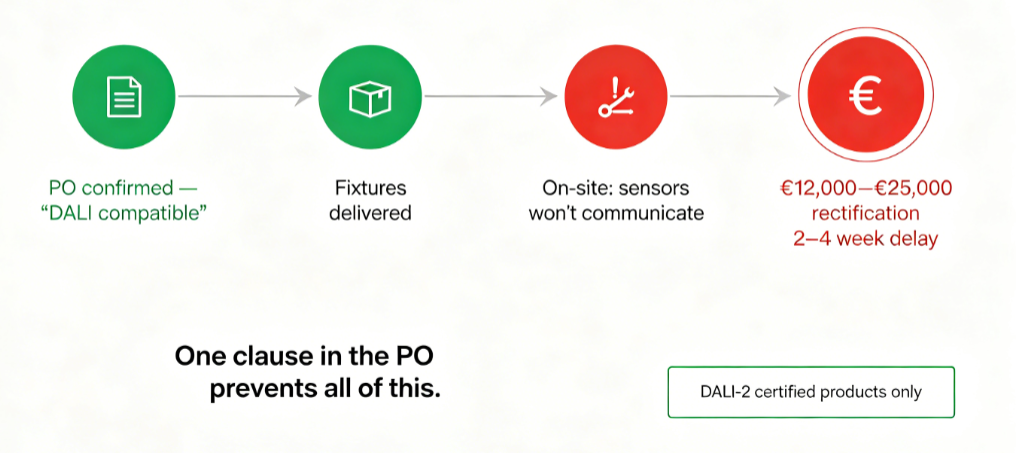
The Contract Risk: “DALI Compatible” vs “DALI-2 Certified”
A supplier quotes “DALI compatible” luminaires. The spec says DALI-2. On-site, the occupancy sensors from a second brand fail to communicate with the drivers. Daylight-linked dimming does not function. Rectification cost: €12,000–€25,000. Delay: 2–4 weeks. Responsibility: disputed.
This happens because “DALI compatible” has no legal or technical definition that guarantees interoperability.
Add this clause to every PO:
“All control gear, sensors, and input devices shall be DALI-2 certified per IEC 62386 and registered in the DiiA product database. DALI-compatible products without DiiA certification will not be accepted as equivalent.”
Suppliers who push back cannot meet the requirement.
How to Verify DALI-2 Certification
The DiiA maintains a public database at dali-alliance.org/products.
Before ordering:
- Ask for the product model number as listed in the DiiA database
- Request the DiiA certification number
- Verify the model and certification number in the database yourself
- Confirm the certified firmware version — certification is firmware-specific
If the product does not appear in the database, it is not DALI-2 certified regardless of catalogue claims.
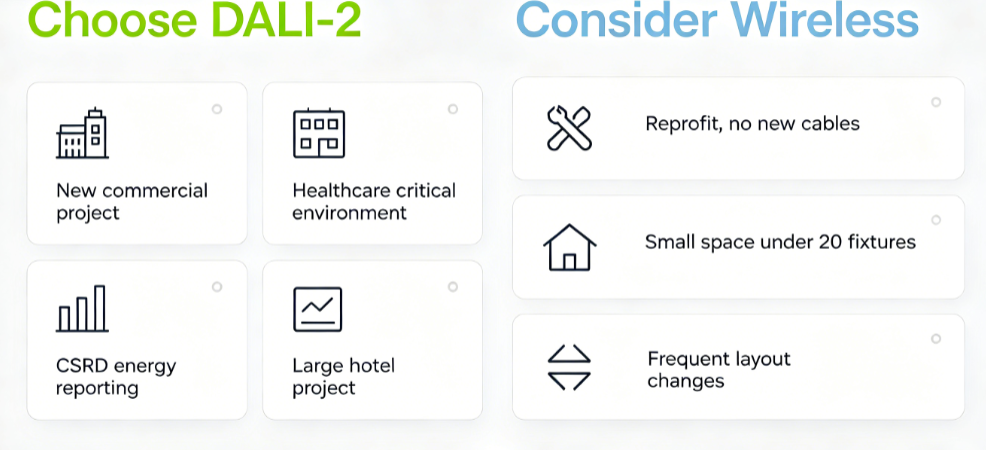
DALI-2 vs Wireless: When to Use Which
| Scenario | Protocol | Reason |
|---|---|---|
| New-build commercial fit-out | DALI-2 | Guaranteed interoperability, built-in energy monitoring |
| Retrofit — rewiring not feasible | Casambi / Bluetooth Mesh | No additional wiring, rapid commissioning |
| Mixed new-build and retrofit | DALI-2 + wireless gateway | Balances reliability and flexibility |
| Small space (< 20 fixtures) | Wireless or 0–10V | DALI-2 cost premium not justified |
| Healthcare / critical environment | DALI-2 | Wired reliability, standardised emergency lighting |
| Hospitality — frequent layout changes | Wireless | Re-addressed without rewiring |
| CSRD energy reporting required | DALI-2 | Built-in per-zone energy monitoring |
On Casambi: widely used in Scandinavia and Northern Europe. Bluetooth Mesh-based, reliable for commercial applications, integrates with DALI-2 luminaires via gateway. DALI-2 fixtures and Casambi control are not mutually exclusive.
Specifying DALI-2 by Application
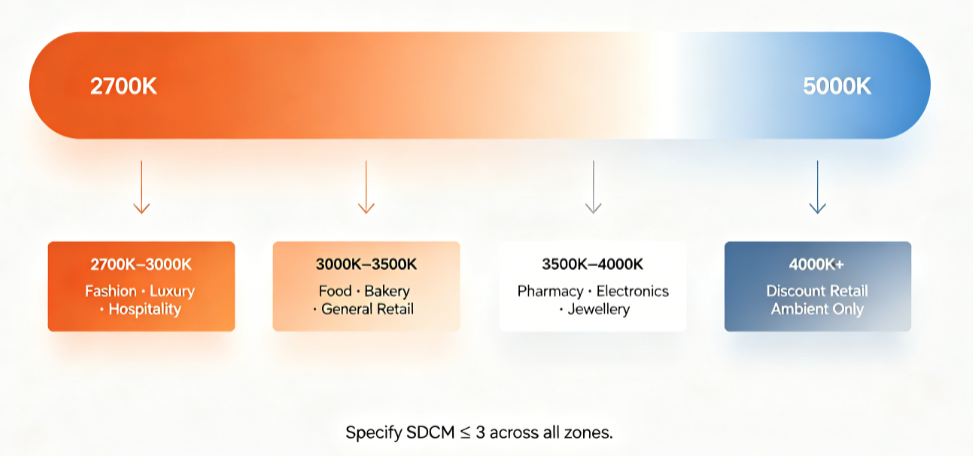
Retail: Daylight-linked dimming and scheduled CCT for tunable white track lighting.
- Control gear: DALI-2 certified, device type 8 for tunable white
- Sensors: DALI-2 daylight sensor (type 304) at each perimeter zone
- Minimum 4 scenes: open, morning, afternoon, closed
Hospitality: Scene control and circadian CCT shift across the day.
- Control gear: DALI-2 with tunable white (device type 8)
- Emergency: DALI-2 certified module per IEC 62386-202
- Confirm gateway compatibility with hotel BMS
Office: Occupancy control and daylight compensation per EN 12464-1:2021.
- Occupancy sensor: DALI-2 certified (type 303)
- Daylight sensor: DALI-2 certified (type 304) at window zones
- Activate DALI-2 energy reporting for CSRD Scope 2 data
Upgrading an Existing DALI System
DALI-2 drivers are backward compatible with original DALI controllers — basic dimming and group control will work. However, DALI-2-specific features (energy monitoring, standardised sensors) require a DALI-2 controller.
Practical retrofit approach:
- Replace drivers with DALI-2 certified equivalents when replacing luminaires
- Upgrade sensors first — this is where original DALI interoperability problems most commonly occur
- Keep existing DALI controller if budget is constrained; upgrade when energy monitoring is needed
Q: What is the difference between DALI and DALI-2?
DALI-2 requires mandatory third-party certification; original DALI allows self-declaration. In practice, DALI-2 guarantees that devices from different manufacturers work together. DALI does not. Specify DALI-2 for all new commercial installations.
Is DALI-2 backward compatible with DALI?
DALI-2 drivers respond to original DALI controllers. DALI-2-specific features — sensor types, energy monitoring — require a DALI-2 controller. For retrofits, DALI-2 drivers can be added to existing networks with basic compatibility.
How do I verify DALI-2 certification?
Search dali-alliance.org/products by model number. Cross-check the certification number the supplier provides. If the product is not in the database, it is not certified. Certification is model-specific and firmware-specific.
Can I mix DALI and DALI-2 devices on the same bus?
Yes, but the interoperability guarantee only applies between DALI-2 certified devices. Original DALI sensors alongside DALI-2 drivers may cause communication conflicts. Use an all-DALI-2 system for new installations.
What is the cost premium for DALI-2?
Typically 5–15% per driver unit. For a 200-fixture fit-out, approximately €800–€2,000 additional cost. Rectification for a failed DALI integration on-site: €8,000–€25,000. The economics are straightforward.
Does DALI-2 support emergency lighting?
Yes. IEC 62386-202 standardises emergency lighting under DALI-2 — automatic function tests, logged results, fault reporting to the control system. Replaces manual monthly testing and simplifies EN 1838 compliance documentation.
What does “DALI-2 ready” mean?
Nothing official. It means the hardware is capable but not yet certified. Do not accept as equivalent to DALI-2 certified. Require the DiiA certification number or reject the product.
Pre-Order DALI-2 Checklist
- “DALI-2 certified per IEC 62386” written into PO — not “DALI compatible”
- All sensors DALI-2 certified (type 303 occupancy, type 304 daylight)
- Certification numbers verified in DiiA database
- Firmware version confirmed — certification is firmware-specific
- Emergency modules DALI-2 certified (IEC 62386-202) if required
- Tunable white specified as device type 8 if CCT control needed
- Controller confirmed as DALI-2 certified
- BMS integration confirmed if required
- Energy monitoring activated for CSRD Scope 2 reporting
- Contract clause added rejecting non-certified “DALI-compatible” substitutes
BREE LIGHTING supplies DALI-2 certified commercial LED luminaires for retail, hospitality, and office projects worldwide. Certification numbers provided with every quotation.