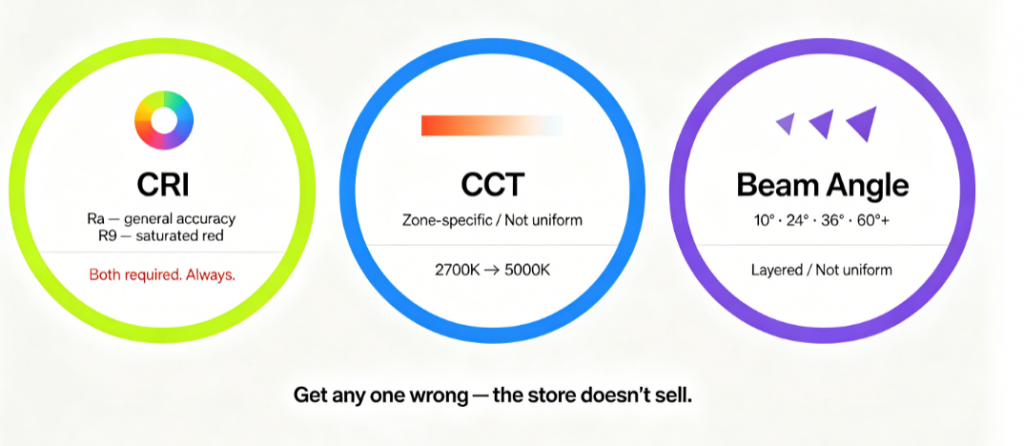
Retail lighting specification requires three parameters: CRI (Ra + R9), CCT by zone, and beam angle by display type. Get any one wrong and the lighting actively suppresses sales — wrong CCT makes gold look silver, wrong R9 makes fresh meat look grey, wrong beam angle creates glare instead of focus.
This guide gives buyers the exact spec for eight store types, the most common procurement mistakes, and the supplier questions that matter before any order is placed.
Flexibility Is a Core Spec Requirement — Not a Nice-to-Have
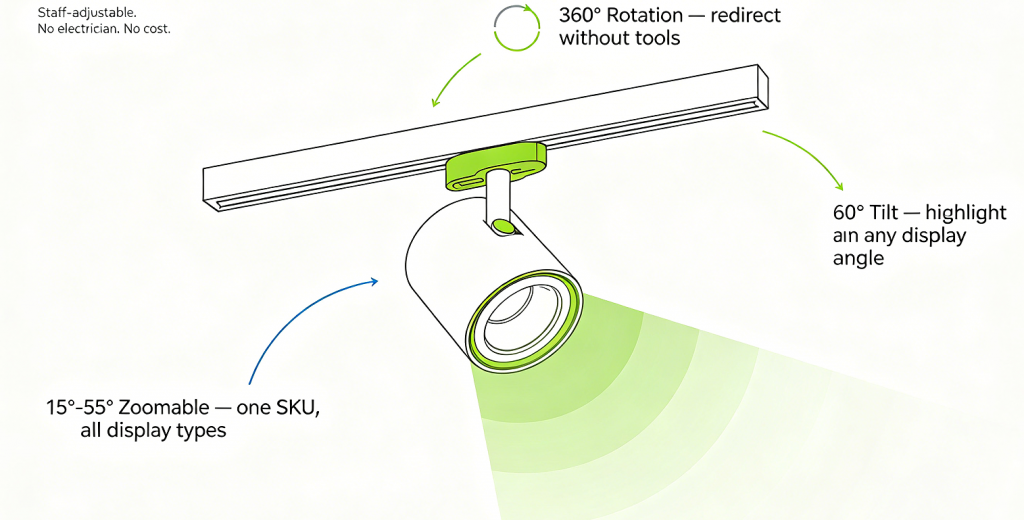
Track-mounted spotlights are the professional standard for retail accent lighting because they allow staff to redirect light when displays change — without tools, without an electrician, without cost. Fixed downlights cannot do this.
When specifying track lighting for retail, require all of the following:
- Rotation: 360° horizontal rotation on track
- Tilt: minimum 45°, ideally 60° from vertical
- Beam angle options: minimum three options from same family (narrow / medium / wide)
- Zoomable option: adjustable beam (e.g. 15°–55°) allows one SKU to serve multiple display types — reduces inventory complexity for multi-store rollouts
- Lumen maintenance: L80B10 rated — meaning the fixture retains 80% output with no more than 10% failure rate across its rated lifetime. For retail, 50,000 hours minimum; premium installations specify 100,000 hours
The Three Parameters That Determine Every Retail Spec
CRI — Specify Ra and R9, Both Required
For retail, two CRI figures matter and both must appear in the test report:
Ra (general CRI): average across eight colour samples. Ra ≥ 80 is the minimum for general retail. Ra ≥ 90 wherever product colour drives purchase decisions.
R9 (saturated red): not included in the Ra average but critical for fashion, food, and skin tones. Ra 90 with R9 < 30 makes red merchandise look muted and skin tones look flat. A supplier who provides Ra without R9 for a retail application is hiding a weak R9. Always request both.
CCT — Zone-Specific, Not Uniform
| CCT Range | Effect | Retail Application |
|---|---|---|
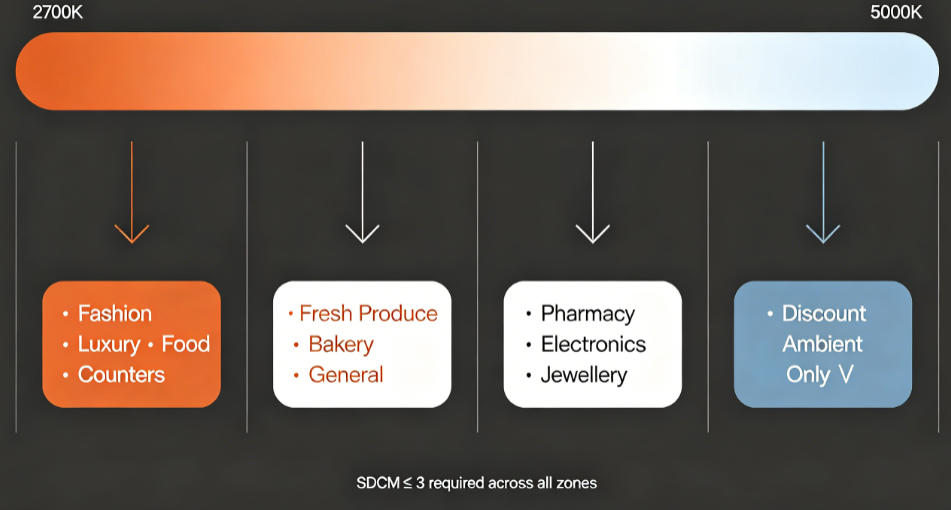
| 2700K–3000K | Warm, rich, flattering | Fashion, luxury, hospitality retail, food counters |
| 3000K–3500K | Balanced warmth and clarity | Fresh produce, bakery, general merchandise |
| 3500K–4000K | Clean, precise, high acuity | Pharmacy, electronics, jewellery |
| 4000K+ | Cool, alert | Discount retail ambient only |
Specify SDCM ≤ 3 for all retail. SDCM > 5 creates visible colour variation across the ceiling — some fixtures appearing warm, others cool — that no amount of repositioning fixes and that communicates poor quality regardless of fixture price.
Beam Angle — Layered, Not Uniform
| Angle | Application | Typical Mounting Height |
|---|---|---|
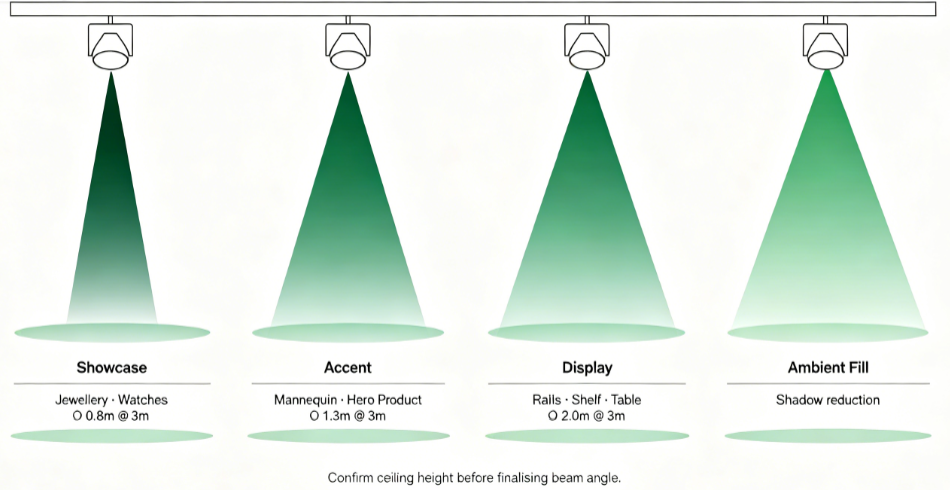
| 10°–15° | Showcase: jewellery, watches, single featured product | 2.5–4m |
| 24° | Standard accent: mannequin, product pile, hero item | 2.5–3.5m |
| 36° | Garment rail, shelf illumination, mid-table display | 2.5–3.5m |
| 60°+ | Ambient fill, reducing shadow between accent fixtures | Any |
At 3m ceiling height, a 24° beam produces a light pool approximately 1.3m in diameter at floor level — appropriate for mannequin highlighting. At the same height, a 15° beam produces a 0.8m pool — correct for a display pedestal or showcase top. Confirm mounting height before finalising beam angle.
A zoomable spotlight (adjustable from 15° to 55° in a single fixture) eliminates the need to stock multiple beam angle variants for flexible retail layouts. For multi-store rollouts where floor plans vary, zoomable is a significant inventory advantage.
Specification by Store Type
Fashion Retail
The goal: make garments vivid, skin tones healthy, the environment aspirational.
| Parameter | Specification |
|---|---|
| CCT | 2700K–3000K |
| Ra / R9 | ≥ 90 / ≥ 50 |
| SDCM | ≤ 2 |
| Beam angle | 24° mannequin, 36° rails, 60° ambient fill |
| Fitting room lux | 500–750 lux at face height (1.2m) |
| UGR | < 22 (critical in mirror-heavy environments) |
| Track flexibility | 360° rotation, 60° tilt — staff-adjustable without tools |
| Control | Dimming to 60–70% for evening atmosphere |
| Lumen maintenance | L80B10 ≥ 50,000h |
Common mistake: specifying 4000K to feel contemporary. Cool white suppresses warm fabric tones and makes fitting rooms clinical. The biggest luxury fashion retailers in the world use 2700K–3000K — not because it is traditional, but because it sells more.
Luxury Retail (Handbags, Watches, Jewellery)
Every product must look its best. The specification standard is significantly higher than general fashion.
| Parameter | Specification |
|---|---|
| CCT | 2700K–3000K (jewellery showcase: 3000K–3500K) |
| Ra / R9 | ≥ 95 / ≥ 70 |
| SDCM | ≤ 2 |
| Beam angle | 10°–15° showcase, 24° featured display |
| Showcase lux | 1,000–2,000 lux on product surface |
| Ambient lux | 150–300 lux (high contrast ratio = perceived luxury) |
| Flicker | SVM < 0.4 — visible on camera, affects brand content |
| Lumen maintenance | L80B10 ≥ 100,000h |
Contrast ratio is the design principle: luxury retail does not mean bright retail. A showcase at 2,000 lux against an ambient of 150 lux creates a contrast ratio of approximately 13:1. This focal intensity is what makes a product feel rare and worth examining. Increasing ambient lux reduces this effect.
On jewellery CCT: diamonds appear whiter and larger under 3500K–4000K with Ra ≥ 97. Gold and warm metals appear richer under 2700K–3000K. If a jeweller sells both, specify separate CCT zones or a zoomable tunable-white track system.
Food Retail and Fresh Produce
Fresh food lighting demands the highest CRI of any retail category. The wrong light makes food look old before it is.
| Zone | CCT | Ra | R9 | IP |
|---|---|---|---|---|
| Bakery / deli counter | 2700K–3000K | ≥ 90 | ≥ 70 | IP44 |
| Fresh produce | 3000K–3500K | ≥ 90 | ≥ 70 | IP44 |
| Meat / seafood | 2700K–3000K | ≥ 90 | ≥ 80 | IP44 |
| Chilled / dairy | 3000K–3500K | ≥ 80 | — | IP44 |
| Dry goods / aisles | 3500K–4000K | ≥ 80 | — | IP20 |
L80 ≥ 36,000h for all food retail fixtures — replacement disruption in a trading environment is a measurable operational cost.
Common mistake: uniform 4000K throughout. Meat under 4000K looks grey. Fresh produce loses vibrancy. Operators who have re-lit fresh sections with 2700K–3000K consistently report increased fresh food sales. The CCT change pays for itself.
Pharmacy and Health Retail
Clinical clarity and trust. Products must be easy to identify, read, and compare.
| Parameter | Specification |
|---|---|
| CCT | 3500K–4000K |
| Ra / R9 | ≥ 90 / ≥ 50 |
| SDCM | ≤ 3 |
| Shelf lux | 500–750 lux |
| UGR | < 19 (staff at shelves for extended shifts) |
| Flicker | < 1% — affects staff wellbeing over long periods |
Electronics and Technology Retail
Products need to look sharp. Ambient illuminance must support detailed comparison without screen reflections.
| Parameter | Specification |
|---|---|
| CCT | 3500K–4000K |
| Ra | ≥ 80 |
| Demo table lux | 500–750 lux |
| Beam angle | 36°–60° (narrow beams create reflections on glass screens) |
| UGR | < 19 |
Avoid downlights positioned directly above glass display cases — the specular reflection obscures product visibility from customer eye level.
Home Furnishing Retail
Show how products look at home — not under warehouse conditions.
| Parameter | Specification |
|---|---|
| CCT | 2700K–3000K throughout |
| Ra / R9 | ≥ 90 / ≥ 50 |
| Vignette ambient | 200–400 lux |
| Featured accent | 500–700 lux |
| Beam angle | 36°–60° ambient, 24° featured pieces |
| Control | Scene-based: morning / afternoon / evening moods |
Common mistake: over-lighting. A home furnishing space at 750 lux uniform looks like a storage facility. Lower ambient with targeted accent creates the domestic atmosphere that turns browsers into buyers.
Coffee Shop and Food Service
Customers stay longer — and spend more — in well-lit coffee environments.
| Zone | CCT | Lux | Ra |
|---|---|---|---|
| Counter / service | 3000K–3500K | 400–500 lux | ≥ 90 |
| Seating / lounge | 2700K–3000K | 150–250 lux | ≥ 90 |
| Display cabinet | 2700K–3000K | 500–750 lux on product | ≥ 90 |
DALI scene control or tunable white for morning-to-evening transition. Morning: brighter and cooler for takeaway rush. Evening: dimmer and warmer for dwell-and-spend.
Discount and Value Retail
Price perception drives purchase. High uniform illuminance signals abundance and accessibility.
| Parameter | Specification |
|---|---|
| CCT | 4000K–5000K |
| Ra | ≥ 80 |
| Illuminance | 500–750 lux uniform |
| Beam angle | 60°+ wide flood |
| Lumen maintenance | L70 ≥ 50,000h |
| Control | On/off or basic dimming |
Full DALI-2 is not cost-justified at this price point. Simple switched zones are adequate.
Lighting as a Visual Merchandising Tool
liability. A system that staff can redirect in minutes is a competitive advantage.
Professional retail track lighting must enable:
- Campaign highlights: redirect spots to new product arrivals without rewiring
- Seasonal shifts: adjust beam angle and intensity for Christmas/sale/new season layouts
- Hotspot creation: concentrate light on hero products to create focal points that guide customer flow
- Staff-managed adjustments: 360° rotation and 60° tilt, operable by any member of staff
This operational flexibility is what separates a professional retail lighting installation from a fixed ceiling grid. It should appear in the specification — not just in the product datasheet.
Red Flags in a Retail Lighting Quote
- One CCT for all zones — supplier has not read the brief
- Ra without R9 — ask directly; R9 < 50 disqualifies for fashion and fresh food
- SDCM not specified — require SDCM ≤ 3 in PO with pre-shipment batch report
- Single beam angle only — a retail track family needs minimum three options
- No tilt/rotation spec — a fixed-aim spot is not a retail spot
- Sample built to order — request production sample from existing batch
- L70 claimed without test basis — require L80B10 with IES LM-80 documentation
FWhat CRI do I need for retail track lighting?
Ra ≥ 80 is the absolute minimum for general retail. Ra ≥ 90 with R9 ≥ 50 for fashion, luxury, and fresh food. Ra ≥ 95 with R9 ≥ 70 for jewellery and high-end cosmetics. Always request both Ra and R9 — Ra alone is insufficient for retail specification.
What colour temperature is best for fashion retail?
2700K–3500K. Warm white renders fabric richly and makes skin tones flattering. Above 3500K, warm-toned fabrics appear washed out and fitting rooms feel clinical. Every major luxury fashion retailer uses warm white — it is not a conservative choice, it is the correct one.
What is SDCM and why does it matter in retail?
SDCM measures colour consistency across fixtures in the same production batch. SDCM ≤ 3 means no visible variation between fixtures. SDCM > 5 creates warm-to-cool variation across a ceiling grid that is immediately perceptible to customers and communicates poor quality regardless of fixture cost. Specify SDCM ≤ 3 and require a pre-shipment batch consistency report.
What is L80B10 and why does it matter for retail?
L80B10 means a fixture retains 80% of its initial lumen output with no more than 10% of units failing within its rated lifetime hours. It is a more complete performance claim than L70 alone. For a multi-store retail rollout, L80B10 ≥ 50,000h means consistent light output across all stores for the useful life of the installation — no hot spots from degraded fixtures and no early replacement costs.
What beam angle for mannequin lighting at 3m ceiling height?
24° produces a light pool of approximately 1.3m diameter at floor level — appropriate for a full-length mannequin. For a featured product on a plinth, 15° creates a tighter, more dramatic pool (approximately 0.8m). For garment rails, 36° covers a wider section of hanging merchandise. Confirm mounting height before finalising beam angle — the same fixture at 2.5m vs 4m ceiling produces very different floor coverage.
Should I specify a zoomable or fixed beam angle track light?
or single-location installations with a stable layout: fixed beam angles are simpler and typically more cost-efficient. For multi-store rollouts with variable floor plans, or for stores that change layouts frequently: zoomable (adjustable beam, e.g. 15°–55°) reduces SKU complexity and allows one product to serve multiple display types. The per-unit cost premium for zoomable is typically 15–25% — justified in flexible retail environments.
Can I use the same track light family across all zones?
Yes, if the family covers multiple beam angles from the same LED chip and CCT platform. Mixing products from different families or production batches creates CCT inconsistency across the space. Confirm that all beam angle variants and wattage options within the family share the same colour specification (CCT, Ra, SDCM) before ordering.