
Track lighting, occupancy sensors, LED panel retrofits, daylight harvesting, and high-bay LEDs cover most retail needs. Sources at 160-180 lm/W cut energy use 30-40% beyond standard 100-130 lm/W LEDs.

Why It Matters
Retail lighting runs 12-14 hours a day, 4,000+ hours a year. Small efficiency gains compound fast at that runtime. Old fluorescent and halogen fixtures also mean lamp changes every 18-24 months — labor and downtime that often cost more than the fixtures themselves.
In the EU, this is now a compliance issue too. Regulation (EU) 2019/2020 sets minimum efficacy, flicker (SVM ≤ 0.4), and lumen maintenance requirements for nearly all LED light sources sold in the bloc. Every product needs an EPREL database registration before it can go to market.
Three Numbers That Actually Matter
| Metric | Industry standard | BREE LIGHTING |
|---|---|---|
| Efficacy (lm/W) | 100-130 | 160-180 |
| CRI | ≥80 | ≥90 for retail display (Ra95 /Ra97) |
| Flicker (SVM) | ≤0.4 (EU minimum) | Factory-tested on every batch |
One catch buyers miss: efficacy numbers are only comparable at matched CRI and color temperature. Some budget LEDs hit high lm/W by pushing color temperature up or CRI down — the light looks harsher and product colors shift. 160-180 lm/W only means something if CRI stays ≥90. Otherwise it’s a spec-sheet trick, not a real energy saving.
The Five Solutions
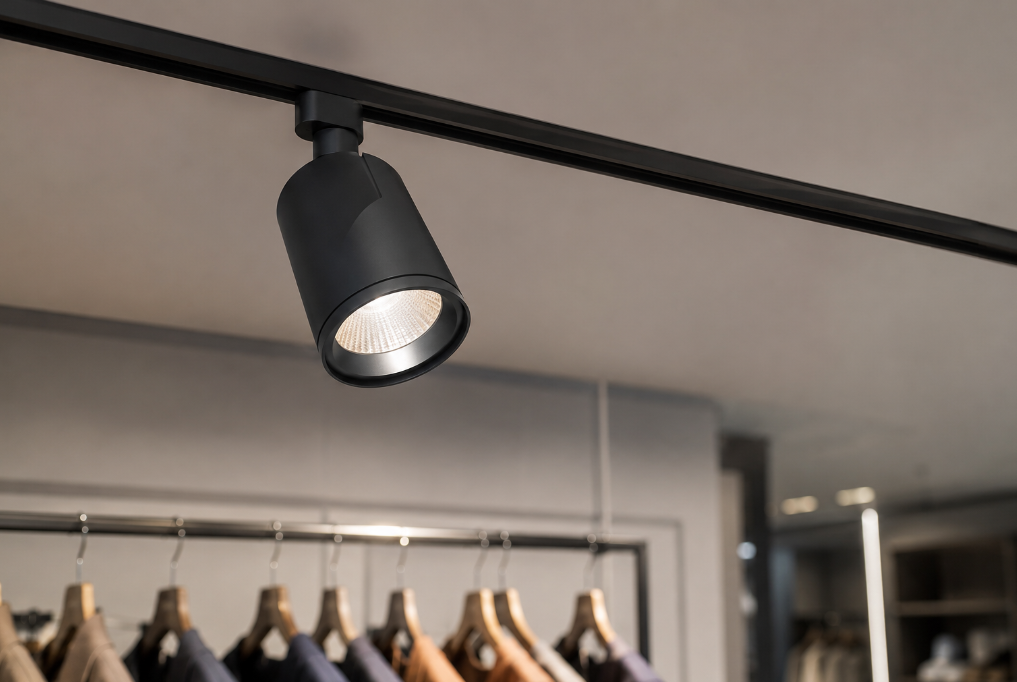
1. High-efficacy, high-CRI track lighting Best for stores that rotate displays often. At 160-180 lm/W, you hit the same window or shelf illuminance with roughly a third less installed wattage than standard track systems.
2. Occupancy sensors and zoned dimming Stockrooms and back-of-house: sensors save 20%+ with no downside. Sales floor: skip binary on/off sensors — customers notice the flicker and it reads as surveillance. Use zoned dimming with smooth transitions instead.
3. LED panel retrofits For stores stuck with old fluorescent grid ceilings. A straight swap is cheaper and faster than a full rewire. High-efficacy drivers push typical retrofit savings from ~50% to 60%+.
4. Daylight harvesting Works well for storefronts and atriums with strong natural light — but only with proper commissioning. Skip it and cloud cover causes visible flicker as artificial light tries to compensate. Pair with continuous dimming drivers, not stepped switching.
5. High-bay LEDs For warehouse-format retail with 6-12m ceilings. This is where high efficacy pays off most — the higher the mount, the more a lower fixture wattage saves overall. Use IP65+ sealed fixtures in humid zones like cold-chain grocery areas to protect the driver from condensation.
EU Compliance, Beyond the Basics
- EU 2019/2020 (Ecodesign): minimum efficacy, flicker limits, lumen maintenance — covers almost every LED source sold in the EU, including fixtures with non-replaceable LED modules.
- EPREL registration: mandatory before market entry. Non-EU manufacturers need an EU authorized representative. Missing or wrong entries trigger fines and product withdrawal.
- ESPR transition: current Ecodesign rules hold until end of 2026, then the Ecodesign for Sustainable Products Regulation takes over — adding replaceability and Digital Product Passport requirements. Buy products already EPREL-registered with replaceable drivers/light sources now, to avoid a second retrofit later.
ROI: Audit First, Then Pilot
- Audit energy use over 12-24 months per store — don’t estimate from nameplate wattage alone.
- Pilot in 1-2 stores first. Check CRI and customer response before rolling out chain-wide.
- Budget extra time for older buildings — 3-5 extra weeks for conduit/trunking work versus new-build stores.
How much does 160-180 lm/W actually save over standard 100 lm/W LEDs?
Roughly double the efficacy means roughly 40-45% less installed wattage for the same lux target, in theory. Real projects land at 30-40% once you factor in fixture optics and any CRI trade-offs — measure your baseline first.
Should sales floors use occupancy sensors?
No. Binary on/off sensors create a jarring experience for customers. Use zoned dimming or scene presets on the floor; save sensors for stockrooms, restrooms, and other non-selling areas.
What’s the compliance mistake most EU buyers make?
Assuming CE marking covers everything. EPREL registration is a separate, parallel requirement — a product can be CE-marked and still non-compliant without it. Also check whether the LED module is replaceable: non-replaceable modules get classified differently under the regulation, with different obligations.