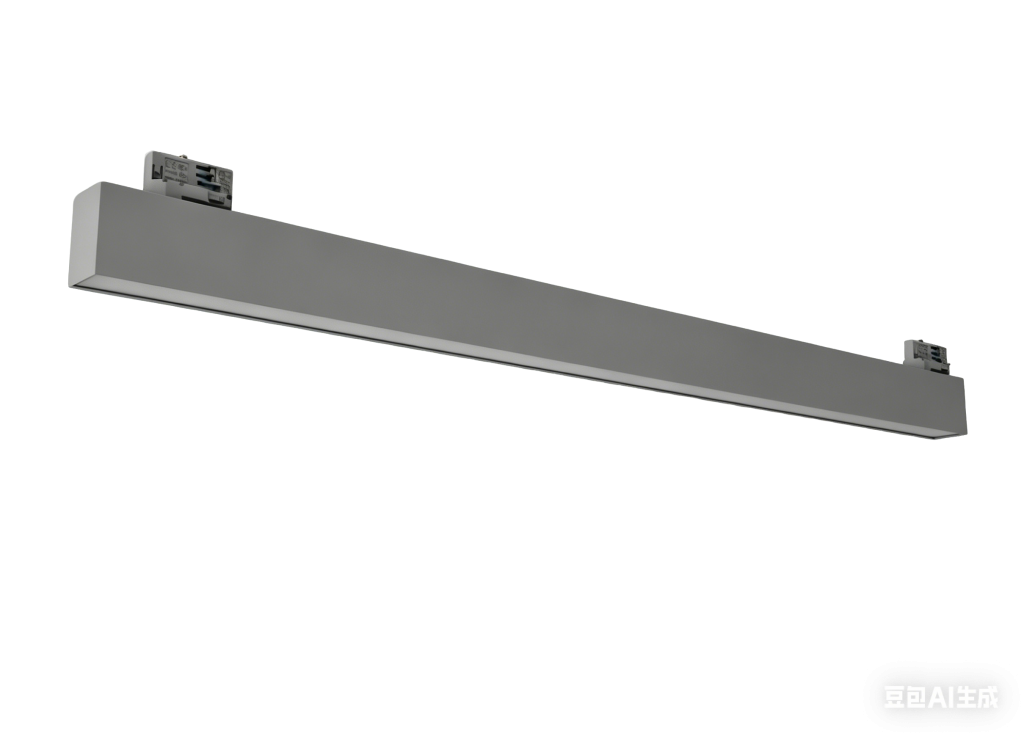
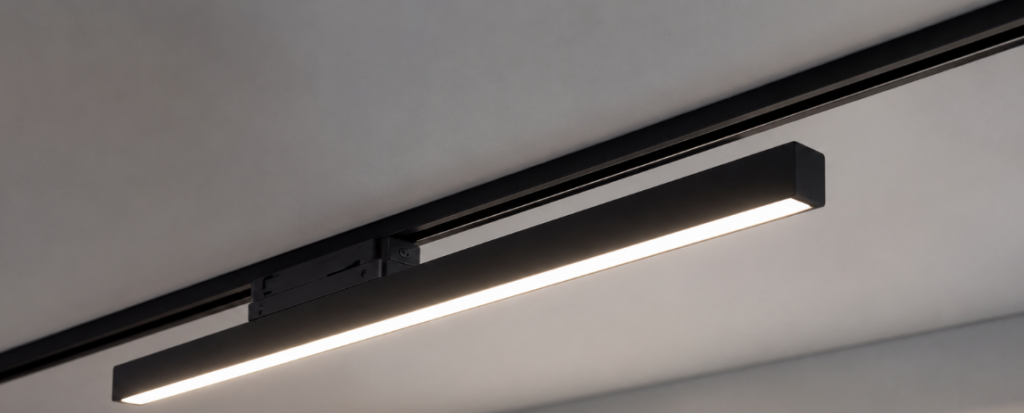
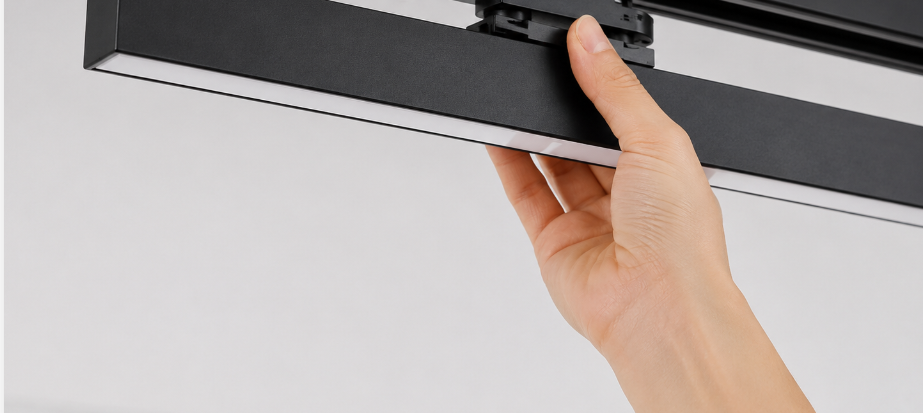
A track linear light is an LED luminaire that combines a linear, continuous light source with a track-mounted rail system. It slides and rotates along the rail for tool-free repositioning, while producing an even, uninterrupted line of light rather than isolated spotlight beams.
What Is a Track Linear Light?
In European commercial interiors, lighting designers increasingly favour systems that are easy to reconfigure without disturbing the ceiling. A track linear light answers that need by merging two established typologies:
- Track system: the luminaire clips directly onto a busbar or rail, drawing power from it and allowing repositioning, rotation and angle adjustment without rewiring.
- Linear light: the light source itself is arranged as a continuous strip rather than a single point, giving a seamless, shadow-free line of illumination.
The result is a fixture that behaves like a spotlight in terms of installation flexibility, but reads visually as a clean architectural line rather than a series of individual beams.
Typical Technical Specifications
Specifications vary by manufacturer, but the following ranges are broadly representative of what European buyers should expect from a well-specified track linear light system:
| Parameter | Typical Range |
|---|---|
| Mounting | Direct click-on to 1-circuit or 3-circuit global track (busbar) |
| Beam angle | Fixed at 15°/24°/38°/60°, or adjustable zoom 15°–55° |
| Colour rendering (Ra) | Ra80 or Ra90 |
| Colour temperature | 2700K / 3000K / 4000K |
| Wattage | Typically 10W–450W per head; linear sections made to order |
| Ingress protection | IP20 for indoor use; IP65 variants for semi-outdoor or industrial settings |
| Impact resistance | IK07–IK10 |
| Rated lifetime | L80B10 approx. 100,000 hours at 25°C |
| Driver | Integrated, compatible with DALI, 0-10V or app-based dimming |
| Rotation / tilt | Up to 360° rotation, tilt typically up to 60° |
How It Differs from Conventional Track Spots and Fixed Linear Fixtures
Versus conventional track spotlights: individual point-source spots are adjusted one by one and, when grouped, often produce visible gaps or hotspots. A track linear light is engineered to read as one continuous band of light, avoiding that broken, patchwork effect.
Versus fixed linear luminaires: a recessed or surface-mounted linear fixture is set once and rarely moved again. A track linear light retains the rail’s core advantage — the layout can be revised as a space evolves, without cutting into the ceiling or re-running cables.
Where It Is Used
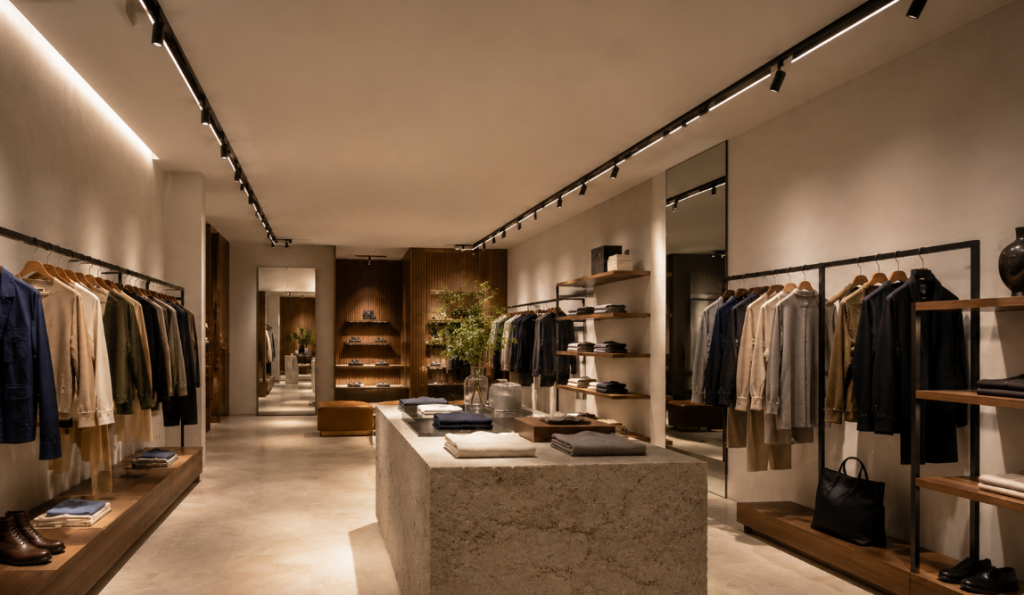
- Retail and showroom environments — highlighting merchandise or shop windows while the continuous line reinforces a coherent brand atmosphere across the store.
- Museums and exhibition spaces — layouts change frequently, and a track-based system lets curators reposition light without structural work.
- Offices and commercial interiors — often paired with DALI-based lighting control for zoned dimming and energy management in lobbies, corridors and open-plan areas.
- Education and public buildings — an open-profile track can integrate with acoustic ceiling systems, balancing illumination with architectural finish.
Installation Essentials
- Power and fixing: the luminaire clicks directly onto the rail; there is generally no separate junction box required.
- Suspended or surface-mounted: many systems support wire suspension as well as direct ceiling mounting, with brackets typically supplied.
- Integrated driver: the driver usually sits inside the fixture body, simplifying external wiring.
- Seamless jointing: better-engineered systems use near-invisible connectors so that multiple sections form one uninterrupted line of light.
A Short Selection Checklist
- Is the track profile compatible with your existing rail system (single-circuit or 3-circuit)?
- Do you need a fixed beam angle or an adjustable zoom lens?
- Is Ra80 sufficient, or does the application call for Ra90 (e.g. fine merchandise display)?
- Which colour temperature suits the space — warm 2700K/3000K or neutral 4000K?
- Is smart dimming (DALI, 0-10V, app control) required?
- Does the IP and IK rating match the environment (indoor, semi-outdoor, industrial)?
- Will you need bespoke lengths or a modular jointing solution?
Frequently Asked Questions
Is a track linear light suitable for residential use?
It was originally developed for commercial settings — retail, exhibitions, offices — but its flexibility also suits residential spaces with strong display or gallery-wall requirements.
Can it be dimmed?
Yes. Most systems support DALI, 0-10V or app-based control for zoned dimming and scene-setting.
How does it differ from a standard track spotlight?
A standard track spot is a single point source adjusted individually. A track linear light is designed to form one continuous, even line when several sections are combined.
What lifetime can be expected?
Well-specified LED track linear systems typically offer a rated lifetime (L80B10) of around 100,000 hours at 25°C, with driver lifetimes around 50,000 hours.
In Summary
A track linear light brings together the repositioning freedom of a track system with the visual calm of a continuous linear light source, making it a practical choice across retail, exhibition, office and public-sector interiors. Selection should centre on rail compatibility, beam control, colour rendering, and compatibility with the dimming protocol already in use on site.