A track spotlight is a movable light fixed to a powered rail, adjustable in position and angle after installation. Retailers use it to highlight products, guide customer flow and set a store’s mood — cheaper and far more flexible than wiring fixed points into the ceiling.
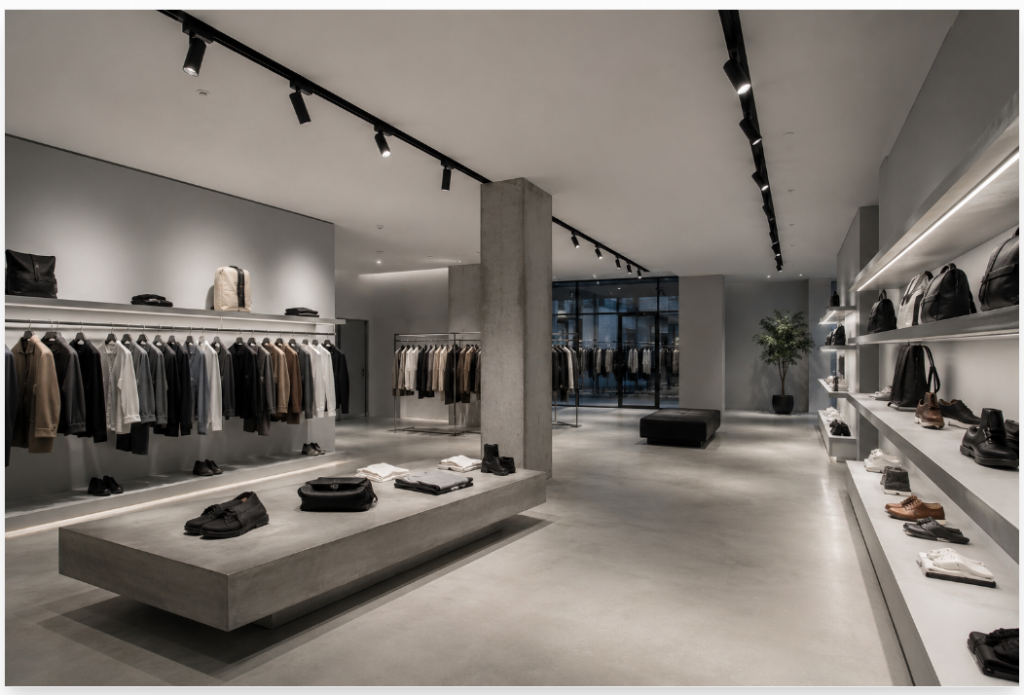
Why retailers still build lighting around track systems
Good retail lighting starts with the brand and the space, not a parts list. Swiss, German and Austrian fit-out teams tend to work this way: understand the product, the customer, the architecture — then decide on fixtures, not the other way round.
Track systems fit that logic well:
- Nothing is fixed once installed. Move a spotlight, angle it differently, swap the beam — no electrician needed, no new holes in the ceiling. Useful for a floor that gets rearranged every season.
- One rail, several jobs. Narrow and wide optics sit on the same circuit, so a single track handles both general fill and sharp accents.
- The running cost gets planned, not guessed. Total cost of ownership and the energy balance are usually worked out before a fixture is chosen, not after.
- It plugs into building energy rules. In Switzerland, lighting plans are often checked against Minergie targets as part of the wider building sign-off.
Questions people ask about track spotlights in retail
1. How is a track spotlight different from a recessed downlight?
A track spotlight can be repositioned any time. A downlight is committed the day it’s wired. That difference matters most in retail, where a store might reset its layout three or four times a year — with track, the lighting just follows.
2. What wattage and light output is normal for retail track spotlights?
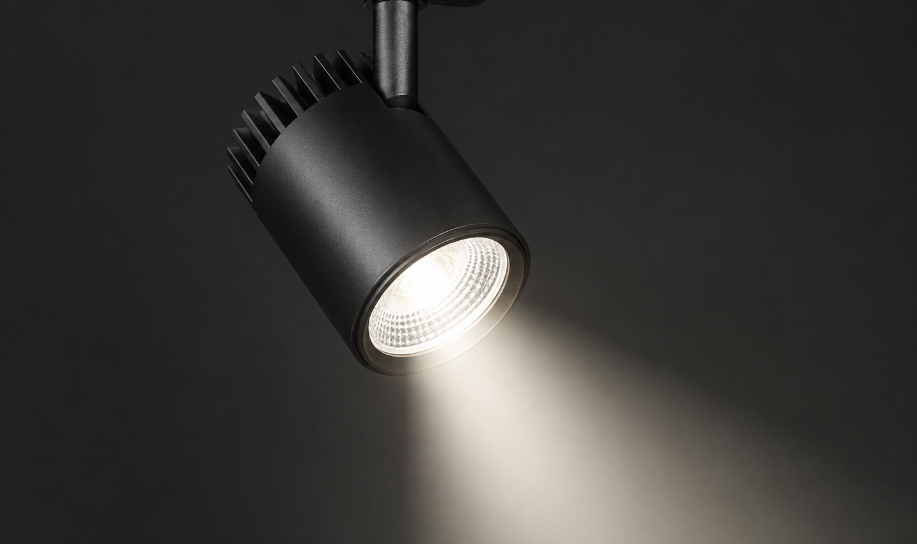
Most retail-grade units sit between 11–43 W, putting out roughly 1,600–5,400 lumens, with the better ones reaching 150–160 lm/W. Ceiling height and how reflective the surfaces are will push you toward one end or the other.
3. What CRI do retail spotlights need?
CRI 90, not the CRI 80 that’s fine for a warehouse or corridor. Fashion, cosmetics and food retail live or die on colour accuracy — a customer who sees the “wrong” colour on a garment under store light is a return waiting to happen. Some fixtures also come in a warmer variant built specifically for meat and deli counters, since ordinary white light makes fresh meat look grey.
4. Which colour temperatures get used, and where?
2700K to 4000K covers most of it, with some ranges offering a deeper warm tone around 3000–3500K for wood, leather and richer textures.
| Colour temperature | Works well for |
|---|---|
| 2700K–3000K | Boutiques, jewellery, delicatessens |
| 3000K–3500K | Fashion, footwear, lifestyle stores |
| 4000K | Electronics, pharmacy, supermarket |
5. What beam angles should a store use, and how do you combine them?
Four are standard:
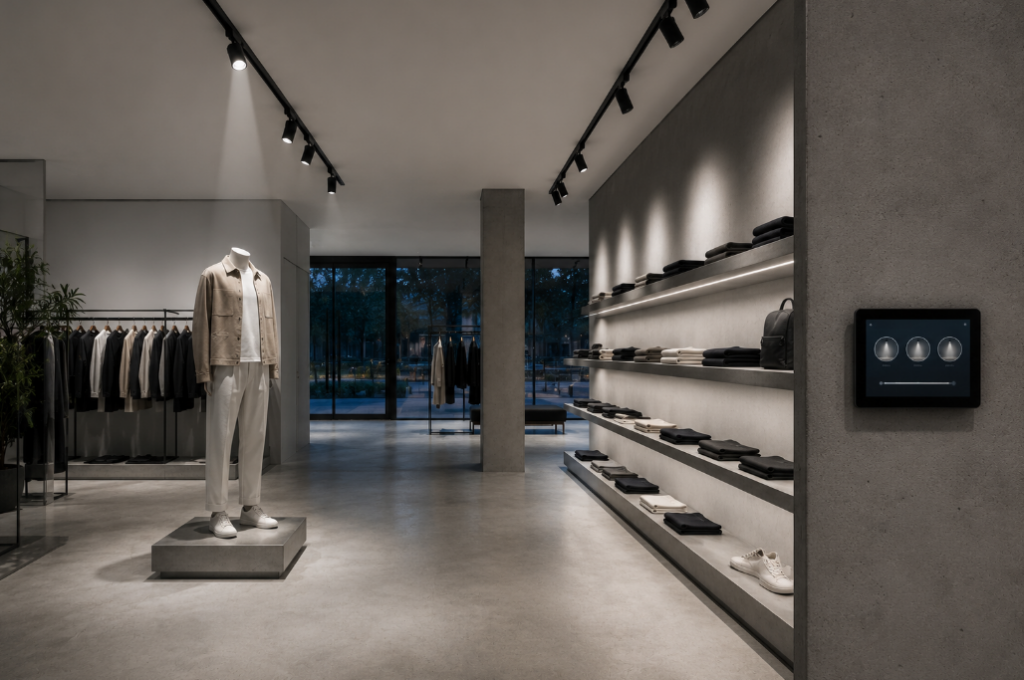
- ~15° — single hero pieces, mannequins, jewellery
- ~24° — shelf sections, grouped products
- ~36° — wider merchandising walls
- ~60° — general fill, walkways
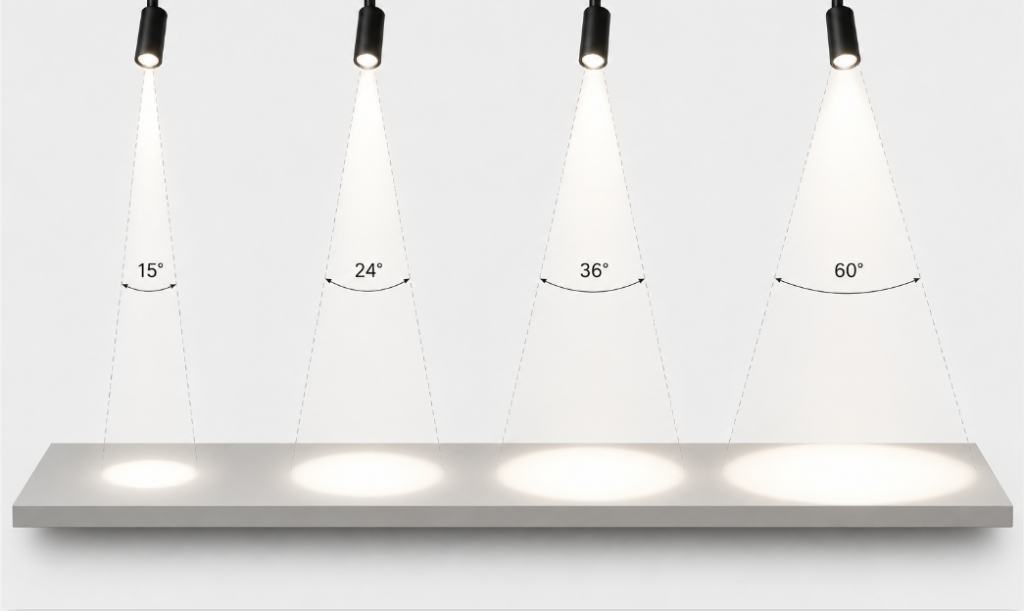
Mix them. A whole store lit at one angle looks flat. Narrow beams on the pieces you want noticed, wide beams filling the gaps — that’s what pulls a customer’s eye through the space instead of just switching the lights on.
6. How long do these fixtures actually last?
Around 50,000 hours at L90/B10 — after that long, 90% of units still put out at least 90% of their original brightness, and no more than 1 in 10 has failed. A store trading 3,000–4,000 hours a year gets over a decade out of that before maintenance becomes a real conversation.
7. What IP and safety rating do indoor retail spotlights need?
IP20 / Safety Class II covers a normal dry sales floor. You only need to go higher for anything exposed to moisture or dust — a window display prone to condensation, or a spot near food prep.
8. How do stores control track lighting day to day?
Three approaches show up repeatedly:
- DALI-2 — the standard for addressable, dimmable lighting, common in chains with central building management
- Wireless mesh (Bluetooth-based, typically) — popular in retrofits since there’s no new control wiring to run
- Preset scene systems — one button switches the whole store between a daytime look, an evening look, an event look
Static, one-setting lighting is becoming the exception rather than the rule.
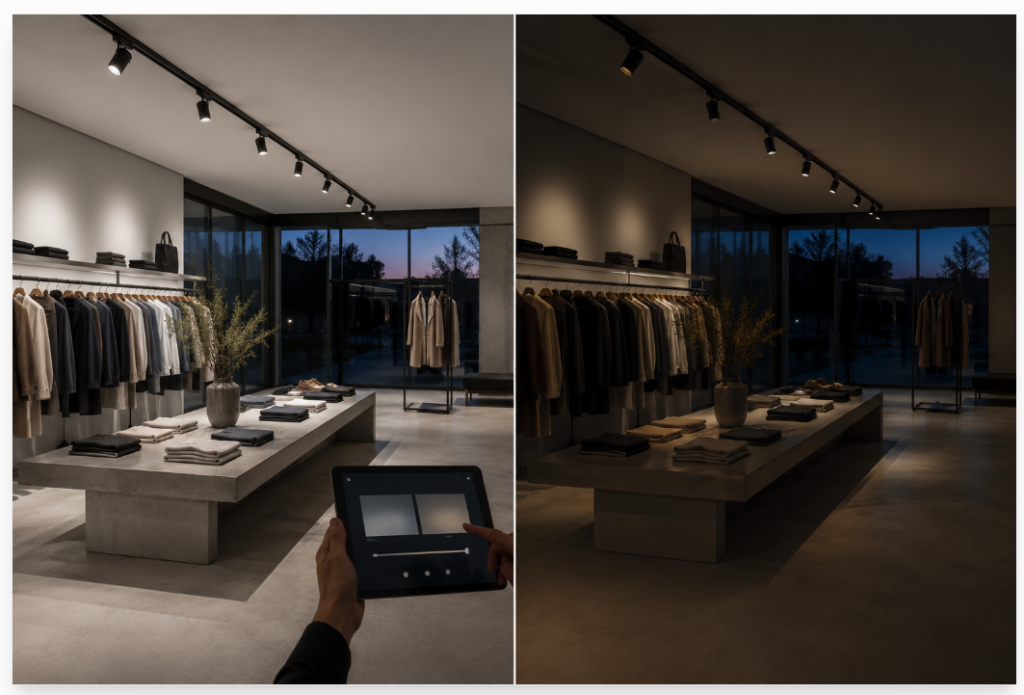
9. What does a proper lighting project actually look like, start to finish?
- Discovery — brand, customer, building constraints, before any product gets picked
- Calculation and concept — lighting plans and visuals, so everyone signs off before installation
- Compliance checks — energy balance, TCO, and Minergie or equivalent where relevant
- Fixture decisions — bespoke development for flagships, standard specification for smaller stores
- Installation and upkeep — commissioning, then a maintenance plan rather than a one-off install
10. Is a proper lighting concept worth it, or is a catalogue spotlight enough?
For one small shop, a decent catalogue fixture is usually fine. For flagships, multi-site chains, or any brand where the in-store feel matters, a planned concept — calculated and checked for energy compliance before anything is ordered — tends to pay for itself: lower running costs, fewer callouts, and a floor that actually helps sell rather than just being lit.
The short version
- Track spotlights win on flexibility — the lighting adapts after installation, not just before it.
- CRI 90 and a deliberate colour-temperature choice are baseline, not upgrades.
- Combine beam angles (roughly 15°/24°/36°/60°) instead of lighting everything the same way.
- Check lifespan (L90/B10, ~50,000h), IP/safety class, and control protocol before specifying anything.
- Treat lighting as something planned early — energy balance, TCO, visuals — rather than a last-minute order.
Is track lighting more expensive than fixed downlights?
Upfront, roughly comparable or slightly higher per fixture. Over the life of the store it’s usually cheaper, since layouts can be changed without re-wiring.
Can track spotlights be dimmed?
Yes — most current fixtures support dimming via DALI-2 or wireless mesh control, on top of basic ON/OFF.
What’s the minimum ceiling height for track spotlights to work well?
Around 2.5–2.6 m is workable; below that, beam spread and glare become harder to control. Higher ceilings (3 m+) give more flexibility with wider beam angles.
Do track spotlights need a dedicated electrician to install?
The rail itself needs a qualified electrician for the initial wiring. Once it’s live, moving or swapping individual spotlights on the rail doesn’t require one.
Can track lighting be retrofitted into an existing store without a full renovation?
es, this is one of its main advantages — a track can often be surface-mounted or suspended without touching the existing ceiling structure, especially with wireless control options.
How many spotlights per metre of track is typical?
There’s no fixed rule, but a common density for accent-heavy retail is one spotlight roughly every 60–100 cm, adjusted based on beam angle and merchandising density.
Is 4000K too cold for a retail interior?
Not inherently — 4000K reads as clean, neutral white and suits electronics, pharmacy and supermarket formats well. For a warmer, more intimate feel (fashion, hospitality-adjacent retail), 3000K is usually preferred instead.
Do track spotlights work with existing building management systems?
Fixtures using DALI-2 typically integrate directly with standard building management systems; wireless mesh systems usually need a gateway or bridge to connect to the same network.