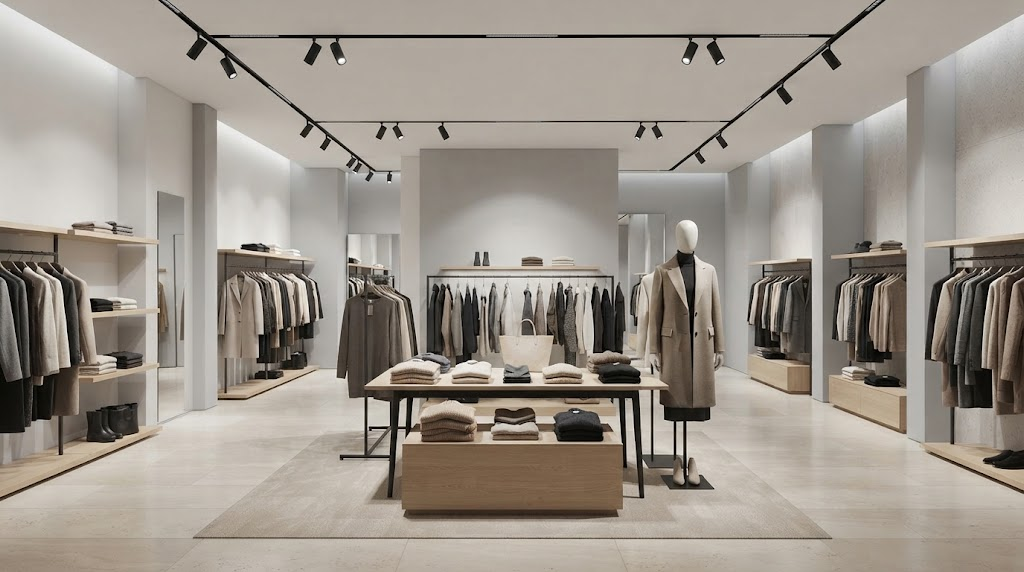
Commercial lighting should make a space easy to use, easy to navigate and visually interesting. The most effective approach is to combine general, task and accent lighting, then adjust the light to the products, architecture and activities within each area.
A commercial space does not need the same amount of light everywhere.
In fact, one of the most common mistakes in commercial lighting is trying to make the entire room equally bright. A better lighting design creates differences between areas. Some light supports movement. Some supports a task. Some draws attention to a product or architectural feature.
That difference is what gives a space depth.
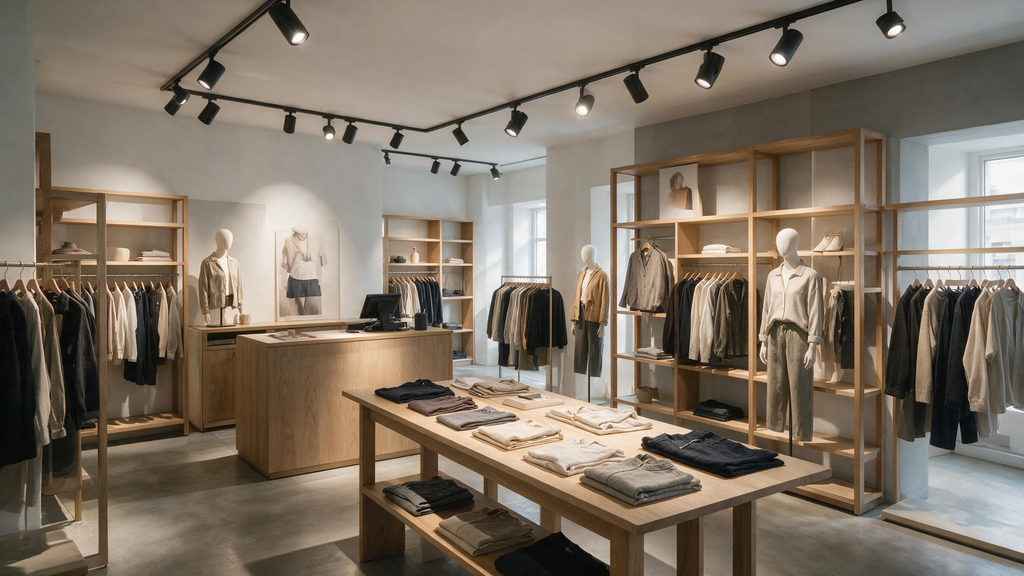
What Is Commercial Space Lighting?
Commercial space lighting is the planned use of artificial light in places such as retail stores, offices, restaurants, hotels, showrooms and other public or business environments.
It includes more than selecting light fixtures.
A complete lighting concept considers:
- What people need to see
- Where people spend time
- Which products or features need attention
- How the space changes throughout the day
- How much glare is acceptable
- How the lighting interacts with materials and colours
- How easily the system can be adjusted or maintained
- How much energy the installation will use
The fixture is only one part of the solution. The real result comes from how the fixtures, optics, controls and space work together.
Why Does Lighting Matter in a Commercial Space?
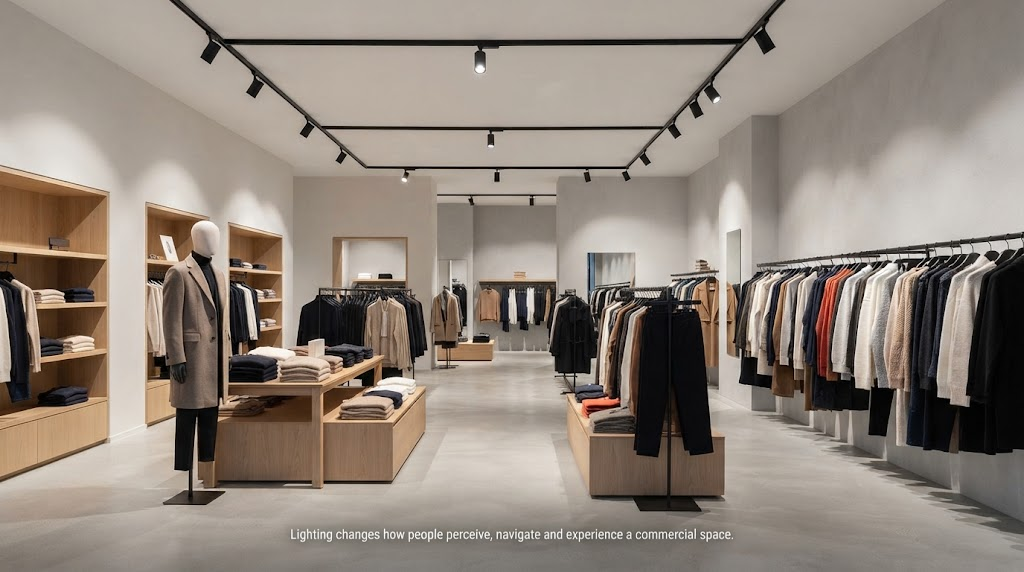
Lighting changes the way people read a space.
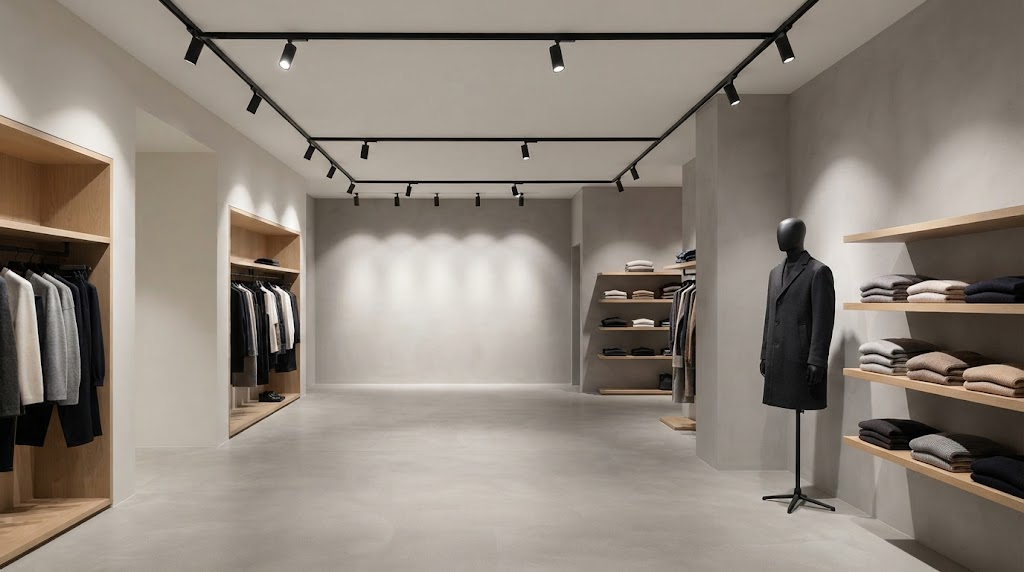
A store with flat, uniform illumination can make every display compete for attention. A store with carefully controlled contrast can make the entrance feel different from the main sales floor and a featured product feel more important than the surrounding merchandise.
The same principle applies outside retail.
In an office, lighting needs to support work without creating distracting reflections or glare. In a restaurant, the light may need to create a more intimate atmosphere while still allowing customers to see their food clearly. In a showroom, lighting has to reveal materials, colours and details.
So the starting point should not be:
“Which light fixture should we use?”
It should be:
“What needs to happen in this space?”
That question usually leads to a better lighting solution.
The Three Layers That Build a Good Commercial Lighting Scheme
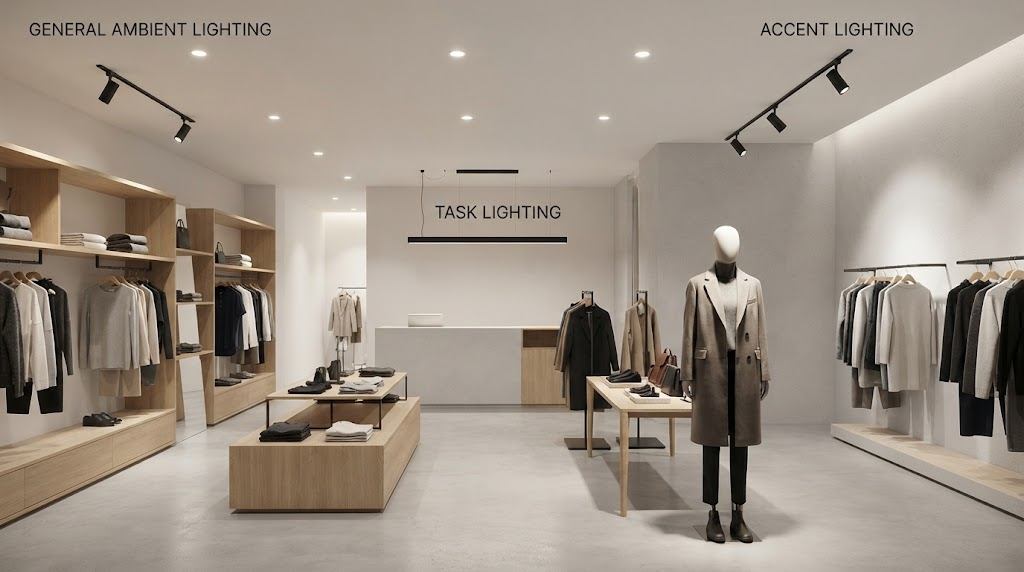
Most commercial interiors benefit from several types of light working together.
General Lighting: The Base Layer
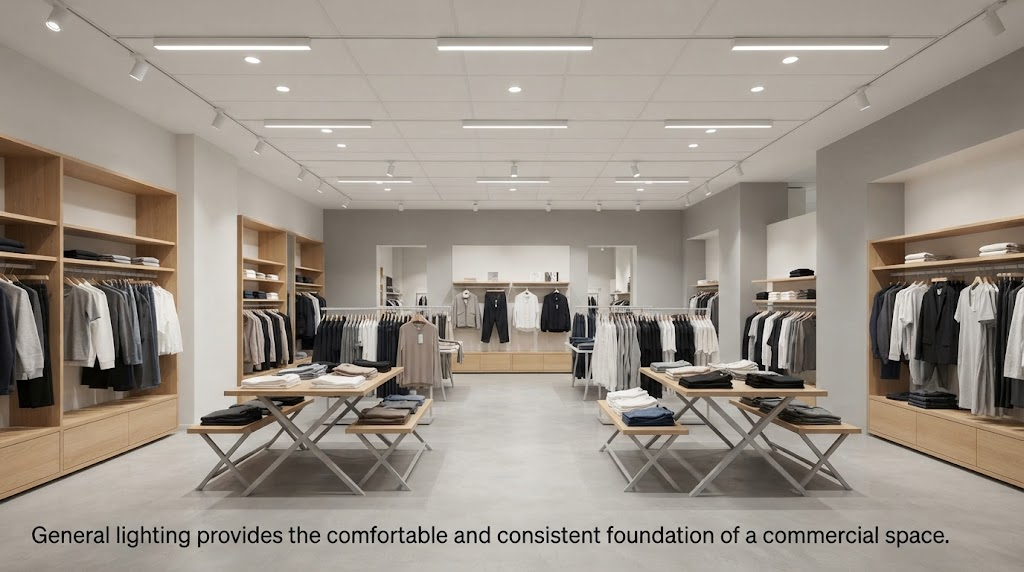
General lighting provides the basic visibility of the space.
It allows customers and staff to move around comfortably and gives the interior a consistent visual foundation.
Typical solutions include:
- LED downlights
- Linear luminaires
- Surface-mounted fixtures
- Suspended systems
- Wide-beam track lights
General lighting does not have to be the brightest element in the room. Its job is to establish the background against which other lighting can work.
Task Lighting: Light for Specific Activities
Task lighting is more focused.
A checkout counter, reception desk, workstation or service area may need more controlled illumination than the surrounding space.
The purpose is straightforward: provide enough light for the activity without unnecessarily increasing the lighting level everywhere else.
This is particularly useful in large commercial interiors where different zones have very different functions.
Accent Lighting: Light That Creates Focus
Accent lighting is where directional light becomes especially useful.
Spotlights can be aimed at:
- Mannequins
- Feature products
- Shelving
- Artwork
- Display tables
- Architectural details
- Feature walls
The objective is not simply to make these objects brighter.
It is to create a visual hierarchy.
When everything is highlighted, nothing is highlighted.
Why Contrast Is More Important Than Simply Adding More Light
A brighter store is not automatically a better-lit store.
Human vision naturally responds to differences in brightness. This is why a product displayed against a slightly darker background can attract more attention than the same product under uniformly high illumination.
Retail lighting guides commonly describe this as a layered approach, where ambient light provides the base and accent lighting creates contrast around merchandise and displays.
The practical lesson is simple:
Use light to create hierarchy, not just brightness.
A display area may need stronger directional light, while the surrounding circulation space can remain more restrained.
This approach can also help reduce unnecessary energy use because not every square metre needs to operate at the same lighting level.
How Should Lighting Be Planned in a Retail Store?
A retail store is easier to light when it is divided into zones.
Consider the entrance, sales floor, display areas, fitting rooms, checkout and circulation routes separately.
Each area has a different job.
| Area | Main Lighting Requirement |
|---|---|
| Entrance | Create a clear and inviting first impression |
| Sales floor | Comfortable general visibility |
| Feature display | Stronger visual emphasis |
| Shelving | Good vertical illumination |
| Fitting room | Accurate and comfortable facial and product lighting |
| Checkout | Clear task lighting with controlled glare |
| Circulation | Easy orientation and movement |
This approach prevents the ceiling layout from becoming the starting point of the design.
Instead, the customer journey becomes the starting point.
Why Vertical Lighting Matters in Retail
One area that is often overlooked is the wall.
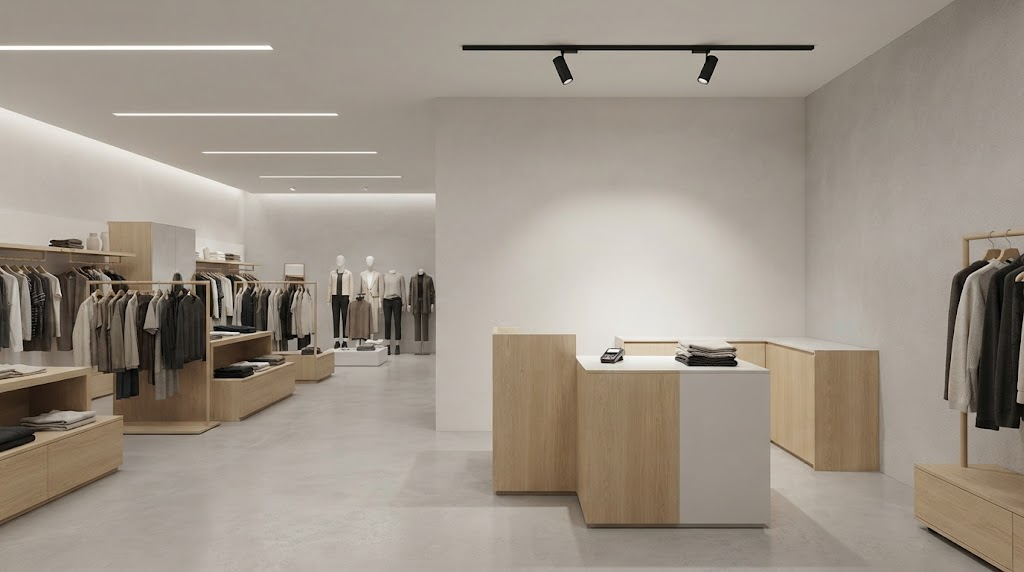
A store may have plenty of light on the floor while the vertical surfaces remain relatively dark. The result can make the space feel smaller and leave merchandise on wall displays without enough visual emphasis.
Wall washing and vertical illumination can help define the perimeter of a store, improve visual orientation and make display areas more noticeable.
This is particularly relevant for:
- Clothing stores
- Shoe stores
- Furniture showrooms
- Cosmetics stores
- Supermarkets
- Galleries
For many retail environments, lighting the walls properly can be just as important as lighting the floor.
How Do You Choose the Right Track Lighting?
Track lighting works well when the space needs flexibility.
A track system allows multiple fixtures to share the same electrical track while individual luminaires can be adjusted to different targets.
This is useful when:
- Product displays change frequently
- Store layouts are flexible
- Seasonal collections need different emphasis
- Feature areas move
- The same space has multiple lighting scenes
But track lighting should not be selected simply because it is flexible.
The optical performance matters just as much.
When choosing a track spotlight, look at:
- Beam angle
- Light output
- Colour rendering
- Glare control
- Adjustment range
- Mounting height
- Target distance
- Driver performance
- Track compatibility
A technically good spotlight can still perform badly if its beam is unsuitable for the distance or object being illuminated.
How Does Beam Angle Affect Retail Lighting?
Beam angle determines how widely light spreads from the luminaire.
A narrow beam creates a concentrated pool of light. A wider beam covers a larger area.
For example:
Narrow beams can work well for individual products, mannequins or architectural details.
Medium beams can suit display tables, shelving and defined merchandise zones.
Wide beams are generally more appropriate when a larger area needs relatively even illumination.
There is no universal “best” beam angle.
A 15° spotlight may work beautifully on a small feature from a suitable distance but be completely inappropriate for a large display wall. Conversely, a wide beam may illuminate a wall effectively but fail to create enough emphasis on a small product.
Beam angle should always be considered together with mounting height and target distance.
What Colour Temperature Should Commercial Lighting Use?
Colour temperature influences the visual character of a space.
Warm light can create a relaxed and intimate atmosphere. Neutral light can feel clean and contemporary. Cooler light can produce a crisp, energetic appearance.
Common commercial applications often fall somewhere between approximately 3000K and 4000K, but the right choice depends on the project.
For example:
- 3000K: often suits hospitality, premium retail and warmer interiors.
- 3500K: provides a balanced warm-neutral appearance.
- 4000K: offers a clean, neutral appearance and is often suitable for contemporary retail and professional spaces.
The important thing is not to choose a colour temperature simply because it is popular.
Look at the materials first.
Wood, stone, metal, fabrics, skin tones and product colours can all respond differently to light.
Colour Rendering Can Matter More Than Colour Temperature
Two luminaires can both be labelled 4000K and still make products look noticeably different.
That is because colour temperature does not describe the quality of colour rendering.
For retail applications, consider:
- CRI
- R9
- Spectral distribution
- Consistency between luminaires
This becomes particularly important in fashion, cosmetics, food, jewellery and other product categories where colour perception affects the customer experience.
For a clothing store, for example, accurate colour rendering helps fabrics and garments appear closer to their actual colours under natural viewing conditions.
A good specification should therefore ask two separate questions:
How warm or cool should the light look?
and
How accurately should the light reproduce colour?
They are not the same thing.
How Can Commercial Lighting Reduce Energy Use?
Energy efficiency does not start with choosing the lowest-wattage fixture.
It starts with avoiding unnecessary light.
A well-designed system can reduce energy demand by combining efficient LED luminaires with:
- Appropriate lighting levels
- Independent lighting zones
- Dimming
- Occupancy sensors where suitable
- Daylight response
- Scheduled operation
- Efficient optical distribution
For example, if a feature display needs stronger illumination but the surrounding circulation area does not, there is little reason to increase the output of every luminaire.
This is one of the advantages of a layered lighting approach: each light source has a clear job.
Should Commercial Lighting Use Smart Controls?
Smart controls can be useful, but they should solve a real problem.
A retail store may need different scenes for opening hours, cleaning, events or seasonal displays. An office may need different settings depending on occupancy and daylight. A hotel may require separate scenes for different areas and operating periods.
Useful control functions can include:
- Dimming
- Scene selection
- Scheduling
- Occupancy detection
- Daylight response
- Zone control
The system should remain simple enough for staff to operate.
A complicated control system that nobody uses effectively adds complexity without adding much value.
What Changes When the Ceiling Is High?
High ceilings change the relationship between the light source and the illuminated surface.
As the distance increases, light distribution, output and beam control become more important.
A lighting designer should therefore consider:
- Ceiling height
- Mounting position
- Distance to the target
- Beam angle
- Light output
- Glare
- Maintenance access
This is particularly important in showrooms, large fashion stores, department stores and other commercial interiors with high ceilings.
A spotlight that works well at three metres may not deliver the same visual result at six metres.
The fixture should always be evaluated in relation to the actual installation height.
How Early Should Lighting Be Considered?
Ideally, lighting should be discussed during the early design stage.
Waiting until the ceiling plan is finished can create unnecessary compromises.
Early coordination allows the project team to consider:
- Ceiling structure
- Electrical infrastructure
- Track positions
- Fixture locations
- HVAC coordination
- Display layouts
- Emergency lighting
- Lighting controls
- Maintenance access
It also gives the lighting designer enough freedom to place light where it matters rather than simply filling the available ceiling positions.
Good lighting is easier to achieve when it is part of the interior design from the beginning.
Common Commercial Lighting Mistakes
Making the Whole Space Equally Bright
This often produces a flat environment with little visual hierarchy.
Using Too Many Spotlights
More spotlights do not automatically mean better product presentation. Poorly positioned fixtures can create glare, excessive contrast or unwanted shadows.
Ignoring the Walls
Lighting only the floor can leave merchandise and architectural surfaces visually weak.
Choosing Colour Temperature by Habit
A standard 3000K or 4000K specification may not suit every project.
Looking Only at Wattage
Wattage tells you how much electrical power a fixture uses. It does not tell you how effectively that fixture delivers useful light to the target.
Forgetting Maintenance
A lighting system that is difficult to access, clean or replace can become expensive over its lifetime.
Treating Every Zone the Same
A checkout counter, fitting room, product display and circulation aisle have different lighting requirements.
A Better Way to Think About Commercial Lighting
Instead of asking:
“How many lights do we need?”
ask:
“Where does the project need light, and what should each light achieve?”
That small change in thinking can completely change the lighting design.
A good commercial lighting scheme should answer five basic questions:
Where should people be able to see clearly?
Which products or architectural elements deserve attention?
Where does the space need stronger or softer light?
How should the lighting change throughout the day?
How can the system remain efficient and flexible over time?
Once these questions are answered, selecting luminaires becomes much easier.
Commercial Lighting FAQ
What is the best lighting for a commercial space?
There is no single fixture that works for every commercial space. A strong solution normally combines general lighting for overall visibility, task lighting for functional areas and accent lighting for products or architectural features.
Is track lighting suitable for retail stores?
Yes. Track lighting is particularly useful where displays change regularly or where individual products need directional illumination. Its value comes from flexibility, but the beam angle, output, glare control and colour quality still need to match the project.
What colour temperature is best for retail?
There is no universal answer. Around 3000K creates a warmer atmosphere, while 3500K–4000K generally produces a more neutral appearance. The decision should be based on the store concept, materials and products.
What CRI should retail lighting have?
A higher CRI is generally preferred when accurate product colour matters. Fashion, cosmetics, food and other colour-sensitive retail environments should pay particular attention to colour rendering rather than specifying only by colour temperature.
How do you reduce energy use in commercial lighting?
Start by providing light where it is needed instead of increasing illumination everywhere. Efficient LED luminaires, zoning, dimming, occupancy control and daylight response can then further reduce energy use.
Why is accent lighting important?
Accent lighting creates visual focus. It can make selected products, displays or architectural features stand out from their surroundings and give the interior more depth.
Does a brighter store sell better?
Not necessarily. Excessive brightness can create glare and flatten the visual hierarchy. Effective retail lighting is about the relationship between brightness, contrast, colour and focus rather than maximum light output.
When should lighting be planned in a commercial project?
As early as possible. Early planning allows lighting positions, ceiling systems, electrical infrastructure, displays, controls and maintenance requirements to be coordinated before construction decisions become difficult or expensive to change.
Final Takeaway
Commercial lighting works best when every light has a reason to be there.
General lighting provides the foundation. Task lighting supports specific activities. Accent lighting creates focus. Wall and vertical lighting can strengthen the architecture and merchandise presentation. Controls add flexibility, while good optical performance keeps the system comfortable and efficient.
The goal is not to make every part of a commercial space equally bright.
The goal is to give every part of the space the right light for its purpose.
That is what turns a collection of luminaires into a lighting design.