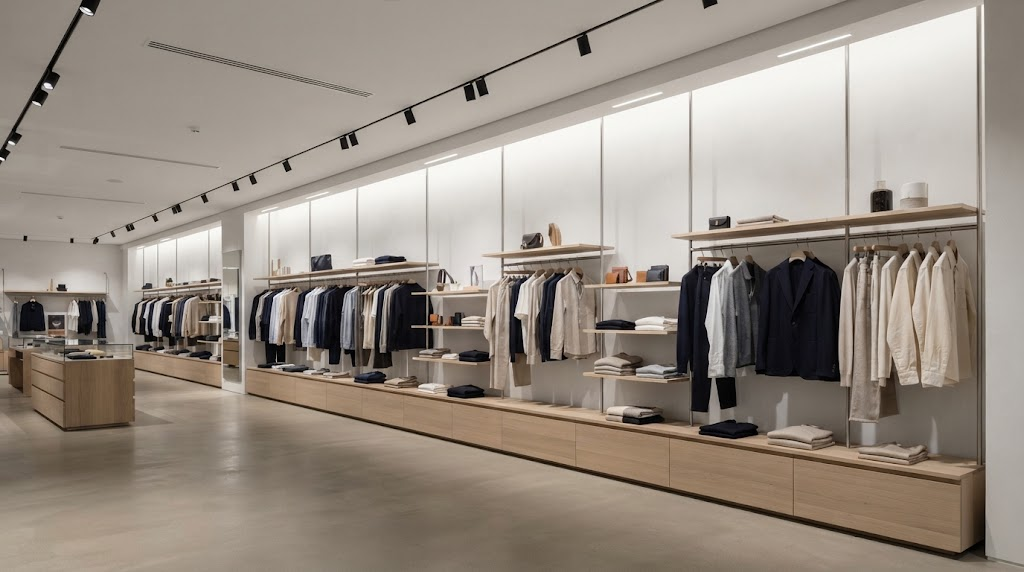
Good retail lighting should make products easier to see, create visual comfort and support the store’s atmosphere without becoming the main visual focus. The best lighting works quietly in the background, guiding attention while allowing products, materials and architecture to take the lead.
When lighting is working properly, customers rarely stop to think about it.
They experience the atmosphere.
They notice the products.
They feel comfortable moving through the space.
That is exactly what good store lighting should do.
Retail lighting is not about putting as many luminaires as possible into a ceiling or making the space uniformly bright. It is about deciding where light is needed, where attention should go and how the lighting should work with the architecture and merchandise.
When light becomes part of the store rather than something added to it, the result is usually more natural, more comfortable and more effective.
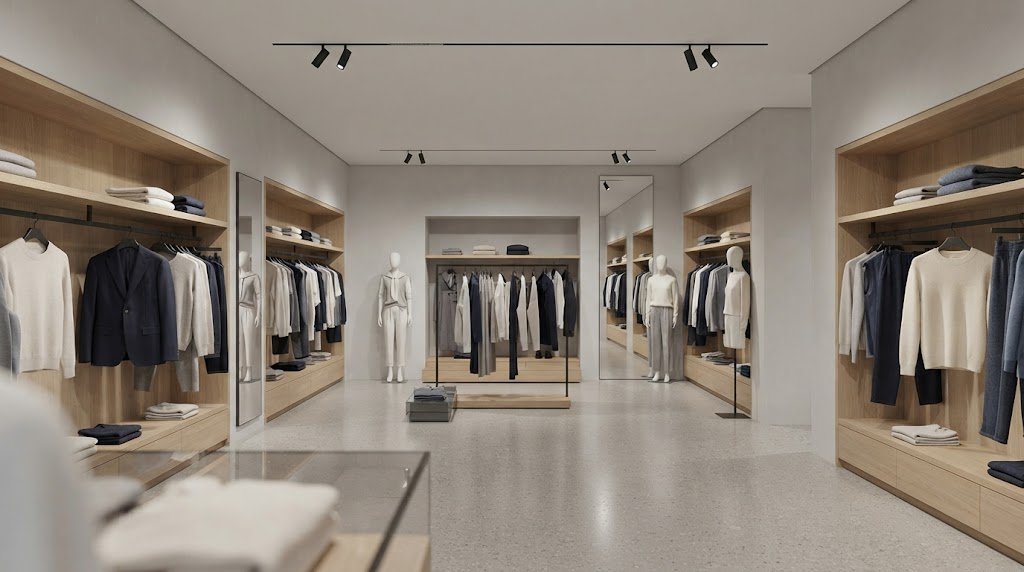
What Makes Good Retail Lighting?
Good retail lighting combines comfortable general illumination with controlled accent lighting, appropriate colour rendering, glare control and a clear visual hierarchy.
A retail store rarely needs one type of light doing everything.
General lighting provides enough illumination for customers and staff to move around comfortably. Accent lighting gives selected products or displays more visual importance. Vertical lighting helps shelves, walls and merchandise remain visible. Decorative lighting can then add character where the interior design calls for it.
The important part is how these layers work together.
A well-designed store does not need every surface to have the same brightness. Instead, light creates subtle differences that help customers understand the space.
The lighting should answer a simple question:
What do you want people to notice first?
Lighting Should Support the Store, Not Compete With It
A lighting fixture can look impressive on its own and still be the wrong choice for a retail environment.
If large numbers of visible luminaires, harsh light sources or uncontrolled beams dominate the ceiling, customers may become more aware of the lighting system than the products. In a fashion store, boutique or lifestyle shop, that can weaken the overall design.
The better approach is to make the lighting feel connected to the space.
Track systems, downlights, wallwashers and other luminaires should follow the logic of the architecture. Their position, appearance and light distribution should support the layout rather than fight against it.
This becomes especially important in stores where materials and finishes are part of the experience. Wood, stone, textiles, metal and glass all respond differently to light.
Good lighting allows those materials to speak for themselves.
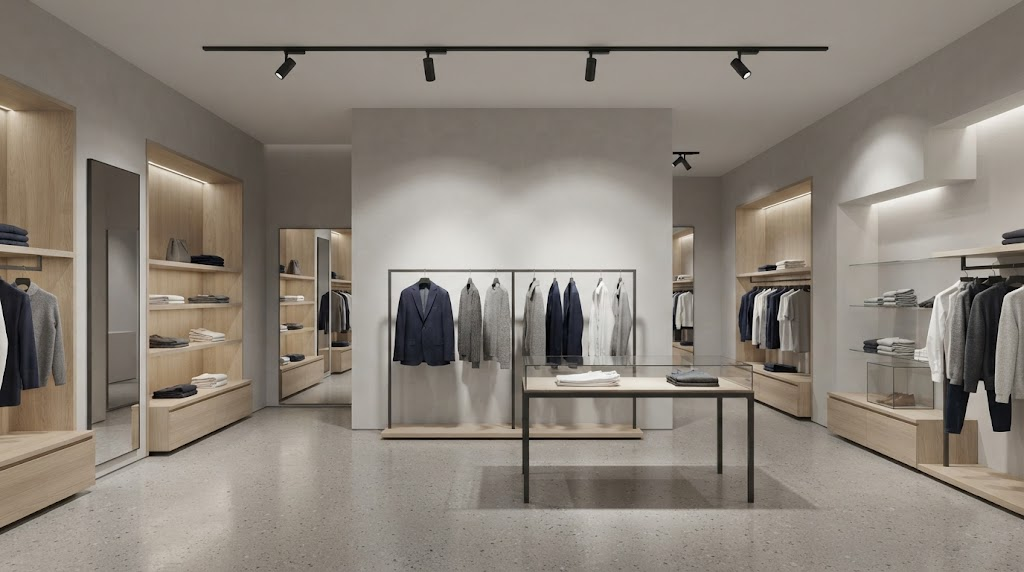
Create a Visual Hierarchy With Light
Retail lighting should not make everything equally important. It should create a visual hierarchy that naturally directs attention toward products, displays and key areas.
A practical retail lighting scheme often contains several layers.
General Lighting
General or ambient lighting provides the basic level of illumination throughout the store.
It helps customers see the floor, circulation routes and surrounding environment without making the space feel overly bright.
Recessed downlights, surface-mounted fixtures and linear lighting systems can all be used for this purpose, depending on the architecture.
Accent Lighting
Accent lighting gives specific products or displays more attention.
A track spotlight aimed at a mannequin, product table or feature display can create a stronger focal point without increasing the brightness of the entire store.
This is where precise optics become important.
Vertical Lighting
Walls and displays should not be treated as an afterthought.
Wallwashing and other forms of vertical illumination can make merchandise easier to see and help prevent the store from feeling visually dark, even when the floor itself is adequately illuminated.
Decorative Lighting
Decorative fixtures can contribute to the character of a store, particularly in hospitality-inspired retail, premium boutiques and lifestyle environments.
But decorative light should have a clear role. It should add to the concept rather than compete with the merchandise.
Together, these layers give the store depth and make the lighting feel intentional.
Why Uniform Brightness Is Not Always Better
A uniformly bright store is not necessarily a well-lit store.
If every area receives roughly the same visual emphasis, the space can feel flat. Customers have fewer clues about where to look, while important displays may not stand out.
Retail lighting works better when brightness is used selectively.
A featured product can receive more focused light than the surrounding area. A display wall can be brighter than a circulation zone. A new collection can receive stronger accent lighting than a secondary display.
The difference does not need to be dramatic.
Good lighting often works through relatively subtle changes in brightness, direction and contrast.
The customer may never consciously notice the lighting strategy. They simply notice that the store feels easier to understand.
How Accent Lighting Helps Products Stand Out
Accent lighting makes products more noticeable by creating controlled contrast between the merchandise and its surroundings.
This is one of the reasons track lighting remains popular in retail.
The advantage of a track spotlight is not simply that it produces a lot of light. It can be aimed where the light is actually needed.
A narrow beam can create a focused highlight on a particular product or display object. A medium beam can cover a shelving section or merchandise table. A wider beam can provide softer coverage across a larger area.
The right beam angle depends on the application.
Important factors include:
- Mounting height
- Distance between the luminaire and target
- Size of the display
- Product arrangement
- Desired contrast
- Surface reflectance
- Position of the customer
A 15° beam, for example, behaves very differently from a 36° beam at the same mounting height. Choosing between them should therefore be part of the lighting design rather than simply a product selection exercise.
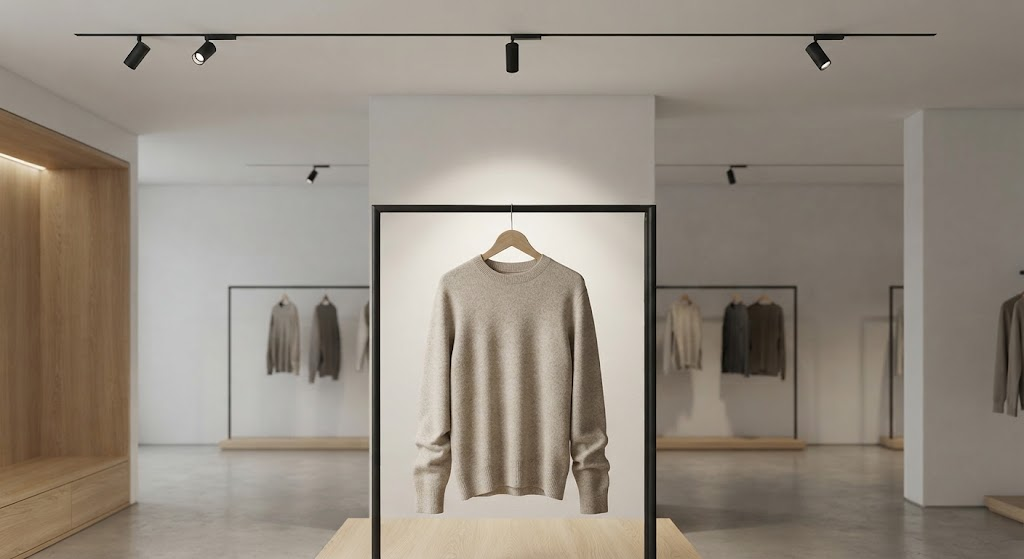
Glare Control Is Essential for Customer Comfort
A bright retail store can still feel uncomfortable if the light sources create excessive glare.
Glare depends on more than luminaire brightness. The position of the light source, its luminance, the viewing angle and the brightness of surrounding surfaces all affect how comfortable the space feels.
UGR, or Unified Glare Rating, is one established method used in lighting design to assess discomfort glare. It is useful as part of a broader assessment rather than as a standalone measure of lighting quality.
In a retail environment, glare control can involve:
- Appropriate luminaire positioning
- Controlled beam angles
- Shielding or anti-glare accessories
- Recessed light sources
- Suitable mounting locations
- Balanced brightness across the space
The practical test is straightforward:
Can customers comfortably look around the store without repeatedly seeing harsh or distracting light sources?
If the answer is no, increasing or decreasing overall brightness will not necessarily solve the problem. The optical design and positioning may need to change.
Colour Rendering and Colour Temperature in Retail
Retail lighting should reproduce merchandise colours and materials naturally while using a colour temperature that fits the store concept.
Colour rendering matters because customers judge many products visually.
Clothing, cosmetics, furniture, food, jewellery and interior products can all look different depending on the light source.
CRI is commonly used to describe colour rendering performance, but a high CRI value alone does not guarantee that every material will look exactly as expected. The spectral characteristics of the light source and the product itself also matter.
For demanding retail projects, checking real products under the proposed lighting can be more useful than relying only on specification sheets.
Colour temperature also affects the character of the store.
Around 2700–3000K
A warmer appearance can create an intimate and relaxed atmosphere and may work well with premium interiors, hospitality-inspired retail and natural materials.
Around 3000–3500K
This range can provide a balance between warmth and visual clarity and is often considered for fashion and lifestyle environments.
Around 4000K
A more neutral appearance can support a clean, contemporary environment where visual clarity is important.
There is no universal “best” colour temperature for retail.
The right choice depends on the brand identity, architecture, merchandise and desired atmosphere.
Consistency is equally important. If different colour temperatures are used within one store, the transition should be intentional rather than accidental.
Why Vertical Lighting Matters in Retail Stores
Customers do not experience a store by looking only at the floor, so lighting walls, shelves and displays is an important part of retail lighting design.
This is often overlooked.
A store can have an acceptable level of horizontal illumination and still feel visually dull if the walls and merchandise remain dark.
Vertical illumination can help:
- Make merchandise easier to see
- Increase the visual presence of displays
- Create a stronger sense of depth
- Improve the perceived brightness of the space
- Support the rhythm of the interior
- Draw attention toward important display areas
This is particularly useful in fashion stores and boutiques, where much of the merchandise is displayed vertically on rails, shelving or wall-mounted systems.
Instead of simply asking how much light reaches the floor, lighting designers should also consider how the customer sees the merchandise.
Flexible Lighting for Changing Retail Displays
A retail lighting system should be able to adapt when products, displays and layouts change.
Retail interiors are rarely static.
A new season brings new products. Shelving moves. Promotional displays appear and disappear. Store layouts are updated.
This is where adjustable track lighting can provide a practical advantage.
Individual spotlights can be repositioned or re-aimed without changing the complete lighting installation. The same track system can therefore support different merchandising arrangements over time.
Flexibility also has a financial benefit.
A lighting system that can adapt to future layouts may reduce the need for frequent changes to the physical installation.
For retailers, this can be just as important as the initial lighting performance.
Smart Lighting and Lighting Controls
Lighting controls can make a retail lighting system more flexible by allowing different lighting levels, scenes and operating schedules without changing the physical installation.
The technology should serve a purpose.
For larger or more flexible projects, systems such as DALI-2 can support individual or grouped dimming, scene setting and scheduling.
This can be useful for different operating conditions, such as:
- Normal trading hours
- Cleaning
- Stock replenishment
- Events
- Seasonal displays
- Different daylight conditions
The best control system is not necessarily the one with the most features.
It is the one that gives the retailer useful control without making everyday operation unnecessarily complicated.
Energy Efficiency Without Sacrificing Visual Quality
Energy-efficient retail lighting is not simply about choosing a low-wattage luminaire. It is about delivering the right amount of useful light where it is needed.
A lighting system’s energy performance depends on several factors, including luminaire efficacy, installed lighting power, operating hours, dimming, controls and daylight availability.
Optical efficiency also matters.
If a spotlight sends useful light directly onto a product, less light may be needed in surrounding areas to achieve the same visual effect.
This is why precise lighting design can contribute to both visual quality and energy efficiency.
The better question is not:
“How many watts does the luminaire use?”
It is:
“How effectively does the system use energy to create the required visual result?”
For retailers, this approach can help balance operating costs, product presentation and customer comfort.
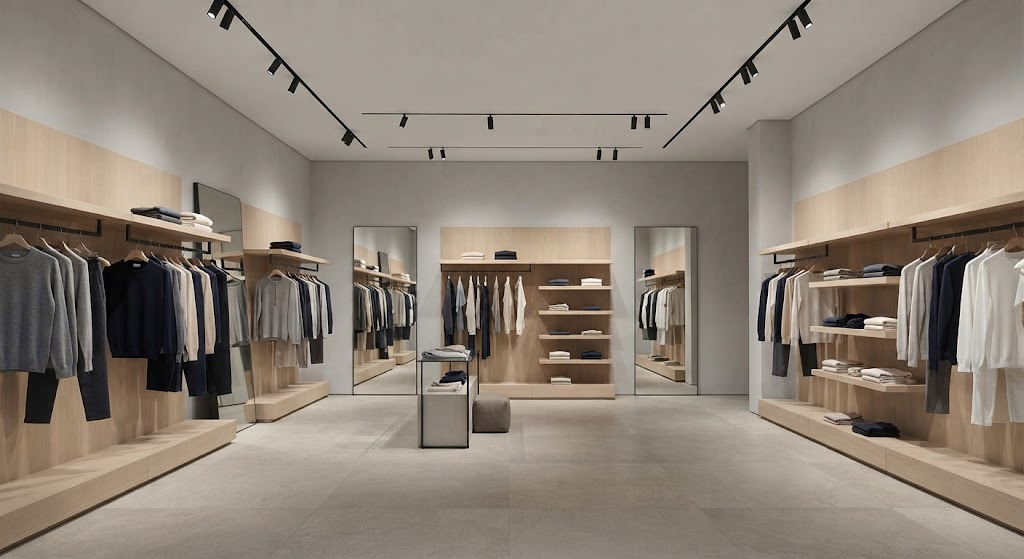
A Practical Retail Lighting Checklist
Before selecting luminaires or finalising a retail lighting layout, consider these questions:
- What products should customers notice first?
- Where should the main visual focus be?
- Is the general lighting comfortable for customers and staff?
- Are shelves, walls and displays sufficiently visible?
- Is glare controlled from typical customer viewpoints?
- Does the colour rendering suit the merchandise?
- Does the colour temperature fit the store’s identity?
- Are beam angles appropriate for the display distances and sizes?
- Can the lighting adapt when merchandise changes?
- Would dimming or lighting controls provide a practical benefit?
- Is the installed lighting power appropriate for the intended result?
- Can the lighting system continue to support the store as the layout evolves?
These questions often provide a better starting point than simply comparing lumen output or wattage between luminaires.
What Should Good Retail Lighting Ultimately Achieve?
The best retail lighting makes the store work better without making the lighting itself the centre of attention.
Customers remember the products.
They remember the materials.
They remember the atmosphere.
They remember how the space felt.
They rarely remember how many spotlights were installed in the ceiling.
That is not a weakness of good lighting.
It is the point.
When lighting becomes an integral part of the store’s design, it can quietly guide attention, reveal products, support architecture and create visual comfort.
The lighting does its job without asking to be noticed.
Good store lighting should not steal the attention. It should direct attention.
FAQ: Retail Lighting Design
Good retail lighting provides comfortable visibility, highlights important products, controls glare and creates a clear visual hierarchy while remaining integrated with the store’s architecture and design.
A retail store is usually best served by a combination of general lighting, accent lighting and vertical illumination. The balance depends on the store layout, merchandise, ceiling height, architecture and desired atmosphere.
Not necessarily. Excessive brightness can increase glare and reduce visual hierarchy. Effective retail lighting uses brightness and contrast selectively so that important products and displays receive appropriate attention.
There is no single lighting solution for every clothing store. A combination of comfortable ambient lighting, adjustable accent lighting, suitable colour rendering and controlled glare generally provides a strong foundation.
Yes. Track lighting is particularly useful when merchandise and displays change frequently because individual spotlights can be aimed and repositioned. The final result depends on the optics, beam angle, glare control and overall lighting layout.
There is no single best beam angle. Narrow beams are useful for focused product highlights, medium beams for shelves and displays, and wider beams for broader coverage. The correct choice depends on mounting height, target size and lighting distance.
There is no universal answer. Warm white around 2700–3000K can create a more intimate atmosphere, 3000–3500K can provide a balanced appearance, while around 4000K can offer a cleaner and more neutral visual environment. The choice should match the merchandise, architecture and store identity.
Vertical lighting helps customers see walls, shelves and merchandise more clearly. It can also improve visual depth and make a retail environment feel brighter and more balanced.
Glare can be reduced through appropriate luminaire positioning, controlled optics, shielding, suitable beam angles and balanced brightness throughout the customer’s field of view. Glare assessment methods such as UGR can also form part of the lighting design process.
Retail lighting can reduce energy use through efficient LED luminaires, accurate optical distribution, appropriate lighting levels, dimming, scheduling, daylight response and effective lighting controls. The objective is to avoid wasting light where it does not contribute to the customer experience.
Not every store needs advanced controls. Smart lighting becomes more useful when the store has changing layouts, different operating conditions, daylight variations or a need for scheduled and scene-based lighting.
The most important principle is simple: use light to support the products and the customer experience rather than making the lighting itself the focus. A successful retail lighting design creates visibility, comfort, hierarchy and atmosphere while fitting naturally into the architecture.