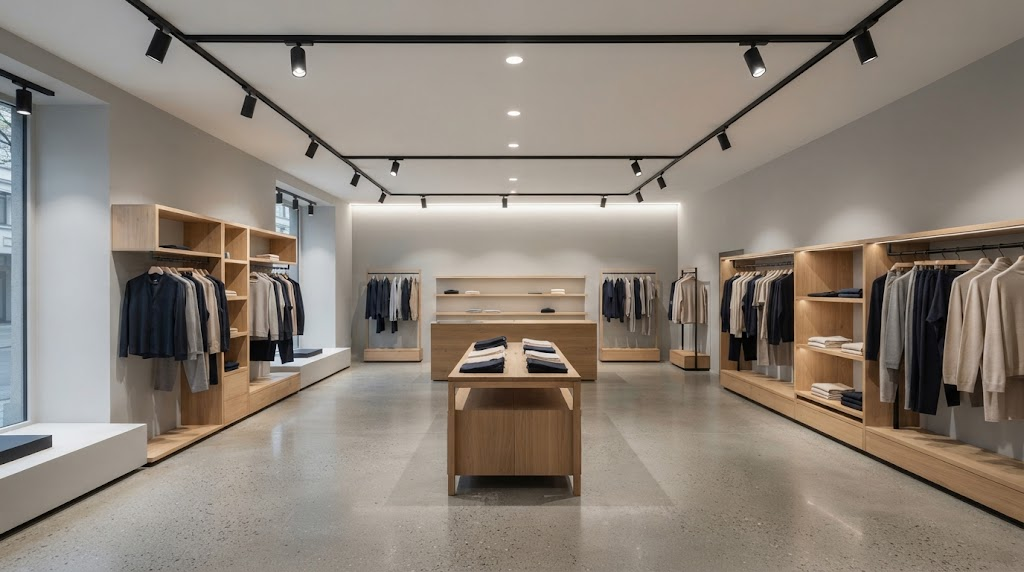
DALI-2 gives retail lighting individual control, dimming, zoning and monitoring. Combined with occupancy and daylight sensing, it can reduce unnecessary lighting while allowing stores to create scenes, manage different areas and adapt lighting to changing retail conditions.
What Is DALI-2 in Retail Lighting?
DALI-2 is a digital lighting control system based on the international DALI standard.
Unlike a simple on/off circuit, DALI-2 allows compatible luminaires and control devices to communicate through a digital lighting network. Depending on the system configuration, individual luminaires or groups can be addressed, dimmed and assigned to different lighting scenes.
For retail, that matters because a store is rarely one uniform space.
A typical sales floor may contain:
- General circulation lighting
- Product displays
- Feature walls
- Window displays
- Fitting rooms
- Checkout areas
- Promotional zones
- Back-of-house areas
These areas do not always need the same lighting level at the same time.
DALI-2 makes it possible to control them separately rather than treating the entire store as one lighting circuit.
Why Is DALI-2 Useful for Retail Stores?
Retail lighting has two competing requirements.
The store needs enough light to present products properly, but it does not need every luminaire operating at full output all day.
DALI-2 can provide the control layer needed to manage that difference.
Depending on the installation, a DALI-2 system can support:
- Individual luminaire control
- Group control
- Dimming
- Scene setting
- Scheduling
- Occupancy-based control
- Daylight-responsive control
- Monitoring
- Energy-related data
- Fault or device information
Professional DALI-based systems are designed around interoperability and expandable digital control rather than a single fixed lighting arrangement.
For a retailer with several lighting zones, this flexibility can be more valuable than simply having a higher-performance LED fitting.
DALI-2 vs Conventional Lighting Control
The difference becomes clearer when comparing the control methods.
| Function | Conventional switching | 0–10 V dimming | DALI-2 |
|---|---|---|---|
| On / off | Yes | Yes | Yes |
| Dimming | Limited / no | Yes | Yes |
| Individual addressing | No | Usually limited | Yes |
| Group control | Circuit-based | Circuit-based | Configurable |
| Lighting scenes | Limited | Possible | Yes |
| Scheduling | External system | External system | System dependent |
| Occupancy control | External | External | Supported with compatible devices |
| Daylight response | External | External | Supported |
| Device information | Limited | Limited | Available with compatible equipment |
| System expansion | Limited | Moderate | High |
The important distinction is addressability.
With conventional switching, the electrician mainly determines which fixtures belong to the same circuit.
With a digital system, the control structure can be configured after the luminaires are installed.
That is particularly useful when retail layouts change.
How Does DALI-2 Control Track Spotlights?
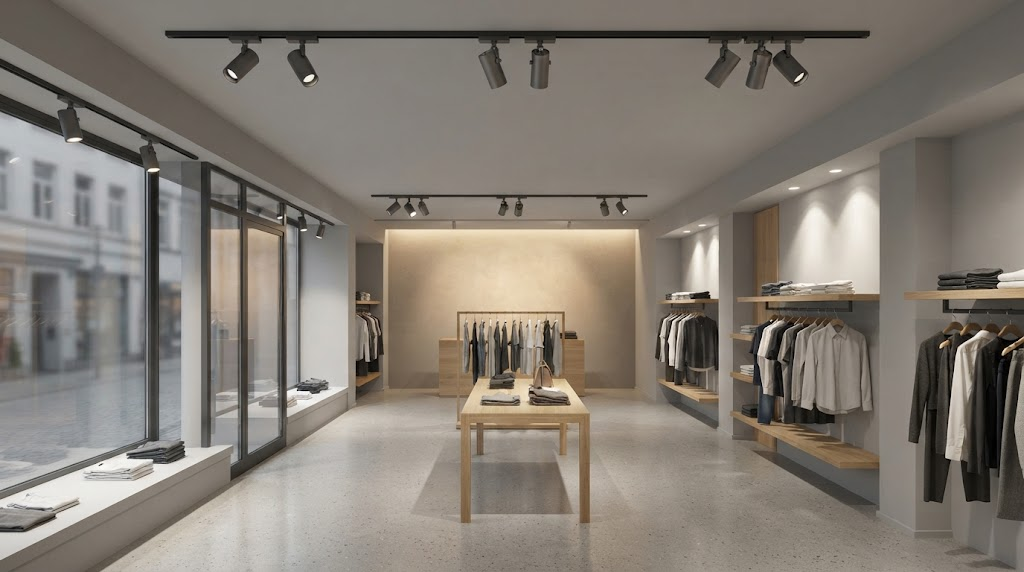
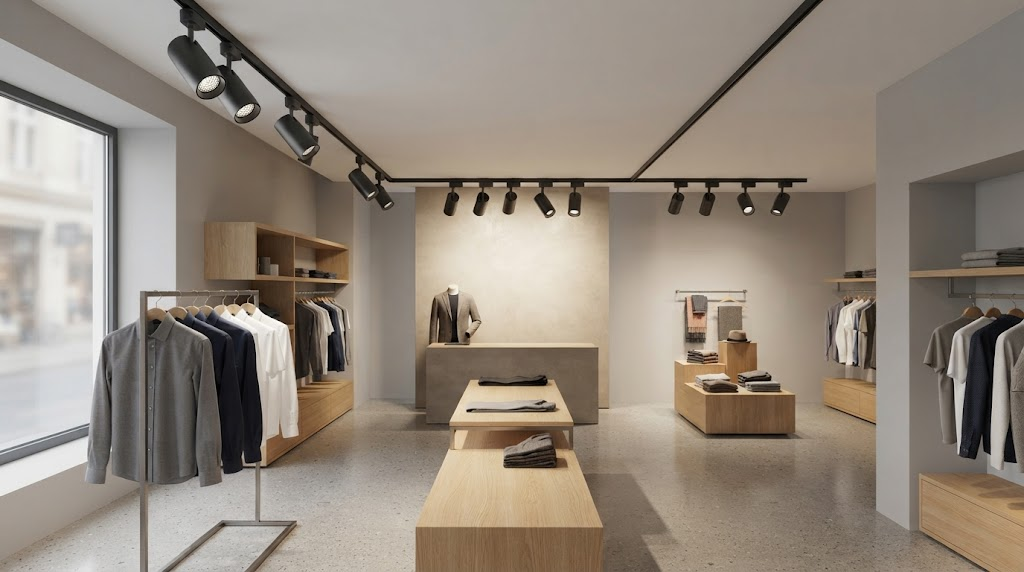
Track lighting is a natural application for digital control because different spotlights often serve different purposes.
For example:
Zone A: general sales-floor lighting
Zone B: feature wall
Zone C: promotional display
Zone D: window display
Zone E: fitting-room area
A DALI-2-compatible system can assign luminaires to different control groups without requiring every group to be physically separated in the same way as a traditional switching installation.
That gives the retailer more freedom to change scenes and operating schedules.
It also works well with adjustable track spotlights because the physical flexibility of the fixture and the digital flexibility of the control system complement each other.
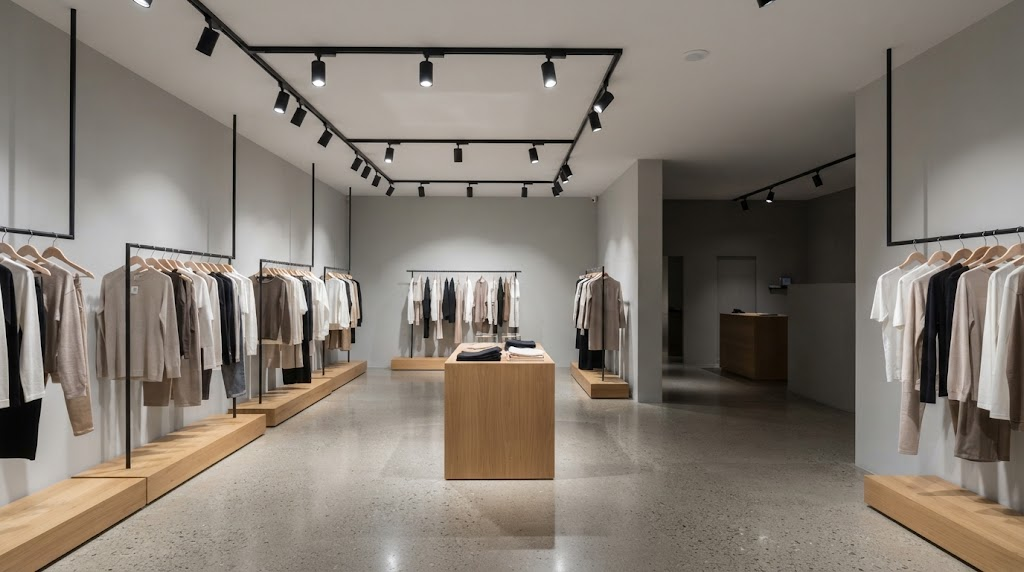
What Can Smart Retail Lighting Actually Do?
“Smart lighting” can mean very different things.
For a retail store, useful functions include:
1. Scheduled lighting
Different lighting levels can be programmed for:
- Opening
- Trading hours
- Evening
- Cleaning
- Night-time
- Security periods
2. Occupancy-based control
Areas that are temporarily unoccupied can be dimmed or switched according to the control strategy.
This can be particularly useful in:
- Storage areas
- Staff rooms
- Back-of-house spaces
- Corridors
- Low-traffic areas
It is usually less appropriate to simply switch the main sales floor off whenever occupancy drops, because retail presentation is part of the customer experience.
3. Daylight-responsive control
Near windows and glazed façades, available daylight can be considered when setting artificial lighting levels.
This can reduce unnecessary output during periods when natural light already contributes significantly to the space.
4. Scene control
A retailer can create different lighting scenes for different situations.
For example:
Normal retail
Balanced general and accent lighting.
Promotion
Higher emphasis on selected displays.
Evening
Lower ambient lighting with stronger product accents.
Cleaning
Higher uniform illumination for staff.
Smart retail control should therefore be designed around the operation of the store, not simply around the technology.
Can DALI-2 Reduce Energy Consumption?
Yes, but DALI-2 itself does not guarantee a specific energy saving percentage.
This distinction is important.
The control protocol provides the ability to manage lighting more precisely.
Actual energy reduction depends on what the system is programmed to do.
For example, energy consumption can be influenced by:
- Operating hours
- Dimming levels
- Occupancy
- Daylight availability
- Lighting power density
- Store opening schedule
- Scene settings
- Control strategy
A store operating all luminaires at 100% throughout opening hours will not suddenly become highly efficient simply because the drivers communicate through DALI-2.
The energy benefit comes from using the control capability effectively.
Professional lighting-control systems commonly combine occupancy detection, daylight response, continuous dimming, scheduling and scene control for this reason.
DALI-2 and Daylight Harvesting
Large retail stores often have substantial glazed façades.
The lighting requirement near the windows can therefore be very different from the requirement in the centre of the store.
A daylight-responsive control strategy can reduce artificial light output when sufficient daylight is available.
A typical arrangement might divide the store into:
Window zone → stronger daylight influence
Middle zone → moderate daylight influence
Interior zone → less daylight influence
The exact zoning should come from the lighting design rather than from an arbitrary number of control groups.
This is where DALI-2 can be useful: the digital control architecture allows the lighting zones to be configured more precisely.
DALI-2 and Occupancy Sensors
Occupancy detection can be useful, but retail stores need a different approach from offices.
In an office, an empty room can often be dimmed substantially.
In a retail store, the lighting may still need to remain active even when the sensor detects fewer people.
The right application is therefore often:
Full lighting → reduced lighting → automatic return
rather than simply:
Occupied → ON / Empty → OFF
This is particularly useful for secondary spaces.
For example:
- Staff areas
- Toilets
- Storage rooms
- Delivery areas
- Corridors
Occupancy and daylight sensors can also be integrated into DALI-based control architectures when compatible devices are used. Recent commercial control systems continue to expand the use of DALI-connected sensors for this type of application.
DALI-2 Lighting Scenes for Retail
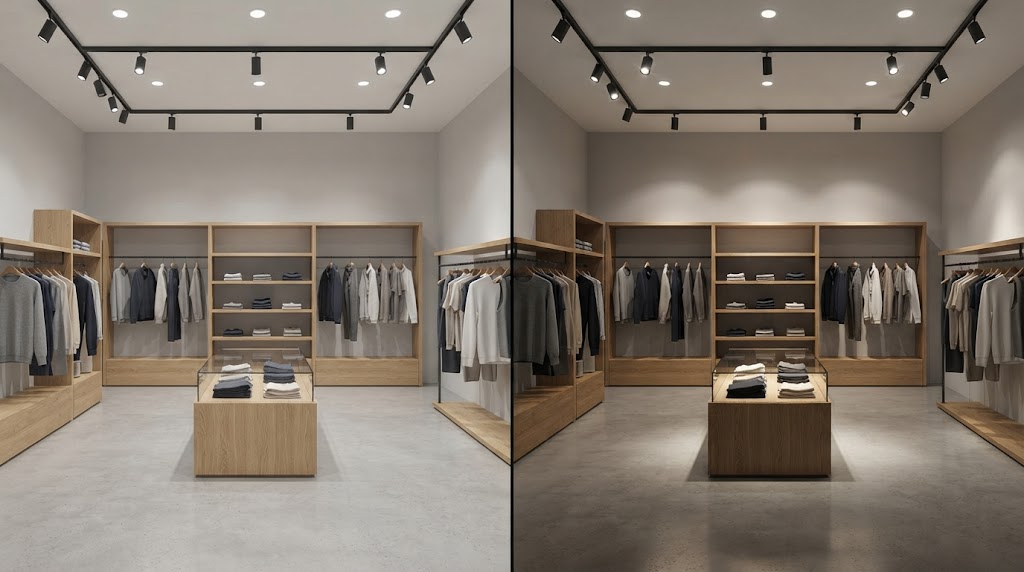
Lighting scenes are one of the more practical smart-control functions for retailers.
A store could have several predefined scenes.
Scene 1 — Standard Trading
Balanced general illumination with normal accent lighting.
Scene 2 — New Collection
Selected track spotlights increase emphasis on a new product area.
Scene 3 — Evening
General illumination is reduced while key displays remain visually strong.
Scene 4 — Cleaning
Higher and more uniform lighting is used during cleaning and maintenance.
Scene 5 — Window Display
The window zone operates independently according to the required schedule.
The exact values should be determined by the lighting designer and retailer.
There is no sensible universal rule such as “set the store to 70%”.
The correct level depends on the space, merchandise, daylight and visual target.
Does DALI-2 Allow Individual Luminaire Control?
Yes, when the luminaires, drivers and control architecture support it.
This is one of the major differences between digital addressable control and simple circuit-based switching.
An individual track spotlight can potentially be assigned to a specific control group or scene.
That makes it easier to create different lighting relationships without physically rewiring every fixture.
For large stores, this can also simplify future changes.
If a promotional display moves, the control configuration can often be changed without rebuilding the entire electrical distribution.
The exact capabilities depend on the DALI-2 components and control system selected.
What Is D4i and How Does It Relate to DALI-2?
D4i extends DALI-2 capabilities for intelligent luminaires and connected devices.
One of the important areas is luminaire data.
Depending on the driver and implementation, D4i can provide information related to:
- Energy data
- Luminaire information
- Diagnostics
- Operating information
- Sensor connectivity
This can become useful for large retail chains where lighting is treated as an asset rather than simply a collection of lamps.
Some current DALI-2/D4i drivers support energy monitoring, diagnostics and auxiliary power for compatible sensors.
For a small store, this level of information may not justify the additional system complexity.
For a multi-site retailer, it can become much more valuable.
DALI-2 for Multi-Store Retail Chains
This is where smart lighting becomes particularly interesting.
A retailer operating one store has one lighting system to manage.
A retailer operating 50 or 500 stores has an asset-management problem.
A connected lighting strategy can potentially provide:
- Consistent lighting scenes
- Centralised configuration
- Energy monitoring
- Fault information
- Remote management
- Standardised commissioning
- Easier updates
Professional connected-lighting platforms already support functions such as energy monitoring, scheduling, scene management and multi-site management.
However, DALI-2 should not automatically be confused with cloud management.
DALI-2 is the lighting-control communication technology.
A higher-level software platform may sit above it.
That distinction is important when comparing smart lighting systems.
Is DALI-2 Suitable for Retail Refurbishment?
Yes.
It can be particularly useful when a retailer wants to improve control without completely changing the architectural layout.
A refurbishment project should first check:
- Existing track system
- Existing drivers
- Luminaire compatibility
- Electrical distribution
- Control wiring
- Sensor requirements
- Emergency lighting
- Existing building-management systems
Not every existing LED fitting can simply be converted to DALI-2.
The driver and control architecture need to support the required functionality.
For a large refurbishment, it is usually worth defining the control strategy before selecting the replacement luminaires.
DALI-2 vs Wireless Smart Lighting
Both wired and wireless approaches can work in retail.
DALI-2 wired control
Advantages:
- Established digital control architecture
- Individual addressing
- Strong suitability for permanent installations
- Good fit for new-build projects
- Suitable for larger structured lighting systems
Wireless control
Advantages:
- Less control cabling
- Useful for refurbishment
- Easier changes in some existing spaces
- Can reduce installation disruption
The choice depends on the project.
A new store with a fully coordinated electrical installation may favour a wired DALI-2 architecture.
An existing shop where opening the ceiling is difficult may benefit from a wireless approach.
Hybrid systems are also possible when compatible equipment is selected.
How Much Energy Can a DALI-2 Retail System Save?
There is no reliable single percentage that applies to every retail store.
Any serious calculation should compare the existing and proposed operating profiles.
For example:
Baseline energy
Lighting power × operating hours
versus
Controlled energy
Lighting power × actual dimming level × operating hours
with adjustments for daylight response, occupancy and scheduling where applicable.
This means a retailer should request an energy model or measured baseline rather than relying on a generic marketing claim.
A lighting-control system can produce substantial operational benefits in the right application, but the result depends on the control strategy.
Does DALI-2 Improve Lighting Quality?
Potentially, yes.
The main benefit is not that DALI-2 makes an LED spotlight produce better light.
The LED module and optics determine the basic light quality.
DALI-2 determines how that light is controlled.
It can therefore improve the consistency and adaptability of the lighting environment.
For example:
- Different zones can operate at appropriate levels.
- Accent lighting can remain active while ambient lighting is reduced.
- Scenes can be reproduced consistently.
- Lighting can respond to changing daylight.
- Future layouts can be reconfigured more easily.
The distinction is important:
Luminaire quality determines the light.
Control quality determines how that light is used.
What Should Be Specified for a DALI-2 Retail Project?
A professional specification should cover more than “DALI-2 compatible”.
Ask for details on:
| Specification | Why it matters |
|---|---|
| DALI-2 compatibility | Confirms digital control capability |
| Driver type | Determines available functions |
| Dimming range | Defines minimum controllable output |
| Control groups | Supports retail zoning |
| Scene control | Supports different store modes |
| Sensor compatibility | Enables occupancy/daylight strategies |
| D4i capability | Useful for data and diagnostics |
| Energy reporting | Supports operational analysis |
| Emergency lighting | Must be coordinated separately |
| BMS integration | Relevant for larger buildings |
| Commissioning | Ensures correct addressing and configuration |
| Documentation | Important for future maintenance |
A statement such as “DALI compatible” is not enough for a detailed specification.
The project should identify the actual control functions required.
DALI-2 Commissioning Matters
Digital lighting systems are only as good as their commissioning.
A retail project should define:
- Luminaire addressing
- Group assignment
- Scene configuration
- Sensor configuration
- Dimming limits
- Time schedules
- Daylight response
- Occupancy logic
- Manual override
- Documentation
The commissioning information should be handed over to the retailer or facility-management team.
This is especially important for stores that change displays regularly.
A well-documented system is much easier to modify later.
Common Mistakes With Smart Retail Lighting
Installing DALI-2 Without a Control Strategy
A digital driver alone does not make a store smart.
Using One Lighting Scene for Everything
Different retail zones have different functions.
Chasing Energy Savings at the Expense of Product Presentation
Retail lighting still has to sell the merchandise.
Installing Sensors Without Considering Store Operation
A sensor strategy designed for an office may not be appropriate for a retail sales floor.
Ignoring Commissioning
Poor addressing or incorrect sensor settings can undermine the entire system.
Assuming DALI-2 Means Cloud Control
DALI-2 provides digital lighting communication. Cloud management requires additional system architecture.
Using Generic Energy-Saving Percentages
Actual savings depend on operating conditions and control settings.
When Does DALI-2 Make Sense for Retail?
DALI-2 is particularly worth considering when the store needs:
- Multiple lighting zones
- Individual luminaire control
- Dimming
- Lighting scenes
- Daylight-responsive control
- Occupancy-based strategies
- Future layout flexibility
- Energy monitoring
- Integration with a wider building-control system
For a small shop with a simple lighting layout and fixed operating schedule, a simpler control system may be more economical.
The system should be specified according to the complexity of the store—not according to how advanced the technology sounds.
DALI-2 Retail Lighting: Quick Comparison
| Requirement | Basic Switching | Dimming | DALI-2 Smart Control |
|---|---|---|---|
| Simple ON/OFF | ✓ | ✓ | ✓ |
| Adjustable light level | — | ✓ | ✓ |
| Individual fixture control | — | Limited | ✓ |
| Flexible zoning | Limited | Limited | ✓ |
| Lighting scenes | Limited | Possible | ✓ |
| Daylight response | External | External | ✓ |
| Occupancy control | External | External | ✓ |
| Energy monitoring | — | Limited | Possible |
| Diagnostics | — | Limited | Possible |
| Multi-store management | — | — | Possible with higher-level system |
| Future flexibility | Low | Medium | High |
FAQ: DALI-2 and Smart Lighting for Retail
DALI-2 is a digital lighting-control technology based on the DALI standard. It allows compatible luminaires and control devices to communicate within a lighting-control system.
DALI-2 is useful when a store needs individual control, flexible zoning, dimming, lighting scenes, sensors or more advanced lighting management.
Yes, provided the track spotlight uses a compatible DALI-2 driver and the track/control architecture supports the installation.
It can help reduce energy consumption by enabling strategies such as dimming, scheduling, occupancy detection and daylight-responsive control. The actual saving depends on the project and operating strategy.
Neither is universally better. DALI-2 provides digital addressing and communication functions that are useful for more complex installations, while 0–10 V can be sufficient for simpler dimming applications.
D4i extends DALI-2 capabilities for intelligent luminaires, including standardised data and sensor-related functions. The exact functions depend on the driver and system architecture.
Not necessarily. DALI-2 is a local lighting-control communication system. Internet or cloud connectivity is an additional layer used when remote monitoring or multi-site management is required.
It can be, but it is not always necessary. If the store has only a few zones and simple operating requirements, a simpler dimming or switching solution may provide better value.
Ask for the DALI-2 driver details, supported dimming range, control compatibility, track adapter, sensor compatibility, commissioning requirements and relevant technical documentation
Final Takeaway
DALI-2 is most useful in retail when lighting needs to change with the store.
It can give retailers more control over individual luminaires, zones, scenes, dimming and sensor-based strategies. When combined with daylight and occupancy control, it can also reduce unnecessary lighting operation.
But DALI-2 should not be specified simply because it is a “smart” technology.
Start with the store operation.
Define the lighting zones, identify which areas need flexibility, decide how the retailer wants to use scenes and sensors, and then select compatible LED drivers, track spotlights and control equipment.
For a simple shop, basic dimming may be enough.
For a large store, flagship location or multi-site retail chain, DALI-2 can provide the digital control architecture needed to make the lighting system more adaptable, measurable and easier to manage over its operating life.