AI is changing commercial LED lighting from fixed schedules to adaptive control. In 2026, lighting systems can combine occupancy, daylight, energy and building data to adjust light levels more precisely and reduce unnecessary operation.
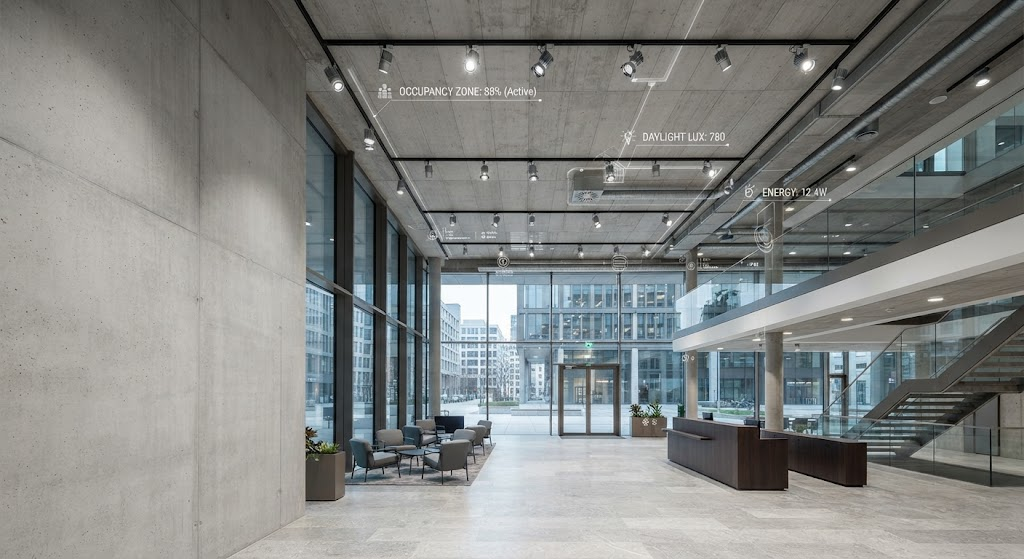
What Is Changing in Commercial LED Lighting in 2026?
For many years, commercial lighting automation was relatively straightforward. A timer controlled the operating hours, an occupancy sensor switched lights on and off, and daylight sensors reduced output when there was enough natural light.
These functions are still useful. What is changing is the amount of information available to the lighting system and how that information can be used.
Modern commercial lighting can connect luminaires, sensors, control systems and building management platforms. AI can then be used to identify patterns in this data and support more responsive control.
This is particularly relevant in buildings where occupancy changes throughout the day.
A retail store, for example, does not need exactly the same lighting conditions at 9:00 in the morning, during peak customer traffic, and after closing. The same applies to offices, hotels, supermarkets and other large commercial spaces.
The move toward AI is therefore less about creating a new type of LED fixture and more about making the lighting system more responsive to actual conditions.
How Does AI Work in Commercial Lighting?
AI needs data to be useful.
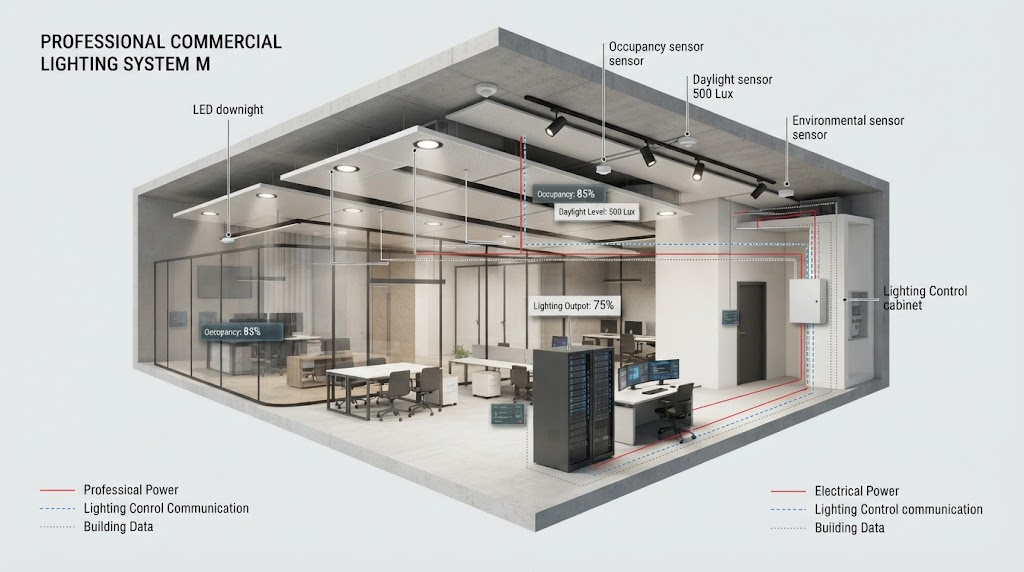
A typical intelligent lighting system may collect information from:
- Occupancy sensors
- Daylight sensors
- Lighting controllers
- Energy meters
- Building management systems
- Operating schedules
- Historical usage data
The system can use this information to identify recurring patterns and adjust lighting operation accordingly.
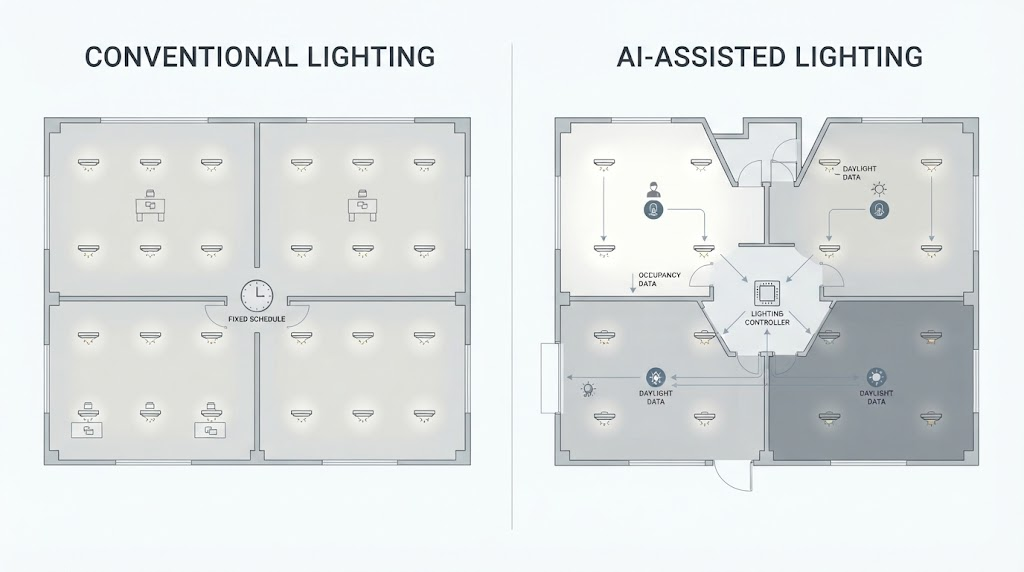
Consider an office with several meeting rooms. Some rooms may be occupied throughout the morning while others remain empty for several hours.
A conventional lighting system may operate according to a fixed schedule.
A connected system can respond to occupancy. An AI-supported system can go further by analyzing historical patterns and helping optimize how those spaces are illuminated over time.
The technology is most useful when it is connected to a well-designed control strategy. AI cannot compensate for poor lighting design, unsuitable sensors or incorrectly configured controls.
AI Lighting vs Smart Lighting
These terms are often used as if they mean the same thing. They do not.
Smart lighting generally refers to lighting that can be controlled automatically or remotely. The system may use predefined rules such as:
- Turn lights on when occupancy is detected.
- Dim lights when daylight increases.
- Reduce output after a certain time.
- Switch off unused zones.
AI-enabled lighting can use larger datasets and historical information to identify patterns and support more dynamic decisions.
That does not mean every lighting system with a sensor is an AI system.
This distinction is important when comparing products and control platforms. A commercial lighting project should be evaluated according to what the system actually does, rather than the terminology used in marketing.
Can AI Reduce Commercial Lighting Energy Consumption?
AI can contribute to energy savings, but it is not the LED technology itself that creates those savings.
The main opportunity comes from better control of when, where and how much light is used.
Energy reduction can come from several strategies:
Occupancy-based control
Lighting levels are reduced or switched off when areas are not being used.
Daylight harvesting
Artificial lighting is dimmed when sufficient daylight is available.
Zonal control
Different areas operate according to their actual requirements instead of using one lighting level throughout the building.
Adaptive dimming
Light output changes according to occupancy, time, daylight or other operating conditions.
Energy monitoring
The system records consumption and helps facility managers identify inefficient operation.
For a large commercial building, relatively small improvements across thousands of operating hours can become significant.
However, actual energy savings depend on the building, operating schedule, control strategy and commissioning quality. Claims of a fixed percentage saving should therefore be treated carefully.
What Role Do Sensors Play?
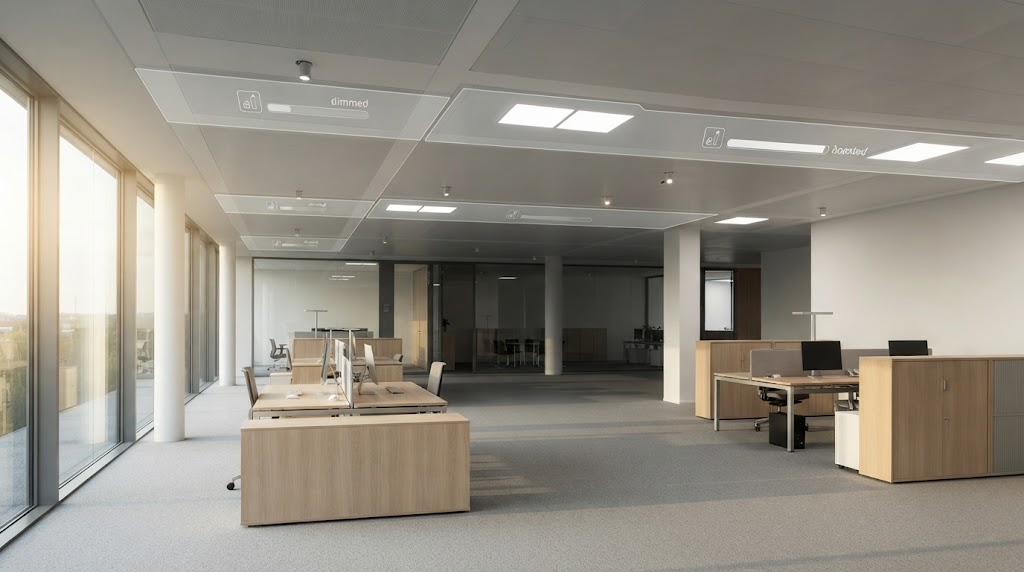
Sensors remain one of the most important parts of an intelligent lighting system.
Without reliable input data, there is little for an AI or control platform to work with.
Occupancy sensing
Occupancy sensors are useful for offices, meeting rooms, corridors, stockrooms and other areas where usage varies considerably.
Daylight sensing
Daylight sensors measure available natural light and allow artificial lighting to be adjusted accordingly.
Environmental data
Some building systems can also provide information such as temperature, air quality or other environmental conditions.
The important point is simple:
AI does not replace sensors. It makes better use of the information they provide.
Sensor positioning, detection range and commissioning can have a direct impact on system performance.
Where Does DALI Fit into AI Lighting?
As commercial lighting becomes more connected, communication between luminaires, sensors and control systems becomes increasingly important.
DALI-2 provides standardized digital control and device interoperability. D4i adds luminaire data and diagnostics, while DALI+ extends DALI communication into IP-based and wireless environments.
The DALI Alliance highlighted wireless, IP-based and interoperable lighting control at Light + Building 2026, reflecting the industry’s move toward more connected lighting infrastructures.
For commercial projects, this creates an important distinction between the lighting fixture and the lighting system.
The fixture provides the light.
The driver, sensors, control protocol and software determine how that light is controlled and monitored.
This is why control compatibility should be considered at the specification stage rather than added after the luminaires have been selected.
Why Interoperability Matters
A modern commercial lighting installation may include:
LED luminaires → LED drivers → sensors → controllers → gateways → BMS
If these components cannot communicate reliably, expanding or modifying the system can become expensive.
For this reason, project teams should check:
- Which control protocols are supported
- Driver compatibility
- Sensor compatibility
- Dimming performance
- Gateway requirements
- BMS integration
- Wired or wireless architecture
- Commissioning requirements
- Future expansion options
Open standards can also make it easier to avoid being locked into a single proprietary ecosystem.
For large retail chains and multi-site projects, this can become particularly important because lighting specifications may need to be replicated across different locations.
What Does AI Mean for Retail Lighting?
Retail is an interesting application because lighting requirements change with the space.
A fashion store may use different lighting strategies for:
- Entrance areas
- Window displays
- Main sales floor
- Product displays
- Fitting rooms
- Cash desks
- Back-of-house areas
The visual requirements also differ.
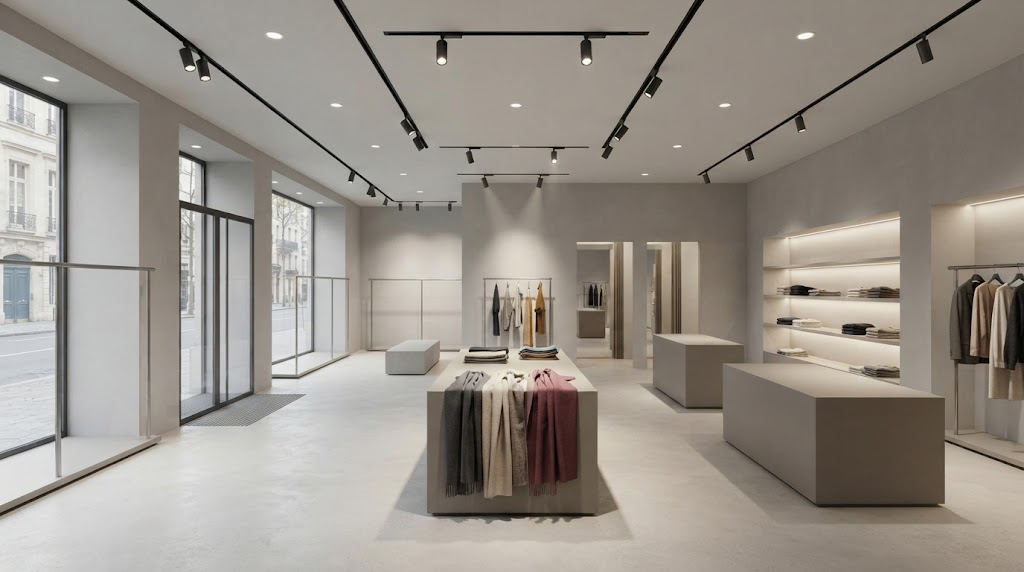
A display wall may require focused accent lighting, while the general sales floor needs comfortable and reasonably uniform illumination.
AI does not change these fundamental lighting principles.
Instead, it can help determine when and how the lighting system should operate.
For example, general lighting can be dimmed during periods of low occupancy while display lighting remains at the level required for merchandising.
This distinction is important. Energy optimization should not come at the expense of the visual quality of the store.
Does AI Replace Lighting Design?
No.
AI can assist with control and optimization, but the fundamentals of commercial lighting design remain the same.
A lighting designer still needs to consider:
- Illuminance
- Uniformity
- Glare
- Beam angle
- Color temperature
- Color rendering
- Visual hierarchy
- Accent lighting
- Luminaire positioning
For example, an AI-controlled track spotlight cannot correct an incorrectly selected beam angle or a poorly positioned luminaire.
A narrow beam may be appropriate for a feature display, while a wider beam may be better for general merchandise lighting.
The lighting design needs to be correct first. Intelligent control can then make the system more responsive.
What Should You Look for When Specifying AI-Ready LED Lighting?
For a new commercial project, it is better to look at the complete lighting system rather than searching for a fixture simply labelled “AI”.
1. LED performance
Check efficacy, lifetime, thermal management and driver quality.
2. Light quality
Consider CRI, SDCM, beam angle, glare and color consistency.
3. Dimming
Confirm that the LED driver supports the required control method and dimming range.
4. Sensors
Check compatibility with occupancy and daylight sensors and consider sensor positioning during the design stage.
5. Control protocol
Depending on the project, this may include DALI-2, D4i, DALI+, Bluetooth Mesh or other control technologies.
6. BMS integration
Large commercial buildings may require lighting to communicate with the wider building management system.
7. Data and diagnostics
For larger installations, access to operating data and luminaire diagnostics can make maintenance easier.
8. Future flexibility
Retail layouts and commercial spaces change. A lighting system should allow zones, scenes and control strategies to be modified without replacing the complete installation.
Is AI Lighting Worth the Investment?
Not for every project.
A small shop with simple opening hours may gain little from a sophisticated AI platform.
The business case becomes stronger when a project has:
- Large floor areas
- Long operating hours
- Variable occupancy
- Multiple lighting zones
- High energy consumption
- Several locations
- A need for centralized monitoring
For a retail chain, for example, the ability to monitor lighting performance across multiple stores can be more valuable than simply automating individual luminaires.
The right question is therefore not:
“Does this lighting system use AI?”
A better question is:
“What operational problem does the intelligent control system solve?”
That question keeps the technology connected to the actual requirements of the project.
AI does not replace LED lighting or professional lighting design. It adds an intelligence layer that helps commercial lighting systems respond more effectively to occupancy, daylight, energy use and building operation.
What Is the Future of Commercial LED Lighting?
The next stage of commercial lighting is not simply more efficient LED fixtures.
It is the integration of efficient luminaires, digital controls, sensors, connectivity and building data.
AI can sit above these technologies and help analyze patterns, optimize operation and support better decisions.
But the basic priorities remain unchanged: good light quality, appropriate illumination, low glare, reliable equipment and a lighting design that suits the space.
In 2026, the most useful commercial lighting systems are likely to be those that combine these fundamentals with flexible digital control.
AI is not replacing good lighting design. It is becoming another tool for operating that design more intelligently.
AI in commercial LED lighting refers to using artificial intelligence to analyze lighting, occupancy, daylight and building data to support more responsive lighting control. It works together with LED luminaires, sensors, drivers and control systems rather than replacing them.
Yes. AI can help reduce unnecessary lighting operation by analyzing occupancy, daylight, schedules and historical usage. However, the actual energy saving depends on the building, lighting design, operating hours, sensors and control strategy. AI should be considered an optimization tool, not a guaranteed energy-saving percentage.
Smart lighting usually operates according to predefined rules, such as switching lights off when a room is empty. AI-enabled systems can analyze current and historical data to identify patterns and support more adaptive control. A lighting system with sensors is not automatically an AI lighting system.
Not necessarily. The key requirements are compatible LED drivers, dimming capabilities, sensors and a suitable lighting control system. Existing commercial LED luminaires may be integrated into an intelligent system if their drivers and control interfaces are compatible.
Yes. DALI-2 provides standardized digital lighting control, while D4i adds luminaire data and diagnostics. DALI+ extends DALI communication into IP-based and wireless environments. These technologies can provide the communication layer required for connected commercial lighting systems.
Occupancy and daylight sensors are the most common. Depending on the project, lighting systems may also use environmental or building data. Sensor quality and positioning are important because inaccurate or poorly positioned sensors can reduce the effectiveness of automated control.
Yes, particularly for larger stores and retail chains with changing occupancy, multiple lighting zones or long operating hours. AI-assisted control can help manage general lighting, accent lighting and circulation areas according to actual store conditions while maintaining the lighting levels required for merchandising.
Yes, provided the track lighting system uses compatible drivers and control interfaces. AI can influence when and at what output the luminaires operate, but the selection and positioning of track spotlights, beam angles and aiming direction still need to be determined during the lighting design stage.
No. AI can support control, analysis and optimization, but it does not replace professional lighting design. Beam angle, illuminance, glare, CRI, SDCM, color temperature, luminaire positioning and visual hierarchy still require proper specification and design.
Not always. A small store with simple opening hours and limited lighting zones may not need a sophisticated AI platform. The business case is generally stronger for larger stores, retail chains, offices, hotels and commercial buildings with variable occupancy and significant lighting operating hours.
Look beyond the LED fixture itself. Check LED efficacy, driver quality, dimming performance, CRI, SDCM, glare, sensor compatibility, control protocols, BMS integration, data availability and future scalability.
The likely direction is greater integration between LED luminaires, sensors, digital controls, building management systems and operational data. AI will increasingly be used to analyze this information and optimize lighting operation, while fundamental lighting design principles will remain essential.