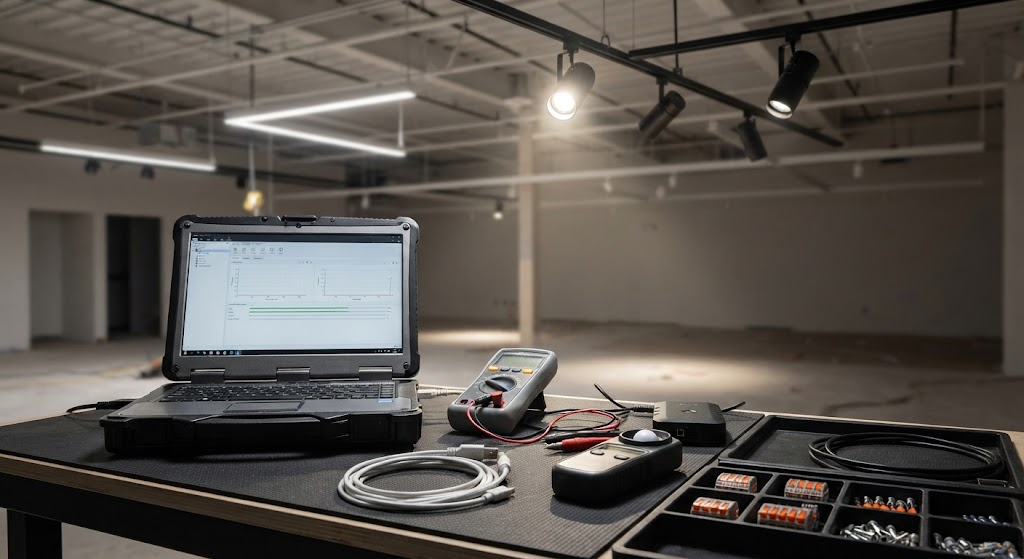
Casambi is well suited to wireless control, retail refurbishment and frequently changing store layouts. DALI is a strong choice for wired infrastructure, new-build projects and structured lighting control. For larger projects, the two can also work together.
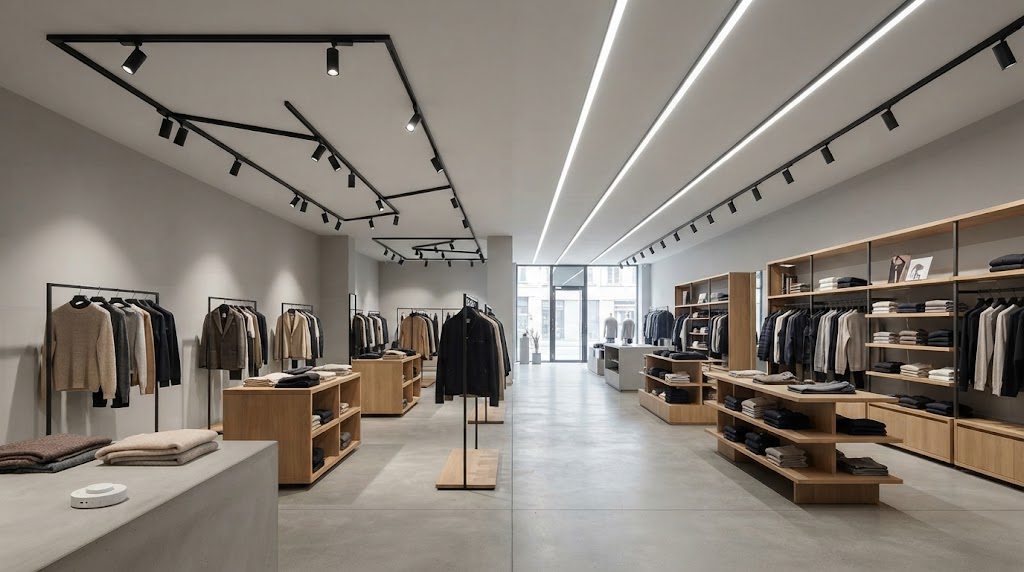
Casambi and DALI Are Not Quite the Same Thing
Casambi and DALI are often compared as if they were two competing lighting control systems. Technically, that is not quite accurate.
DALI is a standardized digital communication protocol for lighting control. It is commonly used to connect LED drivers, luminaires, sensors and control devices through a wired control bus. Individual luminaires can be addressed, grouped and dimmed, while the system can also be integrated into wider building-control strategies.
Casambi, on the other hand, is a wireless lighting control platform based on Bluetooth Low Energy mesh technology. Luminaires, sensors, switches and other control devices communicate through a wireless network, reducing the need for dedicated control cabling.
For a retail project, the real question is therefore not simply whether wireless or wired control is better.
It is about how the store will be used, how often the layout may change, what infrastructure is already available and how the lighting system needs to be managed over time.
Casambi vs DALI: Main Differences
| Casambi | DALI | |
|---|---|---|
| Communication | Wireless mesh | Wired digital communication |
| Dedicated control wiring | Generally not required | Required |
| Retail refurbishment | Very suitable | Requires more infrastructure planning |
| Configuration | Software/app based | DALI commissioning |
| Lighting groups | Flexible | Address and group based |
| Scenes | Supported | Supported |
| Sensors | Wireless options | Wired DALI options |
| Tunable white | Supported with compatible equipment | Supported with compatible equipment |
| Building integration | Possible through suitable interfaces | Widely used for building-system integration |
| Layout changes | Easy to reconfigure | Usually requires more planning |
| Main strength | Flexibility | Structured control |
One point is often overlooked: the control system is only one part of the lighting system.
LED modules, drivers, optics, sensors, control equipment and commissioning all have to work together. A sophisticated control platform cannot compensate for poor driver compatibility or an incorrectly designed lighting system.
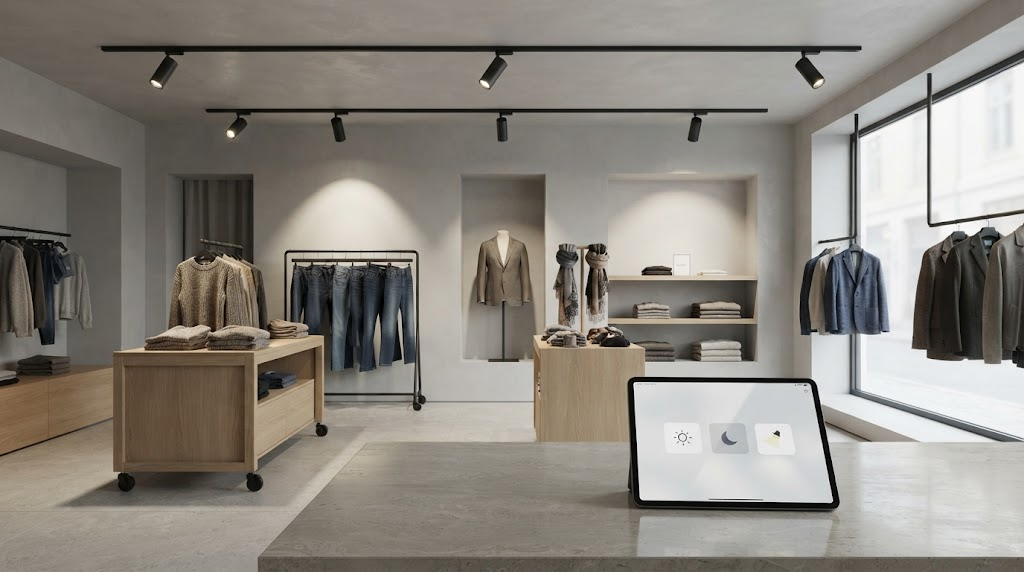
Where Casambi Makes Sense in Retail
Retail layouts rarely stay unchanged for long.
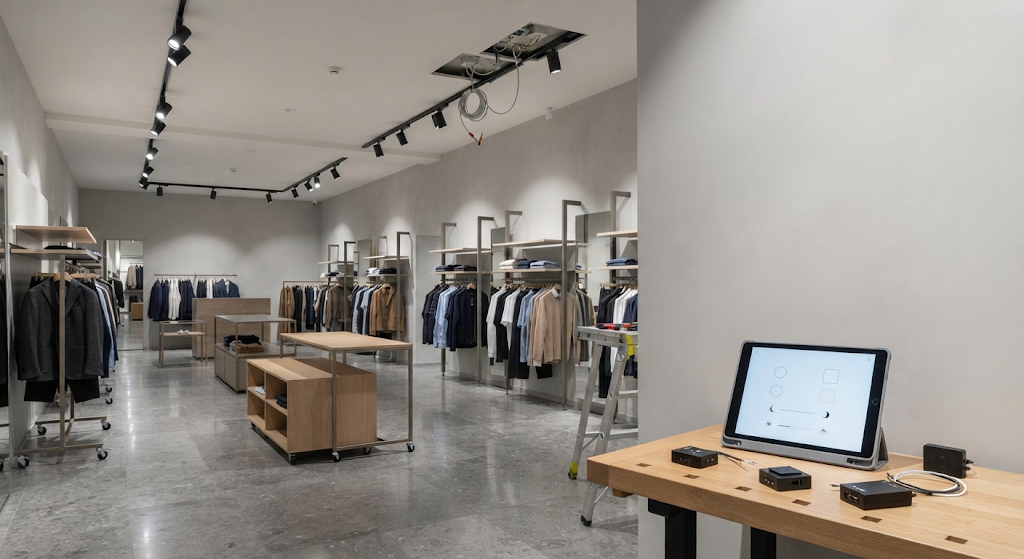
In fashion stores, for example, displays, shelving, feature tables and seasonal collections may move several times a year. The lighting needs to follow those changes without making every adjustment an electrical installation project.
This is where wireless control can be useful.
Lighting groups and scenes can be reconfigured through software rather than by changing control wiring.
A store might have separate scenes for:
- General sales lighting
- Window displays
- New collections
- Fitting rooms
- Evening operation
- Cleaning
If the sales floor is redesigned later, the same luminaires can often be reassigned to different groups without changing the physical installation.
That makes Casambi particularly interesting for retail refurbishment projects, where access to existing ceilings and electrical infrastructure may be limited.
Typical applications include:
- Fashion stores
- Boutiques
- Showrooms
- Restaurants
- Galleries
- Museums
- Retail refurbishment projects
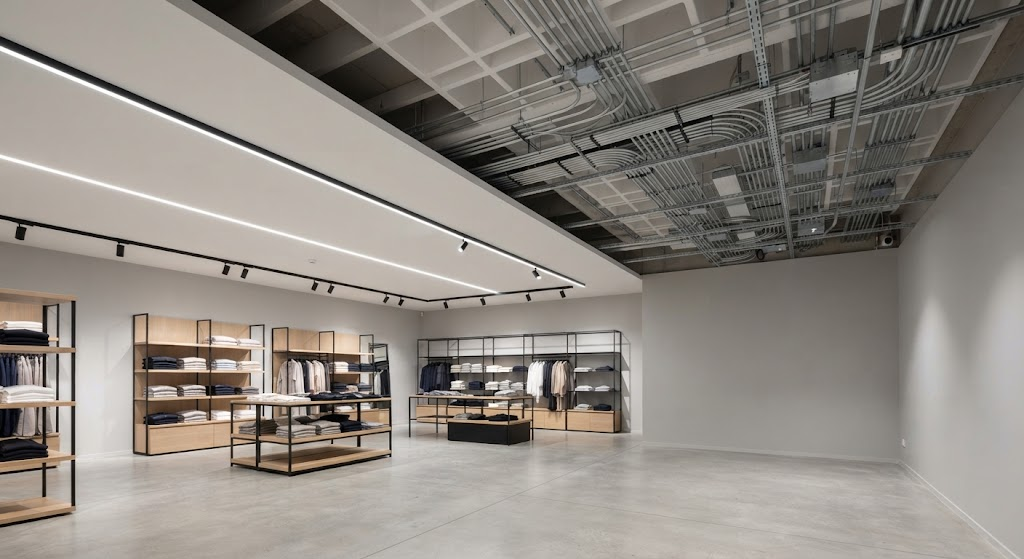
Where DALI Still Has an Advantage
For a new retail building, the situation can be different.
If the electrical and lighting infrastructure is being designed from the beginning, installing a wired control system may be straightforward. In this situation, DALI can provide a clear structure for managing large numbers of luminaires.
DALI is particularly useful where a project requires:
- Individual luminaire control
- Defined lighting zones
- Structured grouping
- Consistent dimming
- Sensor integration
- Building-management integration
- Centralized control
- Long-term maintenance planning
For larger stores and commercial buildings, these requirements can become more important than the installation method itself.
DALI also fits naturally into projects where lighting control needs to be coordinated with a wider building-management strategy.
Casambi vs DALI for Retail Refurbishment
Retail refurbishment is one of the areas where the difference between the two approaches becomes particularly clear.
Imagine a fashion store that already has its track lighting, ceiling and electrical installation in place. The retailer now wants to add:
- Dimming
- Lighting scenes
- Occupancy sensing
- Daylight control
- Tunable white
- Mobile or tablet-based control
If installing additional control cabling requires significant ceiling work, a wireless system can make the project simpler.
By contrast, if the store is already undergoing a complete electrical renovation, installing a wired DALI infrastructure may be relatively straightforward.
A useful rule of thumb is:
Retrofit projects often favour wireless control.
New-build projects often make wired control easier to plan.
It is not an absolute rule, but it is a useful starting point for project discussions.
Casambi vs DALI for Large Retail Projects
The larger the project becomes, the less useful a simple “wireless versus wired” comparison is.
A large retail store may have hundreds of luminaires, multiple sales areas, feature displays, back-of-house spaces, sensors and several lighting scenes.
A retail chain adds another layer of complexity. Different stores may have different buildings and electrical infrastructures, while the lighting concept still needs to remain consistent.
Before selecting a control platform, it is worth defining:
- Lighting zones
- Scene requirements
- Sensor strategy
- Dimming requirements
- Tunable-white requirements
- Building-management interfaces
- Commissioning procedures
- Maintenance responsibilities
- Future refurbishment plans
Once these requirements are clear, the appropriate control architecture becomes much easier to identify.
Can Casambi and DALI Work Together?
Yes.
Casambi and DALI do not necessarily need to be treated as competing technologies.
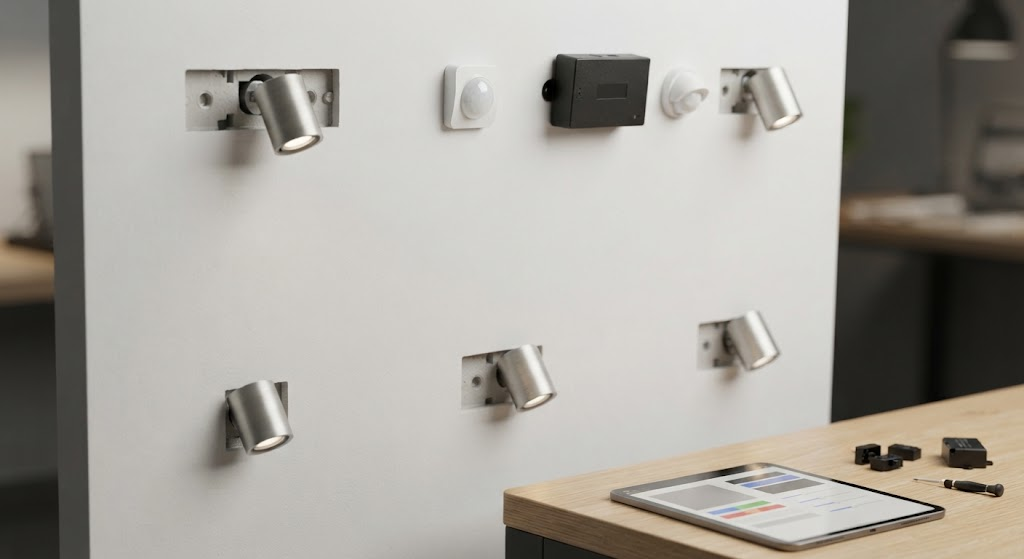
A project can use DALI at the driver or luminaire level while using wireless control at another layer of the system, provided the selected equipment and interfaces support the required architecture.
A simplified example could look like:
LED luminaire → DALI driver → wireless control interface → sensors / switches / scenes
The exact configuration depends on the equipment, project requirements and system design.
This approach can be useful when a project needs the structure of a wired lighting system while also requiring greater flexibility at the user-control level.
For large retail projects, this kind of hybrid approach can be worth considering instead of forcing the entire installation into a single control technology.
Which Is More Energy Efficient: Casambi or DALI?
Neither Casambi nor DALI is automatically more energy efficient.
Energy performance depends largely on how the lighting system is operated.
For example, a store where every luminaire remains at 100% output throughout the day has limited energy-saving potential, regardless of the control protocol.
A well-designed system can reduce consumption through:
- Occupancy detection
- Daylight sensing
- Automatic dimming
- Scheduling
- Reduced output in low-use areas
- Different lighting levels for different activities
This distinction matters when specifying retail lighting.
The control protocol provides the infrastructure. The energy savings come from how that infrastructure is configured and used.
Casambi vs DALI for Tunable White Lighting
Tunable white is increasingly used in premium retail environments where lighting needs to adapt to the time of day, merchandise or desired atmosphere.
Both Casambi and DALI can support tunable-white applications when the relevant equipment is compatible.
However, the control protocol is only one part of the system.
The complete chain needs to be considered:
LED module + driver + control system + commissioning
A luminaire labelled “tunable white” does not automatically guarantee smooth colour-temperature and dimming control with every lighting-control system.
For this reason, driver compatibility should be checked during the specification stage rather than treated as an afterthought.
Is Casambi Replacing DALI?
Not simply.
The two technologies address different project requirements, and there is still a strong role for both.
DALI remains well suited to structured wired installations, particularly where lighting control forms part of a larger building infrastructure.
Casambi is attractive where wireless flexibility, easier reconfiguration and reduced control cabling are important.
The direction of commercial lighting is also moving beyond simple LED replacement. Connected lighting, sensors, automation, energy management and integration with building systems are becoming increasingly important considerations in retail projects.
That makes the future less about choosing one technology as a universal replacement for another.
Instead, the focus is shifting towards selecting the right control architecture for the building and its operation.
Casambi vs DALI: Which Should You Choose?
Choose Casambi when:
- The project is a retail refurbishment
- Additional control wiring is difficult
- Store layouts change frequently
- Flexible scene control is important
- Fast reconfiguration is required
- Wireless sensors and controls are preferred
Choose DALI when:
- The project is a new build
- A wired control infrastructure is already planned
- Large numbers of luminaires require structured control
- Building-system integration is important
- Centralized lighting management is required
- Long-term maintenance and system structure are priorities
Consider a hybrid approach when:
- Existing DALI infrastructure needs to remain
- Wireless control needs to be added
- Different areas have different control requirements
- Future refurbishment flexibility is important
The Bottom Line
There is no universal winner between Casambi and DALI for retail lighting.
Casambi’s main strength is flexibility. DALI’s main strength is structured wired control.
For a small boutique undergoing refurbishment, wireless control may provide the simplest route to flexible lighting scenes.
For a new large-scale commercial project, DALI may fit more naturally into the electrical and building-control infrastructure.
And for complex retail environments, combining wired and wireless technologies can sometimes provide the most practical solution.
The decision should ultimately be based on building infrastructure, store layout, number of luminaires, control requirements, energy strategy, integration and future changes—not simply on whether the technology is wireless or wired.
Not necessarily. Casambi is particularly strong when wireless control, flexible configuration and easy reconfiguration are important. DALI is well suited to structured wired installations, especially in new-build commercial projects. The better choice depends on the building, electrical infrastructure and control requirements.
Casambi can replace a traditional wired lighting-control approach in some projects, particularly retail refurbishments and smaller commercial spaces. However, it should not be considered a universal replacement for DALI. Projects with extensive wired infrastructure or specific building-management requirements may still benefit from DALI.
Yes. Casambi is well suited to retail because lighting groups and scenes can be changed without redesigning the physical control wiring. This can be useful in fashion stores, boutiques and showrooms where merchandise layouts and lighting requirements change regularly.
Yes. DALI is widely suited to structured retail lighting installations where individual luminaires, lighting groups, sensors and control zones need to be managed in a defined system. It can be particularly appropriate for new-build stores and larger commercial projects.
Casambi can be easier to install when additional control wiring would be difficult or disruptive, especially during refurbishment. DALI requires a wired control infrastructure, but this can be straightforward when it is included in the electrical design of a new building.
Neither system is inherently more energy efficient. Energy consumption depends mainly on the lighting design and control strategy. Occupancy sensing, daylight control, scheduling and dimming can reduce energy use with either system when properly designed and commissioned.
Yes. Casambi and DALI can be combined in a suitable system architecture. For example, DALI can be used for structured driver-level control while wireless control is introduced through compatible interfaces. The exact configuration depends on the selected equipment and project requirements.
Casambi can control compatible DALI equipment through suitable interfaces or devices designed to connect the two technologies. Compatibility should always be checked between the specific Casambi control equipment and DALI driver before specifying the system.
DALI can be a strong option for large retail stores because it provides structured addressing, grouping and control of large numbers of luminaires. However, project size alone should not determine the choice. Network architecture, building integration, maintenance and future store changes also need to be considered.
Yes. Retail refurbishment is one of the applications where Casambi can be particularly attractive. Wireless communication can reduce the need for new control cabling, while lighting groups and scenes can be adjusted as the store layout changes.
Yes, provided the LED driver, luminaire and control equipment are compatible. Tunable white performance depends on the complete system rather than the control protocol alone. Driver compatibility and commissioning should therefore be confirmed during the specification stage.
There is no single answer for every store. Casambi is often worth considering when flexibility and wireless installation are priorities. DALI can be a better fit for structured wired infrastructure and larger new-build projects. For complex installations, a hybrid approach may also be appropriate.
No. Casambi’s lighting-control network uses Bluetooth Low Energy mesh communication between compatible devices. Internet connectivity may be used for certain remote-access or cloud-related functions, but it is not the same as requiring Wi-Fi for basic local lighting communication.
A conventional DALI installation uses a dedicated two-wire control bus. The control wiring is part of the system architecture and should be planned alongside the electrical installation.
Before selecting the system, check the number of luminaires, driver compatibility, control zones, sensors, dimming requirements, tunable-white requirements, building-management integration, installation conditions and future refurbishment plans. These factors are more useful for system selection than comparing the two technologies in isolation.