Energy-saving LED lighting reduces electricity use through higher luminous efficacy, better optical control, appropriate lighting levels and intelligent controls. The best results come from designing the entire lighting system for efficiency, rather than simply replacing conventional lamps with LED.
What Makes LED Lighting Energy Efficient?
LED lighting is already more efficient than many older lighting technologies, but not every LED luminaire delivers the same level of performance.
The actual energy performance of a lighting installation depends on several factors:
- Luminous efficacy
- Optical efficiency
- Driver efficiency
- Lighting levels
- Beam distribution
- Operating hours
- Dimming
- Occupancy control
- Daylight response
- Maintenance and lifetime
This is why comparing products only by wattage can be misleading.
A 20 W luminaire is not necessarily more efficient than a 25 W luminaire if the 25 W product delivers significantly more useful light to the required area.
For professional projects, lumens per watt (lm/W) is a useful starting point because it measures light output relative to electrical power. However, it should always be considered together with the actual lighting application.
LED Energy Efficiency Starts With the Right Amount of Light
Energy saving does not mean making a space unnecessarily dark.
The objective is to provide the required illumination where it is needed, while avoiding excessive light in areas that do not need it.
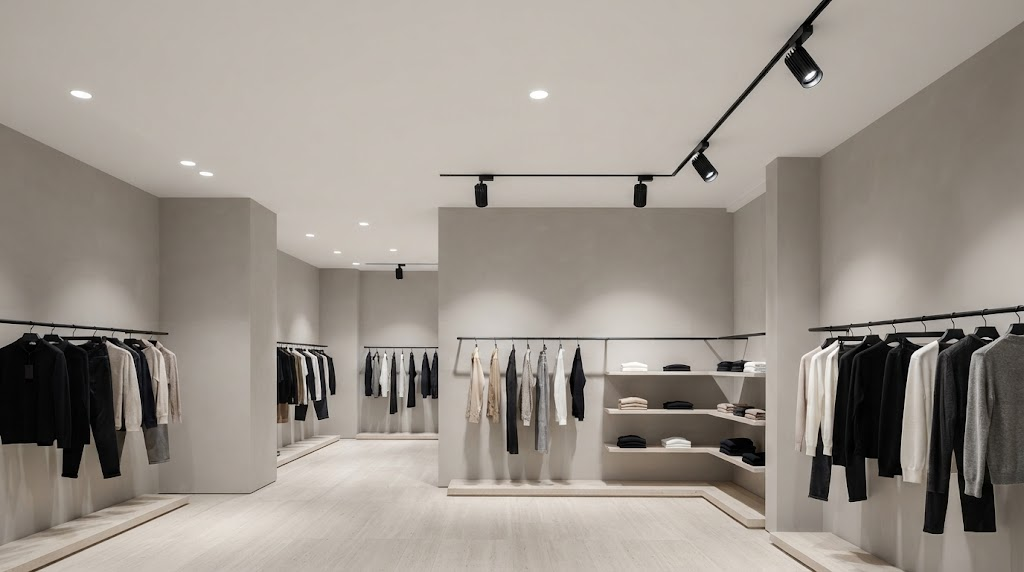
This becomes particularly important in commercial spaces.
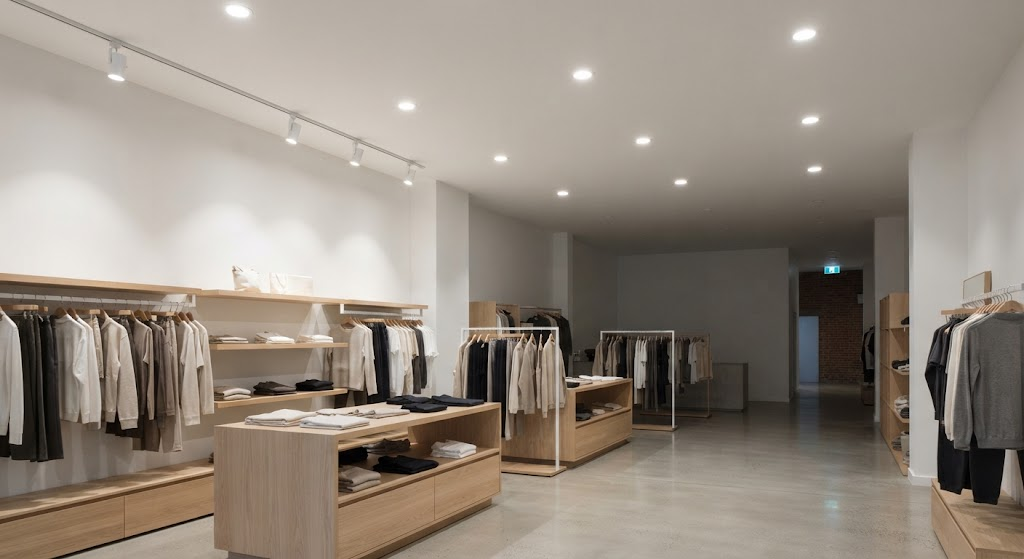
For example, a retail store may require stronger illumination on:
- Product displays
- Shelving
- Mannequins
- Feature walls
- Promotional areas
while circulation areas and secondary spaces may require less.
A lighting design that distributes light according to the function of each area can reduce installed power without compromising the visual experience.
This is often more effective than simply selecting a lower-wattage luminaire.
Luminous Efficacy: Look Beyond the lm/W Number
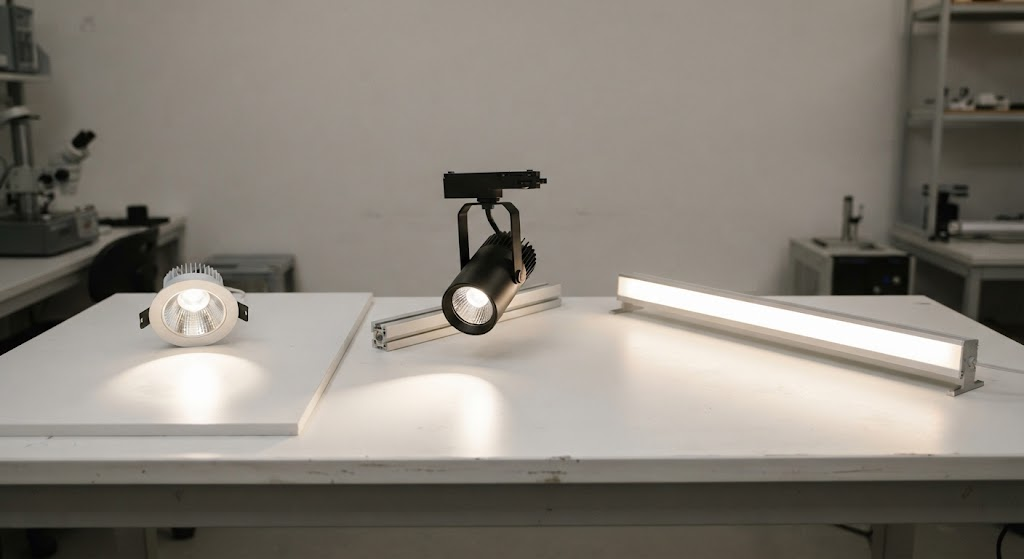
Luminous efficacy is normally expressed as lumens per watt (lm/W).
A higher lm/W value generally means that a luminaire produces more visible light for the same electrical input.
However, very high efficacy should not automatically be treated as the best choice.
A commercial lighting project may also require:
- High colour rendering
- Low glare
- Consistent colour
- Accurate beam control
- Stable light output
- Good thermal management
- Reliable driver performance
For example, a retail application may prioritize colour quality and precise beam control over achieving the highest possible lm/W figure.
The correct question is therefore not:
“Which LED has the highest lm/W?”
It is:
“Which luminaire delivers the required lighting performance with the lowest practical energy consumption?”
Optical Efficiency Can Save Energy Too
Not all energy savings come from the LED itself.
The optical system plays an important role.
A well-designed reflector, lens or optical system can direct light toward the target instead of allowing excessive spill light.
This is particularly useful for:
- Track spotlights
- Downlights
- Retail display lighting
- High-bay lighting
- Wall washing
- Architectural lighting
For example, a narrow beam can be useful for highlighting a specific product, while a wider beam may be more appropriate for illuminating a larger merchandise area.
Using the wrong beam angle can result in wasted light and may require additional luminaires to achieve the desired visual effect.
Smart Lighting Controls Are Becoming Part of Energy-Saving LED Systems
LED efficiency is only one part of the equation.
Lighting controls determine when, where and at what output level luminaires operate.
Common energy-saving control strategies include:
- Occupancy sensors
- Vacancy sensors
- Daylight-responsive dimming
- Scheduled control
- Zone control
- Scene setting
- Networked lighting control
- Automatic dimming
The principle is simple:
Do not use full lighting output when full output is not required.
For example, an office may need different lighting conditions during working hours, cleaning periods and unoccupied periods.
A retail store may also use different lighting levels during opening hours, preparation periods and after-hours cleaning.
Modern LED drivers make these operating strategies easier to implement than with many older lighting technologies. Current industry work on networked lighting controls also continues to focus on deeper energy savings and integration with other building systems.
Dimming Can Reduce Unnecessary Energy Consumption
Dimming is particularly useful when lighting requirements change throughout the day.
A luminaire operating below maximum output generally consumes less power, although the exact relationship depends on the driver and control system.
This makes dimming useful for:
- Daylight-rich spaces
- Retail stores
- Offices
- Hospitality
- Museums
- Showrooms
- Multi-purpose commercial areas
The important point is that dimming should be based on actual lighting requirements.
Simply installing dimmable products without a control strategy does not automatically create meaningful energy savings.
Daylight Can Work Together With LED Lighting
Natural daylight can reduce the need for artificial lighting in suitable spaces.
A daylight-responsive system can measure available natural light and adjust LED output accordingly.
For example:
More daylight → lower LED output
Less daylight → higher LED output
This approach can be particularly useful near windows, skylights and glazed façades.
The lighting system becomes responsive rather than operating at a fixed output throughout the day.
Energy-Saving LED Lighting for Retail
Retail lighting presents a different challenge from basic office illumination.
The lighting needs to save energy while still supporting the products and the identity of the store.
A practical retail system usually combines:
General lighting
Provides comfortable overall illumination.
Accent lighting
Draws attention to selected products.
Display lighting
Provides additional light where merchandise requires stronger visual emphasis.
Decorative lighting
Supports the atmosphere and architectural concept.
Energy efficiency comes from balancing these layers rather than treating every area in the store in the same way.
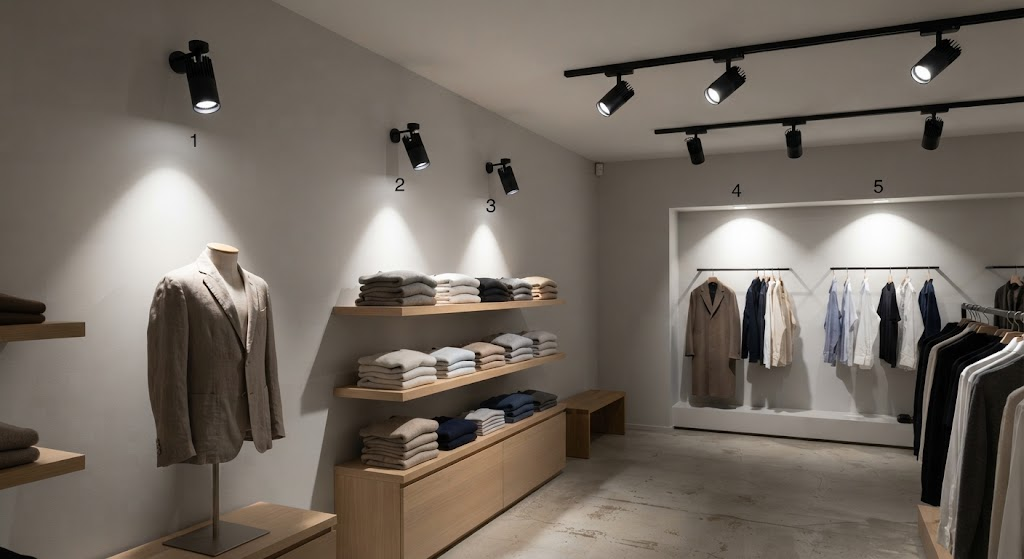
For example, a clothing display may benefit from a focused track spotlight while a wider circulation area can use a broader distribution.
This approach can create a stronger visual hierarchy without simply increasing the overall lighting level.
Track Lighting and Energy Efficiency
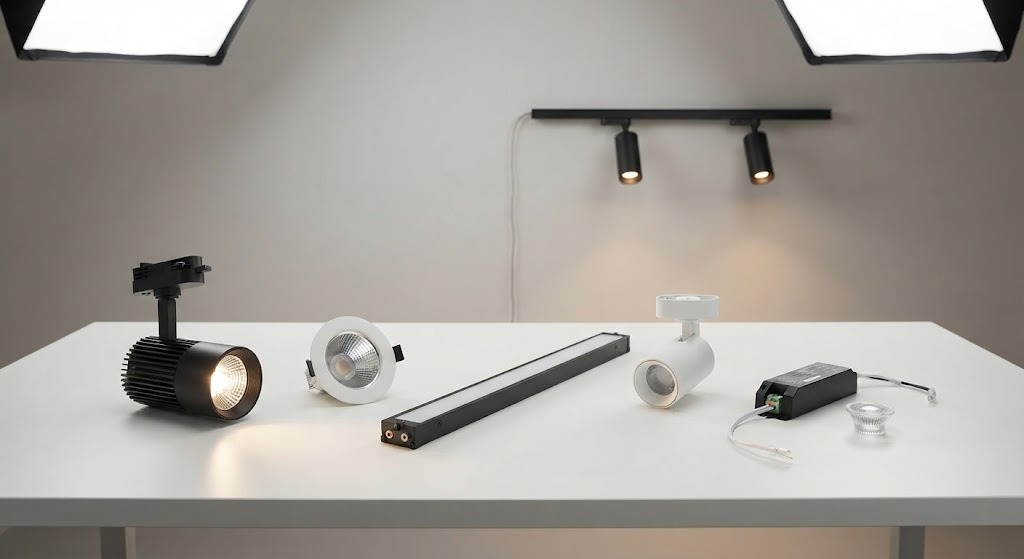
LED track lighting is widely used in retail because it combines energy efficiency with flexibility.
The ability to reposition the spotlight allows lighting to follow changes in:
- Store layout
- Product displays
- Seasonal merchandise
- Promotional areas
- Interior design
Beam angle is also important.
A simplified application approach could be:
| Beam Angle | Typical Application |
|---|---|
| 15° | Focused product accent |
| 24° | Display and merchandise highlighting |
| 36° | General retail accent lighting |
| 60° | Wider area illumination |
These are not universal rules. The correct beam angle depends on mounting height, target size, distance and desired illuminance.
The objective is to use the optics that best match the application.
Energy Efficiency Should Not Reduce Lighting Quality
One common mistake is to treat energy saving as a simple reduction in wattage.
Good energy-efficient lighting should still provide:
- Appropriate illuminance
- Good colour rendering
- Visual comfort
- Controlled glare
- Consistent colour
- Stable performance
- Suitable light distribution
This is especially important in retail.
A lower-energy lighting system that makes products look dull, creates glare or produces uncomfortable visual conditions may not be a successful lighting solution.
Energy efficiency should support the space, not work against it.
LED Energy Saving and Total Cost of Ownership
The purchase price of a luminaire is only one part of the cost.
For commercial projects, it is more useful to consider:
Initial investment + electricity + maintenance + replacement + controls + service life
This is the basic idea behind Total Cost of Ownership (TCO).
A higher-quality LED luminaire may have a higher initial price but can offer better long-term economics through:
- Higher useful efficacy
- Longer service life
- Better thermal management
- More reliable drivers
- Lower maintenance requirements
- Better control compatibility
The energy cost of a lighting system should therefore be evaluated over its expected operating period rather than only at the time of purchase.
Don’t Ignore the LED Driver
The LED chip receives much of the attention, but the driver is an important part of the complete luminaire.
A lighting system should consider:
- Driver efficiency
- Power factor
- Standby consumption
- Dimming compatibility
- Thermal conditions
- Long-term reliability
- Control protocol compatibility
In networked lighting applications, standby and communication-related power consumption can also become relevant when large numbers of luminaires are connected.
Energy efficiency should therefore be evaluated at the luminaire and system level, not only at the LED component level.
High Efficiency Does Not Always Mean the Best Product
A product specification sheet can contain impressive numbers, but professional selection requires more context.
For example, compare two luminaires:
Luminaire A
120 lm/W
20 W
2,400 lm
Luminaire B
140 lm/W
25 W
3,500 lm
Luminaire B consumes more electricity, but it also produces substantially more light.
If both products are used for different applications, simply choosing the lower wattage would not make sense.
This is why energy-efficient lighting should be evaluated based on useful light delivered to the target area, not only the wattage printed on the product label.
How to Choose Energy-Saving LED Lighting
For a commercial lighting project, check the following before making a decision:
| Parameter | What to Consider |
|---|---|
| Luminous efficacy | lm/W at the actual operating condition |
| System power | Total luminaire power |
| Light output | Delivered lumens |
| Optics | Beam angle and distribution |
| CRI | Colour rendering requirements |
| Glare | Visual comfort and application requirements |
| Driver | Efficiency and reliability |
| Dimming | Required control method |
| Sensors | Occupancy and daylight requirements |
| Lifetime | Lumen maintenance and expected service life |
| Colour consistency | SDCM / colour tolerance |
| Maintenance | Accessibility and replacement requirements |
| Controls | Standalone or networked operation |
No single specification should be considered in isolation.
What Is the Future of Energy-Saving LED Lighting?
The next stage of LED energy efficiency is moving beyond simply replacing traditional lamps.
The focus is increasingly on the complete lighting system:
Efficient LED → efficient optics → appropriate lighting levels → intelligent controls → monitoring → better lifecycle performance
Recent industry and research developments also show growing attention to connected controls, dynamic lighting and the relationship between energy performance and lighting quality.
This means future commercial lighting projects are likely to place greater emphasis on how lighting operates over time, rather than judging efficiency only from the initial product specification.
FAQ: Energy-Saving LED Lighting
Energy-saving LED lighting is a lighting solution designed to provide the required light output with less electrical energy. It combines efficient LED technology with appropriate optics, lighting design and, where useful, dimming or automatic controls.
LED efficiency is commonly expressed as luminous efficacy in lumens per watt (lm/W). It indicates how much visible light is produced for each watt of electrical power.
No. Higher lm/W is useful, but lighting quality, colour rendering, glare, beam control, driver performance and the actual application must also be considered.
Yes. Sensors, dimming, scheduling and daylight-responsive controls can reduce operating time or output when full lighting is unnecessary. The actual saving depends on the building, operating schedule and control strategy.
It can be. Efficient LED track lighting combined with suitable beam angles and accurate aiming can direct light toward products and display areas while reducing unnecessary illumination.
In most systems, reducing LED output reduces power consumption. The exact relationship depends on the luminaire and driver, so energy performance should be checked for the complete system.
Look at lm/W, actual system wattage, useful light output, optics, CRI, glare, driver performance, lifetime and control compatibility. Purchase price alone does not show the long-term value of a lighting system.
Conclusion
Energy-saving LED lighting is no longer simply about replacing an old lamp with an LED.
Real energy performance comes from designing the entire system properly: use efficient luminaires, deliver light where it is needed, avoid excessive illumination, control output when conditions change, and consider energy consumption over the full operating life.
For commercial lighting, the best solution is not necessarily the one with the lowest wattage.
It is the one that delivers the required lighting quality with the least unnecessary energy use.