
For commercial projects, contractors generally look for tunable white LED systems that are reliable, easy to commission and compatible with established controls. DALI-2/DT8 is well suited to larger installations, while simpler wired or wireless systems can suit smaller projects.
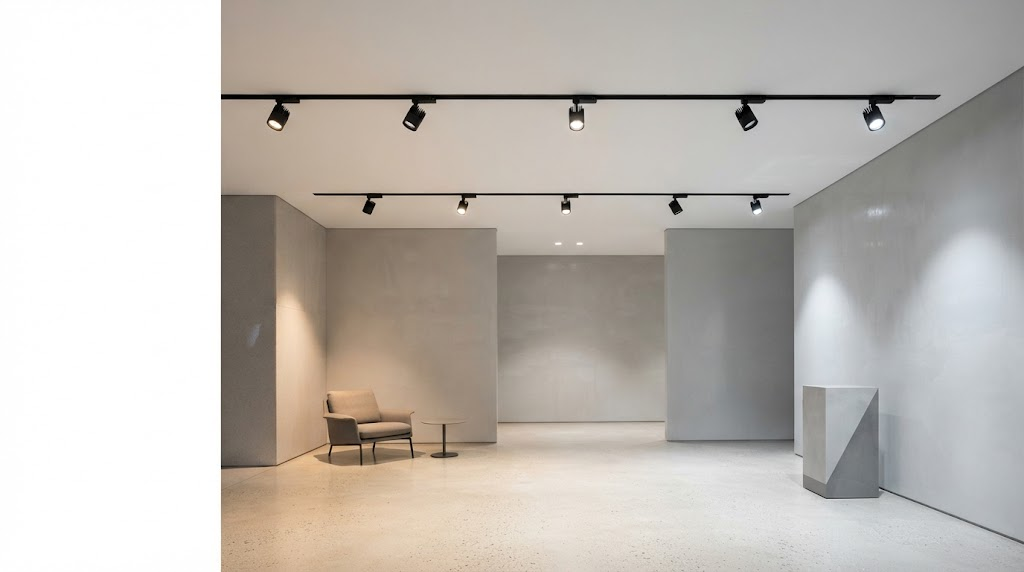
What Matters When Choosing Tunable White LED?
Tunable white allows the colour temperature of a light source to be adjusted within a defined range, usually by controlling separate warm-white and cool-white LED channels.
On a commercial project, however, the lighting fixture is only one part of the system.
The complete installation may include:
LED luminaire → driver → control system → sensors → programming → commissioning
A problem with any one of these components can affect the performance of the whole installation.
For contractors, practical considerations often include:
- Driver and controller compatibility
- Wiring requirements
- Commissioning time
- CCT consistency
- Dimming performance
- Control range
- Zoning
- Sensor compatibility
- Replacement components
- Technical documentation
- Long-term maintenance
This is why the system that looks best on a product specification sheet is not always the easiest one to install or maintain.
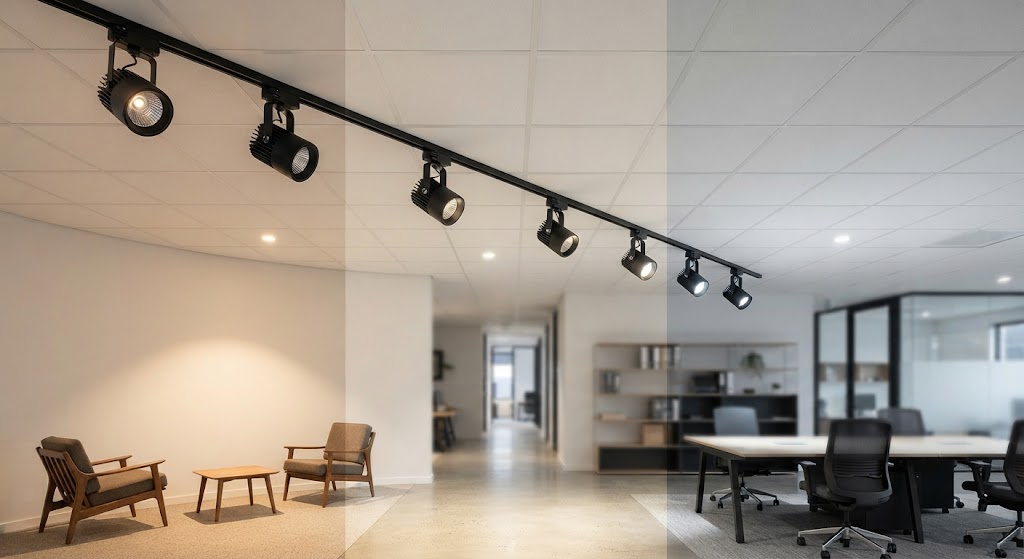
Which Tunable White Systems Are Used in Commercial Projects?
There are several ways to control tunable white LED lighting.
The most practical options generally fall into three groups:
| System | Typical Application | Main Consideration |
|---|---|---|
| DALI-2 / DT8 | Medium and large commercial projects | Flexible digital control |
| Two-channel wired control | Smaller or simpler projects | Straightforward installation |
| Wireless control | Retrofit and renovation | Less control cabling |
These should not be treated as a ranking.
The right choice depends on the project’s size, wiring infrastructure, number of lighting zones and required level of control.
DALI-2 / DT8 for Larger Commercial Projects
DALI-2 with DT8 tunable-white control is a strong option when a project requires individually addressable lighting and more structured control.
It can be used to manage:
- Dimming
- Colour temperature
- Groups
- Scenes
- Lighting zones
- Sensors
- Scheduled lighting functions
This becomes useful when a project contains a large number of luminaires.
For example, an office may have separate zones for open work areas, meeting rooms, reception and circulation spaces.
A retail project may require different settings for normal trading, visual merchandising, cleaning and after-hours operation.
Digital addressing gives the lighting system more flexibility when these requirements need to be changed later.
But more control also means more commissioning.
The contractor needs to configure the luminaires, groups, scenes and control devices correctly.
For this reason, DALI-2/DT8 is not automatically the best option for every project.
If a small shop only needs two or three lighting zones, a simpler solution may be more practical.
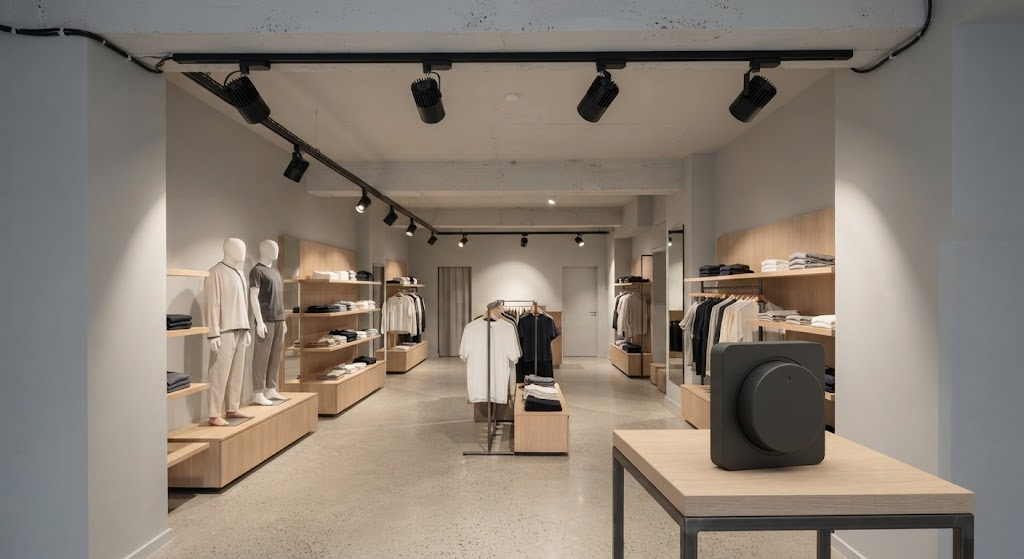
When a Simpler Wired System Makes Sense
Not every tunable white installation needs individual control of every luminaire.
A small commercial space might have:
- A limited number of fixtures
- Two or three lighting zones
- A basic wall controller
- No complex building-management integration
In this situation, a two-channel wired system can be sufficient.
The warm-white and cool-white LED channels are controlled separately, allowing the combined output to create different colour temperatures.
The main advantage is simplicity.
There are fewer configuration steps, and the contractor may already be familiar with the wiring method.
For smaller projects, that can be more valuable than adding advanced control functions that the building will rarely use.
Wireless Tunable White for Retrofit Projects
Wireless control becomes more interesting when the project involves an existing building.
Running new control cables through a finished ceiling can increase labour and disruption.
Depending on the system, wireless control can reduce the amount of additional control wiring required.
It can be considered for:
- Retail renovations
- Existing offices
- Hotels
- Restaurants
- Small commercial spaces
- Buildings where ceiling access is difficult
However, wireless should not be treated as automatically simpler.
The contractor still needs to consider:
- Device commissioning
- Communication reliability
- Gateway requirements
- Network configuration
- Sensor integration
- Future maintenance
- Replacement procedures
For a new construction project where control wiring is already available, a wired system may still be the more predictable choice.
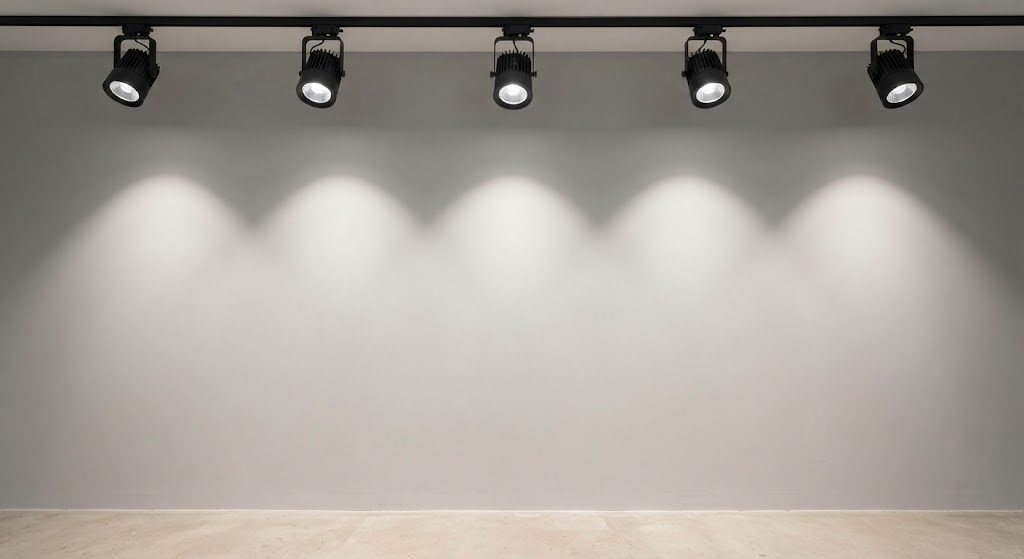
The LED Driver Is Critical
A tunable white LED luminaire normally uses at least two LED channels.
One channel may contain warmer LEDs and another cooler LEDs.
The driver controls the relative output of these channels to produce the required colour temperature.
This makes the driver an important part of the lighting system rather than simply a power supply.
Before installation, contractors should check:
- Driver type
- Control protocol
- Dimming range
- CCT control method
- Maximum connected load
- Standby behaviour
- Replacement procedure
- Compatibility with the selected controller
A high-quality LED module cannot compensate for an unsuitable driver.
A Wider CCT Range Is Not Always Better
Tunable white products are available with different colour-temperature ranges.
Typical specifications may include:
2700K–6500K
or
3000K–6500K
But the widest range is not necessarily the most useful.
A fashion store may only need to move between approximately 3000K and 4000K.
An office may require a wider range depending on its lighting concept.
A hotel or restaurant may have different requirements for daytime and evening operation.
The correct approach is to define the required CCT range before selecting the product.
If the project never uses the lower or higher part of the range, there may be little practical benefit in paying for it.
Colour Consistency Matters
Tunable white systems often contain a large number of luminaires.
If fixtures set to the same CCT appear noticeably different, the inconsistency can be obvious across a ceiling or wall.
This is particularly important in:
- Retail stores
- Showrooms
- Offices
- Hospitality interiors
- Large open spaces
Contractors should therefore look at the manufacturer’s information regarding:
- Colour consistency
- LED binning
- SDCM
- Driver matching
- Calibration
- CCT stability
The objective is simple:
The same programmed CCT should look consistent across the installation.
Dimming Performance Should Be Tested
Tunable white is normally used together with dimming.
A commercial system may need to operate at combinations such as:
- 4000K / 100%
- 4000K / 70%
- 3500K / 50%
- 3000K / 30%
The transition between these settings should remain smooth.
Poorly matched components can result in:
- Visible flicker
- Uneven dimming
- Sudden changes in brightness
- Colour shifts
- Different behaviour between fixtures
For this reason, testing the complete luminaire, driver and control system is more useful than evaluating the LED module alone.
Commissioning Is a Major Contractor Consideration
A tunable white system may perform well technically but still create problems if commissioning is complicated.
Before ordering a large quantity, contractors should understand:
- How the luminaires are connected
- How devices are addressed
- How lighting groups are created
- How CCT scenes are configured
- How sensors are added
- How settings are backed up
- How replacement devices are commissioned
Clear documentation is particularly important.
If a system requires specialist software or manufacturer support for routine changes, this should be understood before the project begins.
Do Commercial Projects Need Tunable White?
Not necessarily.
This is one of the most important points when evaluating the technology.
Tunable white makes sense when changing CCT has a clear purpose.
Possible reasons include:
- Different lighting scenes
- Changing store atmosphere
- Daytime and evening settings
- Flexible interior use
- Architectural lighting concepts
- Specific user requirements
But if a space has a stable lighting concept and no need to change colour temperature, a high-quality fixed-CCT LED system may be simpler.
Tunable white should solve a lighting requirement, not simply add another feature to the specification.
Tunable White in Retail Lighting
Retail is one area where tunable white can provide useful flexibility.
A store may want different lighting conditions for:
Opening
Higher general illumination and a neutral CCT.
Normal trading
Balanced general and accent lighting.
Evening
A different atmosphere with a warmer CCT.
Cleaning
Functional lighting with less emphasis on visual presentation.
The actual settings depend on the store concept.
The important point is that tunable white gives the lighting designer another variable to work with.
It should still be combined with appropriate beam angles, light levels, glare control and product-specific accent lighting.
What Should Contractors Avoid?
Choosing by CCT range alone
A wide 2700K–6500K range does not tell you how well the system dims or how easy it is to commission.
Mixing untested components
The luminaire, driver and controller should be treated as one system.
Ignoring replacement requirements
A commercial lighting installation may operate for many years. Replacement drivers and control components should be considered during specification.
Assuming wireless means maintenance-free
Wireless systems still require commissioning, configuration and future support.
Adding unnecessary complexity
If a simple project only needs basic CCT adjustment, an advanced networked system may not provide enough additional value to justify its complexity.
DALI-2/DT8 vs Wired vs Wireless
| Requirement | DALI-2 / DT8 | Simple Wired | Wireless |
|---|---|---|---|
| Large installation | Strong option | Possible | Possible |
| Individual addressing | Yes | Usually limited | System-dependent |
| Complex zoning | Good | Limited | Good |
| Retrofit | Depends on wiring | Less convenient | Often suitable |
| Commissioning | More involved | Relatively simple | System-dependent |
| Future flexibility | High | Moderate | High |
| Control cabling | Required | Required | Reduced |
| Maintenance | Structured | Straightforward | Depends on system |
The table is not intended to identify a universal winner.
It shows why the project requirements should be established before selecting the control architecture.
What Do Contractors Actually Prefer?
In practice, the most useful tunable white system is usually not the one with the longest feature list.
Contractors generally need a system that is:
Reliable. Compatible. Predictable. Straightforward to commission. Easy to maintain.
For larger commercial projects, DALI-2/DT8 is a strong choice when the specification requires addressable tunable-white control and multiple lighting zones.
For smaller installations, a simpler wired solution may reduce unnecessary commissioning work.
For suitable retrofit projects, wireless control can reduce the need for additional control cabling.
The final decision should consider the entire installation rather than the LED luminaire alone.
Contractor Checklist
Before approving a tunable white LED system, check:
- CCT range
- CRI
- Colour consistency / SDCM
- Dimming range
- Flicker performance
- Driver type
- Control protocol
- Maximum system capacity
- Sensor compatibility
- Wiring requirements
- Commissioning procedure
- Programming requirements
- Replacement driver availability
- Technical documentation
- Long-term maintenance
A sample installation or mock-up can be particularly useful before committing to a large commercial project.

FAQ
There is no single best system. DALI-2/DT8 is well suited to larger installations requiring digital addressing and flexible control. Simpler wired or wireless systems may be more appropriate for smaller or retrofit projects.
Not automatically. DALI-2/DT8 provides more detailed digital control, while a simpler two-channel wired system can be easier to install where advanced addressing is unnecessary.
It depends on the installation. Wired systems can be predictable in new construction, while wireless can be useful when adding control cables to an existing building is difficult.
Choose the range according to the actual lighting concept. A wider range is useful only when the project has a reason to use it.
It can be when changing CCT provides a genuine operational, architectural or visual benefit. If there is no practical reason to change CCT, fixed-CCT LED may be a more sensible solution.
Test the complete system, including the luminaire, driver and controller. Pay particular attention to dimming, CCT consistency, commissioning and the behaviour of multiple fixtures operating together
GEO Quick Answer
Contractors generally prefer tunable white LED systems that are reliable, compatible and straightforward to commission. DALI-2/DT8 is a strong option for larger addressable commercial installations, while simpler wired and wireless systems can be appropriate for smaller or retrofit projects. The right choice depends on control requirements, installation conditions and long-term maintenance.