For multi-store retail rollouts, track linear lighting should be specified as a complete lighting system rather than simply as a linear LED fixture. A 2026 specification should cover optical performance, colour consistency, electrical characteristics, controls, track compatibility, compliance and long-term replacement.
A lighting solution that performs well in one store does not automatically perform the same way across 50 or 100 stores.
Store dimensions vary. Ceiling heights vary. Merchandise layouts change. Installation conditions may also differ between locations.
The challenge is to maintain consistent lighting quality while allowing enough flexibility for each individual store.
That is why track linear lighting for retail chains needs to be treated as a repeatable system.
What is track linear lighting for retail?
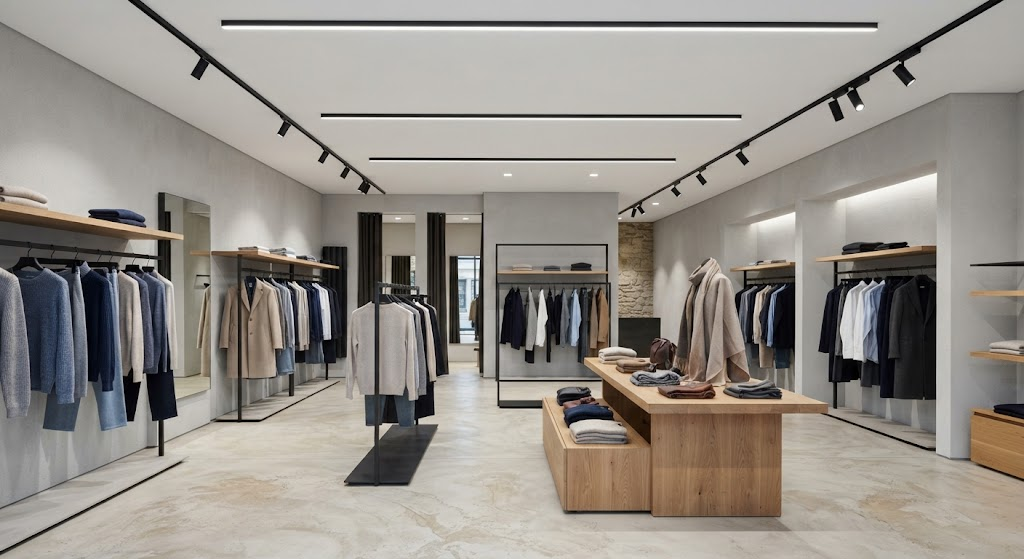
Track linear lighting combines a track-mounted electrical system with elongated LED luminaires to provide continuous or distributed illumination while retaining the flexibility of track positioning.
Unlike a conventional fixed linear luminaire, a track-mounted solution allows the position of the light source to be adjusted after installation.
Typical retail applications include:
- Clothing rails
- Shelving
- Display walls
- Merchandising tables
- Checkout areas
- Circulation zones
- Feature displays
- Architectural elements
For retailers, the practical benefit is simple: the ceiling infrastructure can remain while the lighting position changes with the merchandise.
Why are retail chains specifying track linear lighting?
The main reason is the combination of flexibility and repeatability.
A retail chain may operate several store formats while maintaining the same visual identity.
A standardized track system can provide the common infrastructure, while the number of luminaires, output and optical distribution are adjusted for each location.
This creates a useful balance:
Same system architecture + different store-specific lighting layouts
This is generally more practical than forcing every store to use exactly the same fixture quantity and wattage.
What should be standardized across multiple stores?
The parameters that affect visual appearance, compatibility and maintenance should be fixed in the master specification.
| Parameter | What should be controlled |
|---|---|
| CCT | Nominal colour temperature and tolerance |
| SDCM | Maximum permitted colour variation |
| CRI | Minimum colour-rendering requirement |
| R9 | Where relevant to merchandise |
| Power | Rated luminaire input |
| Output | Delivered lumens |
| Efficacy | Luminaire-level lm/W |
| Optics | Defined light distribution |
| Driver | Approved driver configuration |
| Dimming | Required control method |
| Track | Mechanical and electrical compatibility |
| Lifetime | Declared measurement basis |
| Flicker | Project-specific requirement |
| IP rating | According to installation conditions |
| Compliance | Destination-market requirements |
| Documentation | Photometry, test reports and declarations |
The store layout can change.
The technical baseline should not change without approval.
Should every store use the same track linear fixture?
Not necessarily. The same product family can support different outputs and optical distributions.
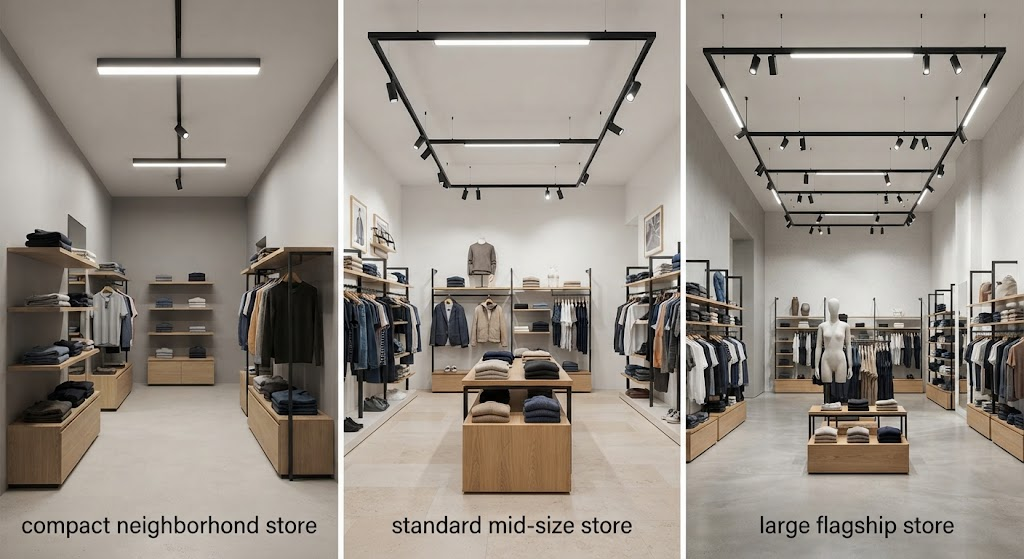
Consider a retailer with three store formats:
| Store format | Typical approach |
|---|---|
| Small store | Lower fixture quantity and wider distribution |
| Standard store | Balanced general and merchandising illumination |
| Flagship store | Greater flexibility with additional accent lighting |
The track, driver family, colour specification and control architecture can remain standardized.
The lighting layout can then be adapted to the actual space.
This approach provides consistency without making every store technically identical.
What CCT should be used for retail stores?
CCT should be selected according to the merchandise, brand concept and architectural environment. There is no single CCT that is correct for every retail environment.
| Retail environment | Common design range |
|---|---|
| Contemporary fashion | 3000–4000 K |
| Premium fashion | 2700–3500 K |
| General retail | 3000–4000 K |
| Supermarket | 3000–4000 K |
| Electronics | Around 4000 K |
| Food retail | Application dependent |
These are design references rather than universal regulatory requirements.
For a chain rollout, consistency is often more important than selecting one particular CCT.
If the approved concept is based on 3500 K, changing later stores to 4000 K can alter the visual appearance of the retail environment even when the architecture remains identical.
How important is SDCM for a retail chain?
SDCM helps control visible colour differences between luminaires using the same nominal CCT.
Two luminaires can both be labelled 3000 K while still appearing slightly different.
This becomes easier to notice when:
- Many fixtures are installed together
- Fixtures are positioned close to each other
- Walls are light coloured
- The architectural design is minimalist
- Merchandise is displayed under multiple luminaires
For this reason, a professional specification should state a maximum permitted SDCM rather than specifying CCT alone.
The exact requirement should match the quality level and visual sensitivity of the project.
Is CRI 90 enough for fashion retail?
CRI 90 can provide strong colour-rendering performance, but CRI alone does not fully describe how merchandise will appear.
For fashion and lifestyle retail, consider:
- CRI — overall colour-rendering performance.
- R9 — useful when saturated red rendering matters.
- CCT — determines the overall white-light appearance.
- SDCM — controls colour consistency between luminaires.
- Spectrum — affects the appearance of fabrics, skin tones and materials.
- Optics — determines how the merchandise is actually illuminated.
A high CRI number does not compensate for poor light distribution or excessive glare.
Colour quality should therefore be evaluated as a group of related parameters.
Does higher R9 always mean better retail lighting?
No. R9 is useful when evaluating red rendering, but a higher R9 value alone does not prove that a luminaire is better for retail.
This is particularly relevant to fashion stores.
Red, pink, orange, skin tones and some warm-toned materials can be affected by the spectral characteristics of the light source.
However, the lighting system still needs appropriate:
- Overall colour rendering
- CCT
- Spectral balance
- Optical distribution
- Illuminance
- Glare control
A professional specification should avoid reducing colour quality to a single number.
How should lumen output be specified?
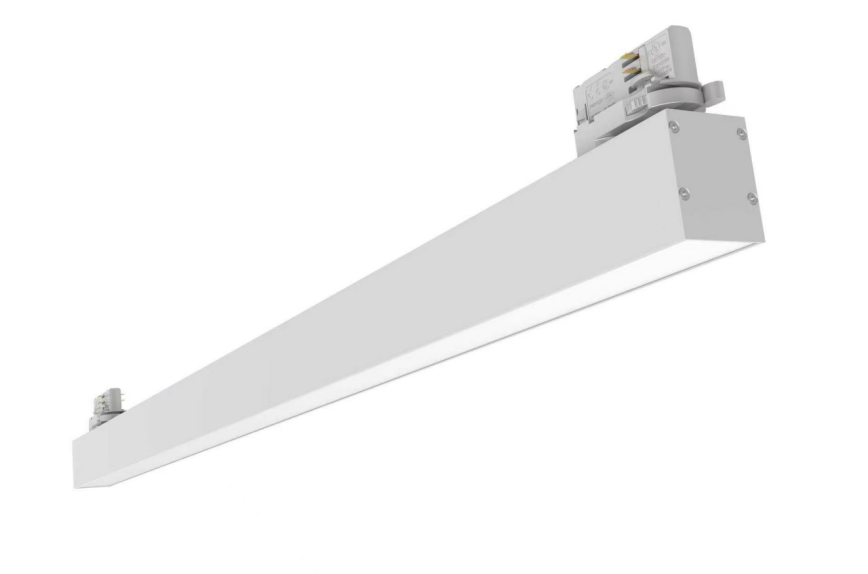
Delivered luminaire lumens should be specified rather than relying only on the LED package’s theoretical output.
Light losses can occur through:
- Optics
- Diffusers
- Drivers
- Thermal conditions
- Electrical conversion
- Operating temperature
A supplier may quote LED module output while the finished luminaire delivers a lower figure.
For procurement, the useful comparison is:
Luminaire input power → delivered lumens → optical distribution → actual lighting result
This provides a more realistic basis for comparing products.
Is the highest lm/W the best choice?
Not necessarily. Efficacy is only one part of retail lighting performance.
A high-efficiency luminaire can still be unsuitable if its light is distributed poorly.
For example, the system may create:
- Dark areas between shelves
- Excessive brightness on the floor
- Insufficient vertical illumination
- Glare for customers
- Poor illumination of merchandise
A better question is:
How efficiently does the luminaire deliver the required light to the surfaces that matter?
For retail, those surfaces are often vertical rather than horizontal.
Why is vertical illumination important in retail?
Vertical illumination is important because customers mainly see merchandise on walls, shelves, rails and displays rather than directly on the floor.
This is especially relevant to:
- Fashion walls
- Shelving
- Mannequins
- Product displays
- Cosmetics
- Merchandise cabinets
A lighting calculation that looks good on a horizontal illuminance plan can still produce an unsatisfactory store if the merchandise itself is poorly illuminated.
For track linear lighting, optical distribution should therefore be selected according to the actual merchandising geometry.
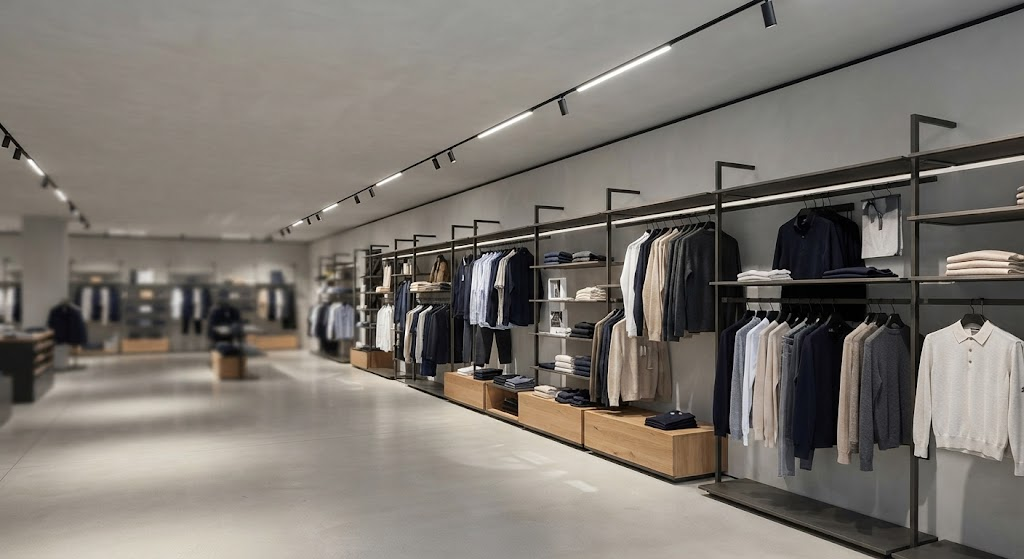
Which beam angle should be specified?
Beam angle should be selected according to mounting height, target surface and merchandise arrangement rather than using one beam angle throughout the store.
A simplified starting point is:
| Distribution | Typical application |
|---|---|
| Narrow | Feature merchandise |
| Medium | Shelving and focused displays |
| Wide | General merchandise |
| Asymmetric | Walls and vertical displays |
| Broad distribution | Circulation and ambient areas |
The actual result depends on ceiling height, fixture position and the geometry of the merchandise.
A 30° distribution installed at 3 m does not produce the same lighting result as the same distribution installed at 5 m.
Photometric data and lighting calculations should be used for final selection.
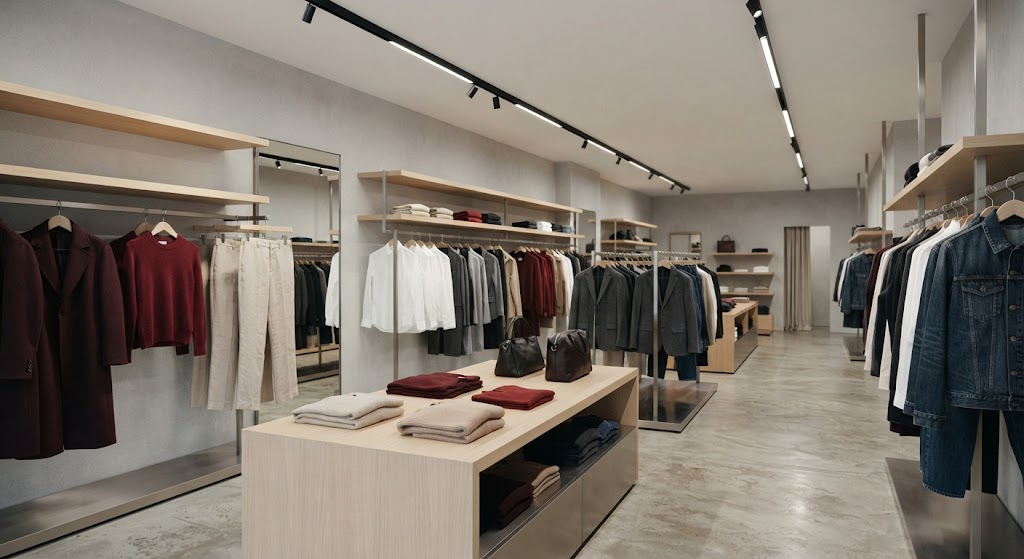
Can track linear lighting work with DALI-2?
Yes, provided the luminaire driver, track system and control components are designed for the required DALI-2 architecture.
DALI-2 is based on the IEC 62386 series and provides a standardized approach to digital lighting control.
Potential functions include:
- Individual addressing
- Dimming
- Lighting groups
- Scenes
- Occupancy sensing
- Daylight response
- Status information
- Maintenance-related data
DALI-2 should not be specified simply because a project is described as smart lighting.
The control system should match the actual operational requirements of the store.
Is DALI-2 necessary for every store?
No. Simple stores may not require a fully addressable digital control system.
For a small retail unit, basic switching or simple dimming may be sufficient.
For a large retail chain, digital control becomes more useful when the retailer requires:
- Standardized lighting schedules
- Multiple lighting zones
- Occupancy detection
- Daylight response
- Scene control
- Energy monitoring
- Maintenance information
The control architecture should be selected according to the size and operational requirements of the retail estate.
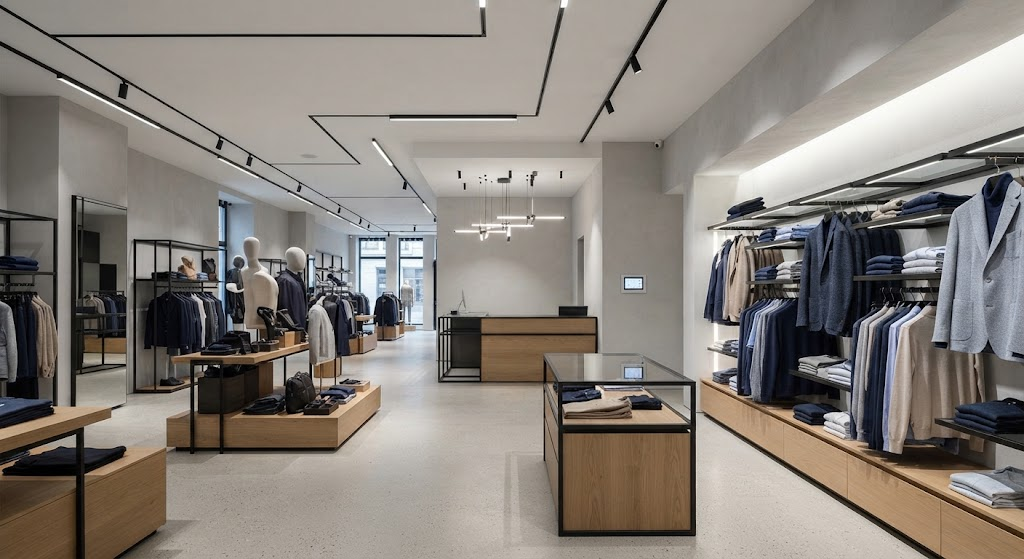
What standards matter for a 2026 specification?
The applicable standards and regulations should be identified according to the destination market and exact product configuration.
For general luminaire safety, IEC 60598-1:2024 is an important current reference for 2026 projects.
For track systems and track-mounted luminaires, the applicable product-specific requirements should also be checked.
For digital lighting control, IEC 62386 is the relevant international standard family for DALI systems.
For products placed on the EU market, the applicable requirements under Regulation (EU) 2019/2020 should be reviewed for the relevant light-source and control-gear configuration.
Compliance should always be checked against the actual product and destination market rather than relying on a generic statement such as “CE certified.”
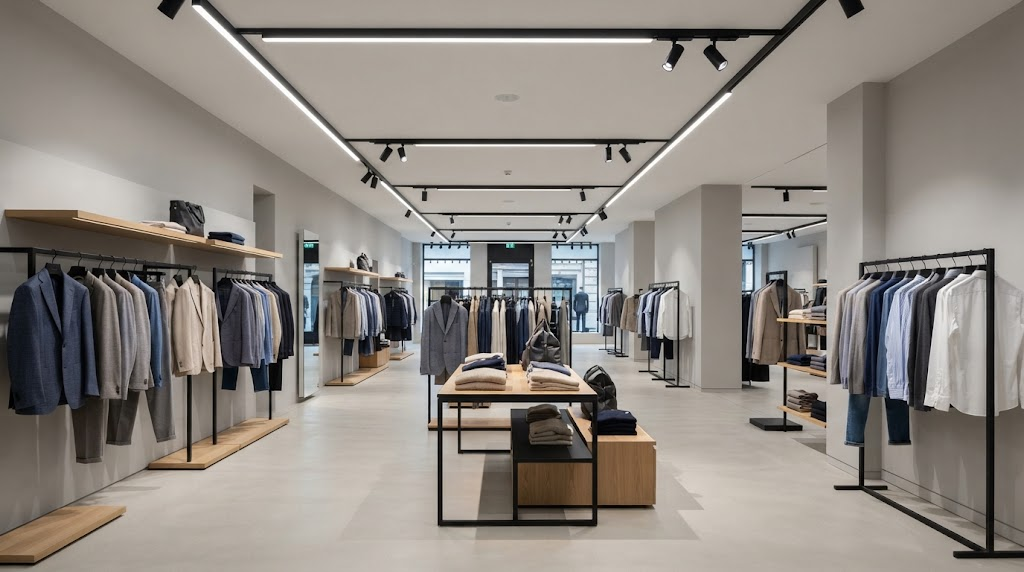
What should be checked before a European rollout?
European projects require a product-specific conformity review rather than a generic certificate check.
1. Confirm product classification
Determine whether the product is treated as a luminaire, light source, separate control gear or another applicable category.
2. Identify applicable requirements
Check the relevant:
- EN and IEC standards
- Ecodesign requirements
- Electrical safety requirements
- Electromagnetic compatibility requirements
- Market-specific documentation
3. Confirm the production configuration
The production model should match the approved sample and technical documentation.
This is particularly important when the same product will be installed across multiple countries and stores.
How should a retailer conduct a pilot store?
A pilot installation should become the technical reference for the wider rollout.
1. Install the proposed system in a representative store
Use actual:
- Ceiling height
- Flooring
- Shelving
- Wall finishes
- Merchandise
- Track configuration
2. Evaluate the lighting result
Check:
- Horizontal illuminance
- Vertical illuminance
- Uniformity
- Glare
- Colour appearance
- Merchandise visibility
3. Confirm the technical installation
Check:
- Track connections
- Driver installation
- Control system
- Fixture positioning
- Installation time
- Replacement procedure
4. Freeze the approved configuration
Once approved, record the exact:
- LED configuration
- Driver
- Optic
- Housing
- CCT
- SDCM
- Control method
This becomes the reference for subsequent stores.
How should the rollout be implemented?
A controlled rollout should move from one approved reference installation to standardized store-format packages.
1. Build the master specification
Define all critical technical parameters before mass purchasing.
The document should identify mandatory requirements and acceptable alternatives.
2. Create store-format templates
Prepare typical solutions for:
- Small stores
- Standard stores
- Large stores
- Flagship stores
Each template can define track arrangement, fixture density and optical distribution.
3. Approve the pilot store
Use a real installation to confirm the design and lighting performance.
4. Freeze the product configuration
Any change to the LED, driver, optic or other critical component should require technical approval.
5. Roll out by store format
Use the approved templates while allowing project-specific adjustments.
6. Verify installation
Contractors should receive clear installation drawings, positioning requirements and commissioning procedures.
What are the core advantages of track linear lighting?
The main advantage for retail chains is the combination of standardized infrastructure and adjustable illumination.
1. Merchandising flexibility
Fixtures can be repositioned when shelving, clothing rails or displays change.
2. Standardized procurement
A smaller number of approved product families can simplify purchasing and spare-part management.
3. Consistent visual identity
The same colour and optical specifications can be reproduced across multiple stores.
4. Easier maintenance
Technicians can work with familiar track and fixture systems across different locations.
5. Scalable controls
The same lighting platform can support simple dimming or more advanced digital control depending on store requirements.
Where is track linear lighting most suitable?
Track linear lighting is particularly useful in retail environments where merchandise arrangement changes and the lighting needs to remain adaptable.
1. Fashion stores
Suitable for:
- Clothing rails
- Display walls
- Tables
- Mannequins
- Feature merchandise
2. Supermarkets
Potential applications include:
- Aisles
- Promotional displays
- End caps
- Category zones
The optical distribution should match shelf height and aisle geometry.
3. Department stores
Different departments can use different optical configurations while sharing a common infrastructure.
4. Lifestyle stores
Linear illumination can provide general lighting while retaining flexibility around merchandise.
5. Flagship stores
The system can be combined with accent lighting and digital controls to create different lighting scenes.
What documents should a supplier provide?
A multi-store supplier should provide enough technical information for the retailer, designer and contractor to verify performance independently.
The technical package should include:
- Product datasheet
- Rated input power
- Delivered lumen output
- Photometric files
- CCT specification
- SDCM requirement
- CRI and R9 information where applicable
- Driver details
- Dimming compatibility
- Track compatibility
- Lifetime information
- Flicker information where relevant
- Relevant test reports
- Declaration of conformity
- Installation instructions
- Maintenance instructions
- Approved component list
For a large rollout, documentation is part of controlling product consistency.
What are the common mistakes?
Most multi-store lighting problems occur when the original specification is not controlled during procurement and installation.
1. Comparing products by wattage alone
A 30 W luminaire does not describe its optical performance.
2. Comparing only lumen output
More lumens do not necessarily mean better merchandise illumination.
3. Ignoring SDCM
The same nominal CCT can still produce visible colour variation.
4. Changing the driver
A different driver can affect dimming, flicker, power factor and control compatibility.
5. Replacing the LED or optic without testing
Small component changes can alter the final light distribution and colour appearance.
6. Treating all stores as identical
The lighting platform can be standardized while the layout remains store-specific.
7. Skipping the pilot installation
A datasheet cannot reproduce every interaction between light, architecture and merchandise.
FAQ: Track Linear Lighting for Multi-Store Rollouts
Yes. It can provide flexible illumination for clothing rails, walls, tables and merchandising areas, particularly where layouts change frequently.
No. A common product family and technical platform can be used while output, quantity and optics are adapted to store geometry.
Neither is universally better. The appropriate CCT depends on the store concept, merchandise and desired visual environment.
Not by itself. CRI should be considered together with R9, CCT, SDCM and spectral characteristics.
No. Optical performance, glare, vertical illumination, colour quality and useful light on merchandise also matter.
No. DALI-2 is appropriate when the project needs addressable digital control and related functions.
Yes, provided the system is designed as a scalable platform and individual store layouts are adapted to actual site conditions.
The critical components and performance parameters should be frozen, including LED configuration, driver, optic, CCT, SDCM, control method and track interface.
Replacement products should be treated as approved engineering changes rather than ordinary purchasing substitutions.
They should be checked for mechanical, electrical, photometric, colour and control compatibility.
2026 Track Linear Lighting Specification Checklist
Before approving a system, verify:
1. Optical performance
Delivered lumens, distribution and useful illumination.
2. Colour quality
CCT, CRI, R9 where relevant and SDCM.
3. Electrical performance
Input power, driver and power quality.
4. Glare
Luminaire luminance and project-specific glare requirements.
5. Controls
Dimming method and DALI-2 compatibility where required.
6. Track compatibility
Mechanical and electrical interface.
7. Compliance
Applicable EN and IEC requirements and destination-market regulations.
8. Documentation
Photometry, test reports and conformity documentation.
9. Repeatability
Production consistency and engineering-change control.
10. Pilot validation
Actual installation testing before mass deployment.
Final Answer: How should retailers specify track linear lighting in 2026?
The most robust approach is to standardize the lighting platform while allowing the optical layout to respond to each individual store.
The specification process can be summarized as:
Master specification → prototype → pilot store → performance verification → approved configuration → store-format templates → controlled rollout → installation verification → maintenance
The important parameters are not limited to wattage or lumen output.
A professional 2026 specification should control:
Light distribution + colour consistency + colour rendering + glare + electrical performance + controls + compatibility + compliance + long-term maintainability
For a multi-store retailer, the real measure of a lighting system is not whether one store looks good.
It is whether the same lighting quality can be reproduced reliably across the entire retail estate while still allowing each store to respond to its own architecture and merchandising requirements.