Dimmable DALI spotlights combine LED accent lighting with digital lighting control. They allow individual luminaires or groups to be dimmed, assigned to scenes and integrated with sensors or other building systems. For retail projects, the important specification is not simply “DALI”, but the complete combination of driver, dimming performance, optics, colour quality, flicker performance and control architecture.
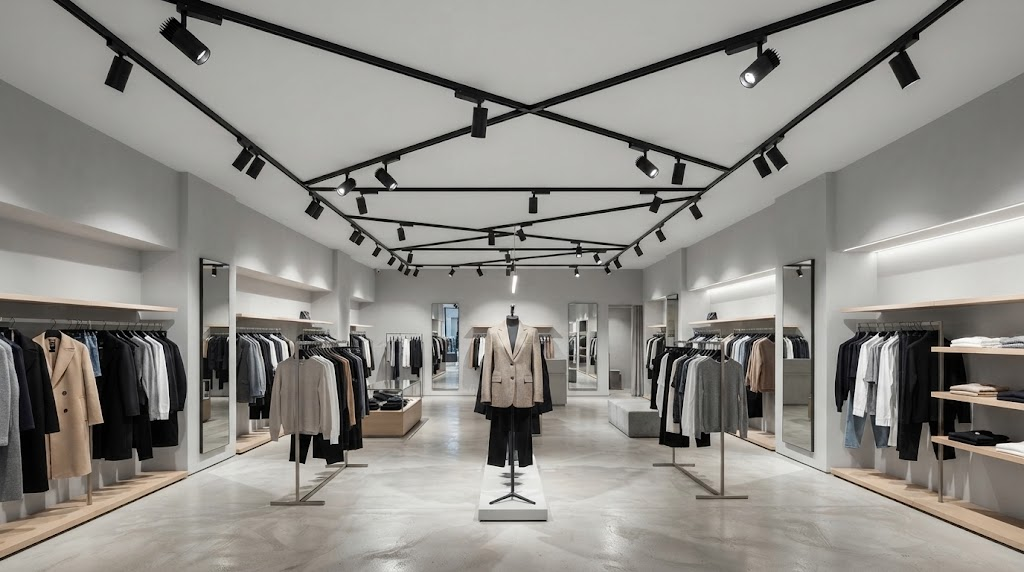
What is a dimmable DALI spotlight?
A dimmable DALI spotlight is an LED spotlight controlled through the DALI protocol, allowing its light output to be adjusted digitally.
DALI stands for Digital Addressable Lighting Interface. DALI-2 is the current certification programme built around the DALI protocol and the relevant IEC 62386 requirements.
The difference is important in commercial lighting. A conventional dimmable spotlight may only provide a way to reduce light output. A DALI-controlled spotlight can also become part of an addressable lighting system.
Depending on the equipment and system configuration, DALI can be used for:
- Individual spotlight control
- Group control
- Scene setting
- Scheduled lighting
- Sensor integration
- Daylight-related control
- Lighting-system monitoring
- Diagnostic and energy data in supported systems
The DALI Alliance and IEC 62386 define the technical framework for these functions.
Why use DALI spotlights in retail stores?
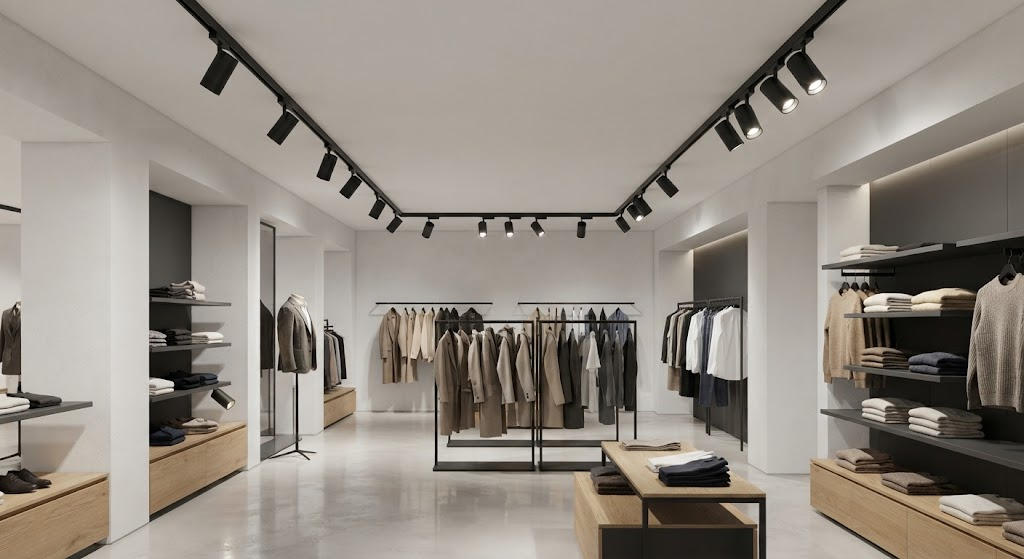
DALI is most useful in retail when the lighting needs to change as the store changes.
A fashion store, showroom or department store rarely has a completely fixed lighting layout. Displays move, products change, seasonal campaigns are introduced and different lighting levels may be required during trading, cleaning and events.
With conventional switching, these changes can require additional circuit planning or manual adjustment. With an addressable DALI system, many changes can be handled through system configuration.
| Conventional switching | DALI lighting control |
|---|---|
| Mainly ON/OFF | Digital dimming and control |
| Fixed circuit groups | Individual and configurable groups |
| Limited scene control | Programmable scenes |
| Limited flexibility | Easy reconfiguration |
| Little system feedback | Feedback available in supported systems |
| Simple installation | More sophisticated control architecture |
DALI does not automatically make a retail lighting system more efficient or more flexible. The benefit comes from using the control capability properly.
What is the difference between DALI and DALI-2?
DALI-2 is a newer certification and interoperability framework rather than simply a different dimming level.
IEC 62386 defines the technical requirements for DALI. DALI-2 certification covers applicable control gear and control devices according to the relevant parts of the standard.
For procurement, this means “DALI compatible” and “DALI-2 certified” should not automatically be treated as the same statement.
A project specification should check:
- The exact LED driver model.
- Whether the relevant product is DALI-2 certified.
- Which IEC 62386 functions are supported.
- Whether the driver is compatible with the selected controller.
- Whether sensors or other control devices are required.
- Whether the complete system has been tested together.
The DALI Alliance maintains certification information for DALI-2 products, so the current status should be checked when a project is being specified.
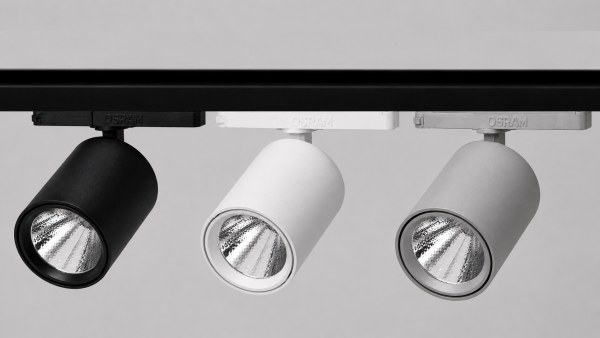
Is the LED driver important in a DALI spotlight?
The driver is one of the most important components because it converts DALI commands into controlled LED output.
Two spotlights can have similar housings, LED power and lumen ratings but behave very differently when their drivers are different.
For a commercial project, the driver specification should include:
| Driver parameter | Why it matters |
|---|---|
| DALI / DALI-2 status | Determines control compatibility |
| Dimming range | Defines usable light levels |
| Dimming curve | Affects how smoothly brightness changes |
| Minimum output | Important for low-light scenes |
| Flicker performance | Important for visual comfort and camera use |
| Standby power | Affects system-level consumption |
| Driver efficiency | Affects electrical demand and heat |
| Thermal performance | Influences reliability |
| Protection functions | Supports long-term operation |
| Data capability | Relevant to advanced DALI/D4i systems |
For this reason, a DALI spotlight should not be evaluated only from its housing, LED chip or wattage.
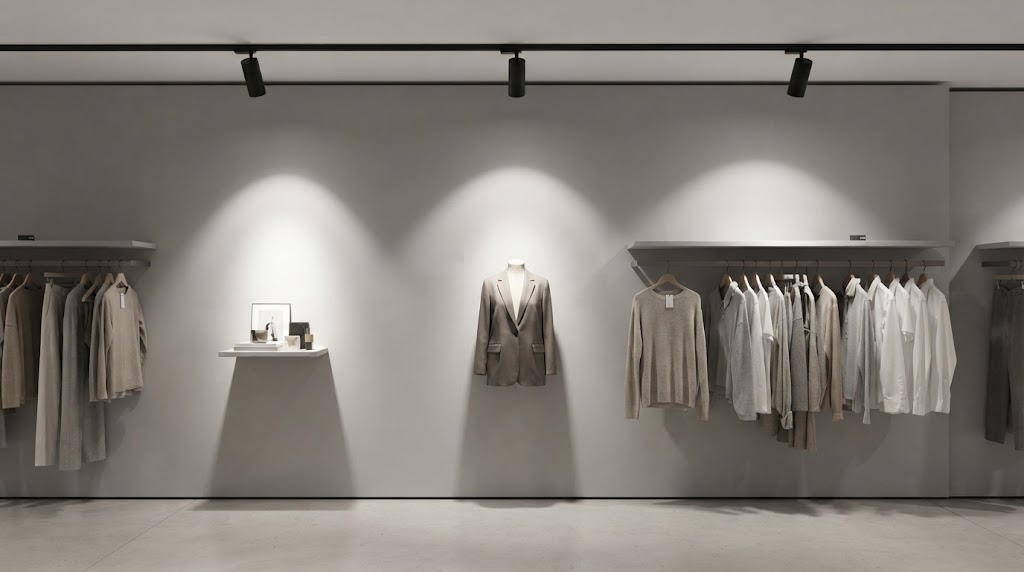
How far can a DALI spotlight be dimmed?
The actual dimming range depends on the LED module and driver combination, so the manufacturer’s tested performance should be used rather than assuming a universal minimum level.
A specification that simply says “1–100% dimmable” does not tell the whole story.
At low output, the important questions are:
- Does the light remain stable?
- Is there visible flicker?
- Does the spotlight switch off suddenly?
- Does the colour change?
- Is the response smooth?
- Does the driver make audible noise?
- Does the luminaire restart correctly?
Low-level performance matters particularly in retail stores that use evening scenes or reduced-output display lighting.
A spotlight that performs well from 100% to 20% may be completely adequate for one project but unsuitable for another that requires very low output.
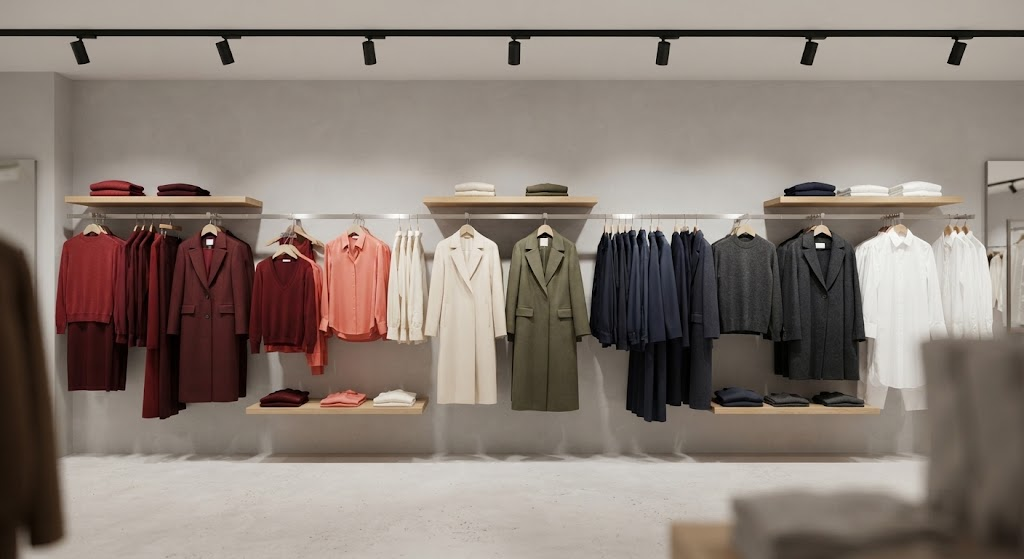
Does DALI automatically save energy?
DALI itself does not guarantee energy savings. It provides the control functions that can be used to reduce unnecessary lighting operation.
Actual energy consumption depends on:
- Luminaire wattage
- Driver efficiency
- Operating hours
- Dimming levels
- Occupancy
- Daylight availability
- Lighting schedules
- Control strategy
For example, a store could operate its lighting at different levels throughout the day:
| Operating condition | Example output |
|---|---|
| Peak retail period | 100% |
| Normal operation | 80% |
| Evening operation | 60% |
| Cleaning | 100% |
| Closed | OFF or minimum level |
These values are examples only and should not be presented as guaranteed energy savings.
The actual project saving should be calculated from the real operating profile.
European lighting-efficiency policy also treats controls, light sources and control gear as separate parts of the overall energy-performance picture.
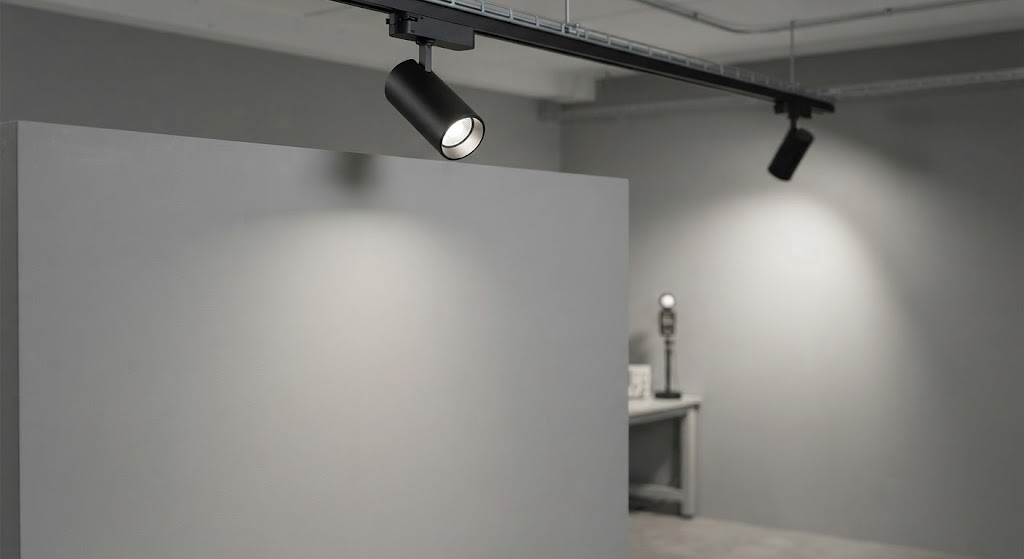
Can DALI control individual spotlights?
Yes. Individual addressing is one of the main reasons DALI is useful in retail lighting.
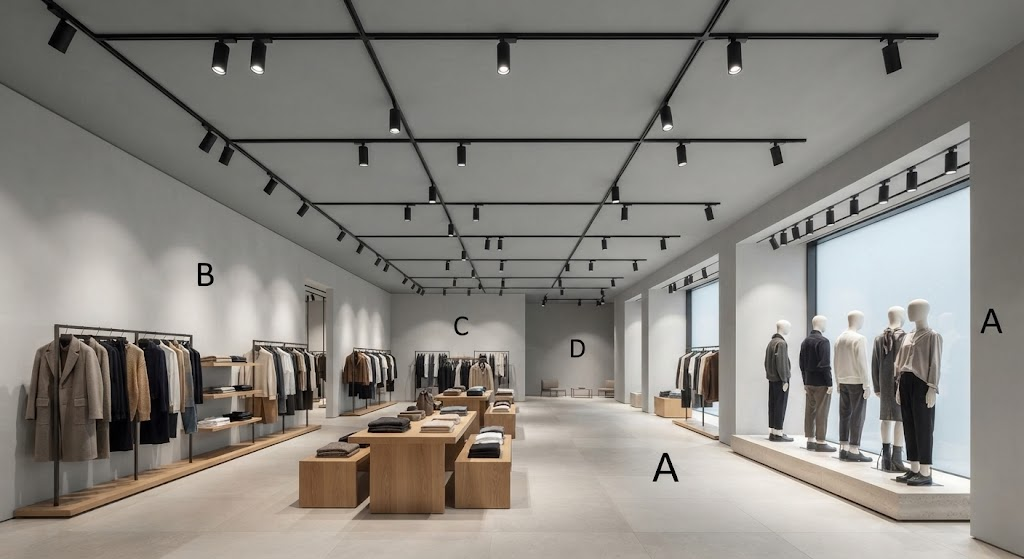
Imagine a store with 60 track spotlights.
The system could potentially organise them into groups such as:
- Window display
- Feature wall
- Central merchandise
- Fitting-room approach
- Circulation area
The individual luminaires can then be assigned to groups or scenes according to the requirements of the store.
This is different from a simple electrical circuit where every luminaire connected to the same switching group behaves in the same way.
What are DALI groups and scenes?
Groups determine which luminaires operate together. Scenes define a particular lighting state.
For example:
Group: Window
Eight spotlights illuminate the window display.
Group: Main retail
Twenty spotlights illuminate the main merchandise area.
Scene: Normal trading
Main retail lighting operates at the normal programmed level.
Scene: Evening
Background lighting is reduced while selected displays remain brighter.
Scene: Cleaning
General lighting is increased for staff.
The practical advantage is that the same physical installation can support several operating conditions without changing the electrical wiring.
Why is DALI useful for fashion stores?
DALI is particularly useful in fashion retail because merchandising changes frequently.
A spotlight may illuminate a mannequin today and a different product wall next month.
The physical track provides mechanical flexibility. DALI provides control flexibility.
This combination is useful for:
- Mannequins
- Hero products
- Feature walls
- Clothing racks
- Seasonal displays
- Window displays
- Promotional areas
The lighting can therefore follow the merchandise rather than forcing the merchandise to follow the original lighting groups.
What beam angle should a DALI spotlight use?
Beam angle should be selected according to the target, mounting height and distance rather than according to the DALI function.
DALI controls the spotlight. The optic determines how the light is distributed.
| Beam angle | Typical application |
|---|---|
| 10–15° | Small hero products, mannequins, strong accents |
| 20–24° | Product displays and fashion walls |
| 30–36° | General merchandise |
| 40–60° | Large display surfaces |
These ranges are practical starting points, not universal rules.
A 15° beam can create a strong focal point, but it can also produce excessive contrast if the target is too large.
A 36° beam covers more area but may provide less visual emphasis.
The final choice should be based on photometric data and the actual distance between the spotlight and the merchandise.
Why does beam angle matter in fashion retail?
Beam angle controls both coverage and visual hierarchy.
For example, a narrow beam may be appropriate for a mannequin or a single hero product. A medium beam can work better across a clothing wall where several products need to be visible together.
The objective is not to make every product equally bright.
Good retail lighting normally creates a hierarchy between:
- General circulation
- Merchandise
- Feature displays
- Hero products
- Architectural elements
DALI allows that hierarchy to be adjusted over time, while the optical system determines how the hierarchy appears physically.
What CRI should a DALI spotlight have?
DALI does not determine colour rendering. CRI, spectral distribution, LED selection and other colour-quality metrics determine how merchandise appears.
For premium retail, CRI 90+ is a common starting point.
However, CRI alone is not enough.
A professional specification may also consider:
- R9
- Rf
- SDCM
- CCT
- Spectral distribution
- Colour consistency between luminaires
Recent CIE work on colour-quality metrics also reflects the industry’s move toward broader colour-fidelity evaluation rather than relying on a single number.
Is R9 important for fashion lighting?
R9 is relevant to fashion retail because red components appear in many garments, leather products, cosmetics and warm-coloured materials.
A spotlight with strong colour rendering can make these products appear more natural and visually convincing.
However, high R9 should not be treated as proof of overall superior colour quality.
A better specification considers CRI/Ra together with R9, newer colour-fidelity metrics where available, SDCM and actual spectral performance.
This also avoids a common mistake: assuming that increasing R9 automatically improves every aspect of the lighting system.
Does dimming affect colour quality?
The LED and driver combination should maintain controlled colour performance throughout the specified dimming range.
The practical test is more important than the catalogue statement.
Check the spotlight at:
- 100%
- 75%
- 50%
- 25%
- Minimum claimed output
Compare the luminaires for:
- CCT change
- Colour consistency
- Flicker
- Stability
- Start-up behaviour
This is particularly important when many track spotlights are installed in the same visual field.
What is SDCM and why does it matter?
SDCM is used to describe colour variation between LED light sources.
It becomes particularly noticeable when many spotlights illuminate the same white wall, clothing rack or display.
For projects requiring tight colour consistency, ≤3 SDCM is a useful specification starting point.
The important point is simple:
DALI controls the lighting system, but it does not correct poor LED colour consistency.
The LED source, binning and luminaire production quality determine that.
Should flicker be specified for DALI spotlights?
Flicker and temporal light modulation should be considered separately from DALI compatibility.
Digital control does not automatically mean excellent flicker performance.
This is increasingly relevant in retail because lighting is frequently recorded by:
- Smartphones
- Security cameras
- Social-media video
- Professional cameras
- Product photography
A spotlight can appear comfortable to the eye but still produce unwanted effects on camera.
For demanding commercial projects, request measured temporal-light-modulation data instead of relying only on marketing terms such as “flicker-free”.
Can DALI spotlights work with 3-phase track systems?
Yes. DALI-controlled spotlights can be integrated into compatible 3-phase track systems.
The complete installation should be checked for:
- Mechanical track compatibility
- Track adapter compatibility
- Electrical connection
- DALI bus connection
- Driver compatibility
- System load
- Control-system compatibility
- Addressing
A DALI driver inside a spotlight does not automatically make every track installation compatible.
Can DALI control track spotlights individually?
Yes, when the spotlight, track adapter and control system support individual DALI addressing.
This creates two different types of flexibility.
Mechanical flexibility: the spotlight can be moved along the track and re-aimed.
Digital flexibility: its control group or scene can be changed through the lighting-control system.
This is particularly useful for stores where displays are regularly rearranged.
What is D4i?
D4i extends DALI capabilities toward luminaire data, diagnostics and IoT-oriented applications.
Depending on the equipment, supported information can include:
- Luminaire information
- Energy-related data
- Operating information
- Diagnostics
- Maintenance-related information
D4i becomes more relevant as a retail lighting project moves from basic dimming toward connected lighting and building-management applications.
For a small boutique, these functions may not be necessary. For a large retail estate, they can become more useful.
Does every DALI spotlight have DALI-2 certification?
No.
“DALI compatible” should not automatically be interpreted as “DALI-2 certified”.
DALI-2 certification applies to relevant products and components under the certification framework. A luminaire containing a certified driver is not necessarily equivalent to a claim that the complete luminaire itself carries a universal DALI-2 certification.
For procurement, verify the exact driver and component information.
This distinction is particularly important when a specification requires certified DALI-2 components.
How should DALI spotlights be specified for a retail project?
1. Define the lighting objective
Start with the merchandise and the visual result, not the wattage.
Define:
- Ceiling height
- Spotlight position
- Target size
- Target distance
- Desired contrast
- Beam angle
- CCT
- CRI
- R9
- Required lumen output
- Glare requirements
A useful specification might say:
“Provide focused accent lighting for a 1.2 m-wide fashion display from a 3.5 m ceiling.”
That is more meaningful than simply specifying a 30 W spotlight.
2. Select the LED and optical system
The LED and optics should be selected together because lumen output alone does not describe how effectively a spotlight illuminates merchandise.
Check:
- Delivered lumens
- Luminaire efficacy
- Beam angle
- Beam uniformity
- CRI
- R9
- SDCM
- CCT
- Glare
- Light distribution
A lower-wattage spotlight with efficient optics can sometimes provide a better result than a higher-wattage fixture with poor distribution.
3. Select the DALI driver
The driver should be specified according to the required control performance.
Check:
- DALI / DALI-2 status
- Dimming range
- Minimum stable output
- Dimming curve
- Flicker performance
- Driver efficiency
- Standby consumption
- Thermal performance
- Protection functions
Do not leave the driver specification entirely to the luminaire supplier if the project has strict control requirements.
4. Define the control architecture
Decide how the lighting should operate before installation.
Define:
- Individual addresses
- Groups
- Scenes
- Sensors
- User controls
- Time schedules
- Daylight response
- Building-management integration
A small boutique may only need several groups and scenes.
A large flagship store may need much more detailed zoning.
5. Commission the system
Commissioning is essential because DALI addresses, groups, scenes and control logic must correspond to the actual store.
A practical commissioning process includes:
- Identify luminaires.
- Confirm addresses.
- Create groups.
- Configure scenes.
- Set default levels.
- Test dimming.
- Test low-level operation.
- Test sensors where applicable.
- Check scene transitions.
- Record the final configuration.
- Provide handover documentation.
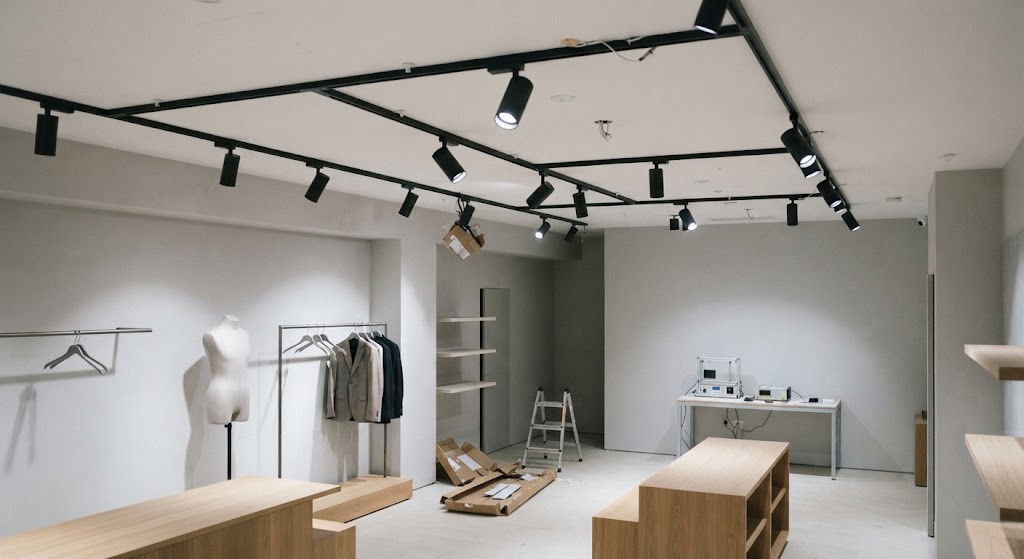
The lighting system should be tested after the merchandise and displays are installed, because the final visual result can differ from the empty-shell condition.
What are the main advantages of DALI dimmable spotlights?
DALI’s main advantage is the combination of digital addressing, flexible grouping and programmable control.
1. Individual control
Individual luminaires can be addressed where the system supports it.
2. Flexible grouping
Spotlights can be organised according to merchandising zones.
3. Scene control
Different lighting conditions can be programmed for trading, evening operation, cleaning and events.
4. Easier adaptation
Control settings can be changed when the store layout changes.
5. Integration
DALI-2 supports a broader control-device ecosystem, while D4i adds further data and diagnostic capabilities where supported.
6. Energy-management potential
Dimming, scheduling and sensor-based strategies can reduce unnecessary lighting operation.
The actual energy saving still depends on the project.
Where are DALI dimmable spotlights most suitable?
DALI spotlights are most useful where lighting needs to respond to different zones, products or operating conditions.
| Application | Typical reason for using DALI |
|---|---|
| Fashion stores | Frequently changing displays |
| Flagship stores | Multiple scenes and zones |
| Premium boutiques | Precise accent control |
| Department stores | Large number of lighting groups |
| Supermarkets | Department and promotional control |
| Showrooms | Different products need different emphasis |
| Galleries | Controlled illumination |
| Hospitality retail | Scene-based operation |
| Small fixed-layout shop | May require only basic control |
DALI vs 0–10 V: what is the practical difference?
DALI provides digital addressing and more advanced control functions, while 0–10 V remains useful for straightforward analogue dimming.
| Function | DALI | 0–10 V |
|---|---|---|
| Basic dimming | Yes | Yes |
| Individual addressing | Yes | Limited |
| Digital communication | Yes | No |
| Group control | Yes | Yes |
| Scene management | Yes | Usually needs additional architecture |
| Feedback | Supported | Limited |
| Sensor ecosystem | Strong | Separate architecture |
| Commissioning | More advanced | Simpler |
| Large retail projects | Suitable | Depends on requirements |
| Simple installations | May be unnecessary | Often adequate |
There is no need to specify DALI simply because it is a newer technology.
The control requirements should determine the choice.
What should a DALI spotlight RFQ include?
A professional RFQ should cover the luminaire, driver and control system together.
Luminaire
- LED power
- Delivered lumens
- Luminaire efficacy
- CCT
- CRI
- R9
- SDCM
- Beam angle
- Glare data
- Lifetime
- Operating temperature
- IP rating where required
Driver
- DALI / DALI-2 status
- Exact driver model
- Dimming range
- Dimming curve
- Minimum output
- Standby consumption
- Efficiency
- Flicker/TLM data
- Protection functions
Control
- Individual addressing
- Group control
- Scene control
- Sensors
- Gateway requirements
- Building-management integration
- Commissioning requirements
Documentation
- Datasheet
- Photometric file
- Driver datasheet
- Wiring diagram
- Certification information
- Dimming curve
- Flicker/TLM test data
- Installation instructions
- Commissioning documentation
How should a DALI spotlight sample be tested?
A sample should be tested as a complete system rather than judged only by appearance.
1. Test the light distribution
Check:
- Beam shape
- Beam uniformity
- Centre intensity
- Spill light
- Glare
- Wall-washing
- Product contrast
2. Test the dimming
Check the spotlight at:
- 100%
- 75%
- 50%
- 25%
- Minimum specified output
Look for flicker, instability, colour change and sudden transitions.
3. Test multiple fixtures
Install several samples together.
Check whether their CCT and colour appearance remain visually consistent.
4. Test the control
Confirm:
- Individual addressing
- Group control
- Scene control
- Sensor response
- Restart behaviour
5. Test the actual merchandise
This is especially important for fashion.
A spotlight can perform well in a technical test and still produce an undesirable result on particular fabrics or colours.
The final approval should therefore include a visual assessment using representative merchandise.
What are the common mistakes when buying DALI spotlights?
The most common mistake is treating “DALI” as a complete product specification.
Mistake 1: Selecting by wattage
Wattage does not tell you how effectively the spotlight illuminates the target.
Mistake 2: Assuming DALI means DALI-2
The exact driver and certification status should be checked.
Mistake 3: Ignoring low-level dimming
A spotlight can be technically dimmable but unstable at low output.
Mistake 4: Ignoring temporal light modulation
DALI compatibility does not guarantee good flicker performance.
Mistake 5: Choosing beam angle without considering mounting geometry
The same optic can produce very different results at different distances.
Mistake 6: Looking only at CRI
Colour quality should be considered using CRI, R9, colour fidelity, SDCM and spectral information where available.
Mistake 7: Forgetting commissioning
The control system needs to be configured for the actual store.
Mistake 8: Testing only one spotlight
Colour consistency becomes much more important when dozens of spotlights are installed together.
Are DALI spotlights suitable for multi-store retail rollouts?
DALI can be useful for multi-store projects because a common control philosophy can be reproduced across different locations.
A retailer can standardise:
- Group naming
- Scene structure
- Default dimming levels
- Operating schedules
- Commissioning procedures
- Documentation
- Control requirements
However, the physical lighting design should still respond to each store.
Ceiling heights, architecture, display density and local electrical conditions may vary significantly.
The goal should be standardised control logic with site-specific lighting design, rather than forcing every store to use exactly the same fixture arrangement.
What is a practical DALI specification for a fashion store?
For a quality-conscious fashion project, the following can be used as a starting specification:
| Parameter | Example target |
|---|---|
| Control | DALI-2 where required |
| CRI | ≥90 |
| R9 | Strong performance |
| SDCM | ≤3 where tight colour consistency is required |
| CCT | 3000K / 3500K / 4000K according to store concept |
| Beam angle | 15° / 24° / 36° depending on target |
| Dimming | Smooth and stable digital dimming |
| Flicker | Measured and appropriate for application |
| Track | Compatible track system |
| Control | Individual + group + scene |
| Documentation | Complete technical documentation |
These are starting points rather than universal requirements. The final specification should reflect the merchandise, architecture and lighting design.
FAQ: Dimmable DALI Spotlights
Yes. A compatible DALI-controlled LED driver allows the spotlight’s output to be digitally controlled.
Only when the specific LED driver and luminaire provide stable operation at that level. The manufacturer’s tested performance should be checked.
No. Standard DALI dimming normally controls intensity. Tunable white requires a suitable multi-channel LED and control architecture.
Yes, when the luminaire and control system support the required multi-channel control functions.
No. DALI enables dimming, scheduling and sensor-based strategies. The actual energy saving depends on how those functions are used.
DALI provides more digital control functionality. 0–10 V can still be appropriate for simpler projects.
Yes, when the spotlight, adapter, track and control system are compatible.
Professional installations should be commissioned so that addressing, groups, scenes and control functions match the actual store.
No. DALI controls the lighting system. CRI, R9 and other colour characteristics depend on the LED source and luminaire design.
It can, depending on the LED and driver design. This should be tested across the complete specified dimming range.
There is no single best beam angle. Narrow beams are useful for focused accents, while wider beams cover larger merchandising areas.
It depends on the control requirements. A small fixed-layout store may need only simple control, while a boutique with changing displays can benefit from addressable scenes and flexible grouping.
Dimmable DALI Spotlight Specification Checklist
Before approving a DALI spotlight, check the following.
Lighting performance
- Delivered lumen output
- Luminaire efficacy
- Beam angle
- Beam quality
- CRI
- R9
- SDCM
- CCT
- Glare performance
- Lifetime
Dimming
- DALI / DALI-2
- Minimum stable output
- Dimming curve
- Low-level stability
- Flicker/TLM performance
- Colour stability during dimming
Driver
- Exact driver model
- Certification information
- Driver efficiency
- Standby power
- Thermal performance
- Protection functions
Control
- Individual addressing
- Groups
- Scenes
- Sensors
- Scheduling
- Building-management integration
- Commissioning requirements
Installation
- Track compatibility
- Adapter compatibility
- DALI bus connection
- Mechanical installation
- Electrical loading
Documentation
- Datasheet
- Photometric file
- Driver datasheet
- Wiring diagram
- Certification information
- Dimming curve
- Flicker/TLM data
- Installation instructions
- Commissioning documentation
Final takeaway
A DALI spotlight should not be specified simply as “an LED track spotlight with dimming”.
The better approach is to treat the LED source, optics, driver and control system as one lighting solution.
For retail applications, the key specification is:
DALI-2 where required + reliable LED driver + stable dimming + suitable optics + high colour quality + consistent colour + controlled temporal light modulation + appropriate beam angle + proper commissioning.
DALI provides the control layer. The LED and optics determine the light. The driver connects the two.
That is why the right question is not:
“Is this spotlight DALI dimmable?”
The more useful question is:
“Does this complete spotlight system provide the lighting quality, dimming behaviour and control functions required by the project?”