
A track light labelled UGR<19 is not guaranteed to achieve UGR<19 in every installation. Unified Glare Rating (UGR) evaluates discomfort glare within a defined lighting environment. Room dimensions, luminaire photometry, mounting position, aiming direction and observer location all affect the result.
This distinction is particularly relevant to adjustable LED track lighting. A spotlight may have suitable low-glare optical characteristics, but its performance in a completed project cannot be established from the product label alone.
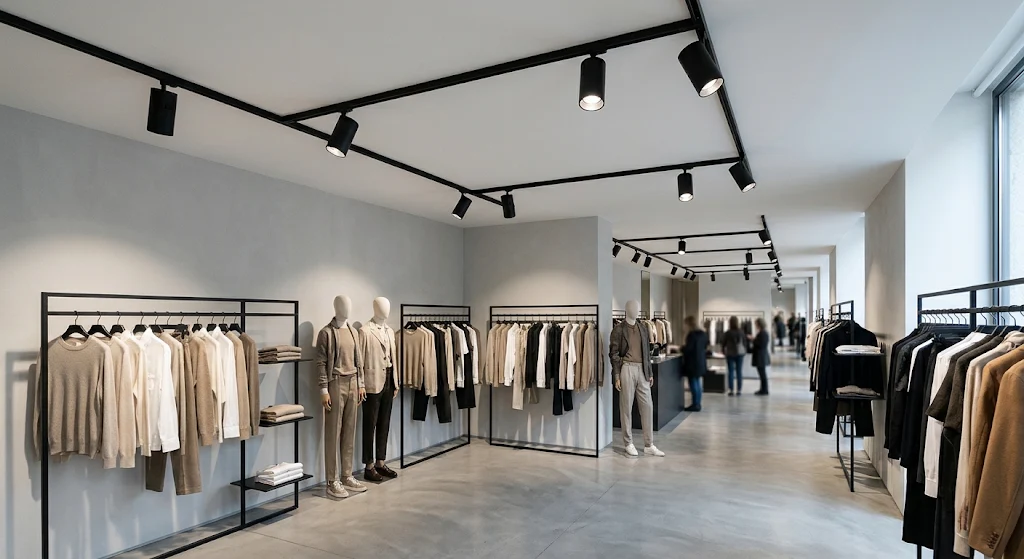
1. What Is UGR in Lighting?
UGR stands for Unified Glare Rating, a method developed by the International Commission on Illumination (CIE) to evaluate discomfort glare from indoor lighting installations.
It considers the brightness of visible luminaires in relation to the surrounding visual field and the observer’s position.
The UGR formula is:
[
UGR=8\log_{10}\left[\frac{0.25}{L_b}
\sum\frac{L^2\omega}{p^2}\right]
]
Where:
- L = luminance of each luminaire in the observer’s viewing direction (cd/m²).
- Lb = background luminance (cd/m²).
- ω = solid angle subtended by each luminaire at the observer’s eye.
- p = Guth position index, accounting for the position of the glare source relative to the line of sight.
The formula shows why UGR cannot be determined from a track light’s wattage, lumen output or beam angle alone.
It is a calculated glare rating based on the photometric characteristics of the luminaires and the viewing conditions within a space.
2. What Does UGR<19 Mean on a Track Light?
UGR<19 is commonly used as a glare-control criterion in certain indoor lighting applications, particularly offices and environments requiring good visual comfort.
However, three different things should be distinguished:
- Luminaire optical performance: How the fixture distributes light and controls the visibility and brightness of its light source.
- Published UGR information: A rating or table calculated under specified conditions.
- Project UGR: The calculated result for a particular room, luminaire arrangement and observer position.
These are not interchangeable.
A manufacturer may provide UGR information for a luminaire based on standardised calculation conditions. That information is useful for product comparison, but it does not establish the UGR of every installation using that product.
For a track spotlight, the final result must be considered in the context of its actual application.
3. Why Does the Same Track Light Produce Different UGR Results?
The same spotlight can produce different glare results when installed in different positions or viewed from different directions.
Four factors are particularly relevant.
3.1 Mounting Height and Luminaire Position
The mounting height determines the distance between the luminaire and the observer, as well as its apparent size and position in the field of view.
Track location also affects how directly the luminous aperture is visible.
For example, a spotlight installed above a display wall may have a different relationship with the customer’s line of sight from one installed directly above a circulation aisle.
Changing the mounting position changes the lighting geometry and can affect the calculated glare rating.
3.2 Aiming Direction and Tilt Angle
Adjustable track spotlights allow the beam to be directed towards merchandise, walls and architectural features.
The aiming direction also determines which parts of the optical system are visible from different viewing positions.
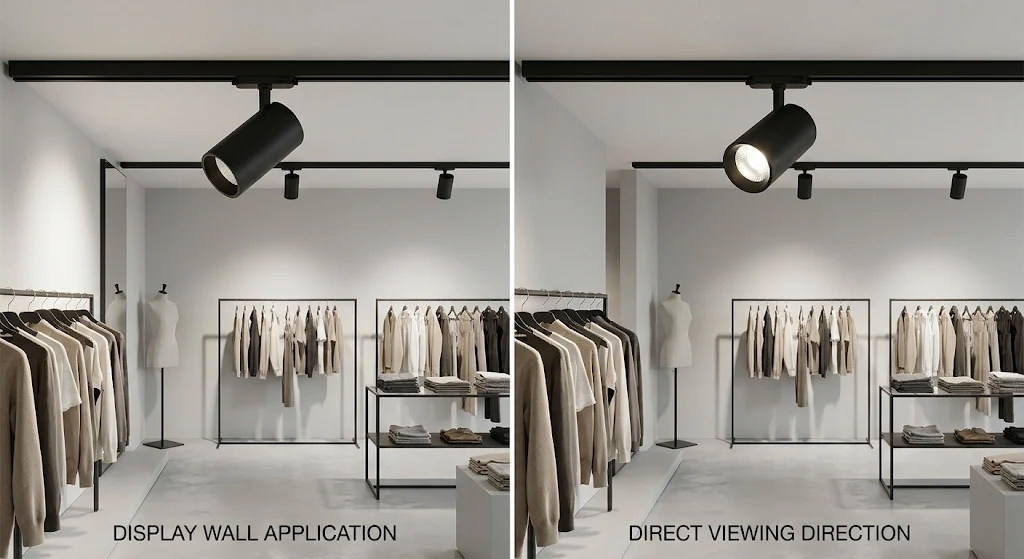
Consider two installations:
- Display lighting: The spotlight is tilted towards a merchandise wall. The beam illuminates the products while the optical aperture is positioned away from the main viewing direction.
- Circulation lighting: The spotlight is aimed across an aisle, where customers may see the bright aperture directly.
The second arrangement may create greater discomfort, depending on the luminaire’s photometry and viewing geometry.
There is no universal tilt angle that guarantees UGR<19. A 30° or 45° aiming angle, for example, should not be treated as a substitute for a proper glare calculation.
3.3 Observer Position and Viewing Direction
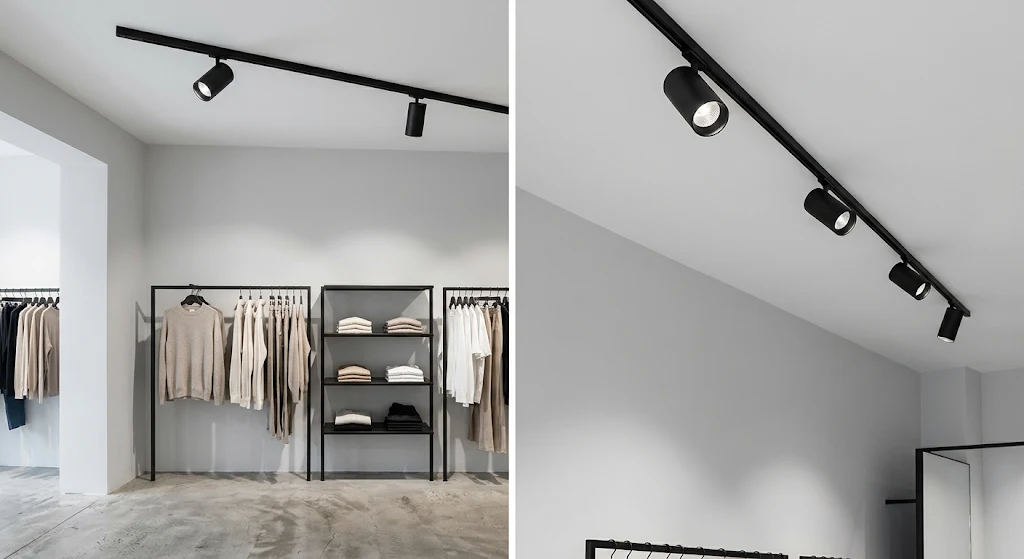
UGR is calculated for a defined observer position and viewing direction.
This is important in retail environments, where customers and staff move through the space rather than remaining at fixed desks.
In a fashion store, relevant viewing positions may include:
- Looking towards a wall-mounted clothing display.
- Standing in front of a mannequin.
- Walking along a circulation aisle.
- Looking towards a fitting-room mirror.
- Standing at a checkout counter.
A lighting arrangement that performs well from one position may produce a different result from another.
For larger retail projects, several representative viewing positions should be considered during the design stage.
3.4 Background Luminance and Surface Reflectance
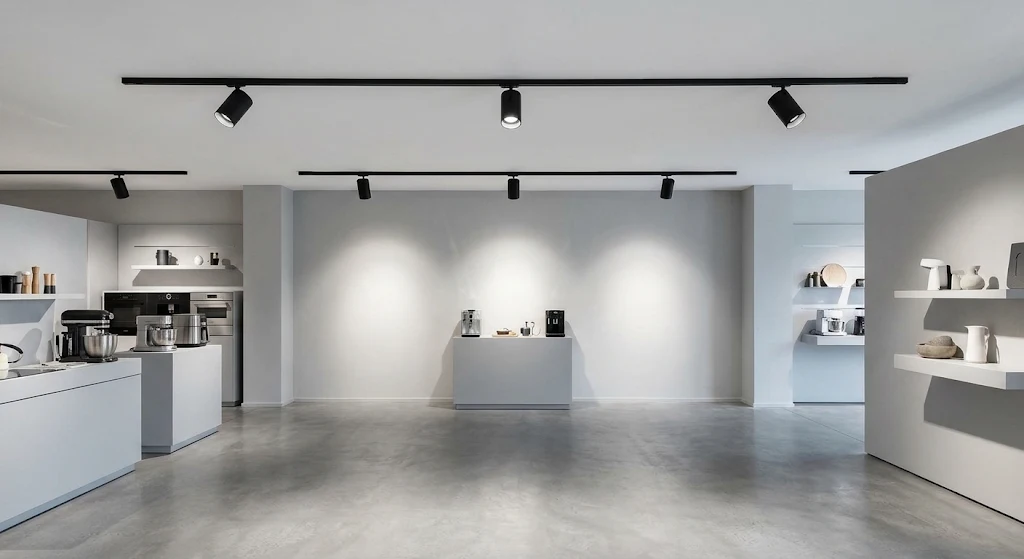
UGR also takes account of the brightness of the surrounding visual field.
A dark ceiling with exposed bright luminaires creates different viewing conditions from a bright ceiling with more evenly distributed illumination.
Ceiling and wall reflectance influence the background luminance used in the calculation. The distribution of ambient light also affects the overall visual environment.
This is one reason why a luminaire’s published UGR information cannot simply be transferred from one room to another.
4. How Does Optical Design Affect Glare from a Track Spotlight?
Optical design determines how light leaves the fixture and how much of the luminous source is visible from different directions.
Several features are commonly used in low-glare track spotlights.
Deep-Recessed Light Source
Positioning the LED deeper inside the housing can restrict direct visibility of the source from certain viewing angles.
The effectiveness depends on the recess depth, aperture diameter and optical geometry.
Anti-Glare Baffle
A dark internal baffle helps shield the LED source from unwanted viewing directions.
Its design should be considered together with the reflector and lens rather than as an isolated component.
Reflector Design
Reflectors control light distribution and influence luminous intensity at different angles.
Their geometry and surface characteristics affect how light is directed towards the target and how the luminaire appears from the observer’s position.
Optical Lens
A lens shapes the beam and determines how light is distributed across the illuminated area.
However, a narrow beam does not automatically mean lower glare. A concentrated beam may produce high luminous intensity in its main direction.
The relevant question is not simply how narrow the beam is, but how the luminaire’s luminous intensity and visible aperture relate to the intended viewing positions.
5. Does Beam Angle Affect UGR?
Beam angle and UGR describe different lighting characteristics.
Beam angle describes the angular distribution of light, commonly measured at the directions where luminous intensity falls to 50% of its maximum value.
UGR evaluates discomfort glare within a lighting installation.
Common LED track spotlight beam angles include:
| Beam angle | Typical application | Lighting purpose |
|---|---|---|
| 15° | Small products and selected display details | Concentrated accent lighting |
| 24° | Mannequins and focused merchandise displays | Controlled product highlighting |
| 36° | Clothing racks and display walls | Broader accent illumination |
| 60° | Wider display areas | More extensive light distribution |
These are typical application examples, not fixed design rules.
A 15° spotlight is not necessarily more comfortable than a 36° spotlight. Beam angle alone does not describe the complete luminous intensity distribution or the luminance of the visible optical aperture.
For a meaningful evaluation, designers should review the actual IES or LDT photometric file rather than relying only on the nominal beam angle.
6. UGR, Illuminance and Luminance: What Is the Difference?
These three parameters describe different aspects of lighting performance.
| Parameter | Unit | What it describes |
|---|---|---|
| UGR | Dimensionless | Discomfort glare under defined viewing conditions |
| Illuminance | Lux (lx) | Luminous flux incident on a surface |
| Luminance | cd/m² | Light emitted or reflected from a surface in a given direction |
| Luminous flux | Lumens (lm) | Total visible light output of a source |
For example, a retail display may receive 500 lux of illuminance. This tells the designer how much light reaches the display surface.
It does not establish whether a customer looking towards the ceiling will experience discomfort glare.
Similarly, a low UGR result does not confirm that merchandise receives sufficient illumination.
Good lighting design considers these parameters together.
7. How Is UGR Calculated for a Track Lighting Installation?
A project-specific UGR calculation requires more than a luminaire specification.
The designer needs accurate photometric information and a model of the actual lighting environment.
A typical workflow involves the following steps.
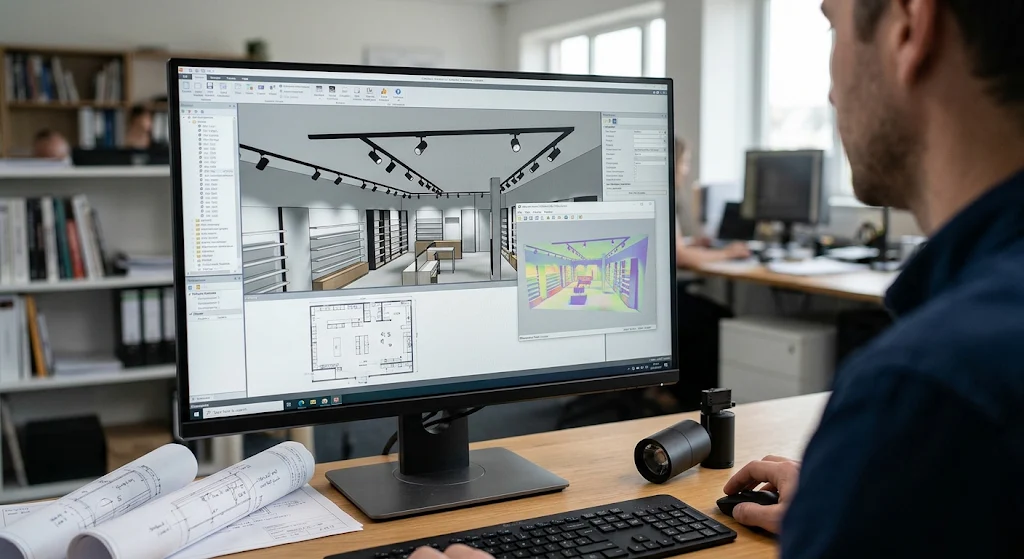
Step 1: Obtain the IES or LDT photometric file
Request the photometric file for the exact track spotlight configuration, including the relevant optical version.
These files provide the luminous intensity distribution required by lighting calculation software.
Step 2: Build the room model
Enter the room dimensions, ceiling height and relevant surface reflectance values.
The model should represent the actual architectural conditions as closely as possible.
Step 3: Define the luminaire layout
Enter the track positions, spotlight spacing, mounting heights and aiming directions.
For adjustable spotlights, the actual orientation should be represented rather than assuming all fixtures point vertically downwards.
Step 4: Define observer positions
Select representative viewing positions and directions based on the intended use of the space.
In retail projects, this may include customer circulation routes, display areas and staff workstations.
Step 5: Run the glare calculation
Use suitable lighting calculation software and the applicable CIE UGR methodology.
Step 6: Review and adjust
If the calculated results are unsuitable, review the fixture position, optical configuration, aiming direction and overall lighting arrangement.
The calculation report should identify the room conditions, luminaire data and observer positions used.
8. UGR Tables vs Project-Specific UGR Calculations
When reviewing a manufacturer’s lighting documentation, it is important to understand how the published UGR information was obtained.
Standard UGR tables are calculated for defined room sizes, surface reflectances, luminaire arrangements and observer conditions.
They provide reference information for comparing luminaires under those assumptions.
A project-specific calculation, by contrast, uses the proposed installation geometry and the corresponding photometric data.
| Method | Purpose | Limitation |
|---|---|---|
| Standard UGR table | Compare luminaires under defined conditions | Does not necessarily represent the actual project |
| Project-specific calculation | Evaluate a particular lighting installation | Depends on accurate project inputs and modelling |
| Product catalogue statement | Provide manufacturer-supplied performance information | May not disclose all calculation conditions |
For adjustable track lighting, the distinction deserves particular attention.
Standardised UGR tables are generally based on prescribed luminaire arrangements. They should not be interpreted as proof that every possible track layout or aiming direction will achieve the same result.
9. Is UGR<19 Necessary for Every Retail Lighting Application?
Not necessarily. The appropriate glare criterion depends on the space, visual tasks and applicable project requirements.
Retail lighting also has to address product visibility, colour rendering, vertical illumination and visual hierarchy.
| Retail area | Main lighting requirement | Design consideration |
|---|---|---|
| Fashion boutique | Accurate garment and colour presentation | Balance accent lighting and glare control |
| Shoe store | Clear visibility of product details | Control beam distribution and reflections |
| Supermarket | Comfortable visibility across aisles | Consider illuminance, uniformity and glare |
| Jewellery store | Controlled highlights on reflective products | Balance sparkle and visual comfort |
| Fitting room | Natural appearance in mirrors | Provide balanced vertical illumination |
| Checkout area | Clear visibility for customers and staff | Avoid direct exposure to bright apertures |
A low UGR value alone does not define good retail lighting.
For example, a fashion store may require carefully controlled accent lighting to reveal fabric texture and garment colour. Reducing glare should not compromise the illumination needed to present the products properly.
10. What Should Lighting Designers Check Before Specifying a UGR<19 Track Light?
Before approving a low-glare track spotlight for a project, designers should review the following information:
- Photometric files: Obtain the correct IES or LDT file for the selected optical configuration.
- UGR documentation: Check the evaluation conditions behind any published UGR claim.
- Optical construction: Review the reflector, baffle, lens and LED recess.
- Beam distribution: Confirm that the beam angle and luminous intensity distribution suit the application.
- Installation geometry: Consider mounting height, track location and aiming direction.
- Viewing conditions: Identify the positions from which customers and staff will see the luminaires.
- Lighting performance: Check illuminance, colour rendering and product presentation alongside glare.
These checks provide a more reliable basis for product selection than a single UGR figure in a catalogue.
Conclusion: UGR<19 Is Not a Guarantee of the Finished Installation
A track light marked UGR<19 may offer suitable low-glare optical performance under defined conditions. However, the final glare rating depends on the complete lighting installation.
Mounting position, aiming direction, room reflectance, luminaire photometry and observer location all contribute to the result.
For lighting designers, the distinction is straightforward: the luminaire provides the optical performance; the installation determines the project-specific UGR result.
Low-glare track lighting should therefore be selected using photometric data and verified within the actual room layout, rather than judged by the catalogue label alone.
Frequently Asked Questions
No. The stated value applies to defined evaluation conditions. The actual project result depends on the room, luminaire arrangement, photometric distribution and observer position.
No. UGR evaluates discomfort glare in a lighting installation. A luminaire’s optical characteristics influence the calculation, but the final rating depends on the installation conditions.
It can reduce direct visibility of the luminous aperture from particular viewing positions. However, the effect on the calculated UGR must be assessed using the complete lighting arrangement.
No. Recessing the LED can help shield the source, but the result also depends on reflector geometry, luminous intensity distribution and the surrounding environment.
Not necessarily. Beam angle describes light distribution, not discomfort glare. The complete photometric data and viewing conditions must be considered.
The main inputs include luminaire photometric data, room dimensions, surface reflectance, fixture positions, mounting heights and observer locations.
No. The applicable glare criteria depend on the space, visual tasks and relevant lighting standards. UGR<19 should not be treated as a universal requirement for all retail environments.
UGR evaluates discomfort glare. CRI evaluates how accurately a light source renders object colours compared with a reference illuminant. They measure different aspects of lighting performance.