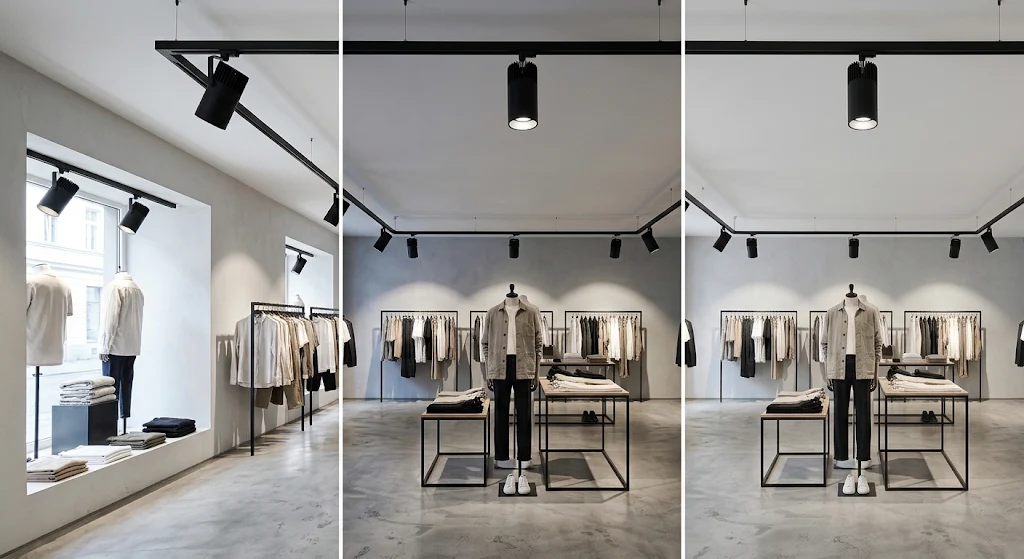
DALI gives LED track lighting three important control functions: individual spotlight control, group control and programmable lighting scenes. It allows different luminaires to operate independently or together, rather than switching or dimming an entire lighting circuit as one unit.
For a fashion store, this means window-display spotlights, wall-mounted lighting and central display lighting can each have their own settings. The store can then switch between daytime, evening and cleaning modes without manually adjusting every fixture.
The difference is not simply how much a spotlight can dim. It is how the entire lighting installation is organised and controlled.
1. What Is DALI in Track Lighting?
DALI (Digital Addressable Lighting Interface) is a standardised digital lighting control protocol defined by the IEC 62386 series.
In a DALI track lighting installation, compatible LED drivers communicate with a lighting controller through a two-wire DALI bus.
Each independently addressable driver can receive digital commands, allowing the connected spotlight to be switched, dimmed or included in a programmed lighting arrangement.
Unlike conventional switched lighting, control does not have to follow the physical electrical circuit.
For example, two spotlights installed on different track sections can be assigned to the same DALI group if they serve the same display area.
This separation between electrical installation and control configuration is one of the most useful features of DALI.
2. Three Things DALI Adds to Track Lighting
2.1 Individual Spotlight Control
Individual control means that each DALI driver can be addressed separately.
Consider a fashion boutique with ten track spotlights illuminating different mannequins and clothing displays.
With independently addressable drivers, the lighting designer can adjust the output of each spotlight without changing the settings of the others.
This is useful when:
- A new collection needs stronger accent lighting.
- One mannequin requires a different lighting level.
- A display has been moved or rearranged.
- Certain areas need reduced output during quieter trading hours.
There is no need to install a separate switching circuit for every spotlight, provided the DALI system is correctly designed and commissioned.
Important: Individual control requires each spotlight to have its own independently addressable DALI control gear. If several fixtures share one driver or address, they cannot be controlled independently through that shared address.
2.2 Group Control
Group control allows several individually addressed luminaires to respond to the same command.
The groups are created during system commissioning, based on how the store needs to operate.
A typical fashion retail layout might use the following arrangement:
| DALI group | Lighting area | Intended control |
|---|---|---|
| Group 1 | Window display | Separate control of promotional lighting |
| Group 2 | Clothing wall | Coordinated illumination of hanging garments |
| Group 3 | Central display | Control of mannequins and featured products |
| Group 4 | Checkout | Independent control of the service area |
| Group 5 | General lighting | Adjustment of ambient illumination |
The important distinction is that DALI groups are logical control groups, not necessarily physical track circuits.
A spotlight on Track A and another on Track B can belong to the same group. Likewise, two spotlights next to each other on the same track can belong to different groups.
This gives designers more freedom when the lighting layout is determined by the merchandise rather than by the electrical wiring arrangement.
2.3 Scene Control
Scene control allows different lighting levels to be stored and recalled for particular operating conditions.
A scene can contain different output settings for individual luminaires. When recalled, each driver responds with its programmed level.
For example, a fashion store could use four lighting scenes:
| Scene | Window display | Clothing wall | Central display | General lighting |
|---|---|---|---|---|
| Daytime | 100% | 90% | 85% | 80% |
| Evening | 100% | 75% | 100% | 55% |
| Cleaning | 100% | 100% | 100% | 100% |
| Night display | 100% | 30% | 50% | 10% |
The percentages are illustrative output settings, not recommended illuminance levels. Actual settings should be established through the lighting design.
The advantage is that the store manager can recall a complete lighting arrangement with one command instead of adjusting multiple lighting groups separately.
A scene is therefore more than a general dimming preset. It coordinates different light levels across the installation.

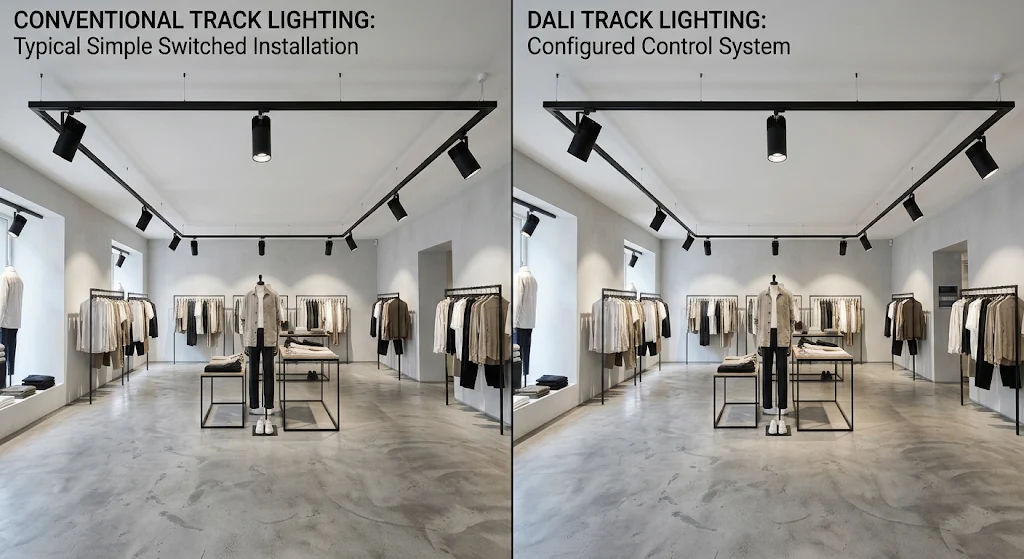
3. DALI vs Conventional Track Lighting: What Changes?
The main difference is the way lighting circuits and individual luminaires are controlled.
| Function | Conventional track lighting | DALI track lighting |
|---|---|---|
| On/off | Usually controlled by electrical switching circuits | Controlled through digital commands |
| Individual spotlight adjustment | Requires additional control arrangements | Available with individual DALI addressing |
| Group control | Usually determined by electrical circuit design | Groups configured during commissioning |
| Dimming | Depends on the installed driver and control method | Digital dimming with compatible DALI drivers |
| Scene recall | Requires additional control equipment | Supported through programmed scenes |
| Reconfiguration | May require changes to electrical wiring | Logical groups can be changed through commissioning |
| Status information | Usually limited | Available with compatible equipment |
For a small shop where all spotlights operate together, conventional switching may be perfectly adequate.
For a larger store with several merchandise zones and changing display requirements, DALI offers considerably more control.
It is worth remembering that conventional track lighting can also support advanced control when combined with other compatible systems. DALI’s particular advantage is its standardised digital addressing and communication.
4. How Does a DALI Track Lighting System Work in a Real Store?
Take a 500 m² fashion boutique as an example.
The store has three main lighting areas:
- Window displays facing the street.
- Wall-mounted clothing displays.
- Central mannequins and promotional displays.
Each independently controlled spotlight is fitted with a DALI-compatible driver. The drivers are connected to the DALI communication bus, and the control system is configured during commissioning.
The commissioning engineer then assigns addresses and creates groups according to the store’s lighting requirements.
The resulting arrangement might look like this:
<escape>Window spotlights → Group 1
Wall display spotlights → Group 2
Central display spotlights → Group 3</escape>
The controller can then recall different scenes:
- Daytime: Window and central displays remain prominent while general lighting is adjusted according to available daylight.
- Evening: Display lighting remains at the required level while other areas are reduced.
- Cleaning: All relevant lighting groups operate at full output.
The actual settings depend on the store’s daylight conditions, merchandise, operating hours and required illuminance.
The physical track installation does not need to change when the store switches between these scenes.
5. Does Installing a DALI Driver Automatically Give You Group and Scene Control?
No. This is an important point when specifying a DALI track lighting project.
A DALI driver provides the communication and dimming capability. It does not automatically configure the lighting system.
A working installation requires several additional steps.
| Stage | What needs to happen |
|---|---|
| 1. Driver selection | Select compatible DALI LED drivers |
| 2. Electrical installation | Provide the required power and DALI communication connections |
| 3. Addressing | Identify and assign addresses to the control gear |
| 4. Group configuration | Assign luminaires to the required control groups |
| 5. Scene programming | Store the required output levels |
| 6. Commissioning | Configure controllers and test the complete system |
Without proper commissioning, a project may have DALI-compatible spotlights but still lack the individual controls, groups and scenes expected by the customer.
For this reason, control requirements should be agreed during the lighting design stage, not left until the fixtures arrive on site.
6. What Equipment Does a DALI Track Lighting System Need?
A typical DALI installation consists of the following components:
| Component | Function |
|---|---|
| DALI LED driver | Receives control commands and regulates LED output |
| DALI communication bus | Carries digital communication between devices |
| DALI bus power supply | Supplies power to the communication bus |
| Application controller | Manages lighting commands, groups and scenes |
| Input devices | Provide commands through switches, buttons or sensors |
| Commissioning software | Used to configure and test the system |
The DALI bus uses two communication wires. Bus polarity is generally not important, but the wiring must follow the relevant installation requirements.
For track lighting, one detail needs particular attention: the electrical track must support the required control connections.
A conventional three-phase track does not automatically provide DALI communication simply because a DALI driver is installed in the spotlight adapter.
Depending on the product design, DALI communication may require dedicated conductors within the track or a separate bus connection.
The track, adapter and luminaire specifications should therefore be checked together before ordering.
7. How Many Lights Can One DALI System Control?
Under the standard DALI arrangement, one DALI subnet supports:
| Parameter | Maximum |
|---|---|
| Control gear addresses | 64 |
| Control device addresses | 64 |
| Groups per control gear | 16 |
| Scenes per control gear | 16 |
These figures refer to a DALI subnet, not necessarily the entire building or retail project.
For example, a store with 80 independently controlled spotlights will need an appropriate multi-subnet architecture or another suitable system design.
It is also important to distinguish between a control gear address and a physical luminaire. A fixture containing multiple independently controlled drivers may use more than one address.
For larger retail projects, network capacity should be considered before finalising the number of luminaires and control devices.
8. DALI vs DALI-2: Does It Matter for Track Lighting?
DALI-2 is based on the updated IEC 62386 standard and introduces a more comprehensive certification and testing framework, particularly for control devices.
This matters when a track lighting installation needs to combine products from different manufacturers.
For example, a project may use:
- DALI LED drivers inside track spotlights.
- A DALI-2 application controller.
- Wall-mounted scene-control switches.
- Occupancy or daylight sensors.
DALI-2 certification helps improve interoperability between compatible products, although it does not mean that every device will automatically work together in every system configuration.
When specifying equipment, check the actual certification and product documentation rather than relying only on the words ‘DALI compatible’.
DALI-2 also does not automatically improve the quality of the lighting or the design of the scenes. Those still depend on the selected luminaires, control strategy and commissioning.
9. When Should You Choose DALI for Retail Track Lighting?
DALI is most useful when the lighting arrangement needs to change according to store activities, merchandise displays or operating hours.
| Retail application | DALI requirement | Reason |
|---|---|---|
| Small boutique | Optional | Basic switching may be sufficient |
| Fashion store | Recommended where multiple zones are needed | Independent control of merchandise displays |
| Flagship store | Strong application | Multiple scenes and complex lighting layouts |
| Supermarket | Depends on project scope | Separate control of departments and operating areas |
| Multi-store retail chain | Worth considering | Consistent control strategies across locations |
| Simple warehouse | Depends on requirements | Advanced scene control may not be necessary |
DALI adds equipment, wiring, programming and commissioning costs. These should be considered alongside the benefits of flexibility and operational control.
For a simple installation with one switching requirement, the additional investment may not be justified.
For a retail project where displays change frequently or different lighting conditions are required throughout the day, the additional control can be worthwhile.
10. What Should Be Confirmed Before Ordering DALI Track Lights?
Before placing an order, the lighting designer, contractor and supplier should agree on the following:
- Driver compatibility: Confirm that the selected LED driver supports the required DALI protocol and dimming functions.
- Independent control: Confirm whether every spotlight needs its own DALI address.
- Track compatibility: Check how DALI communication is carried between the track and the luminaire adapter.
- Control architecture: Confirm the number of DALI subnets and required control devices.
- Group arrangement: Define which spotlights need to operate together.
- Scene requirements: Establish the required operating modes and lighting levels.
- Commissioning responsibility: Identify who will address the drivers, configure the groups and program the scenes.
Agreeing these details before installation helps avoid problems such as incompatible track adapters, insufficient network capacity or a control system that cannot perform the functions originally specified.
Conclusion: DALI Makes Track Lighting More Flexible to Control
DALI changes the way an LED track lighting installation is operated. Instead of relying entirely on fixed electrical switching circuits, individual spotlights can be addressed, assigned to groups and included in programmable scenes.
For retail stores, this means window displays, clothing walls, central displays and general lighting can respond to different operating requirements.
But the control capability does not come from the driver alone. The track system, communication bus, controller and commissioning must all be correctly specified.
A DALI driver makes a spotlight digitally controllable. A properly designed and commissioned DALI system makes the entire track lighting installation flexible.
Frequently Asked Questions
Yes. Each spotlight needs its own independently addressable DALI control gear. The system must also be correctly commissioned.
Yes. DALI groups are logical control groups. Luminaires on different track sections can operate together if they are connected to the same suitable DALI control network.
A standard DALI control gear can be assigned to up to 16 groups.
A standard DALI control gear supports up to 16 stored scenes, with a separately programmed output level for each scene.
No. The scene levels need to be programmed during commissioning. A suitable controller or input device is also required to recall them.
DALI uses a two-wire communication bus. The communication wiring arrangement depends on the track system and installation design. Some track systems integrate dedicated DALI conductors, while others use separate bus wiring.
Yes. It is particularly useful when window displays, mannequins, clothing walls and general lighting need separate control or different programmed lighting scenes.
Generally, yes. Group assignments can be changed through commissioning software without rewiring the physical lighting circuits, provided the existing network and equipment support the new configuration.
Not for every application. DALI is more suitable when individual addressing, group management and scene control are required. For simple on/off or basic dimming applications, a conventional control method may be more economical.