Note on a widespread misreading: “Below BBL” does not mean bluer or cooler light. The CIE 1960 colour system is unambiguous on this point, as are the U.S. Department of Energy and Arrant-Light (light.fi): above the BBL = greenish tint; below the BBL = pinkish / rosy tint. The confusion is understandable — “below” on the chromaticity diagram is not the same direction as “cooler” on the colour temperature scale. Everything that follows uses the correct physics.
In short: At 3000K–3500K, a below-BBL source paired with CRI Ra ≥90 and a strong R9 removes the greenish cast that affects most standard LEDs. White fabrics look genuinely white — what Philips calls “whiteness optimization.” Reds render with more fidelity. The result is a warm, premium atmosphere without pushing the colour temperature up to a harsher 4000K. The engineering behind this: KSF (Potassium Fluorosilicate) phosphor technology, which Cree LED has formalised into dedicated Below BBL colour bins for their Pro9 COB series. Two luminaires with identical spec sheets can produce visibly different light depending on where they sit relative to the BBL.
1. What Is the BBL (Black Body Locus) and Why Does It Matter?
The Black Body Locus (BBL), also called the Planckian locus, is a curve on the CIE chromaticity diagram that maps the colour of a perfect blackbody radiator across the full range of temperatures — from deep red at the low end, through orange, warm white, and eventually into a cool bluish-white at extreme temperatures. Every colour temperature value (2700K, 3000K, 4000K, and so on) corresponds to a specific point on this curve.
LEDs do not generally sit exactly on the BBL. The chromaticity point of any given source can fall above, on, or below it. The metric Duv (Delta-uv), defined in CIE 015:2018, quantifies this perpendicular distance from the locus in the CIE 1960 UCS diagram.
Why does this matter in practice? Philips addressed this directly in their Quality of Light in Fashion white paper (2018): luminaires with identical specification sheet values — same CRI, same CCT, same lumen output — can produce light that is radically different in terms of colour appearance and perceived brightness. The BBL position is one of the key variables that specifications sheets routinely omit, yet it directly determines how garments, white walls, and skin tones read in a retail space.
2. Above vs Below the BBL: Getting the Colour Appearance Right
The tint produced by a source relative to the BBL is counterintuitive to many people, so it is worth being precise:
Below the BBL (negative Duv): The chromaticity point sits below the locus. The light has a pinkish or rosy cast. Per the U.S. DOE: “a source with a negative value for Duv has a chromaticity that falls below the blackbody locus (appearing slightly pinkish).”
Above the BBL (positive Duv): The chromaticity point sits above the Planckian locus. The light has a greenish or yellowish-green cast. The U.S. Department of Energy puts it plainly: “a source with a positive value for Duv has a chromaticity that falls above the blackbody locus (appearing slightly greenish).”
On the BBL (Duv ≈ 0): The source sits on or very close to the locus. The light matches the expected neutral white for its CCT — no perceptible tint shift in either direction.
3. The Four BBL Categories in Retail Lighting
3.1 Warm BBL — positive Duv, above the locus
The chromaticity point sits above the Planckian locus. Most off-the-shelf phosphor-converted white LEDs land here, because standard yellow-phosphor chemistry naturally pushes chromaticity slightly above the locus. At 3000K, the result is a subtle but real greenish cast. In a clothing store, this means white fabrics read dull or slightly off, and cool-toned garments — blues, purples, teals — lose saturation and lean grey. This is the most common LED category in the commercial market, and the one most likely to appear in a standard specification sheet without any mention of BBL position.
3.2 Standard BBL — Duv ≈ 0, on the locus
The source sits on or very close to the Planckian locus — the reference condition for CRI calculation under CIE 13.3-1995. White fabrics appear as a balanced warm white with no obvious tint in either direction under normal operating conditions. This is an acceptable baseline for general retail.
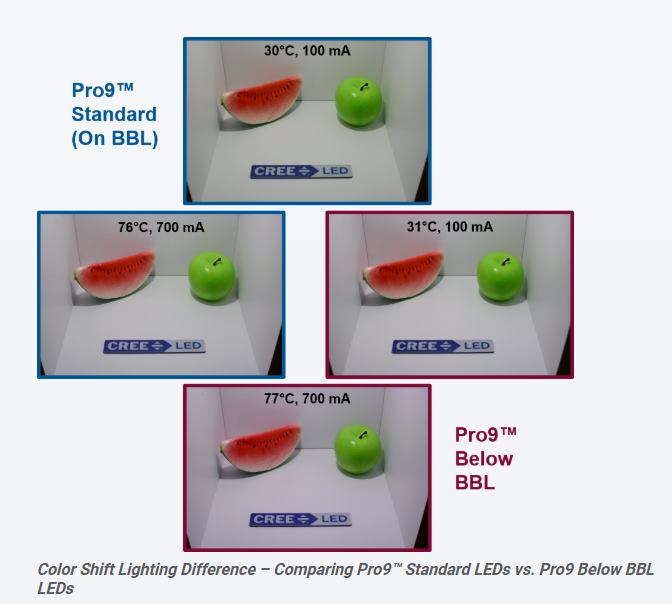
There is, however, an important operational reality that standard specification sheets do not capture. Cree LED’s technical documentation on their Pro9 COB series makes this explicit: a Standard (on BBL) colour point “provides a balanced white point at higher operating temperatures — at lower temperatures, the light may appear slightly green.” This is not a manufacturing defect but a consequence of how phosphor colour output shifts as LED junction temperature changes during warm-up, dimming, or operation in cooler environments. In a real retail store — where luminaires dim at closing time, cycle on from cold, or operate at varying loads — a nominally on-BBL source can drift into positive Duv territory and introduce the greenish cast that buyers find unflattering.
3.3 Negative BBL — slightly below the locus
The chromaticity point sits below the locus, giving the light a pinkish-neutral character. At 3000K–3500K, this shift is subtle enough that it does not read as obviously pink under normal viewing conditions — it simply looks clean and accurate. Philips describes the effect precisely: “if we dip below this BBL just a bit, the light is experienced as more white” — the technical term is whiteness optimization.
The engineering rationale goes deeper than whiteness alone. Cree LED’s documentation on their Pro9 COB Below BBL series explains it directly: a Below BBL colour point “maintains a balanced white point at lower operating temperatures” — the deliberate offset below the locus serves as a buffer against the green drift that affects Standard BBL sources as they cool or dim. In a retail environment where luminaires operate across a range of drive currents and temperatures throughout the day, Below BBL is the more stable choice for maintaining consistent, appealing colour across all conditions.
The phosphor technology that makes this possible is KSF (Potassium Fluorosilicate, also written as KSF or PFS). Unlike conventional yellow phosphors, KSF has a very narrow red-emission band that dramatically improves the efficiency of warm white, high-CRI LED production. Cree LED uses a second-generation KSF formulation in their Pro9 series, specifically engineered for long-term reliability — completing 10,000 hours of LM-80 testing to validate that performance holds over the product lifetime. Luminaire manufacturers sourcing Pro9 Below BBL chips can do so with confidence that the colour point and reliability standards are both met.
In practice the effects on retail are clear: white fabrics appear genuinely white, red tones improve in fidelity, and the warm atmosphere of the 3000K source is preserved. This specification has been the deliberate design choice of major lighting manufacturers for fashion applications for years — Cree LED’s 2025 Pro9 Below BBL launch is its commercial formalisation, not its invention.
3.4 Deep negative BBL — well below the locus
The pinkish shift becomes clearly perceptible and starts to dominate the overall atmosphere. Red rendering improves further, but the visible pink cast can make skin tones look unnatural and may push warm-neutral garments — creams, beiges, taupes — into an unflattering rosy hue. Deep negative BBL is not recommended for general fashion retail floor lighting. It may suit specialist counters — luxury cosmetics, for example — where a warm-pink cast is a deliberate design choice.
4. How Each BBL Category Affects Garment Colours
Conditions: 3000K–3500K, CRI Ra ≥90. Colour descriptions are consistent with Duv physics (CIE 015:2018, U.S. DOE LED Colour Characteristics Fact Sheet) and validated by Philips fashion retail lighting research.
| Attribute | Warm BBL Positive Duv — above locus | Standard BBL Duv ≈ 0 — on locus | Negative BBL Slightly below locus | Deep Neg. BBL Well below locus |
|---|---|---|---|---|
| Tint of white light | Greenish / yellowish-green cast | Neutral, balanced white | Pinkish-neutral; clean, pure white appearance | Noticeably pinkish / rosy |
| White & cream fabrics | Appear dull or slightly off-white; greenish bias | Natural warm white | Clean, luminous white; no green cast | Pinkish tint visible on neutrals |
| Blue & teal garments | Greyed, desaturated; green bias shifts cool tones | True blue, balanced | Vivid, well-saturated blue; pink-neutral base improves contrast | Saturated, but pinkish base may distort cool tones |
| Red garments (R9 impact) | Orange-red; R9 typically lower due to greenish SPD bias | True red; R9 at reference level | Rich, accurate red; R9 typically higher due to below-locus phosphor | Deep red; very high R9 but overall pink cast may alter perception |
| Black fabrics | Slightly greenish-black | Pure black | Deep neutral black | Slightly pinkish-black |
| Fabric texture & sheen | Detail can appear softened by greenish cast | Balanced, even rendering | Sheen and texture more distinct; clean contrast | High contrast, but pinkish overall may distort subtle tones |
| Skin tone rendering | May appear greenish or sallow with higher positive Duv | Natural, balanced | Slightly warmer and rosier; generally flattering for most skin tones | Pink cast may appear unnatural on skin |
| Overall retail atmosphere | Warm but potentially clinical or dull | Neutral, universally acceptable | Premium, clean; daylight-adjacent without harsh CCT increase | Specialised; not recommended for general fashion retail |
| Best suited for | Contexts where green cast is not a concern; some residential/hospitality | General retail; universal baseline | Fashion retail, sportswear, premium apparel, export showrooms | Specialist: luxury cosmetics, intimate apparel, candle-lit environments |
5. The Engineering Behind Below-BBL: KSF Phosphor Technology
Most white LEDs use a blue chip coated with a yellow phosphor. The phosphor absorbs some blue light and re-emits it across a broad yellow-green band; the mixture of unconverted blue and converted yellow reads as white. The problem is that conventional yellow-phosphor chemistry places the chromaticity point slightly above the Planckian locus — positive Duv, with the faint greenish character described above. Arrant-Light (light.fi) notes that “traditional white LEDs’ colour temperature chromaticity is on or very near B.B.L.” — in practice, most production batches land fractionally above it.
Below-BBL sources address this through a different phosphor chemistry. Cree LED’s Pro9 technology uses KSF (Potassium Fluorosilicate) phosphor, also referred to as PFS phosphor. Unlike broadband yellow phosphors, KSF emits in a very narrow red band — this narrow emission dramatically improves efficacy in warm white, high-CRI LEDs because it puts spectral energy precisely where it is needed for red rendering, rather than spreading it across a wide band that includes the less useful yellow-green region.
The result of KSF phosphor formulation is twofold. First, the chromaticity point moves below the Planckian locus — the narrow red emission reshapes the spectral power distribution in a way that naturally places the source in negative Duv territory. Second, the red spectral output is strengthened, which directly lifts R9 values as a side effect of the same phosphor decision that corrects the white point.
Philips identified this phenomenon from a perceptual angle: their CIE 2016 research (Perz, Baselmans, Sekulovski) showed that dipping below the BBL produces light that is experienced as more white — not cooler, not bluer, but perceptually whiter. Cree’s engineering documentation provides the complementary operational explanation: the Below BBL position also acts as a buffer against the green drift that affects Standard BBL sources at lower operating temperatures, making the colour point more stable across real-world conditions.
KSF phosphor does present manufacturing challenges. Cree LED acknowledges in their Pro9 documentation that “not all KSF phosphor is created equal” and that reliability under demanding conditions requires specific engineering expertise. Their Pro9 series uses a second-generation KSF formulation with 10,000 hours of completed LM-80 testing — a benchmark that validates both the colour performance and long-term reliability that fashion retail deployments require.
6. CRI Ra, R9, and CGI: What the Spec Sheet Doesn’t Tell You
Duv and CRI Ra measure different things, and understanding what CRI actually is — and what it is not — matters more than most buyers realise.
CRI Ra is an average of how accurately a light source renders eight standard test colours compared to a reference illuminant at the same CCT. As Philips states plainly in their fashion lighting white paper: “a light source with a CRI of 90 only indicates a difference in color rendering relative to the reference source, and is not informative as to the direction of the difference.” In other words, a CRI of 90 tells you colours differ from the reference — it does not tell you whether they look more or less saturated, or in which direction they shift.
Philips goes further: it is possible to create a LED source with a CRI of 70 or 80 that looks better in a fashion store than a CRI 90 source, if its spectral composition is optimised for the right colours. High CRI is not a goal in itself. The best approach, as Philips recommends, is to evaluate actual LED sources visually against the clothing collection rather than comparing numbers on a datasheet.
Two additional metrics fill the gaps that CRI Ra leaves:
R9 measures the rendering of deep saturated red — a colour not included in the standard CRI Ra calculation. The CRI number on a product datasheet says nothing about R9. For fashion retail, where red garments, warm skin tones, and vivid accessories are commercially critical, R9 must be specified and documented separately. R9 ≥50 is a reasonable minimum; R9 ≥80 is worth asking for in premium environments.
CGI (Color Gamut Index), introduced to address CRI’s directionality blind spot, indicates whether colours will appear on average more or less saturated than under the reference source. A CGI above 100 means colours are over-saturated; below 100 means under-saturated. Philips notes that a slight over-saturation (CGI just above 100) tends to produce a preferred colour appearance in fashion — colours look vivid and appealing rather than flat — though this comes with a minor efficiency trade-off.
Recommended specification for fashion retail luminaires:
CCT: 3000K or 3500K | BBL position: below the locus (negative Duv) | CRI Ra: ≥90 | R9: ≥50 (≥80 for premium environments) | SDCM: ≤3 | Beam angle: 24°–36° (accent/track) | Optic type: lens preferred over reflector for narrow-beam accent lighting
7. Beam Quality: The Other Variable Spec Sheets Miss
BBL position is not the only factor that determines how a garment looks. Philips demonstrated with equal clarity that two luminaires with the same beam angle can produce visibly different spot sizes, brightness perceptions, and contrast effects — purely because of how the beam is shaped.
The standard beam angle metric, FWHM (Full Width Half Maximum), describes the angle at which peak beam intensity is halved. It sounds precise, but it does not capture the transition from the bright core of the beam to its edges — and that transition is what the eye actually perceives as spot size and contrast.
Two specific beam artefacts matter in fashion retail:
Halo is the effect where the bright core of a spot is surrounded by a wide area of lower intensity that ends in a sharp cut-off at the luminaire edge. It is common in reflector-based optics and makes garments look less dramatically lit — the spill light reduces the contrast ratio between the illuminated product and its surroundings.
Spill light in general dilutes the accent effect. For a display to read as a genuine accent, the illuminated area needs to be at least three times brighter than the ambient. Reflectors inherently produce spill; lens-based optics (such as Philips’ Fashion Proof Optic) concentrate the beam without a halo, increasing centre beam intensity by up to 30% and contrast by up to 100% compared to an equivalent reflector at the same beam angle.
The practical implication: when comparing quotes for fashion retail spotlights, ask whether the optic is lens-based or reflector-based. Two 12° luminaires from different suppliers may have identical CRI, CCT, and lumen figures — and produce entirely different results on the shop floor.
8. Multi-Store Rollout: Practical Considerations
Below-BBL sources within a single specification range can still show perceptible differences if they come from different production batches. For brand-wide rollouts across multiple stores, specify SDCM ≤3 to control batch-to-batch colour consistency, and consolidate purchasing from the same production batch where the project scale allows.
Operating conditions also affect colour point in real deployments. Cree LED’s documentation on the Pro9 series makes clear that both Standard BBL and Below BBL sources shift their colour point as operating temperature changes. Standard BBL sources drift toward green at lower temperatures (cold start, deep dimming); Below BBL sources maintain a more balanced white point under these same conditions, with any shift running toward pink rather than green. For retail environments where luminaires dim overnight, cycle on from cold in the morning, or operate at variable loads throughout the day, Below BBL is the more operationally stable choice.
Within a single store, different zones warrant different BBL positions. Accent track lighting aimed at product rails and mannequins benefits from a deeper below-BBL position — maximising the clean-white effect and red-rendering benefit. Fitting room ambient lighting, where skin tone is the critical variable, is better placed closer to the locus, keeping any pinkish shift minimal while still avoiding the greenish cast of above-BBL sources.
No spec sheet replaces a physical lamp test. Before approving any production run, evaluate samples against a white fabric reference and a colour checker under the actual ceiling height and beam angle of the store. Philips puts it simply: seeing is believing.
8. Frequently Asked Questions
Is “below BBL” the same as a cooler or bluer light source?
No, and this confusion trips up a lot of people. “Below the BBL” refers to a position on the CIE 1960 chromaticity diagram — below the Planckian locus — which produces a pinkish or rosy tint, not a bluer one. The colour temperature of the source stays exactly the same; a 3000K below-BBL lamp is still a 3000K warm white lamp. What changes is the tint: a negative Duv gives a pinkish-neutral white; a positive Duv at the same CCT gives a greenish-tinged white. These are different directions on the chromaticity diagram, not a shift along the warm-cool CCT axis. The human perception of below-BBL light in a retail context is not “pinker” — it is “whiter”, which is exactly the effect Philips describes as whiteness optimization.
Will below-BBL lighting make customWill below-BBL lighting make customers’ skin tones look unflattering?
For a moderate below-BBL position, the pinkish shift is subtle enough that it tends to be flattering — it counteracts the greenish cast of above-BBL sources and produces the slightly warm, rosy appearance that most people associate with healthy skin. The risk rises at deep negative Duv values, where the pink tint becomes obvious enough to read as unnatural. For fitting rooms, using a source closer to the locus (less extreme below-BBL) keeps skin tones comfortable while still avoiding the greenish cast of a positive-Duv source.
Is a higher CRI always better for fashion retail?
Not necessarily — this is one of the most important points in the Philips Quality of Light in Fashion white paper. CRI Ra averages the rendering of eight relatively unsaturated colours and does not indicate whether colours will appear more or less saturated, or in which direction they shift. A LED source with CRI 80 but a well-optimised spectral power distribution can produce a more preferred appearance in a fashion store than a CRI 90 source with a greenish bias. The practical advice from Philips: take a line-up of actual LED sources and evaluate them visually against the clothing collection. Datasheets alone cannot tell you which light will make the clothes look best.
Can existing luminaires be retrofitted to achieve a below-BBL specification?
Not in any reliable way. Duv is set by the LED chip’s phosphor formulation during manufacture. Dimming, filtering, and smart controls cannot shift it. Colour-correction gels can move the chromaticity point in principle, but they introduce significant lumen loss and are too imprecise for a professional retail specification. The only practical route to a below-BBL installation is to source luminaires or LED modules built from the ground up with below-locus binned chips.
Does the BBL position change when the luminaire dims or warms up?
Yes — this is one of the most practically important aspects of BBL selection, and one that specification sheets rarely address. LED colour point shifts with junction temperature. For Standard (on BBL) sources, this shift tends toward green at lower operating temperatures — during cold start, at deep dimming levels, or in cool ambient conditions. For Below BBL sources, the same shift runs toward pink rather than green. Since the Below BBL colour point starts below the locus, the temperature-induced drift moves it toward neutral rather than into unwanted greenish territory. In a real retail environment where luminaires cycle on each morning from cold, dim at closing, and operate at variable loads throughout the day, Below BBL is the more operationally stable specification. Cree LED publishes a design guide specifically covering this behaviour: “Understanding Color Shift Across Operating Conditions for Standard & Pro9 COB LEDs.”
What is KSF phosphor and why does it matter for below-BBL lighting?
KSF (Potassium Fluorosilicate, also called PFS phosphor) is a narrow-band red-emitting phosphor that enables significantly higher efficacy in warm white, high-CRI LED production. Unlike conventional broadband yellow phosphors, KSF emits in a tight red band — which both boosts R9 (saturated red rendering) and shifts the chromaticity point below the Planckian locus, producing a naturally below-BBL white point. This is the phosphor technology behind Cree LED’s Pro9 COB series. KSF presents reliability challenges under demanding operating conditions, which is why Cree specifies their second-generation formulation and backs it with 10,000 hours of LM-80 test data. When sourcing below-BBL LED components, it is worth confirming which generation of KSF phosphor a supplier is using and whether long-term reliability testing has been completed.
References and Authoritative Sources
- CIE 015:2018 — Colorimetry, 4th edition. Commission Internationale de l’Éclairage. cie.co.at — Primary definition of Duv and the Planckian locus.
- U.S. Department of Energy — Solid-State Lighting Technology Fact Sheet: LED Color Characteristics. energy.gov — Authoritative description of positive Duv (greenish) vs negative Duv (pinkish).
- ANSI C78.377 — Specifications for the Chromaticity of Solid State Lighting Products. American National Standards Institute / NEMA. — Defines compliance chromaticity quadrangles and maximum |Duv| for LED products.
- CIE 13.3-1995 — Method of Measuring and Specifying Colour Rendering Properties of Light Sources. CIE. — Definition of CRI Ra and R9.
- ANSI/IES RP-2-20 — Recommended Practice: Lighting for Retail Environments. Illuminating Engineering Society. ies.org
- ETC (Electronic Theatre Controls) — LED FAQs Part 3: Chromaticity Diagrams. blog.etcconnect.com — Technically accurate description of Duv tint appearance.
- Cree LED — Pro9 COB Below BBL Product Brief, 2025. cree-led.com — Commercial validation of below-BBL LED products for retail applications.
- Wikipedia — Planckian locus. wikipedia.org — Reference for the definition and mathematical derivation of the Planckian locus.