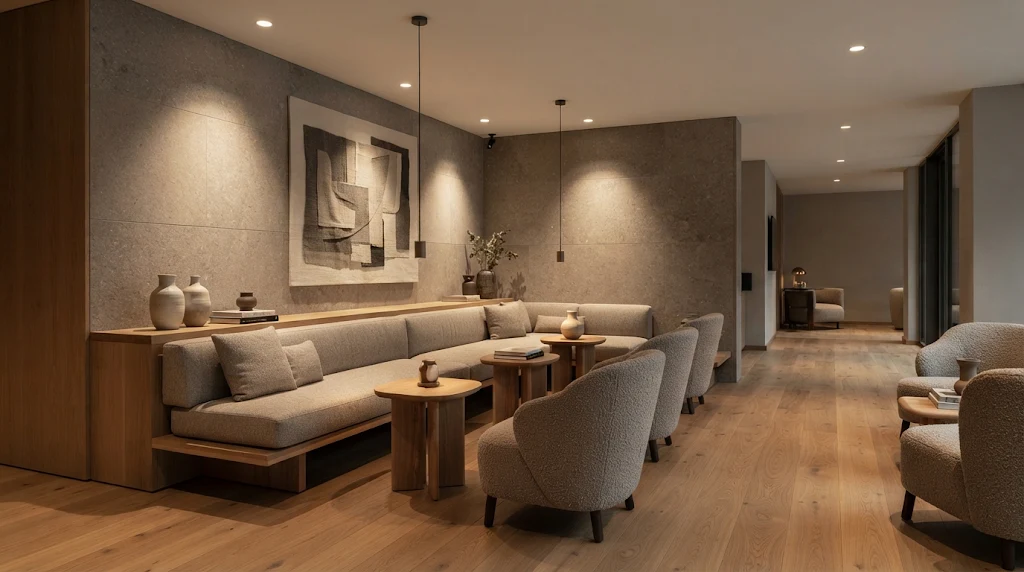
The cost of modernizing lighting across 20, 50 or 100 stores depends on more than the price of new LED fixtures. Installation, lighting design, control systems, energy consumption, maintenance and operating hours all affect the total investment.
For retail chains, hotels and businesses with multiple locations, the more important question is often not simply how much the upgrade costs, but how much it can save over the lifetime of the system.
Replacing outdated lighting with efficient LED solutions can reduce electricity consumption. When combined with appropriate lighting controls, better optical design and a consistent maintenance strategy, the benefits can extend well beyond energy savings.
1. What Determines the Cost of a Multi-Store Lighting Upgrade?
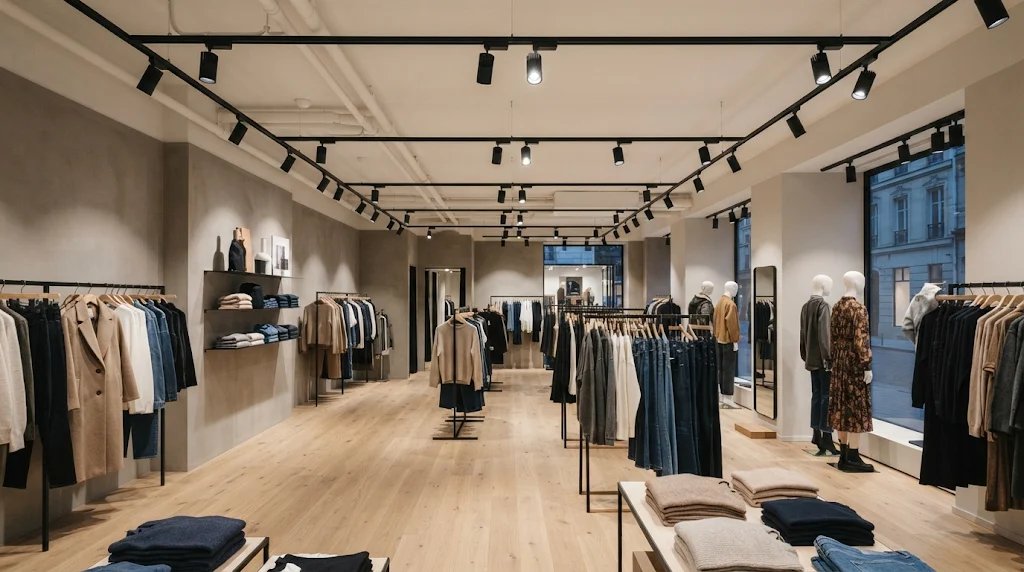
The cost of a multi-store lighting upgrade is determined by the existing installation, the number and type of luminaires, installation requirements and the level of control required.
Two stores with similar floor areas may have very different upgrade costs. One may only need new track lights and downlights, while another may require new wiring, control equipment or changes to the lighting layout.
The main cost factors include:
| Cost factor | What needs to be considered |
|---|---|
| Existing lighting | Number, type, age and condition of existing fixtures |
| LED luminaires | Track lights, downlights, linear lights and other fixture types |
| Lighting design | Beam angles, illuminance, uniformity and glare control |
| Installation | Labour, access equipment, wiring and installation time |
| Lighting controls | Dimming, occupancy sensors, daylight sensors and control interfaces |
| Commissioning | Testing, programming, adjustment and final measurements |
| Maintenance | Spare parts, replacement procedures and ongoing support |
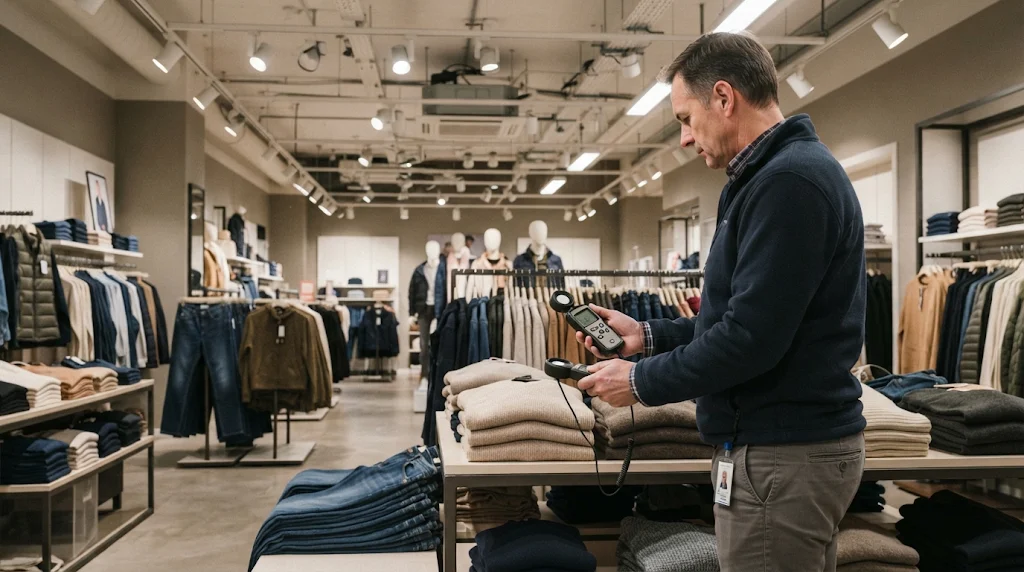
A proper lighting audit should come before a final quotation. It helps identify which existing components can be retained, where replacement is necessary and whether the proposed lighting system will meet the requirements of each location.
For a chain operating dozens of stores, a detailed audit can also prevent unnecessary differences between individual projects.
2. How Should a Business Budget for 20, 50 or 100 Stores?
A multi-location lighting project should be budgeted around a standard lighting specification, rather than treating every store as a completely separate project.
The first step is to establish a typical store layout and define the required lighting performance. This creates a reference specification that can be adapted to different store sizes and architectural conditions.
A practical budget should include:
- LED luminaires and associated accessories
- Lighting design and photometric calculations
- Dimming and control equipment
- Electrical installation and commissioning
- Project management and logistics
- Spare fixtures and replacement components
- Ongoing maintenance and system support
For larger rollouts, it is worth separating the budget into three categories:
Initial investment: The cost of products, installation, design and commissioning.
Operating costs: Electricity consumption, maintenance, replacement parts and any system-related service fees.
Long-term value: Energy savings, reduced maintenance requirements and the expected service life of the installation.
This approach gives decision-makers a more realistic view of the financial impact than comparing fixture prices alone.
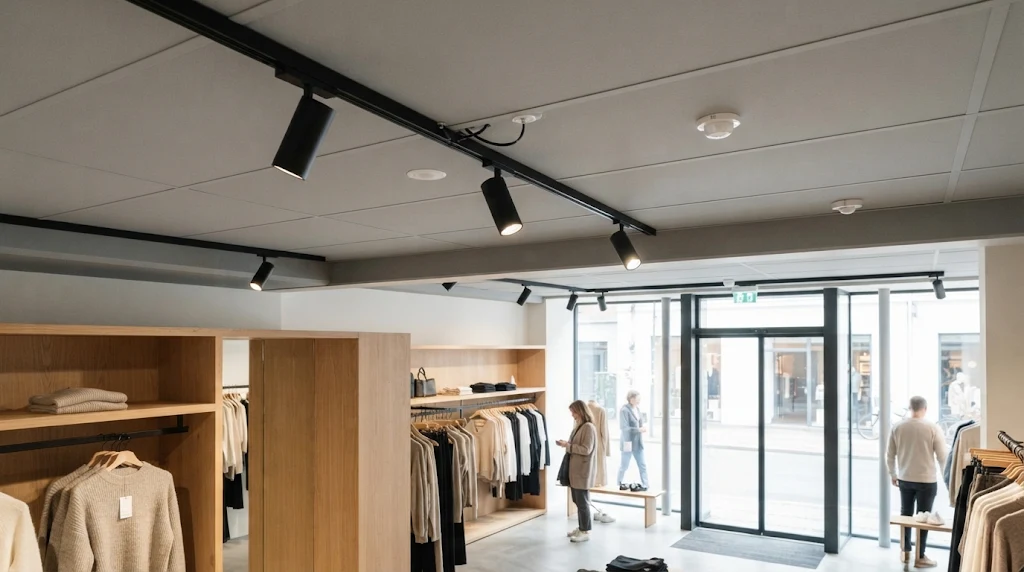
3. How Much Energy Can a Retail Business Save?
Energy savings depend on the difference between the existing lighting load and the new LED lighting load, as well as the number of operating hours.
A straightforward calculation can provide an initial estimate.
Annual lighting energy consumption:
Installed lighting power (kW) × operating hours per year = annual energy consumption (kWh)
Annual energy savings:
Existing lighting consumption − new lighting consumption = annual energy savings
Consider the following illustrative example:
A store currently has an installed lighting load of 10 kW. After modernization, the new LED installation requires 6 kW while maintaining the required lighting performance.
Assuming the lighting operates for 12 hours per day, 365 days per year:
| Item | Existing system | New LED system |
|---|---|---|
| Installed lighting power | 10 kW | 6 kW |
| Daily operating time | 12 hours | 12 hours |
| Annual operating hours | 4,380 hours | 4,380 hours |
| Annual energy consumption | 43,800 kWh | 26,280 kWh |
The estimated annual saving is 17,520 kWh, representing a 40% reduction in lighting energy consumption.
The same example can be extended across a chain:
| Number of stores | Estimated annual energy saving |
|---|---|
| 20 stores | 350,400 kWh |
| 50 stores | 876,000 kWh |
| 100 stores | 1,752,000 kWh |
These figures are illustrative calculations, not guaranteed project results. Actual savings depend on the existing installation, the final LED load, operating schedules, lighting requirements and control strategy.
Electricity tariffs also affect the financial value of the savings.
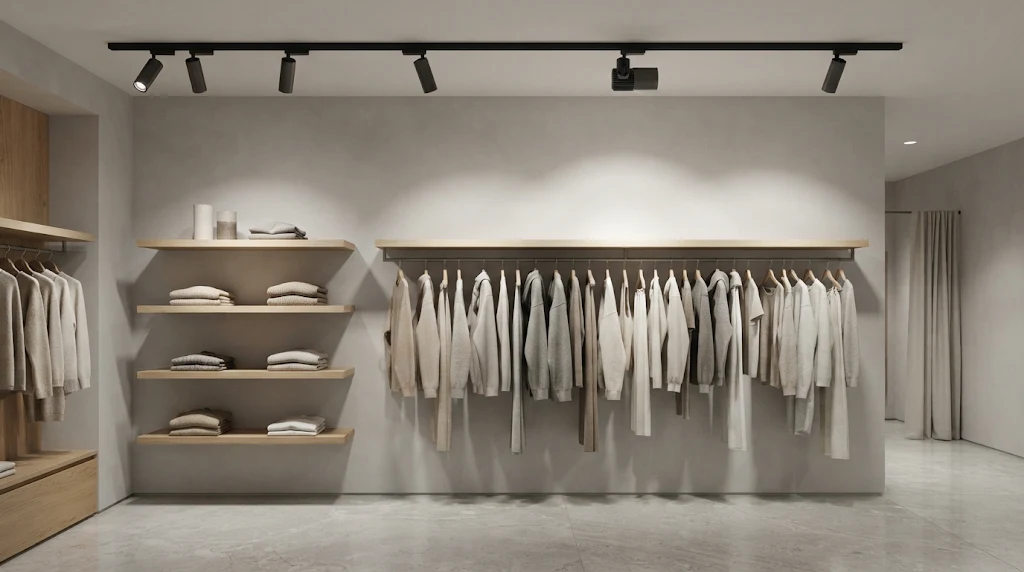
4. Why Is Lighting Design Just as Important as LED Efficiency?
A high-efficiency LED fixture does not automatically produce an efficient lighting installation.
The optical system, beam angle, mounting position and aiming direction determine how effectively light reaches the surfaces that need to be illuminated.
In retail environments, this matters because different areas have different lighting requirements.
For example:
- Product displays: Controlled accent lighting helps highlight merchandise and visual details.
- Wall displays: Suitable beam distribution helps maintain consistent vertical illumination.
- Main circulation areas: Balanced general lighting supports comfortable movement through the store.
- Fitting rooms: Light quality and facial appearance are particularly important.
- Checkout areas: Appropriate task lighting supports visibility and everyday operations.
- Storage and back-of-house areas: Functional lighting should provide sufficient visibility without unnecessary energy use.
A lighting design should consider illuminance, uniformity, glare, colour rendering and the distribution of light across the space.
For track lighting, choosing the correct beam angle is particularly important. A narrow beam may work well for a focused display, while a wider beam may be more suitable for general illumination or larger merchandise areas.
The objective is not simply to install fewer fixtures. It is to achieve the required lighting performance with an appropriate number of well-positioned luminaires.
5. How Can Intelligent Lighting Controls Reduce Energy Consumption?
Lighting controls can reduce operating hours and adjust output when full lighting levels are not required.
However, the potential savings depend on how the controls are configured and how the space is used.
Common control methods include:
| Control method | Typical application |
|---|---|
| Occupancy sensing | Storage rooms, staff areas and selected low-traffic spaces |
| Daylight sensing | Areas receiving sufficient natural daylight |
| Time scheduling | Opening hours, cleaning periods and overnight operation |
| Dimming | Adjusting lighting output to suit different operating conditions |
| Zone control | Managing different areas independently |
In a retail store, occupancy sensing needs careful consideration. A customer may remain in one area for several minutes while browsing products. If the sensor does not detect small movements, the lighting could dim or switch off when the area is still in use.
For this reason, sensor position, detection coverage, time delay and minimum background lighting should be considered during the design stage.
A well-designed control strategy should reduce unnecessary energy consumption without compromising the shopping experience, staff comfort or product presentation.
6. What Does DALI Add to a Multi-Store Lighting System?
DALI provides a standardised way to control compatible lighting devices digitally.
Depending on the system design and equipment, it can support individual luminaire control, lighting groups, dimming and preset scenes.
For a multi-store project, this can make lighting adjustments more structured and repeatable.
For example, a retailer may define separate lighting groups for:
- Window displays
- Main sales areas
- Feature walls
- Fitting rooms
- Checkout areas
- Back-of-house spaces
Lighting scenes can then be configured for different operating conditions, such as normal trading hours, cleaning or reduced evening operation.
It is important to distinguish between DALI control and a complete central management platform. DALI provides lighting control communication, while remote monitoring, energy reporting, fault notifications and multi-site management depend on the wider system architecture and supporting software.
The control solution should therefore be selected according to the actual operational requirements of the business.
7. Can Centralized Lighting Management Simplify Maintenance?
For companies operating many stores, maintenance can become a significant part of the total cost of ownership.
A consistent lighting specification makes it easier to manage products, spare parts and replacement procedures across different locations.
Where a suitable monitoring platform is installed, central management may also provide information about system status, energy consumption and certain equipment faults.
A practical maintenance strategy should include:
- A standard luminaire and component list
- Consistent product specifications across locations
- Clearly identified spare parts
- Documented control settings
- Installation and commissioning records
- A process for reporting and resolving faults
Not every business needs a sophisticated central management platform. For some retail chains, a standardised product range and a clear maintenance process may deliver more immediate operational value.
The right solution depends on the number of locations, the complexity of the installation and the company’s internal maintenance resources.
8. How Should Businesses Compare Lighting Costs Over the Long Term?
The initial purchase price does not show the full cost of a lighting installation.
A more useful comparison is the total cost of ownership (TCO), which considers the investment and operating costs over an agreed period.
A typical TCO calculation includes:
Total cost of ownership = Initial investment + Energy costs + Maintenance costs + System-related costs
When comparing two lighting solutions, businesses should consider:
- Purchase and installation costs
- Annual electricity consumption
- Expected maintenance requirements
- Replacement components and labour
- Control system costs and service fees
- Expected operating life
- Compatibility with future upgrades
A lower-priced fixture may not be the most economical option if it requires more maintenance or delivers less useful light.
Similarly, a more advanced control system is not automatically the best choice. Its additional cost should be justified by measurable operational benefits.
The aim is to select a lighting solution that meets the project’s technical requirements while keeping lifetime costs under control.
9. How Can a Business Calculate the Payback Period?
The simple payback period estimates how long it takes for annual financial savings to recover the initial investment.
Simple payback period = Initial investment ÷ Annual net savings
For example, assume a lighting modernization project has:
- Initial investment: €100,000
- Annual electricity cost savings: €20,000
- Annual maintenance savings: €5,000
- Additional annual system costs: €0
The annual net saving is €25,000.
The estimated simple payback period is:
€100,000 ÷ €25,000 = 4 years
This is an illustrative calculation, not a project forecast. Actual payback depends on electricity prices, operating hours, installation costs, maintenance requirements and any additional control-system expenses.
For larger investments, businesses may also consider net present value (NPV) and internal rate of return (IRR). These methods take the timing of cash flows and the cost of capital into account.
10. Why Should Retail Chains Standardise Lighting Across Their Stores?
Standardisation makes large lighting projects easier to specify, purchase, install and maintain.
A retailer with 50 or 100 locations may have different store formats, ceiling heights and architectural conditions. However, many of the lighting requirements can still be based on a common technical framework.
A standard specification can define:
- Luminaire types and installation methods
- Power and lumen output ranges
- Colour temperature and colour rendering requirements
- Beam angles and optical options
- Dimming and control compatibility
- Product dimensions and finishes
- Spare parts and replacement procedures
The specification should allow for local adjustments where necessary. A compact store, a flagship location and a shopping-centre unit may not need identical lighting layouts.
The objective is to standardise the technical requirements without forcing every store into the same design.
This approach can improve purchasing consistency, simplify stock management and reduce the time needed to prepare future store projects.
11. What Is the Best Way to Roll Out a Lighting Upgrade Across 100 Stores?
A phased rollout is often more manageable than upgrading every location at once.
A typical project can be divided into five stages.
Stage 1 – Lighting audit
Record the existing fixtures, installed power, operating hours, store layouts and current lighting conditions.
Stage 2 – Design and specification
Prepare the lighting design, select suitable LED luminaires and define the control strategy. Photometric calculations should be used where necessary to check the proposed lighting performance.
Stage 3 – Pilot installation
Upgrade a representative store first. This provides an opportunity to assess the lighting result, installation process, product selection and actual energy consumption.
Stage 4 – Review and standardisation
Review the pilot results, make any necessary adjustments and confirm the technical specification for the wider rollout.
Stage 5 – Phased implementation
Coordinate purchasing, delivery, installation and commissioning across the remaining locations. Keep records of product specifications and installation settings for future maintenance.
A pilot project is particularly useful when stores have different layouts or when new lighting controls are being introduced.
It helps identify practical issues before they are repeated across dozens of locations.
12. How Can BREE Lighting Support Multi-Store Lighting Projects?
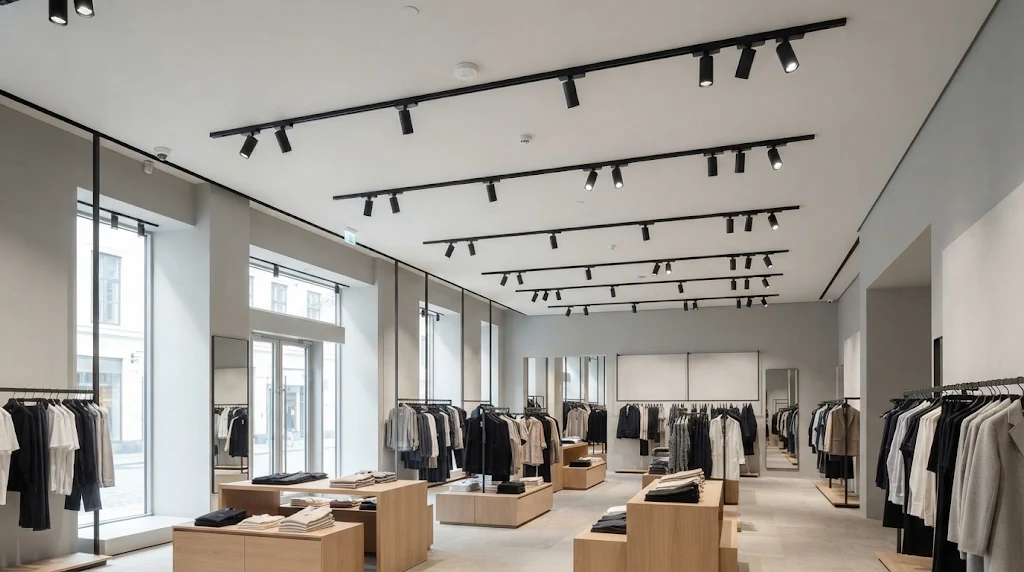
BREE Lighting focuses on LED lighting solutions for commercial and retail environments, including track lights and downlights for applications such as fashion stores, boutiques and other retail spaces.
For multi-location projects, product consistency and technical suitability are important considerations.
A lighting specification may need to address:
- Luminaire types and installation requirements
- Power, lumen output and optical options
- Beam angles for different display applications
- Colour temperature and colour rendering
- Dimming and control compatibility
- Product consistency across different batches
- Replacement and spare-part planning
The right product selection depends on the lighting design and the requirements of each project.
For retail chains planning a phased upgrade, establishing a clear product specification at the beginning can help simplify purchasing and maintain consistency as more stores are modernised.
BREE Lighting works with customers on commercial LED lighting requirements, helping them identify suitable luminaires for their applications and project specifications.
Frequently Asked Questions
There is no fixed price for upgrading 20 stores. The cost depends on store size, existing lighting, the number and type of LED fixtures, installation requirements and whether lighting controls are included. A lighting audit and a standardised specification are the best starting points for an accurate budget.
A larger rollout may create purchasing and project-management efficiencies through standardised products and coordinated installation. However, the final cost still depends on the condition and layout of each store. A phased approach can also help manage investment and operational disruption.
Savings depend on the existing lighting system, the replacement LED load and operating hours. In an illustrative example, reducing installed lighting power from 10 kW to 6 kW with unchanged operating hours reduces lighting energy consumption by 40%.
They can. Occupancy sensing, daylight control, scheduling and dimming may reduce energy use when full lighting output is unnecessary. The actual benefit depends on the store layout, operating patterns, sensor configuration and control strategy.
No. DALI can be useful when individual control, grouped luminaires or programmable lighting scenes are required. Smaller or simpler projects may not need a DALI system. The control solution should match the operational needs and budget of the project.
A pilot installation is recommended for larger rollouts, especially when the existing lighting varies between locations or a new control strategy is being introduced. It allows the company to review lighting performance, installation requirements and energy consumption before wider implementation.
Businesses should compare more than the unit price. Relevant factors include product specifications, optical performance, colour consistency, dimming compatibility, technical documentation, delivery capability, product consistency and long-term availability of replacement components.
Conclusion
Modernising lighting across 20, 50 or 100 stores is not simply a fixture replacement exercise. It is an opportunity to review energy consumption, lighting quality, maintenance procedures and the way lighting is managed across the business.
The most effective projects begin with an assessment of the existing installation, followed by a clear technical specification and a realistic calculation of lifetime costs.
For retail chains and other multi-site businesses, the long-term value comes from combining efficient LED luminaires, appropriate lighting design, suitable controls and a consistent rollout strategy.