A good fashion store does not need to be bright everywhere. It needs the right light in theright places: enough ambient light for orientation, controlled light for merchandise, and good colour quality where customers examine clothing.
That sounds straightforward, but it has become more important as fashion stores move toward more open layouts, larger glazed areas, flexible merchandising and lower-energy operation.
Lighting now has to work with the architecture rather than sit on top of it.
What Has Changed in Fashion Store Lighting?
Fashion retail lighting is moving from uniform illumination toward a more layered and flexible approach.
Older stores often relied heavily on a regular grid of downlights or fluorescent fixtures. The result was predictable: the floor was bright, but the lighting did little to distinguish one product area from another.
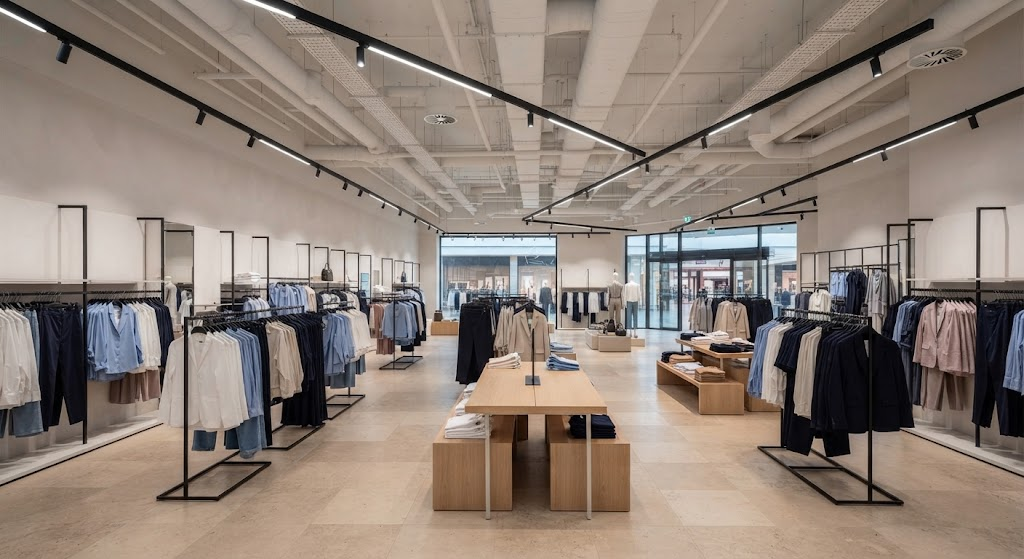
Newer store concepts tend to use a combination of general lighting, track-mounted spotlights, vertical illumination and daylight.
The reason is practical. Fashion merchandising changes regularly. A lighting system that works for one layout may not work after the racks, mannequins or feature walls have been moved.
A flexible system makes those changes much easier to manage.
Why Does Lighting Matter So Much in Fashion Retail?
Lighting affects how customers see colour, fabric, texture and the overall quality of a garment.
A jacket, knitwear collection or pair of trousers can look noticeably different under different light sources. Poor colour rendering, excessive glare or strong shadows can make it harder for customers to judge the product.
There is also a spatial effect.
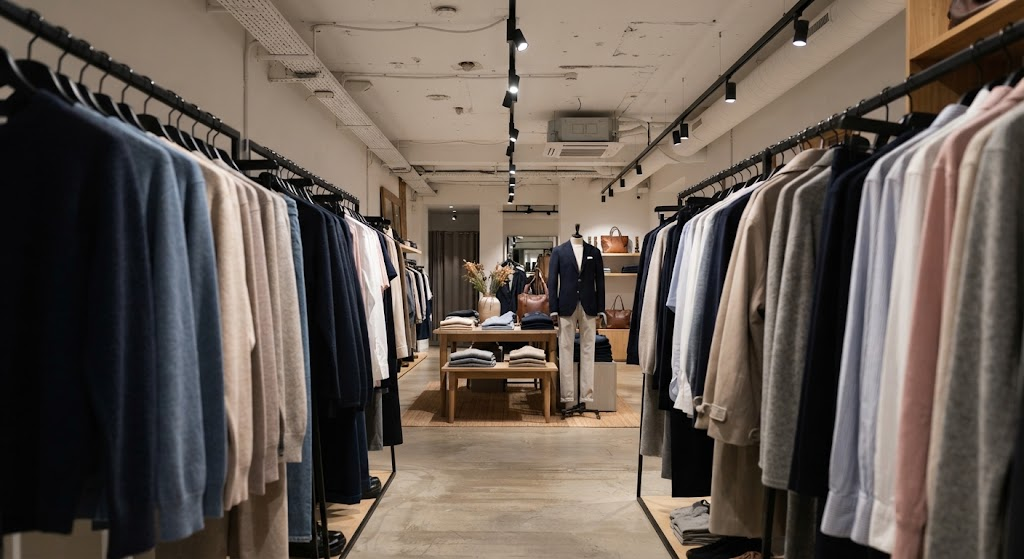
A well-lit entrance can make a store feel more open. Vertical light can bring a dark merchandising wall forward. A focused beam on a mannequin can create a clear point of attention without increasing the brightness of the entire shop.
So the job of retail lighting is not simply to provide enough illumination.
It is to make the store easier to read.
How Should Lighting Be Distributed Across a Fashion Store?
Different areas need different lighting because customers use them for different purposes.
| Store area | Main lighting requirement |
|---|---|
| Entrance | Clear visual transition and first impression |
| Main sales floor | Comfortable general illumination |
| Clothing displays | Good colour quality and vertical light |
| Mannequins | Controlled accent lighting |
| Feature displays | Higher visual emphasis |
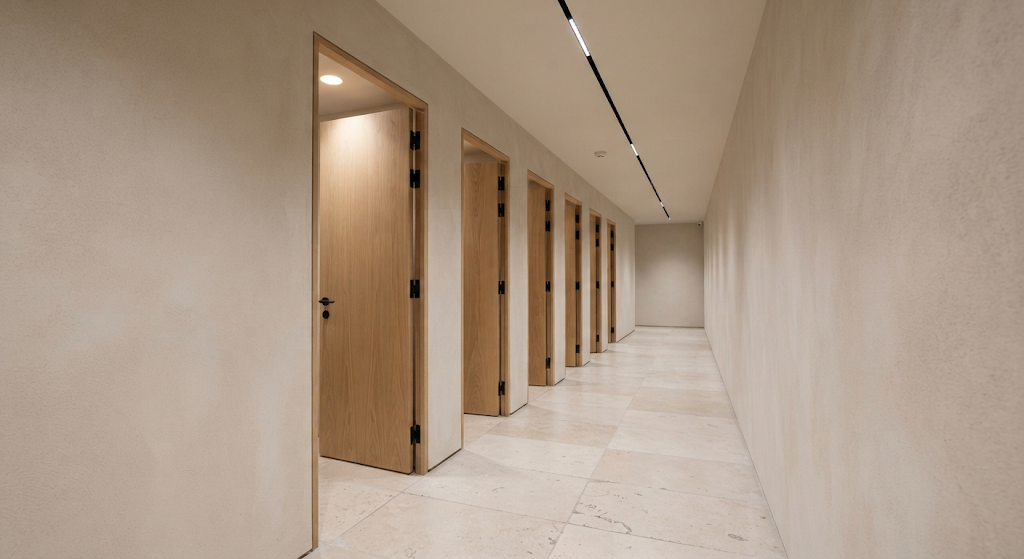
| Fitting rooms | Balanced facial and garment illumination |
| Checkout | Clear, comfortable visibility |
| Lounge areas | Lower visual intensity and a more relaxed atmosphere |
This does not mean every zone needs a completely different luminaire.
In many projects, the same track system can support several applications simply by changing the position, beam angle or output of individual spotlights.
Should Fashion Stores Use Daylight?
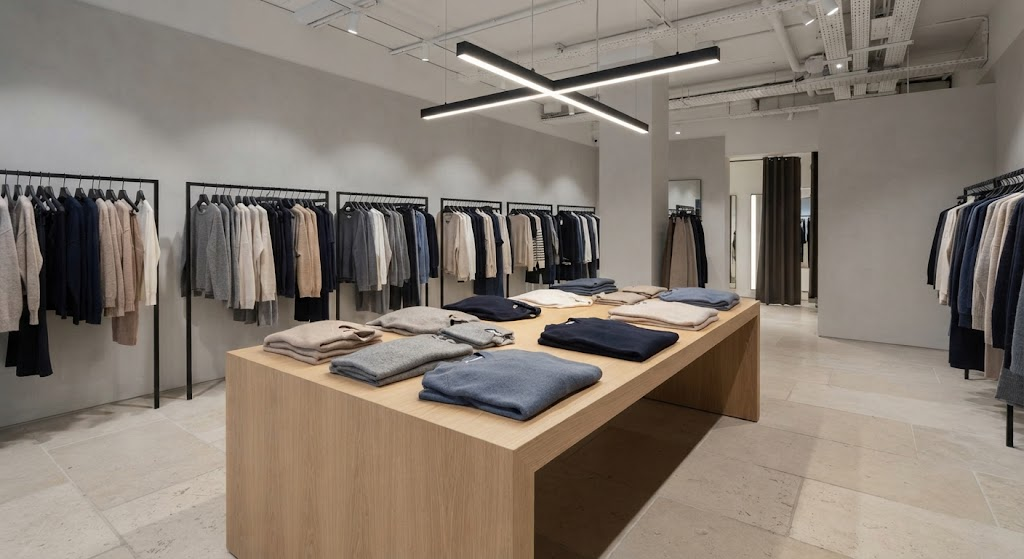
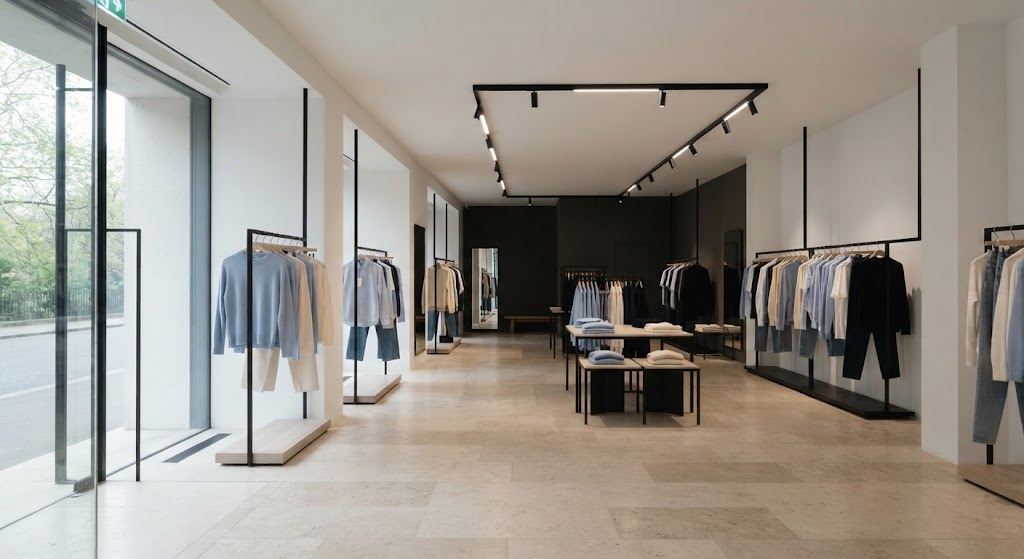
Daylight can make a store feel more open, but it should normally work together with artificial lighting rather than replace it.
Large windows and glazed façades bring useful natural light into the sales area. They can also strengthen the connection between the store and the street.
The difficulty is consistency.
Daylight changes throughout the day and varies considerably with weather and season. A store that looks well balanced at 11 a.m. may have a very different lighting balance later in the afternoon.
This is where controllable LED lighting becomes useful.
A simple approach is:
- Use daylight where it is available.
- Use ambient LED lighting to maintain a consistent base level.
- Adjust artificial lighting when daylight changes.
- Keep product-focused lighting independent where possible.
This approach is particularly useful in stores with large windows, skylights or open entrance areas.
Why Is Vertical Lighting Important for Fashion Displays?
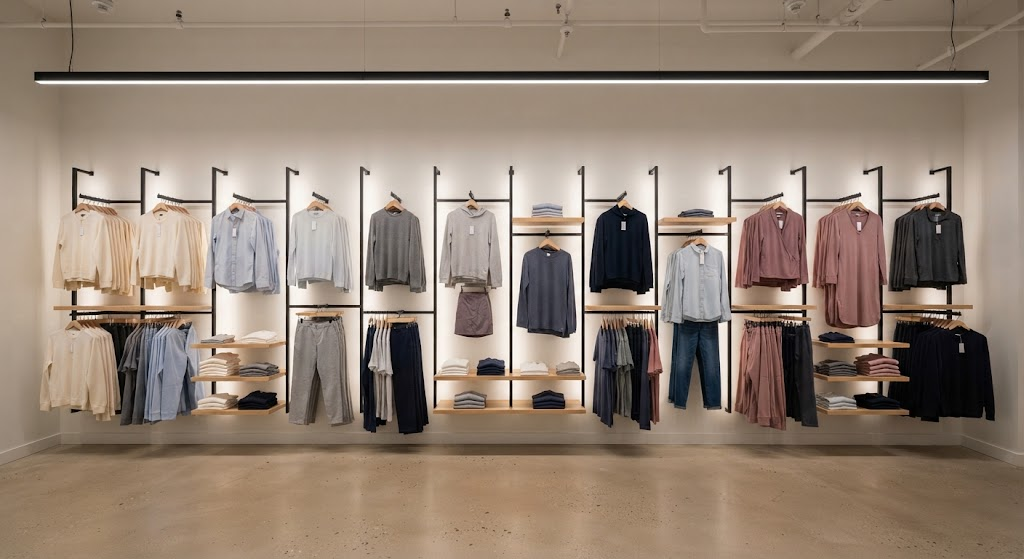
In a clothing store, the walls and displays often need as much attention as the floor.
Customers generally look at garments hanging on rails, displayed on walls or arranged on shelving. If these surfaces are poorly lit, the merchandise can appear flat or lose visual impact even when the overall store is bright.
Vertical illumination can help with:
- Clothing visibility
- Colour recognition
- Fabric texture
- Wall merchandising
- Product hierarchy
- Perceived brightness
This is one reason track spotlights and wall-washing solutions are commonly used together with general lighting.
The goal is not to make every wall extremely bright. It is to give important merchandising areas enough visual presence.
What Beam Angle Should Fashion Track Lights Use?
The appropriate beam angle depends on the size of the display, mounting height and distance between the luminaire and the merchandise.
There is no single beam angle that works for every fashion store.
As a starting point:
| Beam angle | Suitable starting application |
|---|---|
| 15° | Mannequins and small feature displays |
| 24° | Individual products and medium displays |
| 36° | Clothing racks and merchandising walls |
| 60° | Broad areas requiring wider coverage |
These figures are not fixed design rules.
For example, a 15° beam mounted four metres above a mannequin will produce a very different result from the same beam used at a much shorter distance.
Lighting calculations and on-site testing are therefore more reliable than selecting a beam angle from a product catalogue alone.
Is a Brighter Fashion Store a Better Fashion Store?
Not necessarily. Excessive brightness can add energy consumption and glare without making merchandise easier to see.
What matters more is contrast.
A useful retail scene might have a comfortable general level across the sales floor, stronger illumination on a clothing wall and a tighter beam on a featured mannequin.
The customer’s eye naturally moves toward the areas with greater visual emphasis.
This is why good retail lighting often feels brighter than it actually is.
The lighting is doing more with less.
What LED Specifications Should Fashion Retailers Check?
Wattage alone tells very little about whether a retail luminaire is suitable for fashion.
A proper specification should consider the complete optical and electrical performance.
| Specification | Why it matters |
|---|---|
| Colour rendering | Important for accurate garment appearance |
| Colour consistency | Helps maintain a uniform look between luminaires |
| Beam angle | Determines coverage and contrast |
| Glare control | Affects customer comfort |
| LED efficacy | Influences energy consumption |
| Dimming | Allows lighting levels to be adjusted |
| Track compatibility | Makes repositioning easier |
| Control compatibility | Allows integration with lighting-management systems |
| Thermal design | Influences long-term performance |
For European projects, product compliance also needs to be checked against applicable EU ecodesign requirements and other relevant regulations. The European Commission includes light sources and separate control gear within its ecodesign framework.
How Can Fashion Stores Reduce Lighting Energy Use?
The biggest savings usually come from reducing unnecessary operating time and excessive illumination, not simply installing lower-wattage lamps.
A sensible energy strategy includes several measures.
1. Use efficient LED luminaires
Choose luminaires with suitable efficacy and optical performance for the application.
2. Avoid over-lighting
Do not use the same output everywhere simply because the lighting calculation allows it.
3. Use daylight intelligently
Where daylight is strong enough, artificial lighting can be reduced without compromising the customer experience.
4. Use dimming and scheduling
Lighting levels can be adjusted according to opening hours and store conditions.
5. Consider sensors where they make sense
Back-of-house areas, storage spaces and other intermittently occupied areas may benefit more from occupancy control than the main sales floor.
6. Maintain the installation
Dirty optics, ageing components and poorly maintained equipment can gradually reduce performance.
The European Commission’s energy-efficiency policy follows the broader principle that energy should be used efficiently while maintaining the service it provides.
For retail, that means reducing wasted light rather than simply reducing useful light.
Why Is Flexible Track Lighting Useful for Fashion Stores?
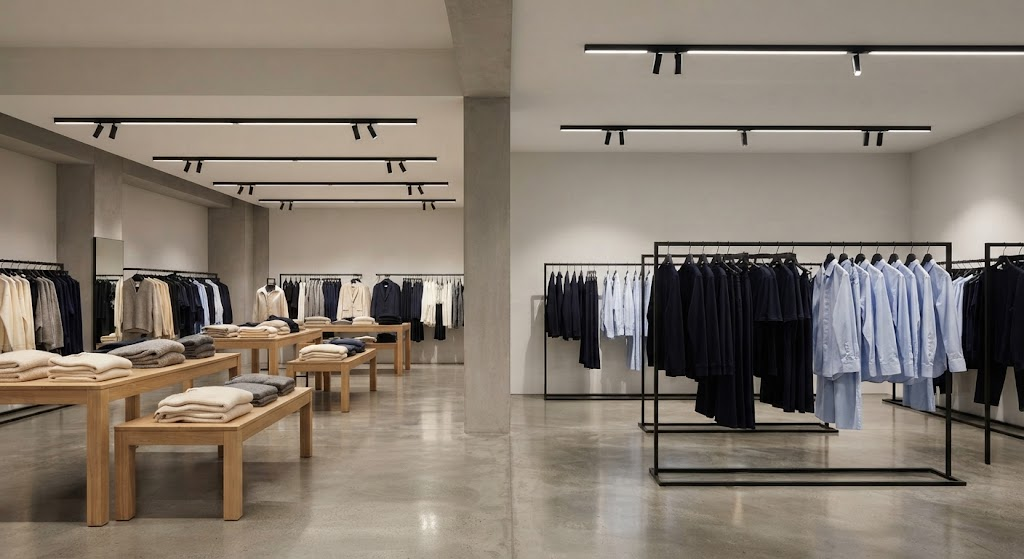
Track lighting is particularly useful when the merchandise moves more often than the ceiling does.
Fashion layouts change with seasons, campaigns, new collections and commercial priorities.
A fixed lighting grid cannot always follow those changes.
A track system allows individual luminaires to be:
- Moved to a new display position.
- Re-aimed toward different merchandise.
- Adjusted when a wall or rack is relocated.
- Reconfigured for seasonal campaigns.
- Expanded when a new feature area is introduced.
That flexibility can reduce the amount of electrical and ceiling work required during future store changes.
How Should a Fashion Retailer Plan a New Lighting System?
The lighting design should start with the merchandise and customer journey, not with a luminaire catalogue.
1. Map the store
Mark entrances, circulation routes, clothing displays, fitting rooms, checkout areas and feature zones.
2. Identify priority merchandise
Decide which products need to attract attention and which areas can remain visually quieter.
3. Establish the lighting layers
Separate general illumination from product-focused and vertical lighting.
4. Check ceiling height
Mounting height has a direct effect on beam spread, illuminance and glare.
5. Select beam angles
Choose optics according to the actual display rather than applying one beam angle throughout the store.
6. Check colour quality
Pay particular attention to colour rendering and colour consistency where garments and materials are being evaluated.
7. Consider daylight
Determine where daylight enters the store and how its level changes during operating hours.
8. Select the control strategy
Dimming, scheduling and daylight response can be considered according to the size and operating model of the store.
9. Build a sample area
Testing a representative section before completing the entire store can reveal glare, shadows and colour issues that are difficult to identify from drawings alone.
10. Standardize what should be standardized
For a fashion chain, keep core specifications consistent while allowing individual stores enough flexibility to respond to their architecture and merchandising.
Which Fashion Stores Benefit Most From This Approach?
Flexible, layered LED lighting is especially useful where layouts and product presentation change frequently.
1. Fashion chains
A common lighting specification can simplify purchasing, maintenance and future store rollouts.
2. Department stores
Different departments can use different lighting treatments without requiring separate infrastructure for every area.
3. Sportswear stores
Mannequins, footwear walls and product displays often benefit from directional accent lighting.
4. Premium fashion stores
Good colour quality, controlled beams and low glare can help present fabrics and finishes more effectively.
5. Lifestyle stores
Lighting can help distinguish different commercial zones within a larger open-plan environment.
6. Renovated stores
A flexible track system can sometimes be integrated into an existing ceiling and electrical structure, depending on the building and existing installation.
Can Smart Lighting Improve Fashion Store Operations?
Smart controls are useful when they provide a clear operational benefit rather than being added simply because the technology is available.
For a fashion store, useful functions can include:
- Scheduled lighting
- Dimming
- Daylight response
- Scene control
- Central monitoring
- Zone-based control
A small boutique may only need straightforward dimming and scheduling.
A large fashion chain with many stores may gain more from centralized monitoring and standardized control strategies.
The control system should follow the operational needs of the retailer.
What Does Sustainable Lighting Mean for Fashion Retail?
Sustainable lighting is about the whole installation, including energy use, flexibility, maintenance and how long the system can remain useful.
Replacing every component whenever a store changes its layout is not necessarily the most efficient approach.
A more practical strategy is to consider:
- Energy efficiency
- Reuse of suitable infrastructure
- Long-term maintenance
- Flexible mounting systems
- Replaceable components
- Future merchandising changes
- Control and operating schedules
A lighting system that can adapt to a new store layout has value beyond its initial energy performance.
What Is the Biggest Lighting Mistake in Fashion Retail?
The most common mistake is treating the entire sales floor as one lighting zone.
A uniform grid may be easy to install, but it gives retailers very little control over visual hierarchy.
The better question is:
Which products should customers notice first, and what lighting will help them see those products properly?
Once that question is answered, beam angle, luminaire position, output and control become much easier to determine.
What Should Fashion Retailers Prioritize When Choosing Track Lighting?
Retailers should evaluate optical performance, colour quality, glare and flexibility alongside price and wattage.
A practical specification checklist includes:
| Question | What to check |
|---|---|
| Does the product show colours accurately? | Colour-rendering performance |
| Is colour consistent between fittings? | Colour consistency |
| Can the light be focused properly? | Beam options |
| Is glare controlled? | Optical design |
| Can output be adjusted? | Dimming |
| Can the fitting move with the display? | Track compatibility |
| Can it work with the selected controls? | Control protocol |
| Is maintenance straightforward? | Driver and component access |
| Can the system support future layouts? | Overall flexibility |
For larger retail projects, these points should ideally be evaluated through samples or mock-ups rather than specifications alone.
FAQ: Fashion Store Lighting
There is no single lighting product that is best for every fashion store. A layered system combining general, accent and vertical lighting provides a practical starting point.
The choice depends on the brand, merchandise and desired atmosphere. Neutral white is often useful where clean product presentation and colour evaluation are priorities, while warmer settings can support a more intimate store concept.
Yes. It is particularly useful when displays and merchandise layouts change regularly because individual luminaires can be repositioned.
It depends on the application. Narrow beams are useful for focused displays, while wider beams are more suitable for larger merchandise areas.
Because much of the merchandise is displayed vertically. Lighting the walls and display surfaces can make clothing easier to see and improve the overall visual balance of the store.
Not by itself. Colour rendering is important, but the complete system also needs appropriate spectrum, colour consistency, beam control, glare management and suitable illuminance.
Yes, when efficient luminaires are combined with appropriate lighting levels, dimming, scheduling and daylight integration. Simply replacing old lamps with LED without reviewing the lighting design may leave efficiency gains on the table.
No. Controls should match the size, layout and operating requirements of the store. A simple system can be more appropriate than a complex one when the operational benefit is limited.
Use flexible track systems, adjustable spotlights and controllable lighting zones. This allows the lighting to follow merchandising changes without rebuilding the entire ceiling.
What Is the Future of Lighting in Fashion Retail?
The direction is toward lighting systems that are more flexible, efficient and closely integrated with the way stores actually operate.
The strongest retail projects are not necessarily the ones with the most sophisticated technology.
They are the ones where lighting, architecture, merchandising and customer movement work together.
For fashion retailers, the practical priorities are clear:
1. Use light to guide attention.
2. Give merchandise accurate colour and useful contrast.
3. Light vertical displays as well as floors.
4. Combine daylight with controllable LED lighting where appropriate.
5. Avoid unnecessary illumination.
6. Use flexible systems when layouts change frequently.
7. Choose controls according to real operational needs.
8. Test the lighting before rolling it out across an entire store network.
Good fashion retail lighting is not about making everything brighter.
It is about making the right things easier to see.
Professional reference points
The principles above are consistent with guidance and requirements from major European sources, including the European Commission’s energy-efficiency and ecodesign framework and established retail-lighting practice around colour quality, glare, visual hierarchy and controllability.
For European projects, designers should also verify the current requirements applicable to the specific light source, control gear and installation before final specification.