Quick answer: For retail use, specify 15W–25W depending on ceiling height, lm/W efficiency of 140lm+ (not just wattage), CRI 93+ for fashion and food, and CE + ENEC certification for EU markets. If those terms are unfamiliar, this guide explains each one and why it matters more than the price tag.
We have been manufacturing LED track lights in Guangzhou for over 15 years. Our products are in retail stores, hotels, galleries, and offices across 53 countries. This guide is written from that experience.
Most track lighting guides online repeat the same surface-level information: “LEDs save energy,” “choose the right color temperature,” “CRI above 80 is good.” That is not wrong, but it is not enough to make a good purchasing decision. We will go further.
What Is Track Light and Where Does It Make Sense?
Track lighting is a ceiling-mounted electrified rail carrying movable light fixtures. Each fixture can be repositioned, redirected, and swapped without touching the wiring. That flexibility is the reason it dominates commercial spaces.
A clothing store rearranges its floor every few weeks. A gallery changes exhibitions. A restaurant wants warm intimate light at dinner service and brighter task light during setup. Fixed recessed downlights cannot respond to any of those needs without rewiring. Track lighting can.
Where track lighting is the wrong choice: purely ambient large-area illumination where directional control is not needed, ceiling heights below 2.5m where the fixture profile becomes intrusive, and outdoor applications unless you specify IP65-rated track heads.
Where it is clearly the right choice: fashion retail, food retail, art galleries, hotel lobbies, restaurant dining rooms, showrooms, museum displays, and any commercial space that changes layout more than once a year.
1-Circuit vs 3-Circuit vs Magnetic Track: Which System Do You Need?
1-Circuit Track
Three independent circuits in one rail profile. Fixtures connect to circuit 1, 2, or 3 by rotating the adapter at mounting. Each circuit connects to a separate dimmer or switch, giving you three independently controllable zones on one track without extra wiring.
This is the European standard for professional commercial installations. A typical fashion store setup: circuit 1 for wall-wash on clothing rails, circuit 2 for accent spots on featured items, circuit 3 for general ambient fill. One track, three lighting scenes.
If you are specifying for any commercial project in Europe, assume 3-circuit unless there is a specific reason not to
Magnetic Track (48V DC)
Low-voltage system (48V DC) with fixtures that attach magnetically and slide freely. No adapters, no rotation — reposition in seconds without tools. Track profiles can be extremely slim (some under 15mm), integrating cleanly into plasterboard ceilings.
The appropriate choice for luxury retail, high-end hospitality, and residential projects where visible hardware needs to disappear. Cost is roughly 2–3× conventional track, which is justified for the right project and not for a budget-constrained one.
| System | Circuits | Repositioning | Best For | Relative Cost |
|---|---|---|---|---|
| 1-Circuit | 1 | Rotate adapter | Residential, small retail | Low |
| 3-Circuit | 3 | Rotate adapter | Commercial retail, offices, EU standard | Medium |
| Magnetic 48V | 1 (48V DC) | Slide freely | Luxury, high-design, slim profiles | High |
Wattage by Ceiling Height — The Rule That Actually Works
The most common mistake we see from first-time commercial buyers: choosing wattage based on old halogen equivalents (“I used 50W halogens, so I need 50W equivalent LED”). That logic breaks down because LED efficacy varies enormously. A 15W LED at 160 lm/W produces more light than a 25W LED at 100 lm/W.
The correct approach: match wattage to ceiling height and required lux level at the product or floor plane, using the actual lumen output of the specific fixture you are buying.
| Wattage | Lumens at 160 lm/W | Ceiling Height | Application |
|---|---|---|---|
| 12W | ~1,920 lm | 2.5 – 3m | Residential, accent, display cases |
| 15W | ~2,400 lm | 3 – 3.5m | Boutique retail, hospitality, residential |
| 18W | ~2,880 lm | 3 – 4m | Standard retail, restaurants, offices |
| 20W | ~3,200 lm | 3.5 – 4.5m | Mid-size retail, galleries, supermarkets |
| 25W | ~4,000 lm | 4 – 6m | High-ceiling showrooms, museums, atriums |
Target lux levels for reference: general retail 300–500 lux at floor level; feature merchandise 1,000–2,000 lux; art gallery accent 500–1,500 lux depending on sensitivity of the work. For a proper fixture count, ask your supplier for a lighting simulation (DIALux or Relux) using the actual IES photometric file for the specific product.
lm/W Efficiency: The Number That Determines Your Electricity Bill
Lumens per watt (lm/W) is the most important number on a track light datasheet and the one most frequently ignored by buyers focused on unit price.
Here is why it matters: efficiency determines how much light you get per watt of electricity consumed. A fixture producing 160 lm/W running at 20W delivers the same light output as a 100 lm/W fixture running at 32W. Over 50,000 hours, that 12W difference costs real money.
Worked example — 200-fixture retail installation, 12 hours/day:
- Switching from 100 lm/W to 160 lm/W (same lux levels, lower wattage per fixture)
- Power saved: 200 fixtures × 12W = 2,400W = 2.4 kWh/hour
- Annual saving: 2.4 × 12 × 365 = 10,512 kWh
- At €0.25/kWh (EU commercial average): €2,628/year saved
- Payback on premium fixtures vs economy: typically 18–30 months
| Efficiency Tier | lm/W Range | Real-world implication |
|---|---|---|
| Economy | 80 – 100 | Cheap chips, often no third-party test data. Works but expensive to run. |
| Standard | 100 – 120 | Mass market. Adequate for low-demand applications. |
| High efficiency | 120 – 140 | Worthwhile upgrade for any commercial project. |
| Ultra-high efficiency | 140 – 170 | Professional commercial standard. Our 12W–25W range sits here. |
| Premium | 170 – 220+ | Flagship. Measurable savings on large installations. |
Important caveat: efficiency claims need to be backed by a third-party photometric test report in LM-79 format from an accredited lab. We have seen suppliers quote 160 lm/W on a datasheet and deliver 110 lm/W in testing. Always request the actual report, not just the figure.
CRI 80 vs CRI 93: The Visible Difference in Retail
CRI (Color Rendering Index) measures how accurately a light source renders colors compared to natural daylight (CRI 100). The difference between CRI 80 and CRI 93 is not a technical footnote — it is visible to any customer walking into a store, even if they cannot name what they are seeing.
Under CRI 80: a deep burgundy dress reads as brownish. Fresh produce looks slightly grey. A white shirt looks marginally yellow. Nothing is wrong enough to complain about. But nothing looks quite as good as it should, and customers respond to that even without knowing why.
Under CRI 93: colors appear as they were designed to appear. Products look the way the buyer selected them. Fabric textures read clearly. Skin tones under fitting room lighting look natural. Every serious fashion or food retailer we work with specifies CRI 90+ without discussion.
| CRI Range | Color Quality | Appropriate Use |
|---|---|---|
| 70 – 79 | Poor | Car parks, storage. Never in retail or hospitality. |
| 80 – 89 | Acceptable | Offices, corridors, back-of-house. |
| 90 – 94 | Excellent | Fashion, food, restaurants, hotels. Professional minimum. |
| 95 – 99 | Near-perfect | Jewelry, art, cosmetics, print proofing. |
If you are specifying for food retail or cosmetics, also request the R9 value separately. Standard CRI testing averages eight color samples; R9 specifically measures deep red rendering, which determines whether meat looks fresh or pale, whether lipstick looks vivid or dull. Specify R9 > 50 minimum for food applications, R9 > 70 for cosmetics. Our CRI 93 track lights achieve R9 > 70 as standard.
CCT, Tunable White, and Smart Track Lights
What color temperature should you specify?
Color temperature (measured in Kelvin) determines whether a space feels warm and premium or bright and clinical. Getting this wrong actively undermines the store atmosphere, regardless of how well-specified everything else is.
- 2700K – 3000K (warm white): Luxury retail, wine, bakeries, restaurants, hotel lobbies. Creates warmth and perceived premium quality.
- 3500K (neutral warm): Fashion retail, lifestyle stores. Safe default for most commercial retail.
- 4000K (cool white): Electronics, supermarkets, offices. Clean and functional.
- 5000K+ (daylight): Jewelers, print work, industrial tasks. Cold; use only where daylight-accurate color is the explicit goal.
CCT Tunable Track Lights
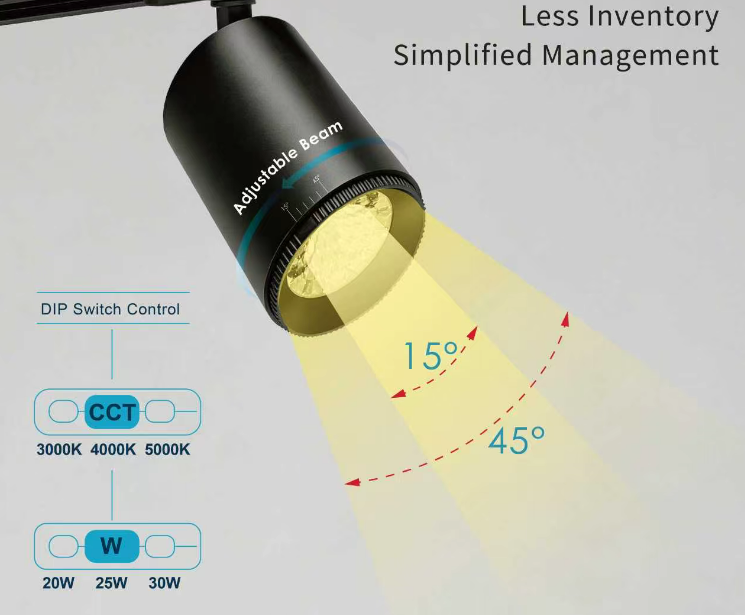
Tunable-white fixtures allow adjustment from warm to cool across the full CCT range via a controller or app. One SKU covers multiple applications; the retailer can shift from 3000K evening mood to 4000K afternoon brightness without changing a fixture.
The trade-off: tunable fixtures contain two LED channels and additional driver circuitry, adding 15–30% to unit cost versus fixed CCT. For most retail applications where the CCT is set at installation and never changed, a high-quality fixed CCT fixture is the better value. Tunable-white makes sense for multi-purpose spaces and hospitality venues that actively use the adjustment.
Smart Track Lights
Smart variants add wireless control — Zigbee, Bluetooth Mesh, Wi-Fi, or DALI-2 — enabling scene programming, scheduled dimming, occupancy-linked control, and BMS integration.
The practical benefit depends entirely on whether the space will use these features. A flagship store running multiple lighting scenes across the trading day gets real value. A back-office corridor does not need it. Our smart track lights support Zigbee and Bluetooth Mesh, are compatible with Casambi and standard DALI-2 ecosystems, and maintain 140–170 lm/W efficiency and CRI 93+ across all smart variants.
Beam Angle Selection
Beam angle determines how concentrated or spread the light is. Choosing wrongly means either a sharp, hard spot that misses the product edges or a flood that washes everything flat without any directional emphasis.
| Beam Angle | Character | Best Application |
|---|---|---|
| 10° – 20° (narrow spot) | Tight, dramatic | Jewelry, art accent, architectural detail |
| 24° – 36° (medium spot) | Focused, defined | Retail product highlight, mannequins, shelf display |
| 40° – 50° (medium flood) | Broad, even | General merchandise, mid-floor illumination |
| 60°+ (wide flood) | Ambient, diffuse | Ambient fill, open corridors, general ambient layers |
For most retail projects, 24°–36° is the primary workhorse beam. Mixing in a narrower 15°–20° on featured displays or product hero shots adds depth and visual hierarchy without requiring more fixtures. Many professional track lights support interchangeable optic lenses, which is the pragmatic solution when beam requirements are not confirmed until you are on site.
EU Certifications: CE, ENEC, RoHS — What You Actually Need
Certification is the area where we see the most confusion among importers and the most risk for distributors who discover problems after the goods are already in their warehouse.
CE Marking — mandatory
CE marking is legally required for all electrical products sold in the EU. For track lighting, this means compliance with the Low Voltage Directive (2014/35/EU) and the EMC Directive (2014/30/EU), verified against EN 60598 (luminaires standard). CE is self-declared by the manufacturer — they sign off that their product meets the standards, based on their own or commissioned testing.
The problem is that a CE logo is easy to print. We have seen products from competitors carrying CE marks with no underlying test documentation. If a distributor in Europe imports and sells non-compliant products, the liability sits with the importer. Always request the full Declaration of Conformity plus the actual test reports — not just a photo of the certificate.
ENEC Certification — strongly recommended for professional procurement
ENEC is issued by independent EU-accredited testing bodies after third-party product testing and ongoing factory audits. Unlike self-declared CE, ENEC cannot be faked. It is the certification expected by public buildings, healthcare facilities, and major retail chains in their procurement specifications.
BREE Lighting holds ENEC certification. Among Chinese LED track light manufacturers, this is relatively uncommon. It is one of the meaningful quality signals we can offer beyond our own word.
RoHS — mandatory
Restricts lead, mercury, cadmium, hexavalent chromium, and certain brominated flame retardants. Required for EU market access. Ask for the manufacturer’s RoHS declaration and, for higher-value orders, third-party substance test results.
ErP / EcoDesign — mandatory for minimum efficiency
EU Regulation 2019/2020 sets minimum efficacy requirements for light sources sold in the EU from September 2021. High-efficiency track lights at 140+ lm/W comfortably clear these thresholds. Economy 80 lm/W products often do not, which means they cannot legally be sold in the EU market regardless of price.
What Causes Track Lights to Fail Before Their Time
In 15 years of manufacturing and field feedback from 53 countries, the failure patterns are consistent. It is almost never the LED chip — modern chips from Cree, Osram, Samsung, and Lumileds are reliable. Failures come from elsewhere.
Thermal management. LEDs degrade when heat is not properly dissipated from the junction. Die-cast aluminium housing (6063 alloy) is the correct material for commercial-use track lights. Plastic housing, regardless of what the datasheet says, does not manage heat adequately for fixtures running 10–14 hours per day. This is the single biggest quality gap between budget and professional fixtures.
Driver quality. The LED driver converts mains AC to regulated DC. A cheap driver delivers unstable current, causes flickering (visible or at a frequency that causes headaches without obvious flicker), and degrades faster than the LED chips it powers. When a fixture fails at 18 months instead of 8 years, the driver is almost always the cause. Ask specifically which driver brand is used and what the warranty on the driver component is.
Reflector quality. A low-quality reflector wastes light that the chip has already produced. We use 98% reflectance reflectors imported from Germany. The difference at the beam edge — sharpness, evenness of the hot spot — is visible in a direct A/B comparison against fixtures using cheaper reflectors.
Lens degradation. Low-quality polycarbonate lenses yellow with heat over time, reducing lumen output and shifting color slightly warm. For fixtures running long daily hours, specify borosilicate glass lenses or UV-stabilised premium PC. It is a small cost difference that matters over 5+ years.
FAQ — 12 Questions Buyers Ask Us Most
What wattage track light do I need for a retail store?
Match wattage to ceiling height, not to old halogen equivalents. For 3–4m ceilings (most common in retail), 15W–20W at 140–170 lm/W is correct. For 4–6m ceilings, 20W–25W. The critical variable is the lm/W of the specific product — a 20W at 100 lm/W delivers the same light as a 12W at 160 lm/W but costs significantly more to run every year.
What is the real difference between 100 lm/W and 160 lm/W?
A 160 lm/W fixture produces 60% more light per watt. In a 200-fixture retail installation running 12 hours daily, that difference saves approximately €2,600–€3,500 per year at EU commercial electricity rates. Payback on the efficiency premium is typically under 2 years.
Is CRI 90 noticeably better than CRI 80 in a retail context?
Yes. Under CRI 80, colors are slightly muted — reds shift brownish, whites look marginally yellow. Most customers will not articulate what is wrong, but they respond to it. Every fashion, food, and hospitality client we work with specifies CRI 90+ without exception. CRI 80 is appropriate for offices, corridors, and back-of-house.
What is the difference between CCT tunable and smart track lighting?
CCT tunable: adjustable color temperature from warm to cool. Smart: wireless dimming, scene control, scheduling, app or BMS control. These are independent features. A track light can be CCT tunable without being smart, smart without being tunable, both, or neither. Most of our smart variants are also dimmable; tunable-white is a separate option.
What certifications do I need to sell track lights in Europe?
CE marking is legally required. RoHS compliance is required. ENEC is voluntary but expected by professional and public procurement. ErP/EcoDesign minimum efficiency must be met. Request original test reports and Declaration of Conformity — not just logos on the product or datasheet.
How long do LED track lights actually last?
Quality commercial LED track lights are rated L70 at 50,000 hours — 70% lumen maintenance after 50,000 hours. At 12 hours/day, that is over 11 years. In practice, the driver limits lifespan before the LED chip in low-quality fixtures. With a quality driver and proper thermal management, 8–12 years in commercial use is realistic. We warrant our products for 5 years.
Are LED track lights dimmable?
Professional-grade ones are, via TRIAC (leading-edge or trailing-edge), 0–10V, or DALI. Smart variants add wireless dimming. Dimming protocol must match your existing dimmer or control system — TRIAC dimmers are incompatible with 0-10V drivers. Confirm compatibility before ordering.
What beam angle should I use for retail spotlights?
24°–36° for general merchandise display. 15°–20° for accent on specific products, mannequins, or artwork. 40°–60° for ambient fill. In practice, a mix of 24° primary spots with 15° accent spots on key displays works well in most fashion retail layouts.
What is 3-circuit track and do I need it for a commercial project?
3-circuit track runs three independent circuits in one rail, giving you three separately dimmable zones without extra wiring. For any commercial project in Europe where zone control matters — which is most of them — specify 3-circuit. The cost difference over 1-circuit is small. Retrofitting later is not.
How do I calculate how many track lights I need?
Basic formula: fixture count = (target lux × floor area m²) ÷ (lumens per fixture × utilisation factor). For retail, target 500–1,000 lux at product/floor level. A 15W BREE track light at 160 lm/W produces 2,400 lm. With a utilisation factor of 0.6 (typical for track spots), each fixture contributes approximately 1,440 effective lux·m². Divide your total requirement by that number for an initial count, then refine with a lighting simulation using the actual IES file.
What import duty applies when bringing track lights from China to Denmark or the EU?
Track lights classified under HS 9405.40 from China to the EU attract approximately 3.7% customs duty on the CIF value (product cost + freight + insurance). Local VAT (25% in Denmark) applies on top and is fully recoverable for VAT-registered importers. The 3.7% duty is a real cost that does not recover. Verify the specific 10-digit TARIC subcode for your product in the EU TARIC database before importing, as subcodes can affect the rate.
What should I check when evaluating a track light supplier from China?
In order of importance: ENEC or CE test reports (originals, not logos) from an accredited lab; LM-79 photometric test report from a third-party lab confirming lm/W and CRI claims; housing material (die-cast aluminium, not plastic); driver brand and warranty; factory certification (ISO 9001); and warranty terms in writing. Price matters, but a €2/unit saving on a fixture that fails at 18 months instead of 8 years is not a saving.
About BREE Lighting
BREE Lighting is an LED track light and downlight manufacturer based in Guangzhou, China. We have been making commercial lighting for over 15 years and supply distributors, project contractors, and retail interior designers across 53 countries.
Our track light range covers 12W to 25W, with efficiency from 140 to 220 lm/W, CRI 93+ standard, and fixed CCT, CCT tunable, and smart variants across the range. CE, ENEC, and RoHS certified. 5-year warranty. OEM and private labeling available.
If you are evaluating track lights for a project, we can provide samples, photometric test reports, and a lighting simulation for your space. Contact us here or email info@br-lighting.com.cn directly.