Tunable White CCT Ranges and Psychological Mapping for Commercial Spaces
| CCT Range | Light Description | Suitable Commercial Applications | Psychological & Physiological Effects |
|---|---|---|---|
| 2200K – 2700K | Amber / Very Warm White | Fine dining (evening), hotel guest rooms (sleep), spas | Extreme relaxation, privacy, promotes melatonin secretion |
| 3000K – 3500K | Warm White | Apparel retail, cafés, hotel lobbies (afternoon) | Comfort, warmth, social friendliness, increases dwell time |
| 4000K – 4500K | Natural / Neutral White | Offices (morning/afternoon), medical exam rooms, classrooms | Alertness, focus, true color rendition, reduces visual fatigue |
| 5000K – 5700K | Cool White | High-end jewelry display, precision assembly, offices (early morning) | High alertness, highlights details, enhances contrast |
| 6000K – 6500K | Daylight / Very Cool White | Window displays (daytime), laboratories, surgical suites | Maximum alertness, mimics noon daylight, suppresses melatonin |
*Data references: ANSI/IES RP-1-22 and WELL Building Standard v2*
1. What is Tunable White Lighting? Technical Principles and Key Metrics
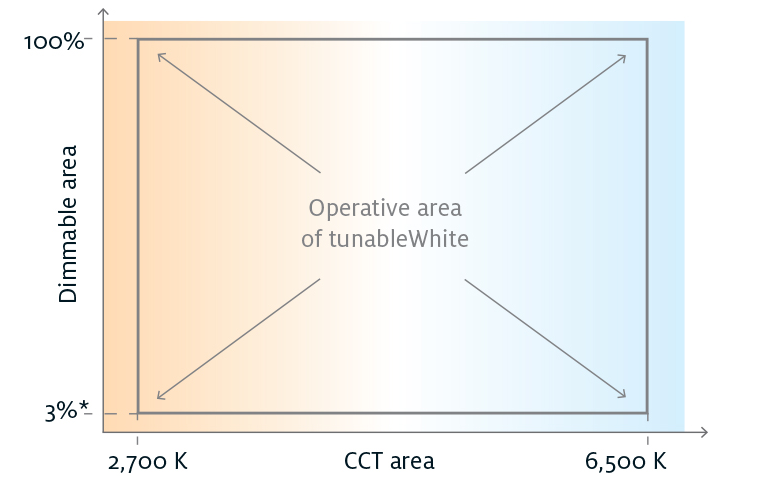
The core of a tunable white LED system lies in independently adjusting the drive current of two or more sets of LED chips with different color temperatures (typically 2700K warm white and 6500K cool white) to achieve smooth transitions across the color temperature spectrum. According to the U.S. Department of Energy (DOE) , the key parameters are Correlated Color Temperature (CCT) adjustment range and precision.
Key Terminology Explained
- CCT (Correlated Color Temperature): Measured in Kelvin (K). Lower values indicate warmer light.
- CRI (Color Rendering Index): Ra value. Commercial spaces should target Ra ≥ 90, with R9 (saturated red) > 50 to ensure vibrant skin tones and food freshness.
- TM-30-20: IES’s advanced color evaluation system, accurately assessing color through Rf (Fidelity) and Rg (Gamut Index) .
- EML (Equivalent Melanopic Lux): A key metric quantifying light’s impact on the circadian system, developed by the Lighting Research Center at RPI.
The Science: How Light Reshapes Business Efficiency and Health
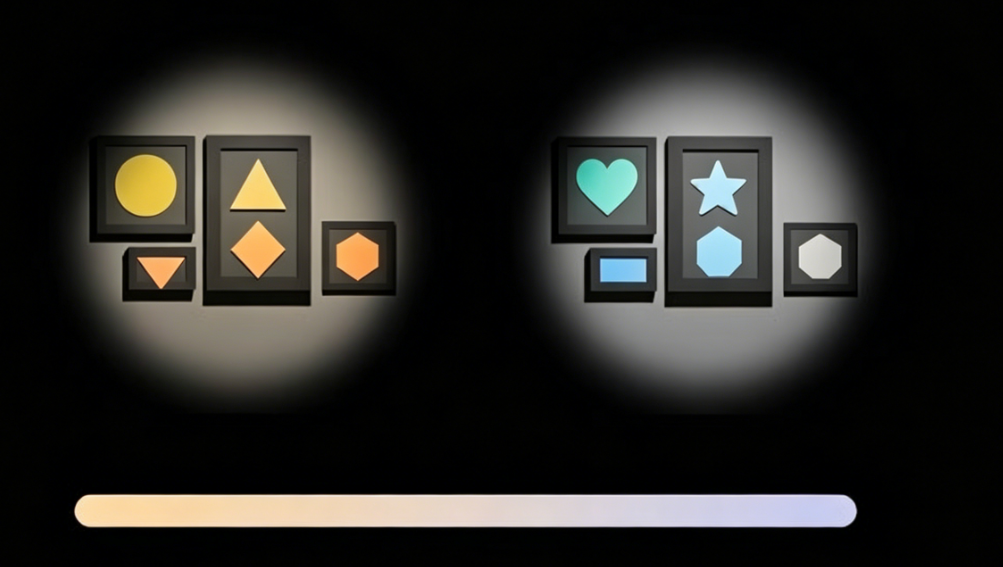
Intrinsically photosensitive Retinal Ganglion Cells (ipRGCs) in the human retina are most sensitive to blue light wavelengths near 480nm. This signal directly regulates melatonin secretion by the pineal gland. The Circadian Stimulus (CS) model and EML metric proposed by RPI’s Lighting Research Center have been incorporated into the WELL Building Standard.
Key Data at a Glance (With Authoritative Sources)
- 📊 Exposure to high CS light in the morning can increase office workers’ reaction speed by 12% and reduce drowsiness by 18% .
Source: Frontiers in Neuroscience, 2021 - 📊 Using warm, low-blue light in the evening can shorten sleep onset latency by 9 minutes and improve sleep efficiency by 5% .
*Source: Harvard Medical School / Sleep, 2015* - 📊 Networked lighting control systems certified by DLC can achieve additional energy savings of 28%-45% compared to conventional LEDs.
Source: DesignLights Consortium NLC 2022 Report - 📊 Dynamic CCT displays in retail stores increase average customer dwell time by 21% and conversion rates by 6-9% .
Source: CBRE / Zumtobel Joint Retail Study (Case Estimate)
In-Depth Application Strategies for Five Key Commercial Sectors
🏢 1. Premium Offices — A Model for Human-Centric Lighting (HCL)
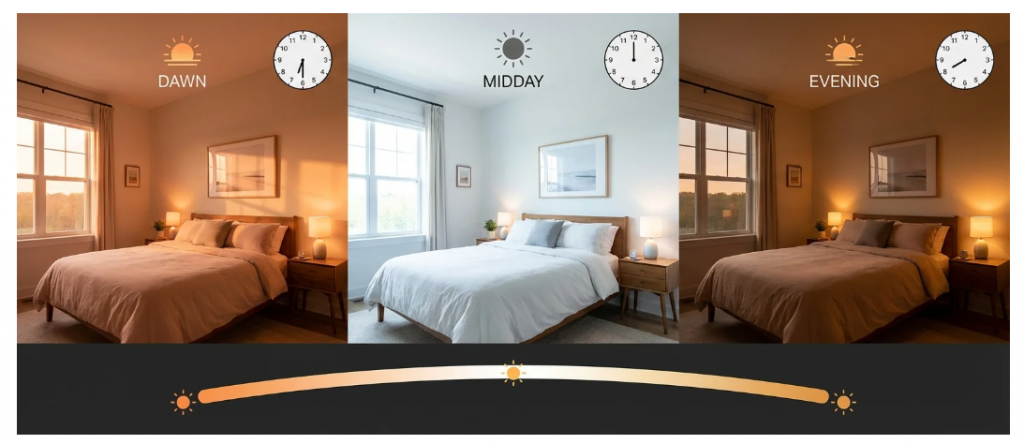
Typical CCT Program: 07:00-10:00 (5500K high illuminance) → 10:00-15:00 (4000K steady output) → 15:00-18:00 (3500K gradual warming) → After 18:00 (2700K low brightness). Integration with occupancy sensors enables deep energy savings.
👗 2. Fashion Retail — Making Every Product “Pop”
- Formal Wear / Dark Colors: 4000K-4500K neutral white light + Ra>95 to accurately render fabric texture.
- Women’s Wear / Light Colors: 3500K warm white light + R9>60 to enhance skin tone and improve fitting room satisfaction.
- Window Displays / Mannequins: Automatically switch to 6000K during the day to compete with daylight, and 2700K at night for a warm, inviting glow.
🏨 3. Hospitality & Dining — Directing the All-Day Ambiance
Banquet halls can seamlessly transition from “business meeting cool white” to “evening gala champagne gold” via control systems. Guest rooms feature one-touch scenes like “Reading,” “Relax,” and “Sleep.”
🏥 4. Healthcare & Senior Living — A Non-Pharmacological Mood Regulator
In senior care centers, high CS light during the day reduces delirium and fall risk, while very low CCT amber light at night ensures sleep continuity.
📚 5. Educational Spaces — Managing Focus to Match Curricular Rhythm
Increase CCT to 5500K during exams for alertness; lower to 3000K during lunch breaks to facilitate calm transitions.
A 5-Step Practical Selection Guide (With Control Protocol Comparison)
Comparison of Mainstream Tunable White Control Protocols
| Protocol | Dimming & Tuning Method | Advantages | Typical Applications |
|---|---|---|---|
| 0-10V (Dual Channel) | Two independent signals for intensity & CCT | Low cost, simple wiring | Small meeting rooms, single retail shops |
| DALI DT8 | Single address controls intensity & CCT (Tc) | Addressable, bidirectional feedback, rich scenes | Mid-to-large offices, malls, high-end commercial |
| DMX512 | Multi-channel digital control | Dynamic color changes, theatrical effects | Building facades, theme parks, ballrooms |
| Wireless (Zigbee/Bluetooth) | Gateway or App control | No rewiring for retrofits, easy sensor expansion | Existing building retrofits, small retail chains |
Step 1: Define Application Goals and Automation Depth
Step 2: Choose the Right Control Protocol (See table above).
Step 3: Review Luminaire Photometric Reports — Verify lumen maintenance, SDCM ≤ 3, and TM-30 Rf/Rg values.
Step 4: Design Intelligent Logic and Sensor Coverage — Define special scenes like “Holiday Mode.”
Step 5: On-Site Commissioning and User Training — Calibration by certified engineers is essential.
ROI Analysis: The Long-Term Value Model of Tunable White
While initial costs are 20%-35% higher than fixed-CCT LEDs, comprehensive benefits include:
- Direct Energy Savings: 40%-60% with controls.
- Reduced Maintenance Costs: Long LED lifespan (L70 > 50,000 hrs).
- Productivity Gains: 3%-5% performance improvement per Harvard Business School research.
- Retail Conversion Uplift: Higher average transaction value.
6. Professional FAQ: High-Frequency Questions Answered
❓ What is Tunable White technology?
Continuous adjustment of color temperature typically from 2700K to 6500K.
❓ Core difference from standard dimming?
Tunable white adjusts both intensity and color temperature independently.
❓ Which spaces see highest ROI?
Premium offices, chain retail, boutique hotels, and healthcare facilities.
❓ How does it support circadian health?
By meeting WELL EML requirements—high EML in the morning, low EML in the evening.
❓ What is Human-Centric Lighting (HCL)?
Dynamic adjustment of light intensity and spectrum to mimic natural daylight and support the biological clock.
❓ DALI or Wireless for my project?
DALI DT8 for new builds; Wireless for retrofits.
❓ Typical payback period?
2-4 years for offices; 1.5-2 years for high-end retail.
❓ Core luminaire quality metrics?
CRI/Ra ≥ 90, R9 > 50, SDCM ≤ 3, IEEE 1789 flicker compliance, TM-30 Rf > 90.
7. References and Further Reading
- Rensselaer Polytechnic Institute Lighting Research Center. “Circadian Light: A New Metric…”
- U.S. Department of Energy. “Color-Tunable Lighting”.
- Illuminating Engineering Society. “ANSI/IES TM-30-20”.
- International WELL Building Institute. “WELL v2: Light Feature L03”.
- Chang AM, et al. “Evening use of light-emitting eReaders…”. Sleep, 2015.
- DesignLights Consortium. “Networked Lighting Controls Specification v5.1”.
- Brainard GC, et al. “Non-visual effects of light…”. Frontiers in Neuroscience, 2021.
- U.S. DOE. “Energy Savings Forecast of Solid-State Lighting…”.