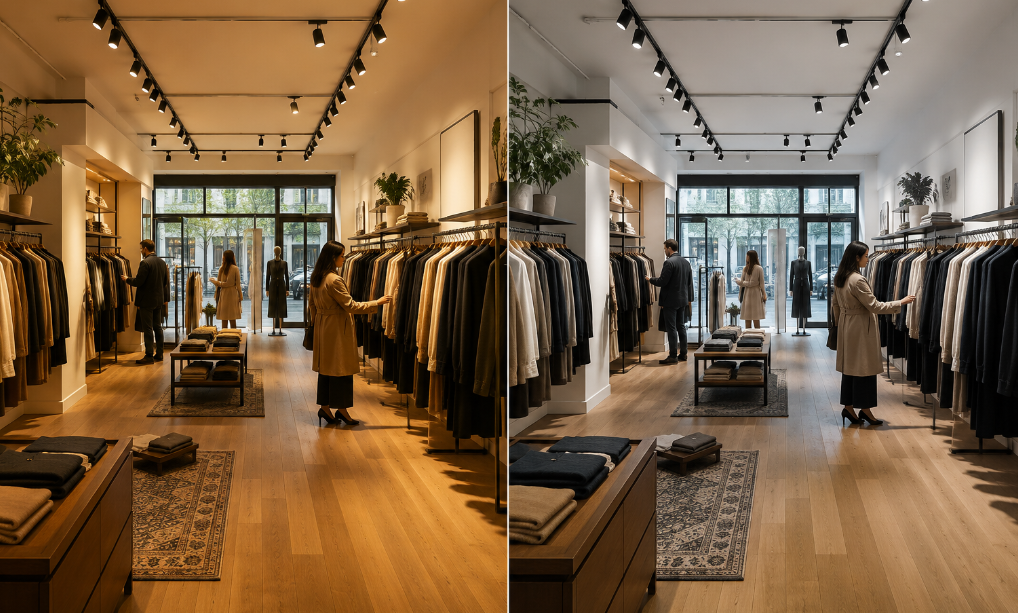
The short answer: For European retail stores, LED track spotlights with CRI ≥ 90, 3000K color temperature, high-efficacy COB chips (130–170 lm/W), and DALI-2 dimming deliver the best combination of visual impact and energy control. With electricity now costing €0.35–0.38 per kWh in Germany, Denmark, and Belgium, efficacy is no longer a secondary spec — it directly determines your monthly operating cost.
The European Electricity Problem Every Retail Operator Knows
Lighting in a retail store runs 10–14 hours a day, seven days a week. That adds up.
According to Eurostat, commercial electricity prices across Northern and Western Europe remain well above pre-2021 levels. In the first half of 2025, household electricity prices hit €0.38/kWh in Germany, €0.36/kWh in Belgium, and €0.35/kWh in Denmark — and commercial tariffs, while lower per unit, carry additional grid charges, capacity fees, and levies that keep effective costs high. The IEA confirmed that EU electricity prices for businesses averaged around USD 95/MWh in 2025, still more than twice US levels and nearly 50% above China.
For a typical 200m² clothing store running 60 track spotlights at 35W each, 12 hours a day:
- Old halogen or low-efficacy LED (80 lm/W): ~60W per fixture to match output → 432 kWh/day → roughly €150/month in Germany
- High-efficacy LED at 160 lm/W: same output from 25W → 180 kWh/day → roughly €63/month
That difference — around €1,000 per year for a single medium-sized store — is why efficacy has moved from a footnote to a first-line specification for any European retail fitout.

Why Track Lighting Is Still the Right System for Retail
Walk into any well-designed clothing boutique, jewelry store, or flagship showroom and you will almost certainly see track lighting. It is not accidental. Track systems let you reposition spotlights whenever displays change, without calling an electrician. Recessed downlights are fixed — the moment your floor plan shifts, they become a liability. Track lights stay useful for the life of the store.
The flexibility argument alone makes track the default choice. But the real difference shows up in two areas simultaneously: how products look, and how much electricity the store consumes every month.
The Key Specifications: What to Prioritise
Efficacy: The Number That Pays Your Energy Bill
Efficacy (lumens per watt, lm/W) tells you how much visible light a fixture produces from each watt of electricity it consumes. A fixture at 80 lm/W needs twice the wattage to produce the same brightness as one running at 160 lm/W.
Market benchmarks in 2025–2026:
- Standard commercial LED track light: 90–110 lm/W
- Good commercial grade: 120–140 lm/W
- High-efficacy COB designs: 150–165 lm/W
Modern COB (Chip on Board) track spotlights have pushed into the 160 lm/W range while maintaining CRI ≥ 90 and tight SDCM ratings. This matters because earlier generations often forced a tradeoff: higher efficacy came with lower CRI or worse color consistency. That tradeoff has largely disappeared in quality COB designs — you can now specify a 160 lm/W fixture with CRI > 93 and SDCM < 2 in the same product.
For a European retailer, choosing 160 lm/W over 90 lm/W at the same brightness roughly halves the lighting electricity bill. Over a 5-year lease, that is a significant operational saving before you even count maintenance.
CRI: How Products Actually Look
Color Rendering Index (CRI) measures how accurately a light source shows true colors compared to natural sunlight (CRI 100). In retail, low CRI lighting is a quiet sales problem — fabrics look flat, food looks unappetizing, skin tones become unflattering in dressing rooms.
The standard:
- General retail: CRI ≥ 90
- Fashion, cosmetics, luxury goods: CRI ≥ 95
- High-end textiles (silk, leather), jewelry: CRI > 97
Beyond the headline CRI figure, R9 matters — it measures how accurately a fixture renders saturated reds. A CRI 90 fixture with strong R9 is significantly better for warm-toned products than a CRI 90 light with weak R9. For serious retail specifications, ask the manufacturer for the full R1–R14 breakdown, not just the Ra average.
Color Temperature (CCT): Match Your Store Concept
| Store Type | Recommended CCT | Effect |
|---|---|---|
| Luxury boutique, jewelry | 2700K – 3000K | Warm, premium, intimate |
| Fashion, general clothing | 3000K – 3500K | Flattering, balanced |
| Grocery, pharmacy, tech | 4000K | Clean, fresh, clinical |
| Electronics, sportswear | 4000K – 5000K | Sharp, high-energy |
Most retail stores land on 3000K/3500K as the default. It flatters skin tones, makes colors appear vivid, and creates an environment where customers want to linger.
Higher-end systems now offer tunable white (2700K–5000K adjustable within the same fixture). Cool light in the morning energizes staff when the store opens; warmer tones in the evening slow customers down and encourage browsing. This is not a luxury feature in 2026 — it is straightforward to implement via DALI-2 scheduling.
Beam Angle: Narrow for Drama, Wide for Coverage
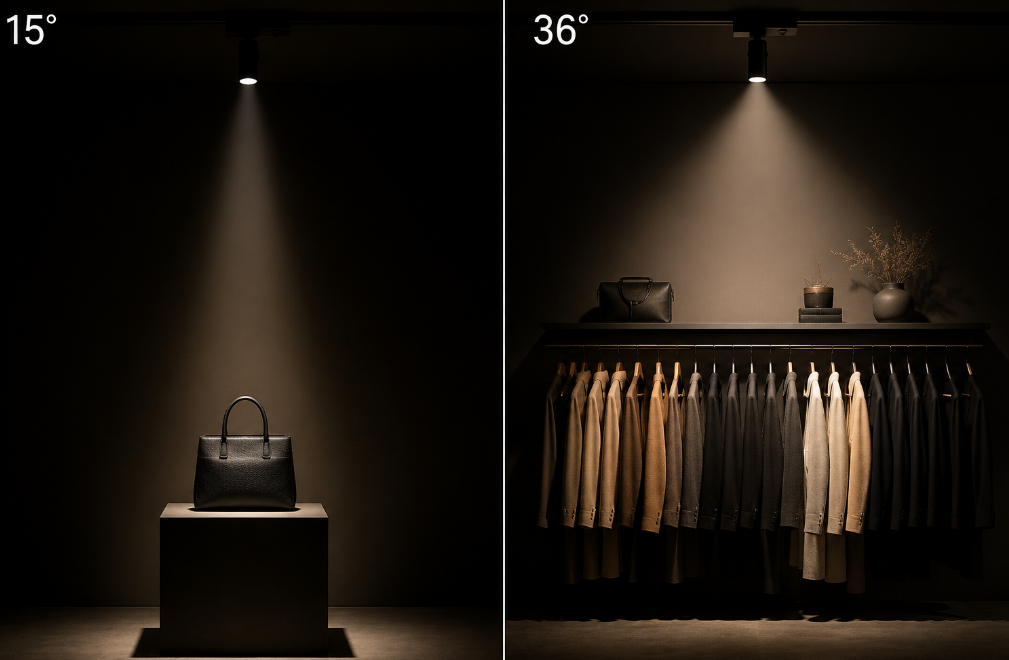
Beam angle is where most retail lighting mistakes happen. Using one angle throughout a store produces flat, uninteresting light with no visual hierarchy.
| Beam Angle | Best Use |
|---|---|
| 10° – 15° | Hero displays, mannequins, feature items, signage |
| 24° – 36° | Wall racks, shelving, general merchandise |
| 45° – 60° | Open floor areas, ambient fill |
The professional approach layers narrow and wide beams in the same space. A 15° spot aimed at a display table creates visual hierarchy that draws customers in. Wider beams (36°) on surrounding racks keep the space readable without competing with focal points.
Zoomable track spotlights — fixtures that let you adjust the beam angle mechanically from 15° to 55° — reduce SKU complexity for larger rollouts. One fixture covers multiple use cases as the merchandising changes.
Wattage and Lux Targets
Ceiling height determines how much wattage you need. Higher-efficacy fixtures mean you can achieve the same lux targets with lower wattage — which is where energy savings are captured at the fixture level, before any smart controls are applied.
| Zone | Target Lux | Ceiling Height | Recommended Wattage (160 lm/W) |
|---|---|---|---|
| Feature display / hero product | 500–750 lux | 2.5–3.5m | 15–20W |
| Wall racks, general merchandise | 300–500 lux | 2.5–3.5m | 12–18W |
| Display windows (street-facing) | 1,000–1,500 lux | 2.5–3.5m | 25–35W |
| High ceiling (4–5m) | 500 lux at floor | 4–5m | 25–35W |
With older 80–90 lm/W fixtures, these same targets require roughly double the wattage — and double the electricity bill.
Track System Types: 1-Circuit, 3-Circuit, and 48V Magnetic
1-Circuit Track
The simplest and cheapest option. All fixtures on the track switch on and off together. Fine for very small spaces, but provides no zoning capability and no energy management.
3-Circuit Track (Standard for European Retail)
Three separate circuits run inside a single track rail. You can group fixtures independently — perimeter wall washers on one circuit, central display spots on another, window lighting on a third. This enables proper scene control (open / promo / evening) without rewiring. For any store with real merchandising requirements, 3-circuit track is the baseline.
48V Magnetic Track (Premium Option)
Low-voltage magnetic systems have grown significantly in popularity across Scandinavia and high-end European retail. Fixtures snap onto a magnetized low-voltage rail; repositioning takes seconds and no tools. The system looks cleaner, is inherently safer (48V DC, not 230V AC), and integrates naturally with wireless controls like Zigbee.
The main tradeoff: 48V magnetic systems cost more upfront and require a compatible driver infrastructure.
Dimming and Control: Where the Second Wave of Energy Savings Comes From
Specifying high-efficacy fixtures cuts energy use at the hardware level. Smart controls cut it further — typically an additional 25–35% — by matching light output to actual need throughout the day.
The main dimming protocols:
| Protocol | Best For | Notes |
|---|---|---|
| DALI-2 | Large stores, chains, EU compliance | Addressable per fixture; supports sensors, daylight harvesting, scheduling |
| 0-10V | Small installations | Simple, low cost, zone-level only |
| Bluetooth Mesh / Zigbee | Wireless retrofits | No control wire needed; app-controlled |
| Casambi | High-end hospitality and retail | Wireless DALI-like control |
DALI-2 assigns a unique digital address to each fixture. You can dim individual spotlights independently without rewiring — critical in fashion retail where seasonal changes require completely different lighting setups every quarter. Integrated daylight sensors adjust output automatically as natural light from windows changes throughout the day, which in a street-facing store with good glazing can reduce lighting energy by a further 15–20%.
Combined with high-efficacy COB fixtures, a properly configured DALI-2 system can realistically reduce a retail store’s lighting electricity consumption by 55–65% compared to a legacy halogen or low-efficacy LED installation.
Glare Control: The Detail That Separates Good from Great
A store that feels “too bright” is usually suffering from excessive glare (measured by Unified Glare Rating, UGR), not excessive lux. For customer-facing retail, UGR < 19 is the standard.
Practical ways to achieve it:
- Deep anti-glare reflectors built into the fixture body
- Honeycomb louvers added as an accessory
- Barn doors and snoots for precision aiming
- SDCM ≤ 3 for color consistency across 50+ spotlights in the same space
In a white-walled boutique, exposed LED chips across 50 spotlights create visible glare that undermines the premium feel the store is trying to project — regardless of how good the CRI or efficacy numbers are.
Retail Track Lighting by Store Type: Quick Reference
| Store Type | CCT | CRI | Beam Mix | Efficacy Target | Control |
|---|---|---|---|---|---|
| Fashion boutique | 3000K | ≥ 95 | 15° + 36° | ≥ 140 lm/W | DALI-2 |
| Jewelry / luxury | 2700K–3000K | > 97 | 10°–24° | ≥ 130 lm/W | DALI-2 |
| Clothing chain | 3000K–3500K | ≥ 90 | 24° + 36° | ≥ 160 lm/W | DALI or 0-10V |
| Grocery / pharmacy | 4000K | ≥ 80–90 | 36° + 60° | ≥ 150 lm/W | 0-10V |
| Car showroom (4S) | 3500K–4000K | ≥ 90 | 15° + 36° | ≥ 140 lm/W | DALI-2 |
| Electronics / sports | 4000K–5000K | ≥ 80 | 24° + 36° | ≥ 130 lm/W | 0-10V |
Layout Principles That Work
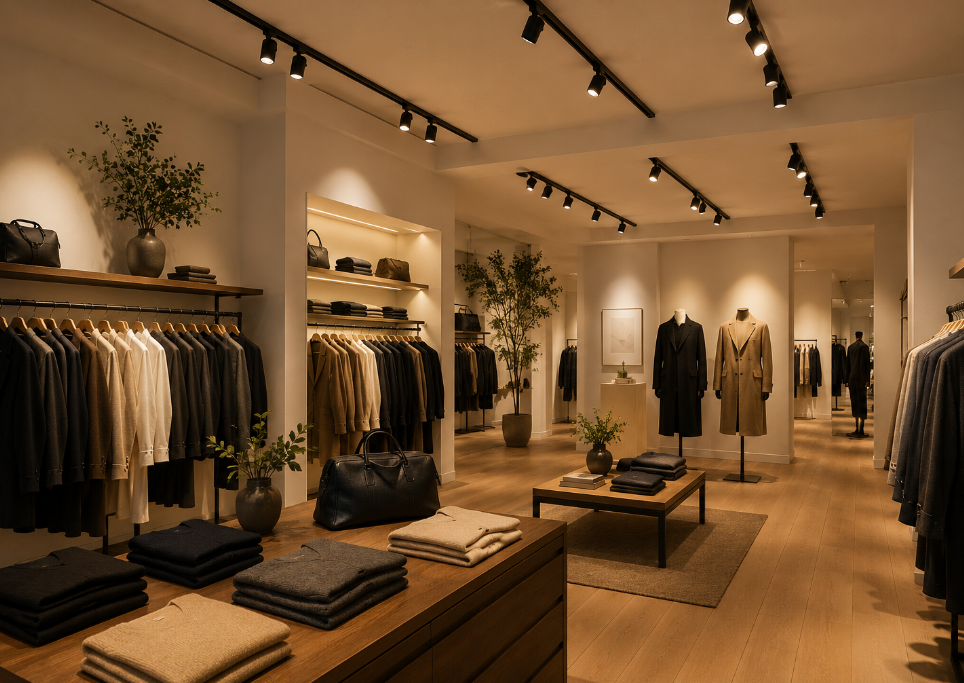
Perimeter lighting first. Walls sell products. A perimeter track washing vertical surfaces with 36° beams draws customers deeper into the store and makes wall-mounted merchandise appear more premium.
Layer beam angles. Combine 15° spots on hero displays with 36° wash beams on surrounding racks. The contrast in intensity creates visual hierarchy that guides customer movement.
Suspend on high ceilings. If ceiling height exceeds 4m, suspending the track on cables at 2.8–3.2m brings the light closer to the merchandise, dramatically improving beam efficiency and reducing wattage further.
Use roughly 1 spotlight per 2–3m² of selling floor as a starting estimate for a 3-layer retail scheme, then verify with DIALux calculations.
How much can I actually save by switching to 160 lm/W track lights?
For a 200m² store running 60 fixtures at 12 hours daily, switching from 35W (90 lm/W) to ~22W (160 lm/W) fixtures delivering the same output saves approximately 80,000 kWh per year. At €0.25/kWh commercial rate, that is around €1,200–1,800 per year in energy savings alone — typically paying back the fixture upgrade in under 2 years.
What is the difference between a trackspot and a track head?
They refer to the same product — a fixture that mounts onto a track rail. “Trackspot” is the common term in European and Scandinavian markets; “track head” is the US convention.
Should I use a 1-phase or 3-phase track?
For any store with zoning requirements, use 3-phase. 1-phase tracks suit only simple supplemental lighting with no scene management.
Is CRI 80 acceptable for retail?
For electronics or sporting goods, CRI 80 is workable. For fashion, cosmetics, food, or anything where color accuracy directly affects buying decisions, CRI 80 produces noticeably inferior results. At the project level, the cost difference between CRI 80 and CRI 90 COB fixtures is small; the visible impact on perceived product quality is not.
Do I need DALI-2 for a small store?
Not necessarily. For stores under approximately 50m², a quality 0-10V dimmer or wireless Zigbee system delivers adequate scene management at lower cost. DALI-2 is the right choice when you need fixture-level addressability, daylight harvesting, energy monitoring, or chain-wide management across multiple locations.
What certifications should I check for European projects?
At minimum: CE marking, RoHS compliance, and ENEC or equivalent safety certification. For EU public projects or energy compliance, check ErP (Ecodesign) directive compliance. LM-80/TM-21 data for lumen maintenance projections (L80B10 ≥ 50,000 hours is a reasonable threshold for commercial use).