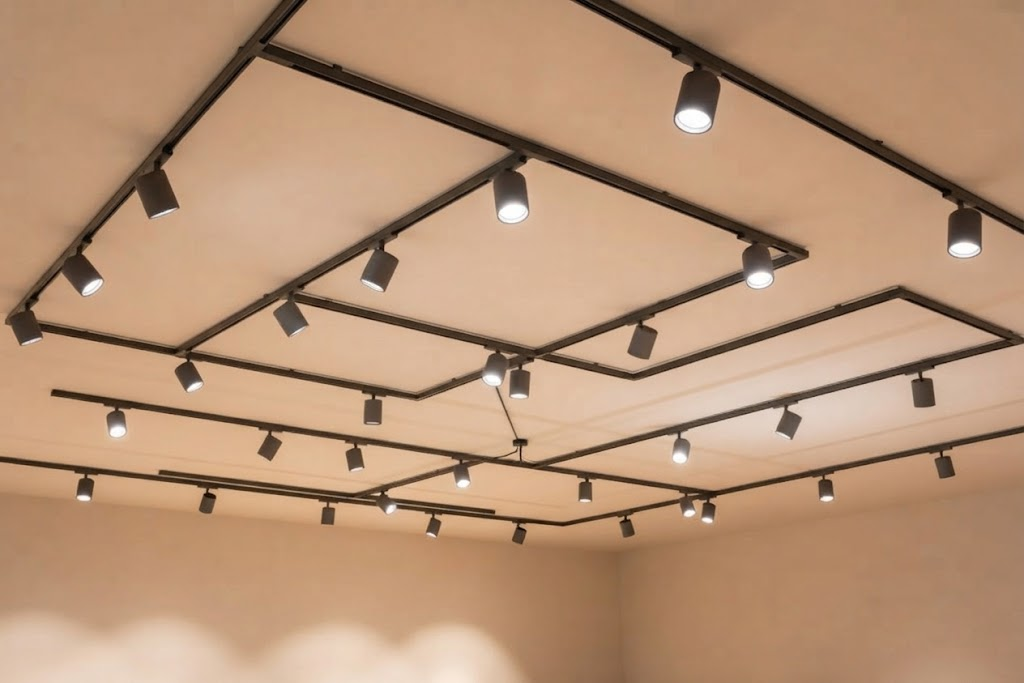
SDCM measures the color consistency of LED light sources. A lower SDCM means less variation from the target color, helping multiple luminaires produce a more uniform appearance. For many commercial lighting projects, 3 SDCM or tighter is a practical choice when consistent light color matters.
What Does SDCM Mean?
SDCM stands for Standard Deviation of Colour Matching.
In LED lighting, it is used to describe how closely the actual color of a light source stays to its specified target.
This matters because two luminaires can have the same color temperature and still look slightly different.
For example, two LED downlights may both be specified as 4000K. One could appear slightly greener, while another looks a little more pink or cool. The difference may be difficult to notice when looking at a single fixture, but several fixtures installed together can make the variation much more obvious.
SDCM gives lighting manufacturers and specifiers a way to control this variation.
The lower the SDCM value, the tighter the permitted color variation.

Why Can Two LEDs With the Same CCT Look Different?
CCT, or correlated color temperature, describes the general appearance of white light.
Typical LED lighting options include:
- 2700K – warm white
- 3000K – warm white
- 3500K – warm-neutral
- 4000K – neutral white
- 5000K – cool white
However, CCT does not define the exact chromaticity of a light source.
Two LEDs can both be rated at 3000K while having slightly different positions within the chromaticity range. To the eye, one may look warmer or slightly greener than the other.
This is particularly noticeable when multiple fixtures are installed close together.
A project specification that only says “4000K LED lighting” therefore does not fully describe color consistency.
Adding an SDCM requirement gives the manufacturer a clearer tolerance for the actual light color.
What Is a MacAdam Ellipse?
SDCM is closely related to the MacAdam ellipse, a concept based on research into how people perceive small differences between colors.
On a chromaticity diagram, a MacAdam ellipse represents an area around a reference color where differences are considered relatively small from a color-matching perspective.
Lighting specifications commonly refer to these tolerances as MacAdam steps or SDCM.
You may therefore see terms such as:
3 SDCM
or
3-step MacAdam
The terminology can vary between manufacturers and specifications, but the practical idea is the same: fewer steps indicate tighter color matching around the target point.
For lighting designers and buyers, the key point is simple:
Lower SDCM = tighter color consistency.
What Do 1, 2, 3 and 5 SDCM Mean?
SDCM values describe the permitted color deviation from a target point.
A simple comparison is:
| SDCM | Color tolerance | Typical application consideration |
|---|---|---|
| 1 SDCM | Extremely tight | Highly controlled or color-sensitive applications |
| 2 SDCM | Very tight | Premium architectural and demanding commercial projects |
| 3 SDCM | Tight | Retail, hospitality, offices and general architectural lighting |
| 4 SDCM | Wider | Commercial applications with moderate color-consistency requirements |
| 5 SDCM | Wider still | General-purpose applications where small differences are less critical |
These values should be treated as practical guidelines rather than universal quality grades.
A lower SDCM does not automatically make a luminaire better for every project. The right specification depends on how the lighting will be used and how closely different fixtures will be viewed together.
Is 3 SDCM Good for LED Lighting?
3 SDCM is a practical color-consistency target for many professional commercial lighting projects.
It is particularly useful when several LED luminaires are installed in the same space and need to create a visually consistent result.
This can include:
- LED downlights
- Track spotlights
- Linear LED lighting
- Wall washers
- Display lighting
- Ceiling grids
- Retail lighting systems
A tighter specification such as 2 SDCM may be appropriate when color consistency is especially important.
For less demanding areas, a wider tolerance may be acceptable.
The important thing is to specify the SDCM according to the application rather than choosing a number simply because it is smaller.
Why Does SDCM Matter in Retail Lighting?
Retail lighting is a good example of where color consistency can affect the finished space.
Imagine a clothing store with a long row of tracklights.
All of the fixtures are specified as 3000K.
If the color tolerance between fixtures is relatively wide, some beams may appear slightly different. One part of a display wall could look warmer, while another section has a subtly greener or cooler appearance.
The difference may not be immediately obvious to a customer, but it can make the lighting feel less uniform.
This becomes more noticeable when:
- Many fixtures are installed together
- White walls are illuminated
- Large display surfaces are washed with light
- Fixtures are arranged in straight rows
- Products have neutral or light-colored finishes
For retail projects, SDCM is therefore worth considering alongside CCT, CRI, beam angle, glare control and lumen output.
Where Is Color Consistency Most Important?
The importance of SDCM depends heavily on the application.
Retail stores
Multiple tracklights and downlights are often installed close together. Consistent light color helps maintain a uniform appearance across sales areas and displays.
Hospitality
Hotels, restaurants and other hospitality environments often use carefully controlled lighting throughout a space. Differences between adjacent luminaires can be more noticeable in clean, minimalist interiors.
Museums and galleries
Where lighting interacts with artwork and other visually sensitive objects, color consistency can become an important part of the lighting specification.
Architectural lighting
Wall washing, linear lighting and large illuminated surfaces can reveal small differences between light sources.
Offices
An office may not require extremely tight color tolerances, but consistent light color across a large ceiling grid can improve the overall appearance.
SDCM vs CRI: What Is the Difference?
SDCM and CRI describe two different aspects of LED lighting.
SDCM measures color consistency
SDCM answers:
How closely do different light sources match each other in color?
It is mainly concerned with variation between light sources.
CRI measures color rendering
CRI answers:
How accurately does the light source reveal the colors of objects?
For example, a high-CRI LED can make clothing, furniture or other products appear more natural.
A lighting product can therefore have:
- High CRI with wider color variation
- Tight SDCM with lower CRI
- High CRI and tight SDCM
For a demanding retail project, both may matter.
A specification such as:
CRI ≥90 + ≤3 SDCM
addresses two different requirements rather than using one as a substitute for the other.
SDCM vs CCT: Why Both Matter
CCT and SDCM are often listed together because they answer different questions.
CCT tells you the intended color appearance.
SDCM tells you how tightly that color is controlled.
For example:
4000K / ≤3 SDCM
means the target light appearance is 4000K and the chromaticity variation is controlled within the specified SDCM tolerance.
If a specification only states:
4000K
the manufacturer still has a permitted color range around the target.
For a single luminaire, this may not be a major concern.
For 20, 50 or 100 luminaires installed in the same environment, it becomes much more relevant.
How Do LED Manufacturers Control Color Consistency?
Color consistency starts with the LED source.
LED manufacturers use binning to classify LEDs according to their measured characteristics. Selecting LEDs from tighter color bins can help manufacturers achieve more consistent output.
However, the LED itself is only one part of the finished luminaire.
Color performance can also be influenced by:
- LED selection
- LED binning
- Phosphor characteristics
- Optical components
- Thermal management
- Driver performance
- Manufacturing processes
- Production tolerances
- Different production batches
This is why the SDCM specification of the LED source should not automatically be assumed to represent the exact performance of the complete luminaire.
For professional projects, it is better to confirm the color-consistency requirement for the finished product.
Can Different Production Batches Look Different?
Yes.
This is an important consideration for large projects and phased installations.
Suppose a retail chain installs the same track lighting system in several stores over a period of time.
The first group of fixtures may be manufactured in one production batch. Additional fixtures or replacement units may be produced much later.
Even when the product model and CCT remain the same, differences in LED batches or production conditions can affect color consistency.
For this reason, large projects should consider not only the initial SDCM specification but also how the manufacturer manages consistency between production batches.
This is especially relevant for:
- Retail chains
- Hotels
- Shopping centers
- Large office projects
- Multi-phase developments
- Replacement orders
If future matching is important, it is worth discussing this with the manufacturer before the first order is placed.
Does Lower SDCM Always Mean Better?
Not necessarily.
A lower SDCM means tighter color tolerance, but the tightest possible tolerance is not required for every application.
Consider two examples.
A storage area with a few ceiling lights may have little practical benefit from extremely tight color matching.
A luxury retail store with dozens of tracklights illuminating white walls and product displays is a different situation.
In the second case, tighter color consistency can have a much greater visual impact.
The better approach is to ask:
How much color variation can this project reasonably tolerate?
rather than:
What is the lowest SDCM available?
That approach usually leads to a more balanced specification.
How Should SDCM Be Included in a Lighting Specification?
If color consistency matters, it should be written into the project specification.
Instead of:
LED Downlight, 4000K
a more complete specification could be:
LED Downlight
CCT: 4000K
CRI: ≥90
Color consistency: ≤3 SDCM
Beam angle: 36°
Dimming: According to project requirements
The actual values should be selected according to the project.
Other parameters may also need to be defined, including:
- Lumen output
- Luminous efficacy
- Beam angle
- Glare control
- Dimming protocol
- Driver type
- Lifetime
- Operating temperature
This gives manufacturers, lighting designers, contractors and buyers a clearer technical reference.
What Should Lighting Buyers Ask Their Supplier?
When color consistency is important, a few questions are worth asking before placing an order.
1. What SDCM value is specified?
Do not assume that the same CCT means the same color tolerance.
2. Is the SDCM value guaranteed?
Check whether the value is a guaranteed specification or simply a typical performance figure.
3. Does the specification apply to the complete luminaire?
The LED source and the finished lighting fixture should be considered separately.
4. How is LED binning controlled?
Ask whether the manufacturer uses controlled LED bins for the required CCT and color tolerance.
5. Can additional units be matched later?
This matters for projects that may require replacement fixtures or expansion.
6. How are production batches controlled?
For large commercial orders, batch consistency can be just as important as the initial product specification.
7. Can technical documentation be provided?
For larger projects, it is better to have the required color-consistency information documented rather than relying on a general product description.
A Practical Example: 30 Tracklights in a Retail Store
Consider a retail store with 30 adjustable LED tracklights.
The original specification says:
CCT: 3000K
CRI: ≥90
Beam angle: 24°
These are useful specifications, but one question remains:
How closely will the 30 fixtures match each other in color?
If the color tolerance is relatively wide, individual beams may not appear exactly the same.
Now add:
Color consistency: ≤3 SDCM
The requirement is clearer.
The manufacturer knows that the chromaticity of the supplied fixtures needs to remain within the specified tolerance around the target color.
This is particularly useful if the fixtures are illuminating the same display wall or a large area of similar-colored products.
SDCM does not guarantee that every fixture will look mathematically identical. It defines a tighter range within which the color variation is controlled.
Does SDCM Affect Brightness?
No.
SDCM describes color consistency, not light output.
Brightness and optical performance are covered by other specifications, such as:
- Lumens
- Illuminance
- Luminous efficacy
- Beam angle
- Candela
- Optical efficiency
A luminaire with a lower SDCM is not automatically brighter.
Likewise, a high-lumen LED product is not automatically more color-consistent.
These characteristics should be evaluated separately.
Does SDCM Affect LED Lifetime?
SDCM is not a lifetime rating.
LED lifetime is normally evaluated through factors such as lumen maintenance, operating temperature, electrical conditions and product design.
Color can also change during the operating life of an LED system, depending on the LED technology, thermal conditions and other factors.
For projects where long-term color stability matters, it is therefore useful to look beyond the initial SDCM value and consider the overall quality of the LED system.
What SDCM Should You Choose?
There is no single SDCM value that is right for every project.
A useful starting point is:
3 SDCM or tighter
For many commercial projects where several luminaires are visible together.
2 SDCM or tighter
For premium architectural, retail and other applications where tighter color matching is particularly important.
4–5 SDCM
For applications where small differences in light color are less critical.
These are not universal requirements. The final specification should reflect the visual expectations, budget and technical requirements of the project.
SDCM vs Other Important LED Specifications
SDCM is only one part of a complete LED lighting specification.
| Specification | What it tells you |
| CCT | The intended appearance of white light |
| SDCM | The consistency of light color between sources |
| CRI | How accurately colors are rendered |
| Lumens | Total light output |
| Efficacy | Light output per watt |
| Beam angle | How widely light is distributed |
| Glare control | Visual comfort and glare performance |
| Driver | Electrical and dimming performance |
| Lifetime | Expected operating performance |
Looking at these specifications together gives a much better picture of overall luminaire performance than focusing on any single number.
SDCM for LED Downlights and Tracklights
For LED downlights and tracklights, SDCM becomes particularly relevant when several fixtures are installed in the same visual field.
A typical commercial installation might include:
- Recessed downlights across the ceiling
- Track spotlights over product displays
- Wall washers along feature walls
- Linear lighting integrated into architectural details
When these fixtures are close together, differences in color can become easier to see.
This is why a professional specification may include both the CCT and SDCM requirement.
For example:
4000K + ≤3 SDCM
is more informative than simply specifying:
4000K
The same principle applies to 3000K, 3500K and other CCT options.
Key Takeaway
SDCM is a measure of color consistency in LED lighting. It describes how much the chromaticity of a light source can vary from its target color point. A lower SDCM means tighter color control.
CCT tells you the intended color appearance.
CRI tells you how well the light renders object colors.
SDCM tells you how consistently different luminaires reproduce their intended color.
For projects using multiple LED downlights, tracklights, linear lights or wall washers, SDCM can be an important part of the technical specification.
For many commercial applications, 3 SDCM or tighter is a practical target when consistent light color is important. More demanding projects may call for tighter control.
The goal is not simply to choose the lowest possible SDCM.
The right goal is to specify a level of color consistency that matches the project and make sure the manufacturer can maintain it throughout production and future supply.
What is SDCM in LED lighting?
SDCM stands for Standard Deviation of Colour Matching. It is used to describe the color consistency of LED light sources. A lower SDCM indicates tighter color tolerance
Is 3 SDCM good for LED lighting?
Yes. 3 SDCM is a practical specification for many commercial lighting projects where multiple fixtures need to have a consistent light color.
Is 2 SDCM better than 3 SDCM?
In terms of color tolerance, yes. 2 SDCM represents tighter control than 3 SDCM. Whether it is necessary depends on the project.
What is the difference between 3 SDCM and 5 SDCM?
3 SDCM has a tighter color tolerance than 5 SDCM. Differences between fixtures may be more noticeable when a wider tolerance is used, particularly across large or uniform illuminated surfaces.
Can two 4000K LEDs look different?
Yes. Two LEDs can both be rated at 4000K while having different chromaticity positions within their permitted ranges.
Is SDCM the same as CRI?
No. SDCM measures color consistency, while CRI measures color rendering.
Is SDCM the same as CCT?
No. CCT describes the intended color temperature of the light, while SDCM describes how tightly the actual color is controlled around the target.
What is 3-step MacAdam?
3-step MacAdam refers to a defined color tolerance around a target chromaticity point. It is commonly associated with a 3 SDCM color-consistency specification.
Does SDCM affect lumen output?
No. SDCM is a color-consistency specification and does not measure brightness or lumen output.
Is SDCM important for track lighting?
Yes, especially when multiple tracklights are installed close together or illuminate the same wall, display or product area.
Should SDCM be specified for retail lighting?
If consistent light color is important, specifying SDCM is recommended. A requirement such as ≤3 SDCM can provide a clearer color-consistency target for the manufacturer.
What is the best SDCM for LED lighting?
There is no universal best value. For many commercial applications, 3 SDCM or tighter is a sensible starting point. More color-sensitive projects may require 2 SDCM or tighter.
Does lower SDCM mean higher quality?
Not necessarily. Lower SDCM means tighter color consistency, but overall LED quality also depends on CRI, efficiency, thermal design, optics, driver performance, lifetime and manufacturing consistency.
Why do LED lights with the same CCT look different?
CCT describes the general color temperature, but LEDs can have different chromaticity positions within the allowed range. SDCM is used to control this variation.
Can SDCM change between production batches?
Color consistency can vary between LED batches or production runs if color binning and manufacturing controls are not properly managed. For large or phased projects, batch consistency should therefore be discussed with the supplier.