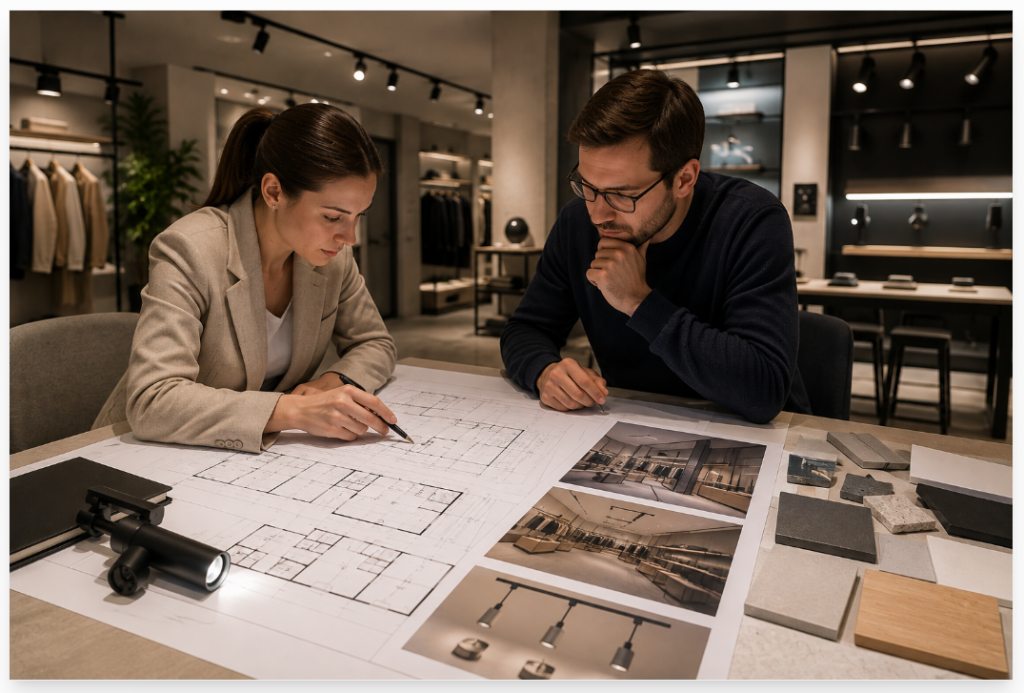
Energy-efficient retail lighting combines efficient LED luminaires, precise optics, sensible lighting levels and smart controls. LED track lights and adjustable spotlights can reduce wasted light while keeping products clearly visible.
What Makes Retail Lighting Energy Efficient?
When retailers look at lighting costs, the first thing they usually check is the wattage of the fixture.
That is only part of the picture.
A 20W spotlight is not necessarily a better choice than a 25W model if it needs twice as many fittings to achieve the same result.
For a retail project, energy efficiency comes from the whole lighting system:
- LED efficiency
- optical design
- beam angle
- lighting levels
- operating hours
- dimming
- sensors
- lighting controls
The aim is simple: put useful light where it is needed, rather than lighting everything at the same level.
Why Track Lighting Works Well in Retail
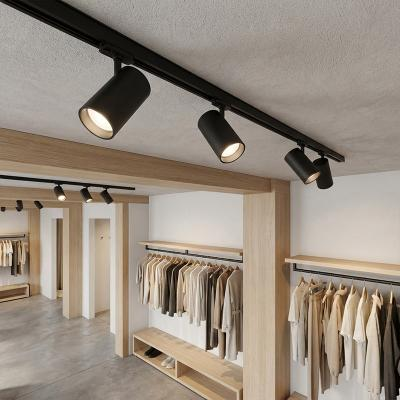
Track lighting has one practical advantage that fixed lighting cannot easily match: the light can move when the store changes.
A fashion retailer may change a display every few weeks. Shelving moves, mannequins are repositioned and seasonal collections replace previous ones.
With an adjustable track spotlight, the lighting can follow those changes.
There is no need to move the electrical points every time the merchandise layout changes.
This makes track lighting particularly useful for:
- Fashion stores
- Boutiques
- Shoe shops
- Cosmetics stores
- Department stores
- Furniture showrooms
- Pop-up retail spaces
It also makes it easier to separate general lighting from accent lighting.
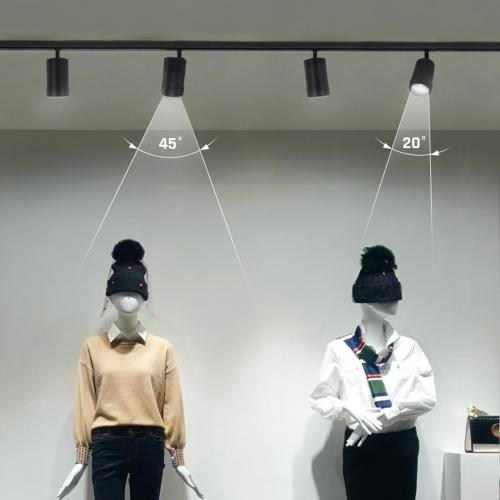
Beam angle has a direct effect on how efficiently a spotlight uses its light output.
A narrow beam concentrates light on a smaller area. A wider beam spreads it over a larger surface.
Typical applications include:
| Beam angle | Suitable application |
|---|---|
| 15° | Feature products, mannequins and focal displays |
| 24° | Shelves and individual merchandise areas |
| 36° | Clothing displays and medium-sized surfaces |
| 60° | Wider walls and general display areas |
These figures are not strict rules. Mounting height and the distance between the spotlight and the merchandise also matter.
The important point is to avoid using the same beam angle everywhere.
A narrow spotlight aimed at a large wall may leave parts of the surface too dark. A very wide beam aimed at a small product can spread light well beyond the area that needs it.
Don’t Design Retail Lighting Around Wattage Alone
A common mistake is to compare fixtures by watts only.
A better starting point is lumens per watt, but even that does not tell the whole story.
Consider two track spotlights:
- Fixture A: 20W, 2,000 lm
- Fixture B: 25W, 2,300 lm
Fixture A has the higher nominal efficacy.
But if Fixture B has better optical control and illuminates the merchandise more effectively, the real project requirement may be different.
For this reason, retail lighting should be assessed at system level rather than by the wattage printed on the product label.
Avoid Over-Lighting
More light does not automatically make a store look better.
In fact, excessive general lighting can flatten the space. Displays lose contrast, accent lighting becomes less noticeable, and energy consumption rises.
A better retail lighting layout usually has some hierarchy:
General lighting provides comfortable overall illumination.
Display lighting gives shelves and merchandise more visual attention.
Accent lighting creates focal points around selected products or architectural features.
This layered approach can create a stronger visual effect without having every luminaire operating at maximum output.
Smart Controls Can Cut Unnecessary Lighting
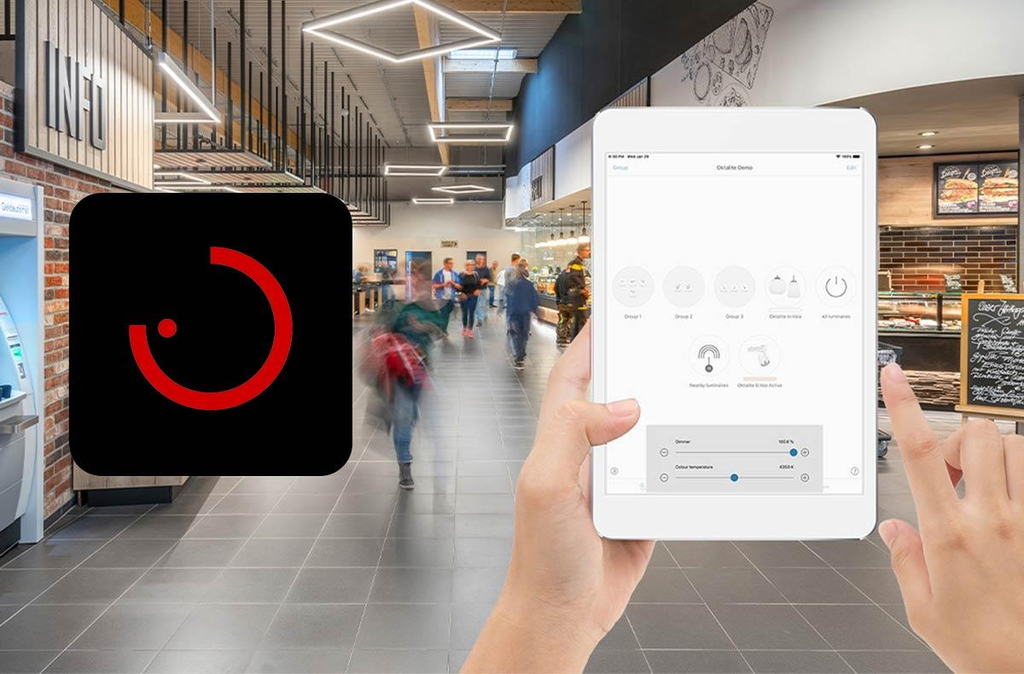
Retail stores are not used in the same way throughout the day.
Lighting requirements during opening hours are different from those during cleaning, stocking or periods when parts of the store are unused.
Dimming and lighting controls can respond to those differences.
Depending on the project, a system might include:
- DALI-2
- occupancy sensors
- daylight sensors
- time schedules
- scene control
- wireless controls
- individual or zoned dimming
A simple example is a store with several lighting zones. The main sales floor can operate at its normal level, while a less-used area runs at reduced output until it is needed.
Small changes like this become more significant when the lighting operates for thousands of hours each year.
Is DALI-2 Worth Considering for Retail?
For larger retail projects, DALI-2 can make the lighting system much easier to control.
Instead of treating a whole store as one lighting circuit, different luminaires or zones can be controlled separately.
That allows retailers to create different settings for:
- normal trading hours
- cleaning
- stock replenishment
- evening operation
- display windows
- special events
It also gives the lighting designer more freedom to adjust light levels after installation.
For a small shop with a simple lighting layout, a more basic control system may be enough. DALI-2 becomes more attractive as the number of zones and luminaires increases.
CRI Still Matters in Energy-Efficient Retail Lighting
6
Energy efficiency should not come at the expense of product appearance.
In fashion, cosmetics, furniture and food retail, colour quality can be particularly important.
High-CRI LED lighting helps products appear closer to their intended colours under the store lighting.
For many quality-focused retail applications, CRI 90+ is a sensible specification to consider.
The key is to look at CRI alongside efficacy, optical performance and actual light output. A high CRI number on its own does not make a luminaire suitable for a retail project.
Choosing the Right Colour Temperature
There is no universal colour temperature for every European retail store.
2700K–3000K can create a warmer and more relaxed atmosphere.
3500K offers a middle ground between warm and neutral.
4000K gives the space a cleaner, more neutral appearance.
The choice should reflect the products, interior materials and atmosphere the retailer wants to create.
A luxury fashion boutique and a supermarket may need very different lighting, even if both use LED track lights.
How Much Energy Does Retail Lighting Use?
The easiest starting point is:
Energy consumption = lighting power × operating hours
For example, if a store has 8 kW of connected lighting and operates the lighting for 3,000 hours per year:
8 kW × 3,000 hours = 24,000 kWh per year
Reducing the installed load is one way to lower consumption.
Reducing unnecessary operating time and dimming lights when full output is not required can reduce it further.
This is why lighting controls are increasingly considered alongside the luminaires themselves.
What Is the Most Energy-Efficient Retail Lighting Setup?
There is no single fixture that works best for every store.
For many modern retail interiors, a combination of efficient LED general lighting, adjustable track spotlights, accurate optics and dimmable controls provides a practical starting point.
Track spotlights are particularly useful where product displays change regularly.
Fixed downlights can make more sense where the layout is stable and uniform illumination is the priority.
The right choice depends on the store layout, ceiling height, merchandise, operating hours and required lighting levels.
A Practical Checklist for Retail Lighting Projects
Before selecting the fixtures, check:
1. Lighting levels
Are different areas being lit according to their actual needs?
2. Beam angles
Is the light concentrated on the intended surface?
3. LED efficacy
How much useful light is produced for the electrical power consumed?
4. CRI
Will the products look natural under the chosen light?
5. Colour temperature
Does the CCT suit the merchandise and interior?
6. Glare
Can customers and staff look around the store comfortably?
7. Controls
Can the lighting be dimmed or controlled by zone?
8. Flexibility
Can the lighting adapt when displays move?
Looking at these points together usually gives a more useful result than simply choosing the lowest-wattage fixture.
FAQ: Energy-Efficient Retail Lighting
Efficient LED luminaires combined with good optical control, appropriate lighting levels and dimming or smart controls are generally a strong choice for energy-efficient retail lighting.
Yes. LED track lights can be highly efficient when the fixture output, beam angle and installation position are matched to the merchandise and space.
Neither is automatically more efficient. Track lights can reduce wasted light in flexible display areas because they can be aimed precisely. Downlights can be effective for consistent general illumination.
Around 15°–24° is commonly useful for focused product accents, while 36° or wider beams are better suited to larger displays and surfaces. The correct choice also depends on mounting height and target distance.
CRI 90+ is often a good choice for retail environments where accurate colour appearance matters, particularly fashion, cosmetics, furniture and food.
DALI-2 itself does not make a luminaire more efficient. Its value comes from allowing more precise dimming, zoning and scheduling, which can reduce unnecessary lighting output and operating time.
Use efficient LED luminaires, avoid excessive lighting levels, choose suitable beam angles, dim lighting when full output is unnecessary and use controls to manage operating hours and different zones.
Final Takeaway
The most efficient retail lighting is not necessarily the lighting with the lowest wattage. It is the system that delivers the required light with the least unnecessary energy use.
For stores using track lighting, that means paying attention to LED efficacy, beam angle, CRI, glare, dimming and control at the same time.
For retailers, this approach can also make the lighting easier to adapt when the store changes — which is often just as important as the energy saving itself.