
Multi-functional commercial spaces require three coordinated lighting layers: ambient lighting for general visibility, accent lighting for architectural and visual focus, and flexible lighting controls for different activities. The lighting layout should be planned around the function of each area, ceiling height, surface materials, beam angles and visual comfort.
A conference room, auditorium, lounge and reception area may share the same building, but each requires a different lighting arrangement. The key is to provide sufficient illumination where needed, control glare and allow different areas to operate independently.
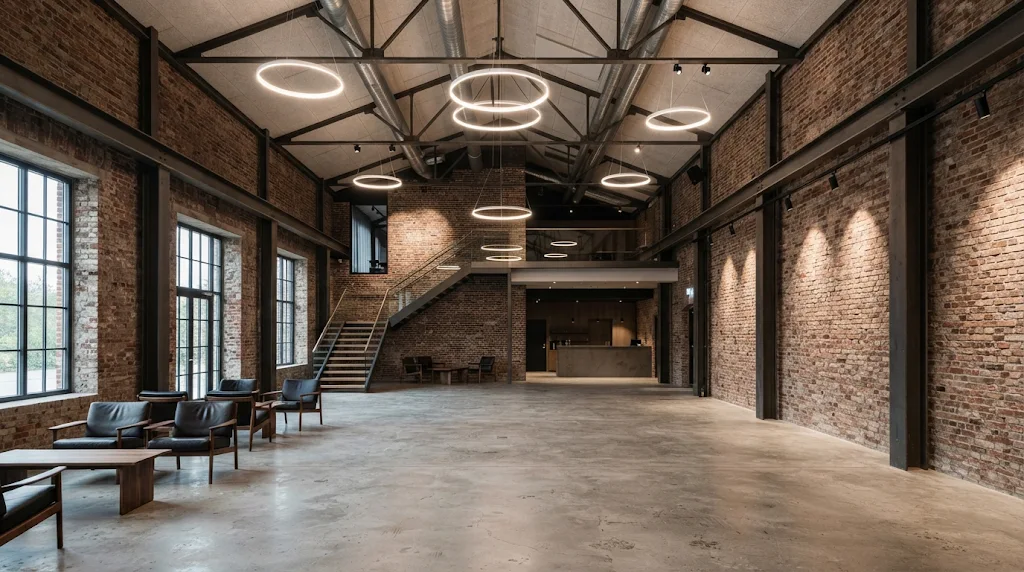
1. What Are the Three Main Types of Lighting Used in Commercial Spaces?
The three main lighting types are ambient lighting, accent lighting and architectural or decorative lighting. Each serves a different purpose and should be considered during the initial lighting design.
| Lighting type | Primary function | Typical applications |
|---|---|---|
| Ambient lighting | Provides general illumination | Conference rooms, corridors, auditoriums |
| Accent lighting | Highlights selected objects and surfaces | Artwork, feature walls, architectural details |
| Architectural lighting | Integrates light into the interior design | Suspended luminaires, linear lighting, decorative features |
Ambient lighting establishes the foundation. It provides the general brightness needed for people to move, work and communicate comfortably.
Accent lighting creates visual focus. Directional LED spotlights can highlight textured walls, artwork, structural elements and selected interior features.
Architectural lighting connects the lighting system with the building design. It can contribute to the visual identity of a space while providing functional illumination.
These layers should complement each other. Excessive accent lighting against a poorly illuminated background can create uncomfortable contrast, while uniform ambient lighting alone may make an interior look flat.
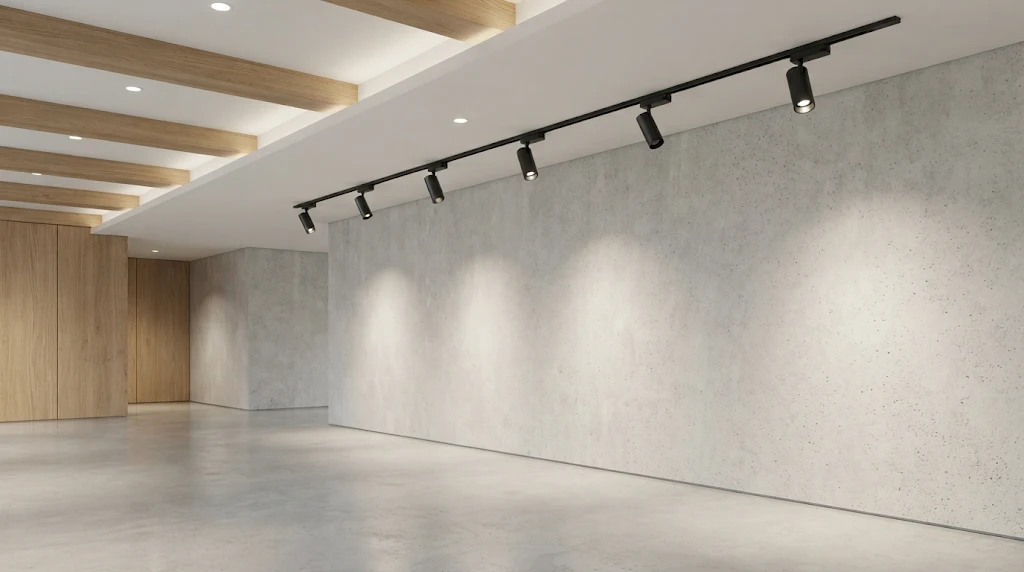
2. How Should Lighting Be Designed for Different Commercial Areas?
Lighting should be selected according to the activity performed in each area, rather than using the same fixture arrangement throughout the building.
| Functional area | Recommended lighting strategy | Main consideration |
|---|---|---|
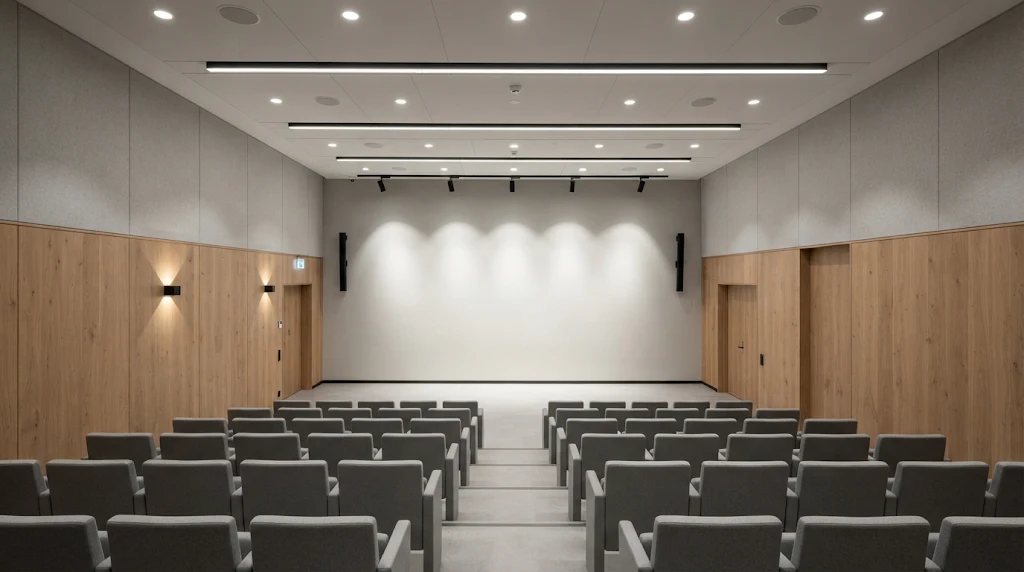
| Auditorium | General lighting with separately controlled presentation lighting | Visibility and visual focus |
| Conference room | Balanced ambient and task lighting | Reading, communication and screen visibility |
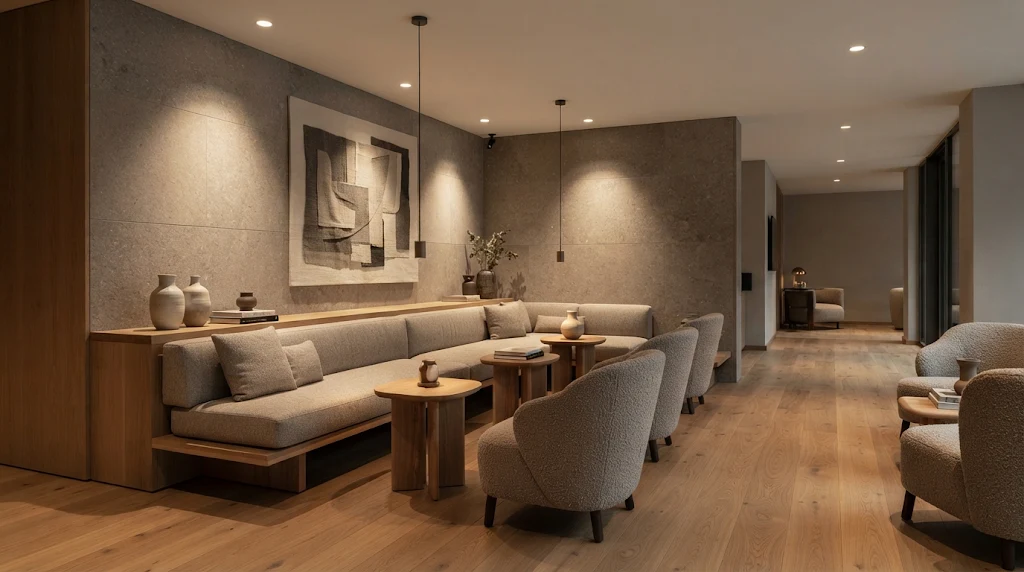
| Lounge | Layered ambient and accent lighting | Comfort and atmosphere |
| Reception area | Architectural lighting and focused highlights | First impressions and orientation |
| Exhibition area | Adjustable track spotlights | Flexible object and display illumination |
| Circulation area | Consistent general lighting | Safe movement and visual continuity |
For example, an auditorium may require reduced ambient lighting during a presentation while maintaining sufficient illumination for safe movement. A conference room generally needs more balanced lighting for face-to-face communication and reading.
The lighting layout should also consider natural daylight, ceiling height, room dimensions, wall reflectance and furniture positions.
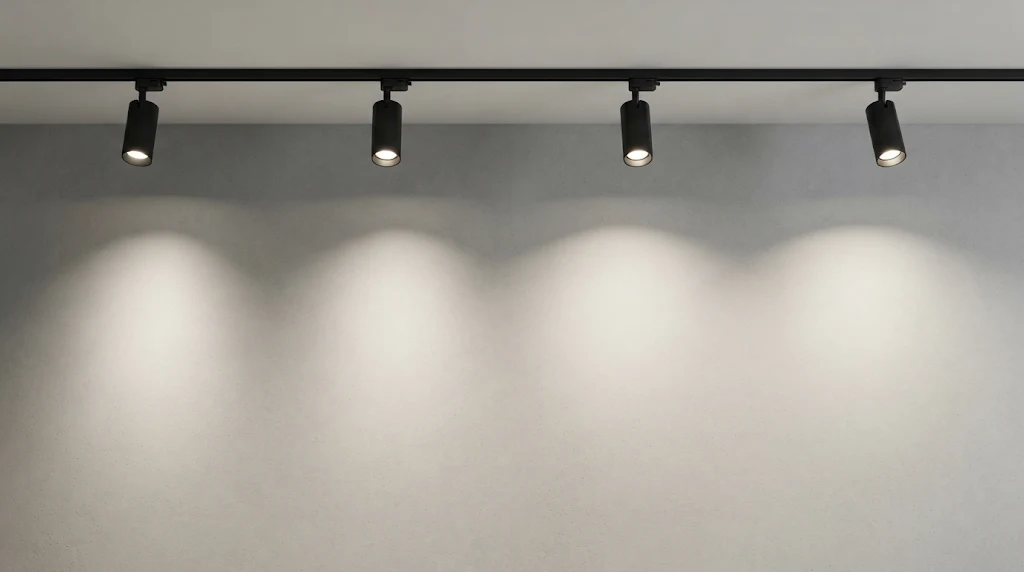
3. What Is the Difference Between Ambient Lighting and Accent Lighting?
Ambient lighting illuminates the general space, while accent lighting directs additional light towards selected surfaces or objects.
The difference is not simply brightness. It is the distribution and purpose of the light.
Ambient lighting is normally designed to provide an appropriate level of illumination across an area. Accent lighting creates controlled contrast to make specific architectural or decorative elements more visible.
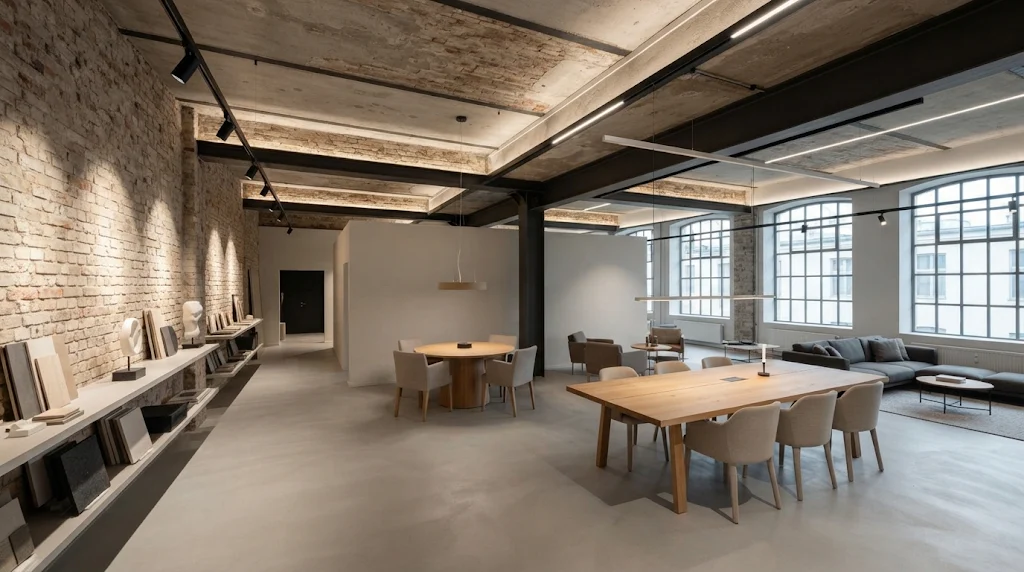
For example, in a renovated industrial interior:
- General ceiling lighting provides overall visibility.
- Adjustable track spotlights highlight exposed brick walls.
- Decorative luminaires contribute to the visual character of the space.
- Separate controls allow each lighting layer to be adjusted.
A good design maintains a balance between the highlighted surfaces and their surroundings.
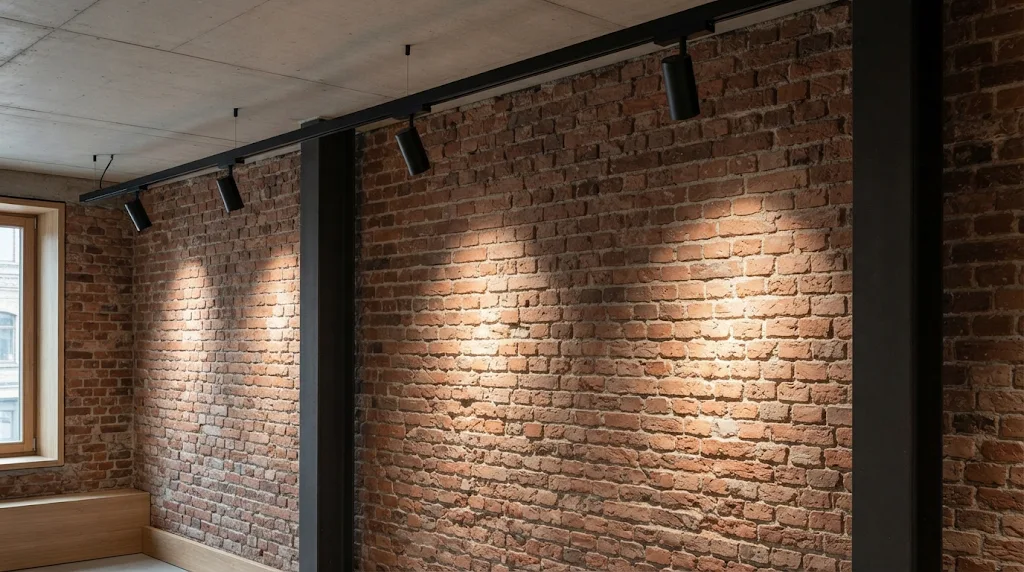
4. Which Beam Angle Is Best for Architectural Accent Lighting?
The best beam angle depends on the target size, mounting distance, required light distribution and desired visual effect.
Common LED spotlight beam angles include 15°, 24°, 36° and 60°.
| Beam angle | Typical application | Light distribution |
|---|---|---|
| 15° | Small objects and concentrated highlights | Narrow |
| 24° | Artwork and selected architectural features | Medium-narrow |
| 36° | Feature walls and wider decorative surfaces | Medium-wide |
| 60° | Larger surfaces and broad accent coverage | Wide |
These are general selection guidelines, not universal specifications.
A narrow beam concentrates light into a smaller area. A wider beam spreads light over a larger area, generally reducing the concentration of illumination at the target when other conditions remain equal.
How Do You Calculate the Illuminated Area?
For an ideal circular beam, the approximate beam diameter can be calculated using:
[
D=2\times H\times\tan(\theta/2)
]
Where:
- (D) = approximate beam diameter
- (H) = distance from the luminaire to the target surface
- (\theta) = beam angle
For example, a 36° beam at a distance of 3 metres produces an approximate beam diameter of 1.95 metres.
This is a geometric estimate. Actual beam boundaries depend on the manufacturer’s photometric definition and optical distribution.
Important: Beam angle alone does not determine lighting quality. Designers should also check centre-beam intensity, field distribution, beam uniformity and photometric files.
5. How Do You Choose LED Track Lights for Architectural and Commercial Projects?
LED track lights should be selected according to their optical performance, colour quality, mounting requirements and control compatibility.
The following specifications deserve particular attention:
| Specification | What to check | Why it matters |
|---|---|---|
| Power | Actual system input wattage | Determines electrical load |
| Luminous flux | Delivered luminaire lumens | Indicates usable light output |
| Beam angle | 15°, 24°, 36°, 60° or project-specific optics | Controls light distribution |
| CRI | CRI 90+ where accurate colour appearance is important | Improves colour rendering |
| Colour temperature | 2700K, 3000K, 3500K or 4000K | Determines the appearance of white light |
| UGR | Installation-based glare evaluation | Helps assess visual comfort |
| Dimming | Compatible driver and control protocol | Enables adjustable light output |
| Photometric data | IES or LDT files | Supports lighting calculations |
For architectural accent lighting, optical quality is particularly important. Two spotlights with the same wattage and nominal beam angle can produce different results because of differences in lens design, reflectors, LED positioning and light distribution.
For retail applications, colour rendering and beam control also influence how products, materials and display surfaces appear.
6. What Colour Temperature Is Best for Multi-Functional Commercial Spaces?
Colour temperature should reflect the function of the space, the interior materials and the desired atmosphere.
| Colour temperature | Typical applications | Visual character |
|---|---|---|
| 2700K | Hospitality lounges and relaxation areas | Warm |
| 3000K | Restaurants, reception and boutique interiors | Warm-neutral |
| 3500K | Mixed-use commercial interiors | Balanced |
| 4000K | Conference rooms, offices and functional retail areas | Neutral white |
These are common design choices rather than mandatory standards.
A lounge may benefit from 3000K lighting, while a conference room may use 4000K for a cleaner and more neutral appearance.
For spaces with multiple functions, separate lighting zones can provide greater flexibility. However, colour temperature should remain visually consistent within areas that need to appear uniform.
7. What CRI Is Recommended for Architectural and Commercial Lighting?
CRI 90 or higher is a useful specification starting point when accurate colour appearance is important.
This is particularly relevant for retail displays, decorative materials, artwork and interiors where the appearance of colours affects the overall experience.
CRI Ra represents the average colour rendering performance across a set of reference test colours. R9 provides additional information about saturated red rendering, which is not included in the general Ra average.
For more detailed colour evaluation, IES TM-30 provides two useful indices:
- Rf (Fidelity Index): Measures how closely colours are rendered compared with the reference illuminant.
- Rg (Gamut Index): Indicates the average change in colour saturation.
For projects where colour appearance is critical, reviewing TM-30 data alongside CRI can provide a more complete assessment than Ra alone.
8. How Can Lighting Controls Improve Multi-Functional Spaces?
Lighting controls allow different areas to operate independently and support different activities without changing the physical lighting installation.
For a multi-functional commercial space, a typical arrangement may include:
| Lighting group | Control requirement |
|---|---|
| General ceiling lighting | Independent dimming |
| Accent spotlights | Separate switching and dimming |
| Presentation lighting | Dedicated scene control |
| Lounge lighting | Adjustable ambient and decorative lighting |
| Circulation lighting | Independent operation where required |
Is DALI-2 Suitable for Commercial Lighting?
Yes. DALI-2 is suitable for commercial lighting systems that require digital control, individual luminaire addressing, grouping and scene management.
It can provide more flexibility than a simple on/off switching arrangement, particularly in large installations with several functional zones.
However, the complete system must be specified correctly. LED drivers, control devices, power supplies and commissioning procedures must all be compatible with the intended functions.
Wireless lighting control may also be suitable for projects where flexible installation and reduced control wiring are priorities.
The selection should depend on system size, project budget, integration requirements and future expansion plans.
9. How Can You Reduce Glare in Architectural and Commercial Lighting?
Glare can be reduced through appropriate optical shielding, fixture positioning, mounting height and light distribution.
For LED track spotlights, designers should consider:
- Deep-recessed optics: Position the LED source further inside the luminaire where the design allows.
- Anti-glare accessories: Use suitable reflectors, lenses or honeycomb louvers.
- Correct aiming: Avoid directing high-intensity beams towards normal viewing positions.
- Balanced brightness: Prevent excessive contrast between illuminated surfaces and surrounding areas.
- Installation assessment: Evaluate the actual positions of luminaires and occupants.
UGR is an important method for evaluating discomfort glare in indoor lighting installations. It should not be treated as a guaranteed product-only value.
A spotlight labelled UGR<19 does not automatically mean that every installation using it will achieve UGR below 19. The result depends on the complete lighting layout, room geometry, surface reflectance and observer position.
10. How Do You Improve Energy Efficiency in Commercial Lighting Design?
Energy efficiency starts with providing the required illumination using an appropriate lighting layout, efficient luminaires and effective controls.
The most important considerations are:
- Select luminaires based on delivered lumens per watt, not LED chip efficacy alone.
- Use suitable beam angles to reduce unnecessary light spill.
- Divide large spaces into independently controlled zones.
- Apply dimming according to occupancy and daylight conditions.
- Specify reliable LED drivers and consider long-term maintenance.
- Calculate connected load and estimated operating hours before installation.
A lower-wattage luminaire is not automatically more energy-efficient if additional fixtures are needed to achieve the required illuminance.
Lighting calculations should consider both the installed power and the actual lighting performance. Energy savings should be based on realistic operating conditions rather than assumed percentages.
11. Commercial Lighting Design Checklist
Before approving a lighting specification, check the following:
| Design stage | Key requirement |
|---|---|
| Space analysis | Identify activities and functional areas |
| Lighting layout | Determine fixture positions and spacing |
| Light distribution | Select appropriate beam angles |
| Colour quality | Check CRI and TM-30 where required |
| Visual comfort | Evaluate glare and contrast |
| Lighting control | Confirm dimming, zoning and scene requirements |
| Technical verification | Review IES/LDT files and lighting calculations |
| Installation | Check mounting and electrical compatibility |
| Maintenance | Confirm driver access and replacement arrangements |
Reviewing these points before installation helps reduce design changes and ensures that the lighting system meets the intended requirements.
Frequently Asked Questions
The three basic layers are ambient lighting, accent lighting and architectural or decorative lighting. They provide general visibility, visual emphasis and integration with the interior design.
There is no single best beam angle. A 15° optic is suitable for concentrated highlights, 24° and 36° optics are commonly used for accent lighting, while 60° optics cover wider areas. The correct choice depends on mounting distance and target size.
3000K is commonly used for warm and welcoming interiors, while 4000K is often selected for functional commercial environments. The choice should follow the space’s purpose and design requirements.
CRI 90+ is a useful starting point for applications where colour appearance matters, including retail displays, artwork and architectural materials. More detailed colour evaluation can include IES TM-30 metrics.
Yes, when the fixture output, beam angle, spacing and installation layout are suitable. However, track spotlights are often more effective as accent lighting than as the only source of general illumination.
DALI is a digital lighting control protocol standard. DALI-2 introduces an updated certification and interoperability framework, including more comprehensive requirements for control devices. Compatibility should always be checked across the complete system.
No. UGR is calculated for the lighting installation, not guaranteed by the spotlight alone. Room dimensions, luminaire positions, surface reflectance and observer positions all affect the result
Conclusion
Effective lighting for multi-functional commercial spaces depends on matching the light distribution and control strategy to the activities taking place in each area.
Ambient lighting provides general visibility, accent lighting creates visual focus, and flexible controls allow the installation to adapt to changing requirements.
For lighting designers, contractors and commercial project developers, the most important decisions involve optical performance, colour quality, glare control, fixture positioning and system compatibility.
BREE LIGHTING provides professional LED track lights, commercial downlights and configurable lighting solutions for retail and architectural applications, with product options designed to meet different project requirements.