
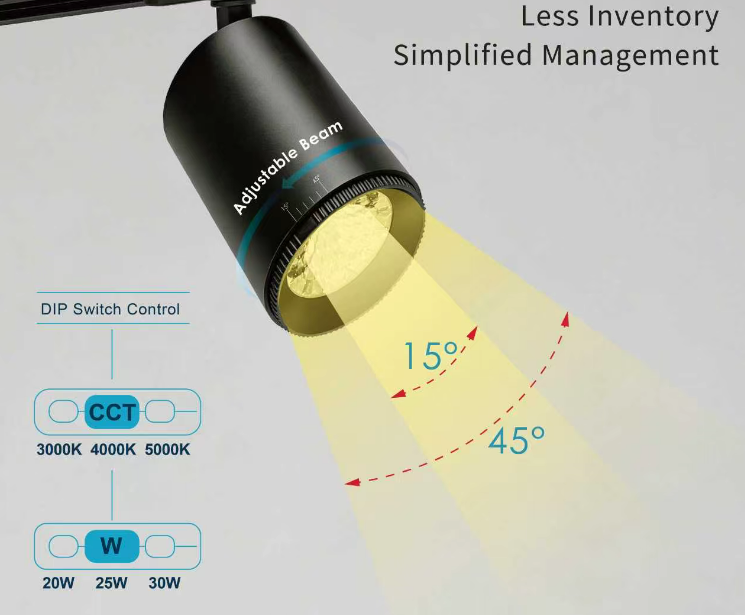
Everything specifiers, architects, and procurement teams in Europe need to know about colour temperature tunable track lighting — from technical standards to EN compliance and application selection.
What is a CCT Tunable Track Light?
A CCT (Correlated Colour Temperature) tunable track light is an LED luminaire that allows the user to adjust the white-light colour tone — from warm (~2700 K) to neutral (4000 K) to cool daylight (~6500 K) — without replacing the light source. This is achieved by independently dimming two separate LED channels: a warm-white chip and a cool-white chip within the same fixture.
Unlike conventional fixed-CCT track lights, tunable white fixtures let operators match lighting conditions to activity type, time of day, or merchandise. In European commercial and hospitality projects, CCT tunability is increasingly specified as a baseline requirement, particularly where circadian lighting design or EU Energy Label compliance are priorities.
Technical Specifications: What to Look For
| Parameter | European Specification Benchmark |
|---|---|
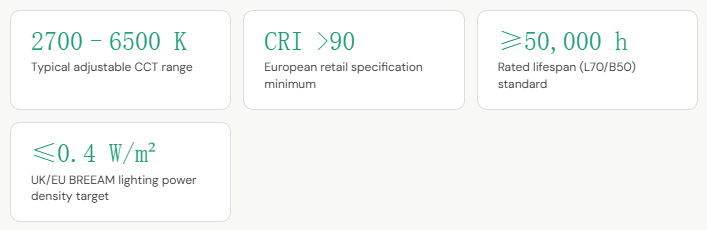
| CCT Range | 2700 K – 6500 K (minimum 3-step: 3000/4000/5000 K) |
| Colour Rendering Index (CRI/Ra) | Ra ≥ 90 for retail; Ra ≥ 80 for offices (EN 12464-1) |
| MacAdam Ellipses | SDCM ≤ 3 (≤ 2 preferred for luxury retail) |
| Dimming Protocol | DALI-2 (IEC 62386) or 1–10 V; Tuya/Zigbee for residential |
| Beam Angle | 15°, 24°, 36°, 60° (interchangeable optic preferred) |
| IP Rating | IP20 (interior); IP44 for damp locations |
| Efficacy | ≥ 140 lm/W (meets EU ERP Tier 1 2021) |
| Flicker | Pst LM < 1.0 (EN IEC 63013:2021) |
| Glare | UGR < 19 (offices per EN 12464-1); UGR < 22 retail |
| Track Compatibility | 3-circuit (J/H/L type); monophase; Eutrac; Global Trac |
| Wattage | 15 W, 20W ,25 W, 35W common; adjustable wattage versions available |
European Regulations and Compliance
Specifiers in the EU, UK, and EFTA markets must verify the following before procurement:
CE Marking (EU)UKCA Marking (UK post-Brexit)EU ERP Directive 2019/2020EN 60598 (Luminaire Safety)EN 62386 (DALI)EN 12464-1 (Workplace Lighting)EU Energy Label Class A–ERoHS 3 (2015/863/EU)
UK-Specific Requirements (Post-Brexit)
Products sold in Great Britain require UKCA marking, tested to the same technical standards as the EU (BS EN 60598, BS EN 62386). Northern Ireland continues to use CE marking. Importers must ensure DoC (Declaration of Conformity) aligns with the correct regime.
Applications in European Projects
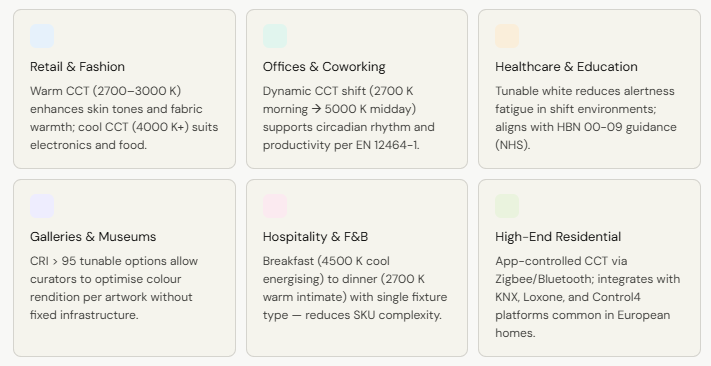
CCT Tunable vs DALI-2 vs Fixed CCT: When to Specify Each
CCT Tunable Track Light
- Best for multi-use spaces
- Higher upfront cost
- Reduces future refit cost
- Requires compatible driver/dimmer
- Ideal: retail, hospitality, office
Fixed CCT Track Light
- Lower cost per unit
- Simpler installation
- Less flexible long-term
- Suitable for single-use areas
- Ideal: warehouses, corridors
DALI-2 vs 1–10 V vs Tuya/Zigbee
DALI-2 (IEC 62386 Part 209) is the European professional standard for addressable tunable white control — each luminaire is individually addressable and reports back status. 1–10 V is simpler and cheaper but only supports group control. Tuya/Zigbee/Bluetooth are cost-effective for residential and small commercial, but lack the robustness required for BREEAM/LEED commissioning reports.
Buyer’s Selection Checklist
| Question | What to Verify |
|---|---|
| Track compatibility? | 3-circuit (J/H/L), monophase, Eutrac, or Global Trac Pro |
| Control protocol? | DALI-2, 1–10 V, Casambi, Zigbee — match to existing BMS |
| CCT range sufficient? | Confirm min/max K and number of tuning steps |
| Colour accuracy? | SDCM ≤ 3 across full CCT range, not just midpoint |
| European certification? | CE or UKCA; request full DoC from manufacturer |
| Driver included? | Some CCT tunable track heads require separate DALI drivers |
| Lumen output suitable? | Calculate with photometric IES/LDT file in DIALux/Relux |
| Warranty? | 5-year minimum recommended for commercial projects in EU |
What CCT range is standard for European retail lighting?
Most European retail specifications call for a CCT range of 2700 K to 4000 K. Fashion and luxury goods tend to favour 3000-3500K for warmth, while food retail and electronics lean toward Special food color. A tunable fixture covering 2700–6500 K provides maximum flexibility to adapt to seasonal or merchandising changes.
What is the difference between CCT tunable and RGBW track lights?
CCT tunable (tunable white) fixtures adjust between shades of white light only — from warm to cool. RGBW fixtures add red, green, and blue channels to produce saturated colours. For most commercial applications in Europe, CCT tunable white is preferred because it maintains high CRI values and looks natural. RGBW is primarily used for decorative, entertainment, or brand-colour accent purposes.
Can I retrofit a CCT tunable head onto an existing track system?
In most cases, yes — provided the track type matches (3-circuit, monophase, etc.). However, CCT tunable heads require a compatible driver. On simple monophase tracks, a DALI-2 or 1–10 V tunable driver must be installed either within the head or as a separate unit in the ceiling void. Always verify whether the existing track carries the correct number of circuits to power tunable white drivers.
Which track types are most common in European commercial projects?
3-circuit track is dominant in professional European retail and hospitality (brands like Eutrac, Global Trac Pro, and Daisalux are widely used). It allows independent circuit switching without rewiring. Monophase (single-circuit) track is more common in smaller retail or residential settings. Magnetic track systems (48 V DC) are emerging as a premium option, particularly in Scandinavian and German market fit-outs.
Is a CCT tunable track light suitable for circadian lighting?
Is a CCT tunable track light suitable for circadian lighting?