
A tunable LED track light lets you adjust colour temperature, lumen output, and beam direction from a single fixture — covering 2700K warm white through 6500K daylight without swapping hardware. For retail, hospitality, and commercial fit-outs where the lighting brief changes between seasons or tenants, that flexibility eliminates the cost of re-ordering.
What to Look for When Specifying a CCT Selectable Track Spotlight
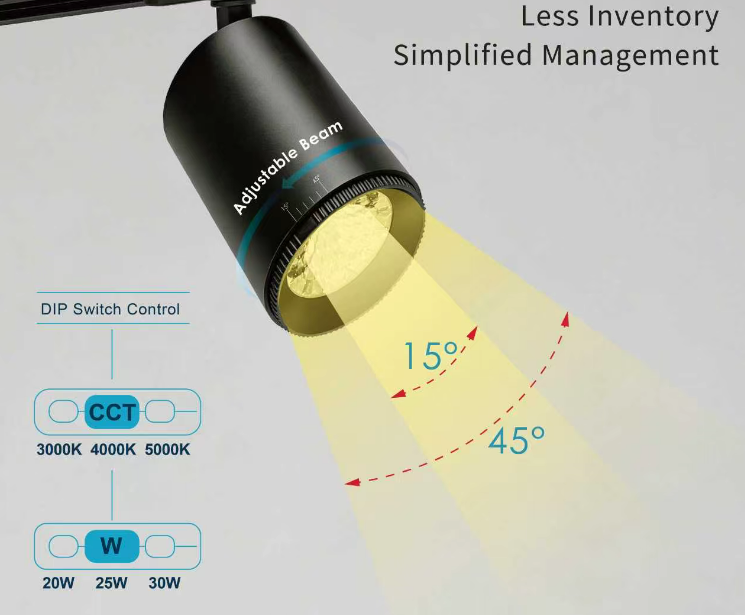
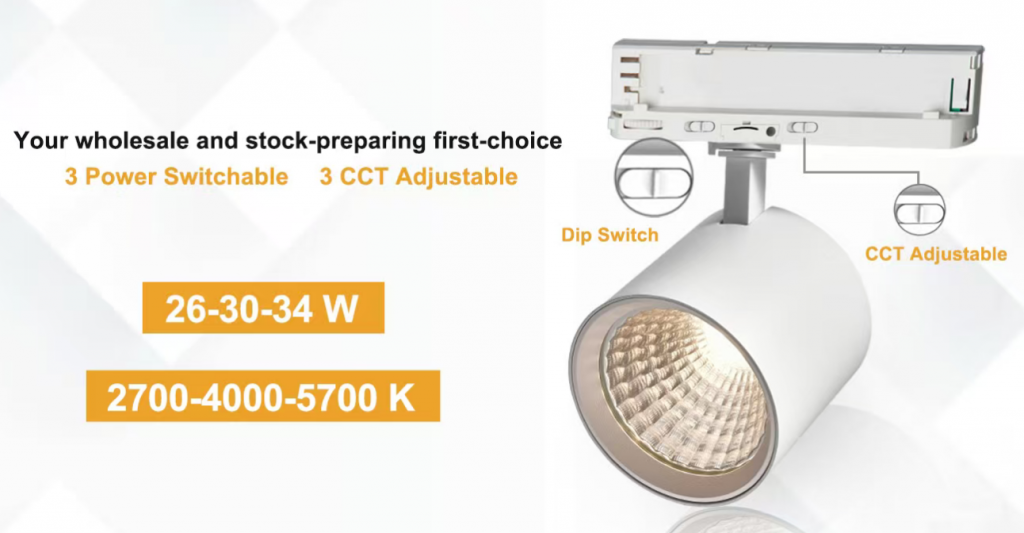
A CCT tunable track spotlight with DIP switch wattage selection does one thing well: it turns a procurement decision into an installation decision. Choose 3000K for a fashion retailer, 4000K for an office, 3500K for a hybrid hospitality space — and dial 20W, 25W, or 30W (any watts cutomized) to match the ceiling height — all from the same box. For projects where the brief shifts between design and commissioning, that flexibility is worth real money.
The spec sheet will tell you the CCT range and the wattage steps. It will not always tell you what actually varies between those steps.
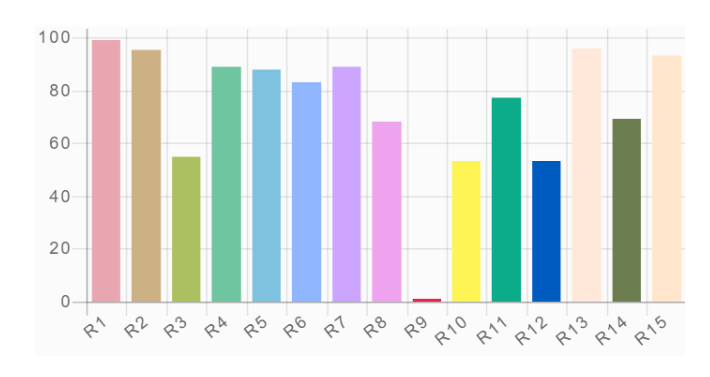
CRI and R9 per CCT step, not per product. A CCT selectable track spot may hit CRI Ra 92 at 4000K and slip to Ra 88 at 3000K — below the Ra ≥90 threshold that ANSI/IES RP-2-20 sets for retail merchandise display. The published CRI figure is often measured at the manufacturer’s preferred setting, not yours. Request CRI Ra and R9 confirmed for the specific CCT you intend to use. R9 — saturated red rendering, absent from the standard CRI calculation — matters most at 3000K and 3500K, where garments, warm stone, and terracotta finishes are most at risk of looking flat.
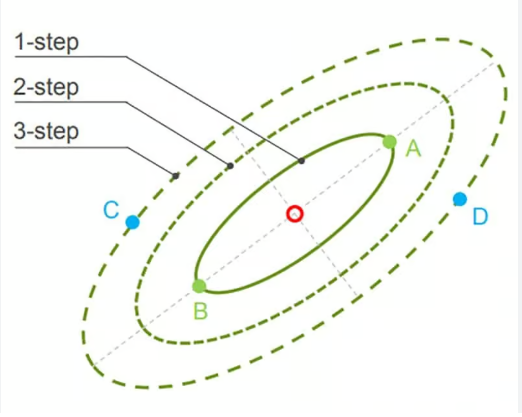
SDCM confirmed per CCT step. A batch achieving SDCM 2 at 4000K may show SDCM 5 at 2700K. That variation is visible as mismatched whites across a row of track heads — not the result anyone paid for. Specify SDCM ≤3 at each colour temperature position you plan to deploy, backed by test data, not a blanket product claim.
IES files for the wattage setting you’re actually using. Photometric layouts run on 30W data. If the installer sets the DIP switch to 20W on site — for energy compliance, or because the client decides the space looks too bright — the layout is wrong by 25–33%. Jarvis Lighting’s technical documentation on selectable wattage fixtures identifies this as the most commonly missed detail in commercial projects. Get IES files for each wattage/CCT combination the design is based on.
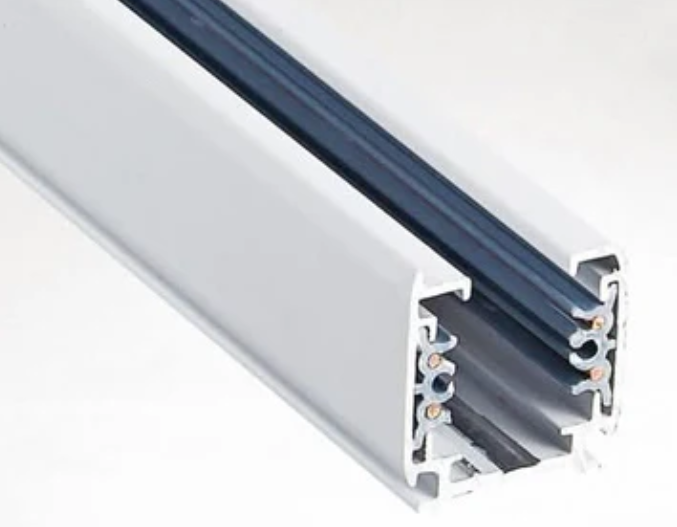
Track system compatibility, confirmed before ordering. 3-phase track (the European commercial standard, also called 3L or 4-wire) is physically similar to single-phase H-track but electrically incompatible. The wrong adapter is a safety issue, not a nuisance. Confirm the track type against the existing rail before the order goes in.
Minimum spec for CCT tunable track spots — commercial, 2026:
CCT: 2700K / 3000K / 3500K / 4000K / 5000K | Wattage via DIP: 20W / 25W / 30W | CRI Ra: ≥90 per CCT step | R9: ≥50 at 3000K and 3500K | SDCM: ≤3 per CCT step | Efficacy: ≥90 lm/W at 30W | Dimming: 0–10V or TRIAC | Track: 1-circuit / 3-phase — confirm before ordering | IES files: Required per wattage/CCT combination in the layout
Product Comparison: What Actually Separates the Options
At first glance, competing CCT selectable track spots look identical on paper — same CCT range, same DIP switch wattage steps, similar price. The differences show up in how honestly the manufacturer documents performance and what happens to colour quality at the non-preferred settings.
The table covers four tiers common in 2026 commercial procurement.
| Specification | Entry-level OEM | Mid-range branded | Premium commercial | High-spec retail grade |
|---|---|---|---|---|
| CCT steps | 3000K / 4000K / 5000K (3-step) | 2700K / 3000K / 4000K / 5000K (4-step) | 2700K / 3000K / 3500K / 4000K / 5000K (5-step) | 2700K / 3000K / 3500K / 4000K / 5000K (5-step) |
| Wattage via DIP | 20W / 30W only | 20W / 25W / 30W | 20W / 25W / 30W | 20W / 25W / 30W |
| CRI Ra | ≥80 (some settings) | ≥90 (max wattage) | ≥90 per CCT step | ≥95, R9 ≥80 |
| SDCM | ≤6 (not specified per step) | ≤4 (general claim) | ≤3 per CCT step | ≤3 per CCT step, 3-step binning |
| Efficacy | 85-95 lm/W | 95–100 lm/W | 110–120 lm/W | 120–140 lm/W |
| IES files | Max wattage only | Max wattage, one CCT | All wattage/CCT combos | All combos + photometric report |
| Beam angle options | Fixed 24° or 36° | 24° / 36° swappable | 15° / 24° / 36° / 60° + accessories | 15° / 24° / 36° / 60° + full accessory range |
| Dimming | TRIAC only | TRIAC / 0–10V | TRIAC / 0–10V / DALI | TRIAC / 0–10V / DALI / Casambi-ready |
| Best for | Budget fit-outs, low dwell time | Offices, schools, general retail | Fashion retail, hospitality, showrooms | Premium fashion, luxury retail, galleries |
The entry-to-mid gap is mostly about documentation. A budget supplier claims CRI ≥90 without stating at which CCT, and publishes a single SDCM figure rather than one per step. For a short-cycle fit-out, that may be fine. For a fashion retailer running the same fixtures across 50 locations for six years, it is not a workable specification.
The mid-to-premium gap is the LED chip and its thermal behaviour. Name-brand COB arrays — Osram Duris, Cree Pro9 — come with LM-80 test data and published colour-shift behaviour across operating temperatures. Cree’s Pro9 documentation explicitly describes how the colour point drifts between cold start and full operating temperature, and how Standard vs Below BBL positions behave differently under those conditions. Entry-level suppliers do not publish this data. For projects where colour consistency over time matters, that data is not optional.
CRI Ra 95 vs 90 is rarely worth the cost in general retail. R9 ≥80 vs ≥50 starts to matter in luxury jewellery, cosmetics, and art applications. For most fashion and commercial retail at 3000K–3500K, Ra 90 with R9 ≥50 is the right call.
What to Avoid When Buying CCT Adjustable Track Lighting
Designing the layout on 30W and installing on 20W. A photometric simulation tied to 30W data will miss its illuminance targets by 25–33% if the DIP switch is later moved to 20W — whether for energy compliance or because the client decides the space is too bright after handover. Lock the wattage in the specification document and confirm it with the installer before the ceiling closes.
Taking the CCT label at face value. Two fixtures both marked “3000K” can look different if one sits above the Planckian locus (greenish cast) and the other below it (cleaner, pinkish-neutral white). ANSI C78.377’s chromaticity quadrangles are wide enough to include both. For retail, hospitality, or any environment where colour accuracy matters, ask for Duv alongside CCT and request the chromaticity test data, not just the label.
Ignoring flicker below 30% dimming. “Dimmable” on a spec sheet does not mean flicker-free at low output. At retail dimmings below 20–30%, TRIAC-driven fixtures often flicker visibly on camera — a real problem in stores where staff photograph products for social media or e-commerce throughout the day. Request IEEE 1789-compliant flicker data at the actual dimming levels the project will use. DALI-controlled fixtures with quality constant-current drivers perform significantly better here.
Ordering without confirming the track adapter type. 3-phase track (3L, 4-wire — the European commercial standard) and single-phase H-track are physically similar and electrically incompatible. The wrong adapter is a safety hazard. Fixtures from Chinese manufacturers shipping to Europe come with 3-phase adapters by default; those going to North America come with single-phase. Check the rail type before the order ships, not after delivery.
Skipping the physical sample evaluation. Two CCT selectable track spots with identical datasheets can produce visibly different light on the same garment or white wall. Lumen figures and CCT labels do not capture Duv position, phosphor spectral character, or beam quality. Evaluate two to four samples at the project’s ceiling height, wattage, and beam angle before placing the bulk order. The cost is negligible against the cost of relighting a completed fit-out.
Defaulting to 5000K because it sounds brighter. Brightness is lumens, not Kelvin. A 5000K fixture at 20W is dimmer than a 3000K fixture at 30W. In fashion and hospitality environments, 5000K reads clinical and makes warm-toned surfaces — oranges, terracottas, warm neutrals — look harsh. The DIP switch exists so you can test all five CCT steps on the actual merchandise before the setting is locked. Use it.
What is a CCT tunable track spot with DIP switch?
A commercial LED track head that lets the installer set colour temperature (2700K / 3000K / 3500K / 4000K / 5000K) and power output (20W / 25W / 30W) using a bank of micro-switches on the driver housing. Once set, the position is fixed — these are installation-time decisions, not dynamic controls like dimming. One SKU covers multiple project types, which reduces stock and simplifies procurement when the brief changes mid-project.
Which CCT works best for fashion retail?
3000K is the standard for fashion retail accent track. It reads warm and premium, and is proven across apparel environments globally. 3500K is a solid alternative when a slightly more neutral result is needed. Both require CRI Ra ≥90 and R9 ≥50 to render white fabrics and saturated reds accurately — ANSI/IES RP-2-20 sets Ra ≥90 as the floor for retail merchandise display. 4000K and 5000K are for utility areas, sportswear, or fitting room task zones where a daylight feel is deliberate.
How does wattage selection affect light output?
A typical 30W setting delivers around 2,700–3,000 lumens; 25W gives 2,200–2,500 lumens; 20W gives 1,800–2,000 lumens, assuming ≥90 lm/W efficacy. Manufacturers usually publish lumen data only for the maximum wattage, so photometric layouts that use 30W figures will overestimate illuminance by 25–33% when the fixture runs at 20W. Get IES files for the specific wattage/CCT combination your layout is based on.
Can DIP switch settings be changed after installation?
In most designs, yes — but it requires opening the fixture or removing it from the track to reach the driver. In practice, treat both CCT and wattage as permanent decisions. Lock them in the project specification and confirm with the installer before fixtures ship.
What SDCM should I specify?
SDCM ≤3 at each CCT step you plan to use, confirmed per step by test data. A blanket product SDCM claim is not enough — a fixture achieving SDCM 2 at 4000K may show SDCM 5 at 2700K. Anything above SDCM 3 is visible as mismatched whites across adjacent fixtures in a retail or hospitality installation.
What is the difference between 3-phase track and H-track?
H-track (single-circuit) is standard for residential and light commercial in North America. 3-phase track (3L, 4-wire) is the European commercial standard. They look similar and are electrically incompatible — fitting the wrong adapter is a safety hazard. Fixtures from Chinese manufacturers default to 3-phase for European projects. Always check the track rail type before ordering.
- IES TM-30-20 — IES Method for Evaluating Light Source Color Rendition. ies.org — R9 and colour rendition framework.
- Cree LED — Pro9™ COB Technology, operating temperature colour shift documentation. cree-led.com