A commercial LED retrofit can cut lighting electricity use by roughly 20–60% in many fluorescent-to-LED projects, but the actual ROI depends on the starting wattage, annual operating hours, electricity price, controls, installation cost, and maintenance requirements.
That is why a warehouse, office and retail store can have very different payback periods even when the LED fixtures cost roughly the same.
For a quick screening calculation, three numbers are enough to start:
- Existing lighting load: kW
- Annual operating hours: hours/year
- Electricity price: $/kWh
Then add installation cost, maintenance, controls and incentives to build the full project case.
DOE Better Buildings guidance places many fluorescent-to-LED retrofit opportunities in the 20–60% lighting-energy-saving range, while individual field projects have produced both lower and higher results depending on the existing system and controls.
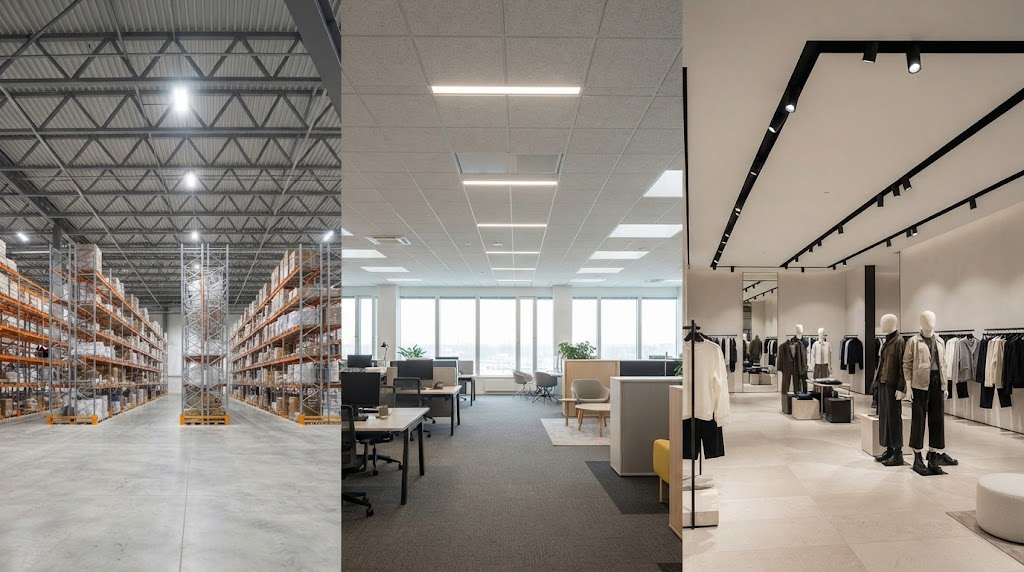
Which has better LED retrofit ROI: warehouse, office or retail?
There is no universal winner because operating hours and the existing lighting system often matter more than the building category.
A warehouse running two or three shifts can accumulate thousands more lighting hours each year than a small office. A retail store may have a dense lighting layout and long opening hours, while an office may have more opportunities for daylight and occupancy controls.
For this reason, a useful comparison looks like this:
| Factor | Warehouse | Office | Retail |
|---|---|---|---|
| Operating hours | Often high | Usually moderate | Often high |
| Existing lighting | High-bay, fluorescent, HID | Troffers, panels, fluorescent | Track lights, downlights, fluorescent |
| Fixture quantity | Medium to high | High | High |
| Lighting density | Medium | Medium | Often high |
| Occupancy controls | High potential | High potential | Moderate to high |
| Daylight controls | Site dependent | High potential | Site dependent |
| Maintenance difficulty | Often high | Moderate | Moderate to high |
| Lighting quality requirements | Uniformity and visibility | Glare and visual comfort | Product appearance |
| Main ROI driver | Runtime + wattage | Controls + runtime | Runtime + density + maintenance |
For portfolio owners, this table is better used as a screening tool than as a fixed ROI ranking.
Why does warehouse lighting often show a strong retrofit case?
Warehouse lighting can produce substantial savings when high-wattage fixtures operate for long hours and maintenance access is expensive.
Older warehouses may still have HID high bays, fluorescent high bays or older linear systems. Replacing them with LED high bays can reduce connected lighting power while also reducing relamping work.
The calculation is straightforward.
Suppose a warehouse has:
- 200 existing fixtures
- 300 W average input power
- 4,500 operating hours/year
The existing annual lighting consumption is approximately:
200 × 0.30 kW × 4,500 h = 270,000 kWh/year
If the replacement system uses 150 W per fixture:
200 × 0.15 kW × 4,500 h = 135,000 kWh/year
The lighting load has been cut in half in this simplified example.
At $0.12/kWh, that represents approximately:
135,000 × $0.12 = $16,200/year
before maintenance savings or control-related savings are included.
The actual result will depend on measured fixture wattage, operating schedules and electricity tariffs.
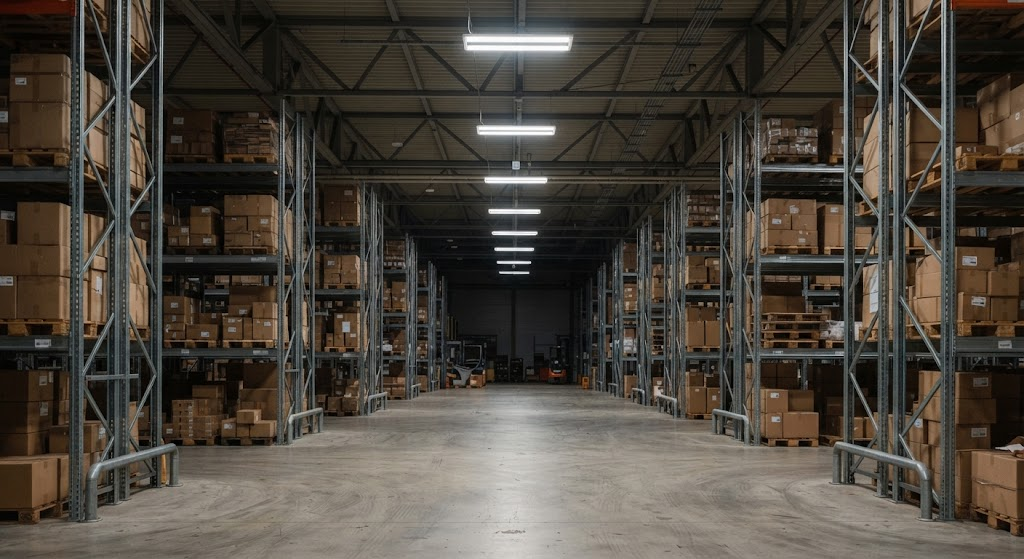
Do warehouse occupancy sensors improve the business case?
They can, particularly in aisles, storage zones and other areas that are not continuously occupied.
A warehouse does not necessarily need every fixture operating at full output throughout the day.
A typical control strategy may divide the building into:
- Main circulation areas
- Storage aisles
- Loading zones
- Picking areas
- Packaging areas
- Staff areas
Occupancy sensors, scheduling and dimming can then be applied according to how each area is actually used.
ENERGY STAR identifies occupancy sensors as a useful strategy for reducing lighting operation in intermittently occupied spaces.
For a warehouse, however, sensor selection and placement matter. Poorly positioned sensors can create dark spots, delayed response or unnecessary switching.
Why is office LED retrofit ROI usually more complicated?
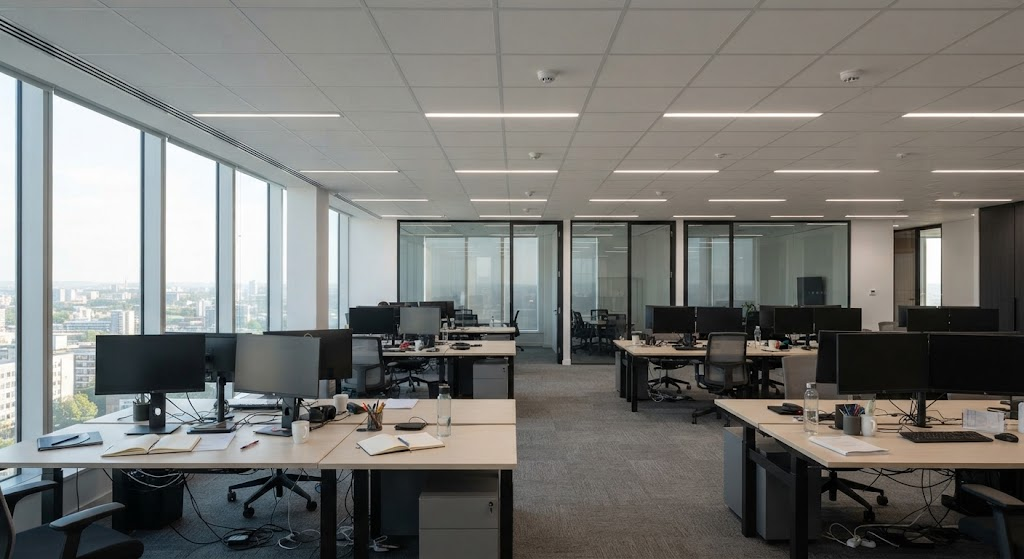
Office lighting has fewer hours in many cases, but controls and daylight can make a major difference to the final savings.
A conventional office retrofit might replace fluorescent troffers with LED panels or LED troffers.
That reduces fixture wattage, but the bigger opportunity may come from controlling when those fixtures operate.
Consider three areas:
- Perimeter workstations near windows
- Interior open-plan workspaces
- Meeting rooms
They do not necessarily need the same lighting schedule.
A perimeter zone may benefit from daylight dimming.
A meeting room may be empty for several hours each day.
An open office may require scheduled operation during normal working hours.
This makes LED + controls a different investment from simply replacing fluorescent fixtures with LED fixtures.
Can daylight controls change office retrofit ROI?
Yes, because daylight controls can reduce fixture output when natural light is already contributing to the required illumination.
This is particularly relevant near windows and glazed façades.
The important point is that daylight savings should be calculated from actual site conditions rather than assumed across the entire floor.
A deep-plan office with limited daylight will have a very different control opportunity from a shallow office with large windows.
DOE field evaluations of advanced lighting controls have shown substantial savings in some commercial applications, while also demonstrating that results vary by building and control configuration.
Why is retail lighting different from warehouse and office lighting?
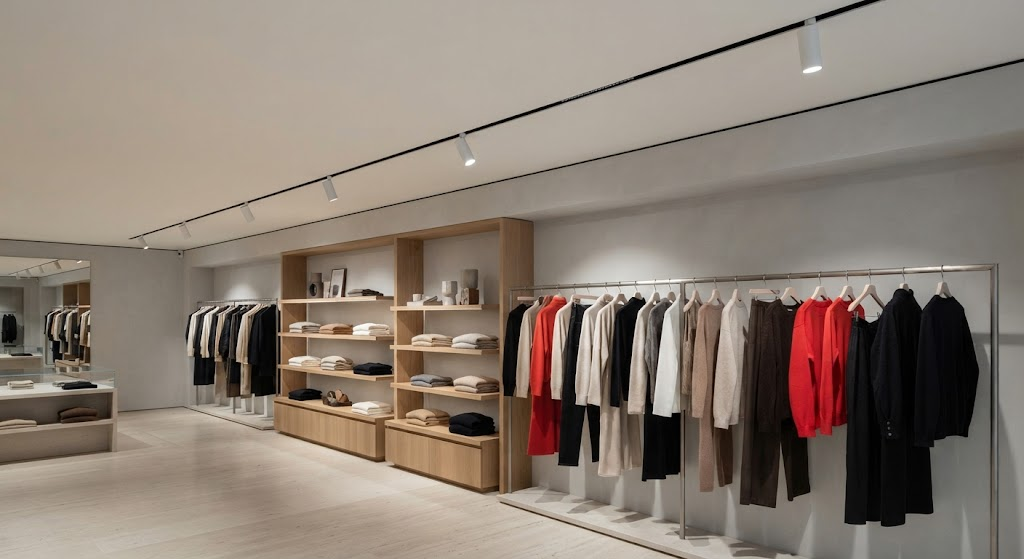
Retail lighting has to deliver energy efficiency without losing the visual effect that helps customers see products correctly.
A retail store may combine:
- General lighting
- Track spotlights
- Display lighting
- Wall lighting
- Shelf lighting
- Decorative lighting
- Feature lighting
Replacing everything with the lowest-wattage fixture is therefore not necessarily the right approach.
A fashion store, for example, may need high color rendering, controlled beam angles and accurate skin and fabric appearance.
A supermarket may place greater emphasis on uniform illumination, shelf visibility and long operating hours.
A jewelry store may have a completely different accent-lighting strategy.
The ROI calculation should therefore include lighting quality and maintenance, not just electricity consumption.
Does retail lighting always save more energy after an LED retrofit?
No; the result depends heavily on the existing lighting layout and how much of the store’s connected load is actually replaced.
A retail store with 500 old 75 W spotlights has a different retrofit opportunity from a store using 250 efficient LED fixtures.
The same applies to opening hours.
A store operating:
12 hours/day × 365 days = 4,380 hours/year
has more annual opportunity for energy savings than a small office operating:
9 hours/day × 250 days = 2,250 hours/year
That difference alone can materially change payback.
How do you calculate commercial LED retrofit ROI?
Start with annual kWh savings, then convert the energy reduction into money.
Step 1 — Calculate the existing lighting consumption
Existing annual kWh = Existing lighting kW × Operating hours
Step 2 — Calculate the proposed LED consumption
LED annual kWh = LED lighting kW × Operating hours
Step 3 — Calculate annual energy savings
Annual kWh savings = Existing annual kWh − LED annual kWh
Step 4 — Convert the saving into money
Annual energy savings = Annual kWh savings × Electricity price
Step 5 — Add maintenance savings
Include:
- Lamp replacement
- Driver replacement
- Lift rental
- Labor
- Access equipment
- Emergency maintenance
Step 6 — Calculate simple payback
Simple payback = Net retrofit investment ÷ Annual total savings
What does a simple retrofit example look like?
A project reducing lighting load from 100 kW to 60 kW and operating for 4,000 hours per year would save approximately 160,000 kWh annually.
Assume:
- Existing load: 100 kW
- LED load: 60 kW
- Operating hours: 4,000 h/year
- Electricity price: $0.12/kWh
Annual energy saving:
(100 − 60) × 4,000 = 160,000 kWh
Annual electricity saving:
160,000 × $0.12 = $19,200
If the installed project cost is $48,000:
$48,000 ÷ $19,200 = 2.5 years
That is a simple energy-only payback.
If the retrofit also removes significant maintenance costs, the effective payback can be shorter. If installation costs are higher or annual operating hours are lower, it can be longer.
Which numbers should go into a sortable retrofit comparison?
A useful retrofit spreadsheet needs enough information to explain why one site produces a different financial result from another.
| Facility | Existing kW | LED kW | Hours/year | kWh saved | Electricity rate | Energy savings | Maintenance savings | Installed cost | Incentive | Payback |
|---|---|---|---|---|---|---|---|---|---|---|
| Warehouse A | 100 | 60 | 4,500 | 180,000 | $0.12 | $21,600 | — | — | — | — |
| Office A | 80 | 50 | 2,250 | 67,500 | $0.12 | $8,100 | — | — | — | — |
| Retail A | 90 | 55 | 4,380 | 153,300 | $0.12 | $18,396 | — | — | — | — |
These figures are illustrative examples rather than industry averages.
The table can then be sorted by:
- Annual kWh saved
- Annual electricity savings
- Maintenance savings
- Installed cost
- Net investment
- Simple payback
That is much more useful for a company managing dozens or hundreds of sites.
Which retrofit variables deserve the most attention?
The six variables below usually determine whether an LED project looks financially attractive or marginal.
1. Operating hours
More operating hours mean more opportunities to monetize every watt saved.
2. Existing fixture wattage
Replacing a 400 W HID fixture with a 150 W LED creates a very different energy opportunity from replacing a 40 W fluorescent fixture with a 30 W LED.
3. Electricity price
A 100,000 kWh saving has a different financial value at $0.08/kWh and $0.25/kWh.
4. Installed cost
Product price is only part of the project cost. Labor, lifts, wiring changes, controls, commissioning and disposal can materially change the final number.
5. Controls
Occupancy sensing, scheduling, daylight response and dimming can reduce energy use beyond the fixture-efficiency improvement.
6. Maintenance
Maintenance savings can be particularly important where fixtures are mounted high above warehouse floors or where retail stores require frequent access outside trading hours.
Is a 20–60% energy saving realistic?
It can be realistic for many fluorescent-to-LED retrofit projects, but it should never be treated as a guaranteed result.
DOE’s Better Buildings material gives a 20–60% range for LED retrofit applications involving troffers and related lighting systems.
Actual results vary according to:
- Existing fixture efficiency
- LED replacement wattage
- Operating hours
- Lighting levels
- Controls
- Occupancy
- Daylight
- Maintenance practices
A project starting with relatively efficient fluorescent fixtures may achieve less direct savings than one replacing older, high-wattage equipment.
A project combining LED fixtures with advanced controls may achieve more.
What about maintenance savings?
Maintenance can be a significant part of the business case when replacing lamps is difficult, frequent or expensive.
This is particularly relevant in:
- High-bay warehouses
- Distribution centers
- Large retail stores
- Shopping centers
- High-ceiling commercial spaces
Imagine a fixture installed 9–12 meters above the floor.
The cost of changing the lamp is not simply the price of the lamp.
It may include:
Lamp + technician + lift + travel + downtime + access + safety procedures
Reducing those interventions can have real operating value.
ENERGY STAR also identifies longer LED service life and reduced replacement requirements as important benefits of LED lighting.
What should a company do before approving a retrofit?
Measure the existing system before committing to the LED specification.
1. Audit
Record fixture type, wattage, quantity, mounting height, operating schedule and controls.
2. Measure
Where possible, verify actual input power rather than relying only on catalogue ratings.
3. Model
Calculate LED-only and LED-plus-controls scenarios.
4. Check lighting performance
Verify illuminance, uniformity, glare, color quality and application requirements.
5. Calculate the complete cost
Include fixtures, controls, labor, lifts, wiring, commissioning, disposal and maintenance.
6. Pilot
Use a representative area when lighting quality or controls are uncertain.
7. Install
Follow the approved specification rather than allowing uncontrolled fixture substitutions.
8. Commission
Check sensors, dimming, schedules, zones and lighting levels.
9. Verify
Compare actual post-retrofit energy use with the original baseline.
When is a pilot project worth doing?
A pilot makes the most sense when the technical risk is higher than the product risk.
For warehouses, a pilot can test:
- High-bay distribution
- Sensor coverage
- Dimming response
- Vertical illumination
For offices:
- Glare
- Uniformity
- Daylight response
- Occupancy control
For retail:
- Color appearance
- Beam angle
- Product illumination
- Track positioning
- Dimming scenes
Retail projects particularly benefit from testing because a technically efficient fixture can still produce an unsatisfactory result if the optical design does not suit the merchandise.
DOE-supported retail projects have used pilot installations and performance evaluation before broader deployment, illustrating the value of testing the proposed solution under real operating conditions.
What is the best way to prioritize a multi-site retrofit?
Rank sites by financial opportunity rather than simply by building size.
A practical screening model is:
Annual lighting kWh × electricity price + maintenance opportunity
Then compare that with:
Net retrofit investment
For a portfolio, collect these fields for every facility:
- Floor area
- Fixture count
- Existing fixture wattage
- Annual operating hours
- Electricity rate
- Existing annual lighting kWh
- Proposed LED wattage
- Control strategy
- Installation cost
- Maintenance cost
- Available incentives
- Expected annual savings
- Simple payback
This allows a company to sort the entire portfolio without assuming that every warehouse, office or store has the same economics.
Warehouse vs Office vs Retail: what should you optimize first?
The first optimization target changes with the facility.
Warehouse
Optimize runtime, high-bay wattage, controls and maintenance access.
Long operating hours and high mounting heights make energy and maintenance closely connected.
Office
Optimize fixture efficiency, daylight response, occupancy and visual comfort.
The energy-saving opportunity often comes from combining LED with intelligent controls rather than relying on wattage reduction alone.
Retail
Optimize energy, product appearance, beam control, flexibility and maintenance together.
A retail retrofit should preserve the visual hierarchy of the store while reducing unnecessary lighting power.
What is the most useful ROI metric?
Simple payback is excellent for initial screening, but larger commercial projects should also consider lifecycle economics.
For larger projects, evaluate:
- Simple payback
- Net present value
- Internal rate of return
- Annual kWh savings
- Annual operating-cost savings
- Maintenance savings
- Incentives
- Expected service life
- Control-system cost
- Replacement cost
- Measurement and verification
DOE’s retrofit financial-analysis resources similarly use measures such as energy savings, energy-cost savings, maintenance savings, net present value and simple payback when assessing retrofit economics.
So, which facility should be retrofitted first?
The first project should be the site where the measured savings opportunity is large enough to justify the required investment.
A warehouse may stand out because of long operating hours and high-wattage high bays.
An office may stand out because its lighting controls are outdated and occupancy is highly variable.
A retail chain may stand out because hundreds of stores use the same inefficient lighting platform, allowing one successful specification to be repeated across the portfolio.
There is no need to force all three into the same ROI model.
The stronger approach is to use one calculation framework, then change the inputs according to the facility.
That gives facility managers a comparison they can actually use:
Measure the load → calculate the kWh → price the savings → add maintenance → subtract incentives → compare investment → verify the result.
For commercial LED retrofits, that is the difference between a generic “LED saves energy” statement and a project-level business case.