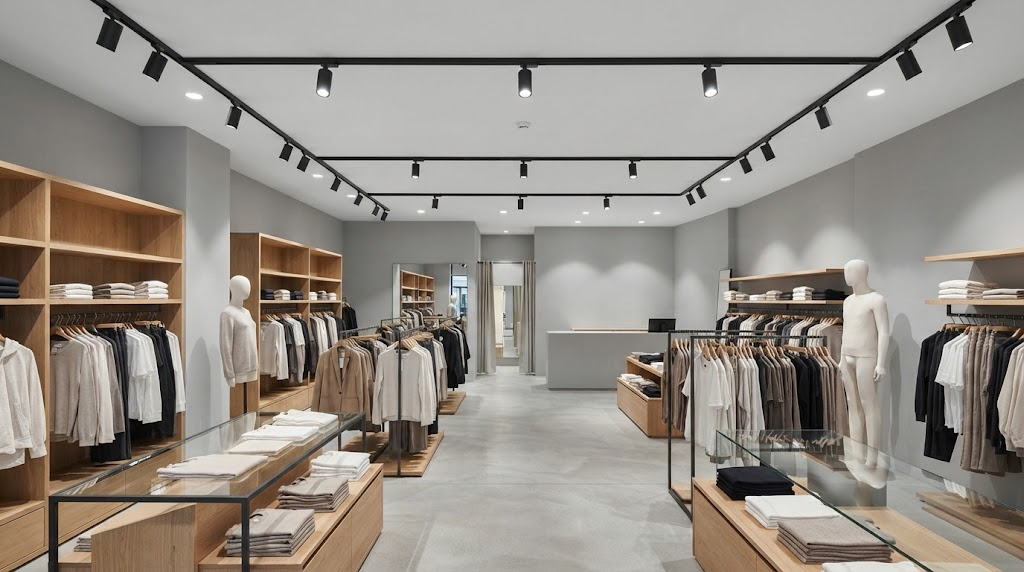
Choose retail LED track spotlights by matching beam angle, light output, colour quality, glare control, efficiency and controls to the merchandise and ceiling height. The best specification is the one that delivers useful light where it is needed without unnecessary brightness elsewhere.
What Makes a Good LED Track Spotlight for Retail?
Retail track lighting has a fairly specific job.
It needs to make products look good, create visual hierarchy and remain flexible when the store layout changes.
That sounds simple, but a spotlight that performs well in a showroom may not be the best choice for a fashion store. A high-output fitting can be excessive for a small display, while a low-output fitting may struggle at a four-metre ceiling.
The useful specifications are therefore not just wattage and lumens.
For a retail project, look at:
- Beam angle
- Delivered lumens
- Candela or beam intensity
- CRI and colour quality
- Colour temperature
- Glare
- Efficacy
- Adjustment range
- Track compatibility
- Dimming and control
- Lifetime and maintenance
These specifications should be considered together.
1. Start With the Merchandise, Not the Fixture
Before selecting a spotlight, identify what it needs to illuminate.
A mannequin, a folded clothing display and a four-metre-wide feature wall do not need the same optical system.
For example:
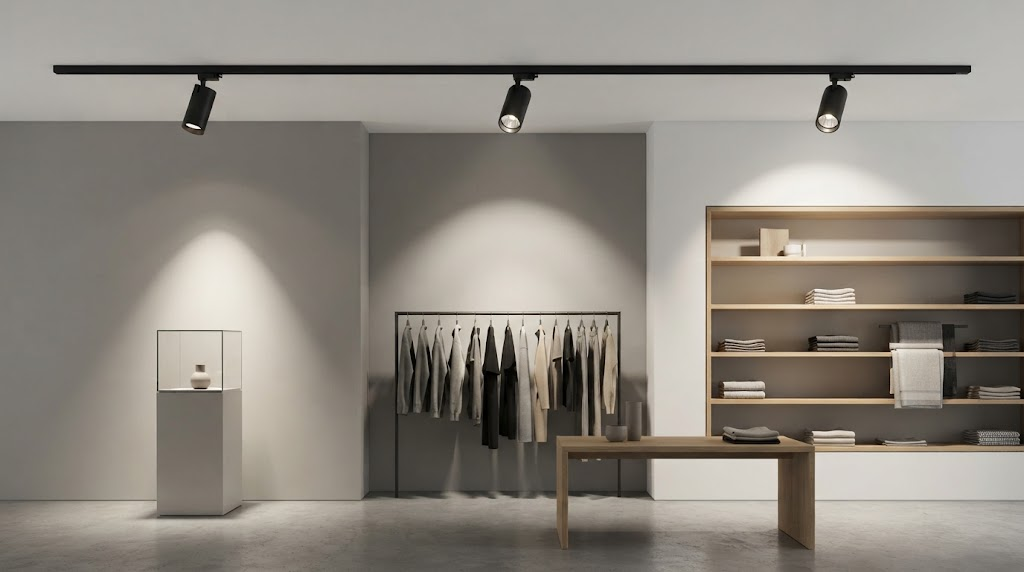
Small feature display → narrower beam
Clothing rack → medium beam
Large wall display → wider beam
General circulation → broad, even distribution
This sounds obvious, but it is one of the easiest parts of a lighting specification to get wrong.
A common mistake is selecting one spotlight and one beam angle for the entire store.
Retail lighting usually works better when the optics follow the merchandise.
2. Select the Beam Angle Carefully
Beam angle determines how concentrated the light is.
As a general starting point:
| Beam angle | Typical application |
|---|---|
| 10°–15° | Small products, feature objects, focal displays |
| 20°–24° | Individual merchandise groups and shelves |
| 30°–36° | Clothing racks, mannequins, medium-sized displays |
| 40°–60° | Large displays and broader surfaces |
These are practical starting ranges, not universal specifications.
The mounting height changes the result.
At a higher ceiling, the same beam angle produces a larger illuminated area. At a lower ceiling, it creates a smaller pool of light.
Professional track-lighting ranges commonly provide several optical options rather than one fixed beam. For example, current commercial product families offer narrow spot through flood distributions, allowing the same track system to be adapted to different retail applications.
A useful rule
Choose the beam angle according to the size of the target at the actual mounting distance.
Do not choose it simply because “24°” or “36°” is a popular specification.
3. Look at Delivered Lumens, Not Wattage
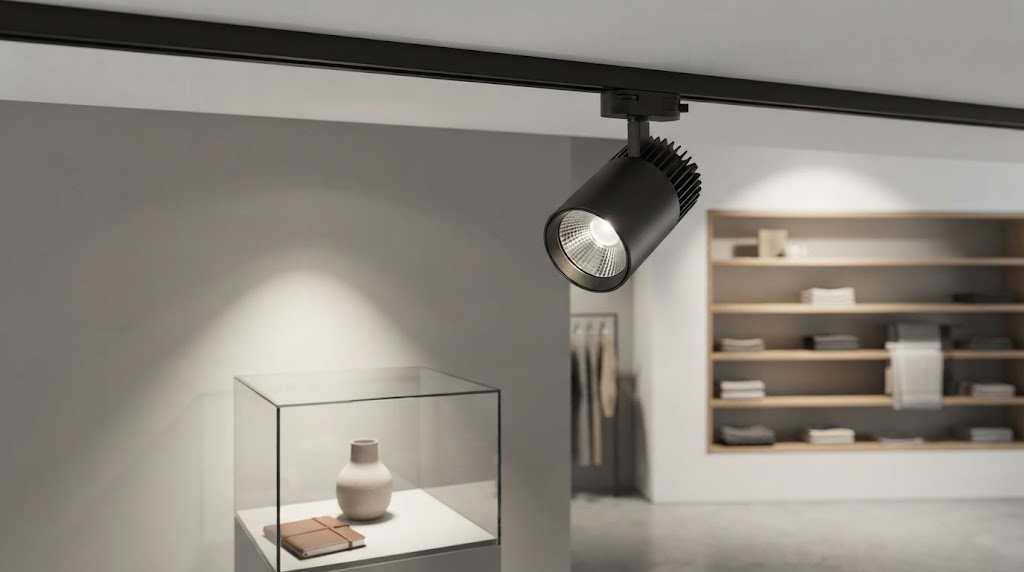
Wattage tells you how much electrical power the luminaire consumes.
It does not tell you how effectively that power is being turned into useful light on the merchandise.
For that, compare:
Lumens → efficacy → optical distribution → light on the target
Current professional retail track-lighting products demonstrate a wide range of performance. Depending on the product class and application, commercial systems can exceed 120 lm/W, while some high-efficiency systems go considerably higher.
That does not mean every retail spotlight should target the highest possible lm/W.
A fashion display may benefit more from excellent colour quality and controlled optics than from squeezing out another few lumens per watt.
The specification should therefore balance:
efficiency + optical performance + colour quality + visual comfort.
4. CRI Matters More Than Many Retailers Expect
For retail, colour rendering is not a cosmetic specification.
It directly affects how merchandise appears.
This is particularly relevant to:
- Clothing
- Cosmetics
- Shoes
- Furniture
- Jewellery
- Food
- Artwork and lifestyle products
For many quality retail projects, CRI 90+ is a sensible baseline.
Professional retail products commonly offer CRI 90 or higher, with some systems also providing specialised colour recipes for fashion, food and other applications.
But CRI should not be viewed in isolation.
If colour appearance is commercially important, also consider:
- R9
- TM-30
- Colour consistency
- SDCM
What is SDCM?
SDCM describes colour consistency between individual luminaires.
A lower SDCM value means the light sources are more closely matched in colour.
This matters when many spotlights are installed next to each other.
If one fitting appears noticeably warmer or cooler than the next, the ceiling can look inconsistent even when all fixtures have the same nominal CCT.
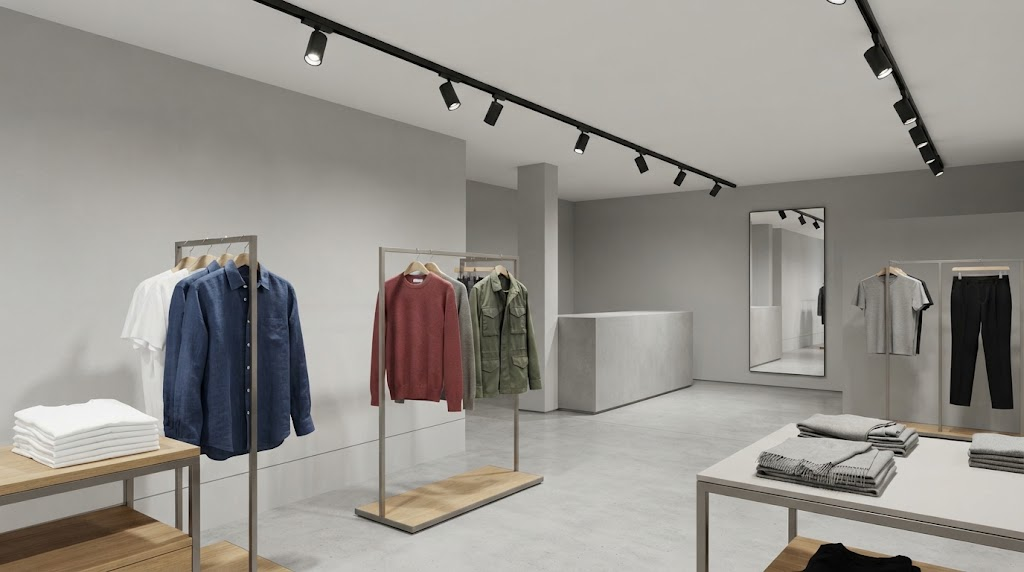
5. Choose the Colour Temperature Around the Store Concept
There is no single colour temperature that works for every retail environment.
Typical choices include:
| CCT | General character |
|---|---|
| 2700K–3000K | Warm and intimate |
| 3000K–3500K | Warm-neutral and versatile |
| 3500K–4000K | Clean and contemporary |
| 4000K+ | Cooler, brighter visual character |
The choice should be made together with the interior materials and brand positioning.
Warm white can work well with timber, dark finishes and premium interiors.
A more neutral 3500K–4000K environment can suit contemporary fashion, sports, electronics and other modern retail concepts.
The key is consistency.
If the main sales floor is 3500K, randomly adding 3000K spotlights can create visible colour differences that were never intended.
6. Don’t Ignore Glare
Glare is one of the specifications that is often noticed only after installation.
The fitting may look excellent on a product sheet.
Then customers walk underneath it and see the LED source directly.
Good track spotlights use optical design to control this.
Depending on the fixture, that can include:
- Recessed LED position
- Reflectors
- Lenses
- Snoots
- Honeycomb accessories
- Barndoors
- Cut-off control
Commercial retail spotlights already use these approaches. Some current products offer honeycomb, barndoor and snoot accessories specifically to improve visual comfort and control the beam.
Don’t judge glare from directly below the fixture.
Check the luminaire from the angles customers actually see.
This is particularly important in stores with low or medium ceiling heights.
7. Check the Fixture’s Adjustment Range
A track spotlight needs to do more than rotate.
Look at:
- Horizontal rotation
- Vertical tilt
- Locking mechanism
- Adjustment resistance
- Heat management
- Position stability
A fitting that slowly changes position after adjustment is a maintenance problem.
For retail, the spotlight should stay where the lighting designer or visual merchandising team aimed it.
The adjustment range also needs to suit the ceiling height.
A fitting with limited tilt may work perfectly at 2.8 metres but become difficult to aim correctly from a 4–5 metre ceiling.
8. Pay Attention to Beam Intensity
Two spotlights can have the same lumen output but create very different visual effects.
Why?
Because lumen output describes total light.
Beam intensity describes how concentrated that light is.
For accent lighting, candela and centre-beam intensity can therefore be useful specifications alongside lumens.
This becomes particularly relevant when:
- The ceiling is high
- The display is small
- Strong product emphasis is required
- The store uses dramatic accent lighting
A narrow beam with strong centre intensity can create a much more defined focal point than a wide beam with the same total lumen output.
9. Choose the Right Track System and Adapter
The spotlight and track should be treated as one system.
Before specifying the luminaire, confirm:
- Track type
- Circuit configuration
- Adapter
- Electrical rating
- Mechanical compatibility
- Driver arrangement
- Dimming method
- Control protocol
This becomes especially important for refurbishment projects.
An existing track may look compatible but use a different mechanical or electrical configuration.
For a new installation, decide the track infrastructure before ordering large quantities of spotlights.
10. Decide Whether You Need Dimming
Not every retail store needs sophisticated lighting control.
But dimming can be useful when the store operates different lighting scenes.
For example:
Opening → normal operating level
Peak trading → full lighting
Evening → adjusted atmosphere
Cleaning → reduced lighting
Window display → separate schedule
Commercial track-lighting systems are available with non-dimming, DALI and wireless control options, depending on the product and system architecture.
The important part is to make the decision before selecting the driver.
A luminaire cannot simply be assumed to be compatible with every dimming system.
11. When Does DALI Make Sense?
DALI can be useful when the project needs individual or grouped digital control.
It becomes more relevant when there are:
- Multiple lighting zones
- Large numbers of luminaires
- Different scenes
- Centralised control
- Sensors
- Energy-management requirements
For a small boutique with 20 spotlights, a simpler solution may be enough.
For a large retail store or multi-zone project, digital control can provide much more flexibility.
The right question is not:
“Should every retail project use DALI?”
It is:
“Does this project benefit from addressable lighting control?”
12. Consider Lifetime and Maintenance
Retail lighting often operates for long hours.
That makes lifetime more important than it may first appear.
When comparing products, look for:
- Rated lifetime
- Lumen maintenance
- Driver reliability
- Warranty
- Replaceable components
- Availability of spare parts
Be careful with lifetime figures.
A statement such as “100,000 hours” should not be interpreted as “the fitting will operate perfectly for 100,000 hours.”
Check what the figure actually represents.
For example, professional lighting specifications may state lumen maintenance such as L80 at a defined ambient temperature, which describes the expected retained light output under the stated test conditions. Current commercial products use this type of specification in their technical data.
That is much more useful than a lifetime number with no test condition.
13. Look at Power Factor and System Performance
For larger retail installations, electrical performance also deserves attention.
Useful specifications can include:
- Power factor
- Total harmonic distortion
- Standby consumption
- Driver efficiency
- Inrush current
These may not matter much for a small shop with a limited number of fittings.
They become more relevant when hundreds of luminaires are installed across a large retail floor or multiple stores.
Good lighting specification is not only about the light you see. It is also about the electrical system behind it.
Which Track Spotlight Is Best for a Fashion Store?
For fashion retail, start with colour quality and optical control.
A sensible specification might include:
- CRI 90+
- Good R9 performance
- Consistent colour between fittings
- Adjustable body
- Multiple beam options
- Good glare control
- Dimming capability where required
- Reliable track adapter
Then match the beam angle to the merchandise.
A narrow beam can create emphasis on a mannequin or hero product.
A medium beam can cover a clothing rail.
A wider beam can work on a large wall display.
The important point is that one specification does not have to cover every application in the store.
What About Supermarkets?
Supermarkets usually need a different balance.
Uniformity becomes more important across long aisles, while selected products and promotional areas may require stronger emphasis.
Track spotlights can be useful for:
- Promotional displays
- End caps
- Feature areas
- Fresh-food displays
- Seasonal campaigns
For long aisles, broad or asymmetric optics may be more appropriate than narrow accent beams.
The lighting should help customers see products clearly without creating excessive contrast from one aisle to the next.
Should You Choose a Zoom Track Spotlight?
Zoom optics can be useful when displays change frequently.
A single fitting can cover a range of beam angles, reducing the need to change the luminaire when the display changes.
But there is a trade-off.
If the store has a stable layout, a dedicated fixed optic can be simpler and may deliver a highly controlled beam for the specific application.
So zoom is most useful when the flexibility has a real operational benefit.
It should not be selected simply because it sounds more advanced.
Fixed Lens or Interchangeable Optics?
Both approaches can work.
Fixed optics
Good when:
- The application is predictable
- The store layout is stable
- The beam angle is known
- Consistency is the priority
Interchangeable optics
Useful when:
- Different displays require different beams
- The retailer wants future flexibility
- One spotlight family needs to cover several applications
Professional track-lighting ranges commonly provide different optical configurations rather than treating one beam as suitable for every retail application.
What Should a Retail Lighting Specification Include?
Before approving a track spotlight, ask the manufacturer or supplier for the following information:
| Parameter | Why it matters |
|---|---|
| Power consumption | Electrical load |
| Delivered lumens | Actual light output |
| Efficacy | Energy performance |
| Beam angle | Light distribution |
| CBCP / candela | Centre-beam intensity |
| CRI / Ra | Colour rendering |
| R9 / TM-30 | Additional colour information |
| SDCM | Colour consistency |
| CCT | Colour appearance |
| UGR / glare data | Visual comfort |
| Lifetime / Lxx | Long-term performance |
| Driver | Dimming and reliability |
| Control | DALI / wireless / other |
| Track adapter | System compatibility |
| Photometric file | Lighting calculation |
A serious retail project should have access to the photometric data before the final fixture quantity is confirmed.
An IES or LDT file can be used for lighting calculations in professional planning software.
That is a much stronger basis for a specification than estimating the number of fixtures from wattage alone.
A Practical Selection Example
Imagine a fashion store with a ceiling height of around 4 metres.
The retailer wants:
- General illumination across the sales floor
- Stronger light on mannequins
- Accent lighting for feature walls
- Flexible positioning
- Good colour rendering
- Dimming capability
A sensible approach would be to divide the application.
General areas: medium or wider distribution.
Clothing racks: medium beam.
Mannequins: narrower beam with stronger centre intensity.
Feature walls: beam selected according to wall height and distance.
Colour quality: CRI 90+.
Control: dimmable driver if scenes or zoning are required.
This is more reliable than selecting one 30W or 40W spotlight and installing it everywhere.
The Most Common Specification Mistakes
Choosing by wattage
A higher wattage does not automatically produce better retail lighting.
Choosing by lumens alone
Total lumens do not tell you where the light goes.
Using one beam angle throughout the store
Different displays have different requirements.
Ignoring colour consistency
Multiple fittings with noticeably different colour points can make a store look poorly controlled.
Treating CRI as the only colour-quality measurement
R9, TM-30 and SDCM can provide additional information where colour quality matters.
Ignoring glare
The brightest fitting can be the wrong fitting if customers see the LED source directly.
Selecting the driver too late
Control requirements should be decided before the luminaire and driver are finalized.
Skipping a lighting test
A sample installation can reveal beam, glare and colour issues before hundreds of fixtures are purchased.
LED Track Spotlight Selection Checklist
Before placing an order, check these points:
Optics
- Is the beam angle suitable?
- Is the beam intensity sufficient at the mounting height?
- Can the fixture be aimed accurately?
Light quality
- Is CRI appropriate?
- Is R9 important for the application?
- Is colour consistency specified?
- Is the CCT suitable for the interior?
Comfort
- Is glare controlled?
- Is the fixture comfortable from customer viewing angles?
Performance
- What is the actual luminaire efficacy?
- What are the lumen-maintenance figures?
- Is the driver suitable for the operating hours?
System
- Does the adapter match the track?
- Is dimming required?
- Is DALI or wireless control required?
Planning
- Is an IES/LDT photometric file available?
- Has the lighting been calculated at the actual mounting height?
- Has a sample installation been tested?
FAQ: Choosing LED Track Spotlights for Retail
There is no single specification. Beam angle, light output, colour quality and glare control should be considered together with the ceiling height and merchandise.
Around 10°–15° is useful for focused accents, 20°–24° for smaller product areas, and around 30°–36° for many clothing and medium-sized displays. Wider beams are useful for larger surfaces.
CRI 90+ is a strong starting point for many retail applications. For demanding colour-critical applications, also review R9, TM-30 and colour consistency.
There is no universal lumen requirement. Ceiling height, beam angle, mounting distance and target size all affect the required output.
No. Efficiency matters, but retail lighting also needs good optics, colour quality and visual comfort. A slightly less efficient spotlight can be the better product if it delivers the required light more effectively.
SDCM is a measure of colour consistency between light sources. A lower SDCM generally means tighter colour matching between luminaires.
L80 indicates that the LED system is expected to maintain at least 80% of its initial luminous output under the stated test conditions and lifetime criteria.
Not necessarily. DALI is useful when individual addressing, zoning, dimming or integration with a larger lighting-control system is required.
Usually, yes. Different merchandise and display sizes often benefit from different optical distributions.
Yes. A sample installation is one of the best ways to check the actual beam, glare, colour appearance and product presentation before committing to a large quantity.
Final Answer: How Should You Choose?
For retail, start with the display, not the catalogue.
Determine the mounting height and target area first. Select the beam angle. Then check the required lumen output and beam intensity.
After that, evaluate CRI, colour consistency, CCT and glare.
Finally, confirm the track adapter, driver, dimming and control requirements.
A good LED track spotlight should do three things well:
put light where the product needs it, make the product look right, and remain reliable enough for everyday retail operation.
The best specification is rarely the fixture with the highest lumen output or the highest efficacy on the datasheet.
It is the one whose optics, light quality, efficiency and control system fit the actual store.