Retailers keep lighting consistent across multiple stores by setting clear technical standards, approving specific luminaires, and checking the finished installation against a reference design. The aim is to make every store feel like part of the same brand, even when floor plans, ceiling heights, and local construction conditions differ.
For fashion chains, footwear retailers, beauty stores, and supermarkets, lighting consistency affects more than appearance. It influences how customers see products, how easily staff can maintain displays, and how much energy each store consumes.
1. What Should a Retail Lighting Standard Include?
A retail lighting standard should define the required lighting effect and the technical specifications needed to reproduce it. Simply ordering the same type of LED light for every branch is not enough.
Two luminaires can look almost identical but produce different results because of their optics, LED characteristics, driver settings, or light distribution.
A practical specification should cover the following parameters.
| Specification | What retailers need to define | Why it matters |
|---|---|---|
| Colour temperature (CCT) | Approved Kelvin values for each store zone | Keeps the lighting atmosphere consistent |
| Colour rendering | Minimum CRI and, where relevant, R9 requirements | Helps merchandise retain its intended colours |
| Colour consistency | Permitted LED colour variation, expressed in SDCM where specified | Reduces visible differences between adjacent fittings |
| Beam angle | Approved angles for product displays, walls, and general lighting | Controls how merchandise and surfaces are illuminated |
| Light output | Required luminaire lumens and target illuminance | Prevents branches from appearing too bright or too dim |
| Glare control | Optical requirements appropriate to the application | Improves visual comfort |
| Driver and dimming | Approved driver type and control compatibility | Avoids inconsistent dimming and commissioning problems |
| Energy performance | Luminaire efficacy and installed lighting power | Makes energy use easier to compare |
| Product identification | Exact model numbers and approved configurations | Simplifies repeat orders and replacement |
The lighting designer should translate these requirements into a master specification that purchasing teams, contractors, and suppliers can all follow.
Should every store use the same colour temperature?
Not necessarily. What matters is consistency within each designated area and across stores using the same concept.
A fashion chain might specify one colour temperature for general sales areas and another for selected feature zones. A cosmetics retailer may have different requirements for product displays and customer-facing mirrors.
The decision should be made at brand level, not left to individual installers. Otherwise, one branch may appear noticeably cooler or warmer than another, even when the same products are being sold.
Is CRI 90 enough for fashion retail lighting?
CRI 90 or higher is a common specification for fashion and premium retail applications, but the appropriate requirement depends on the merchandise and lighting design.
CRI alone does not describe every aspect of colour rendering. For colour-sensitive products, retailers should also consider R9 performance, LED colour consistency, and the spectral characteristics of the selected light source.
Where colour appearance is especially important, assess samples under the proposed lighting before approving the specification.
2. How Can Retailers Maintain Consistency Across Different Store Sizes?
The most practical approach is to standardize lighting by store format rather than force every branch to use an identical layout.
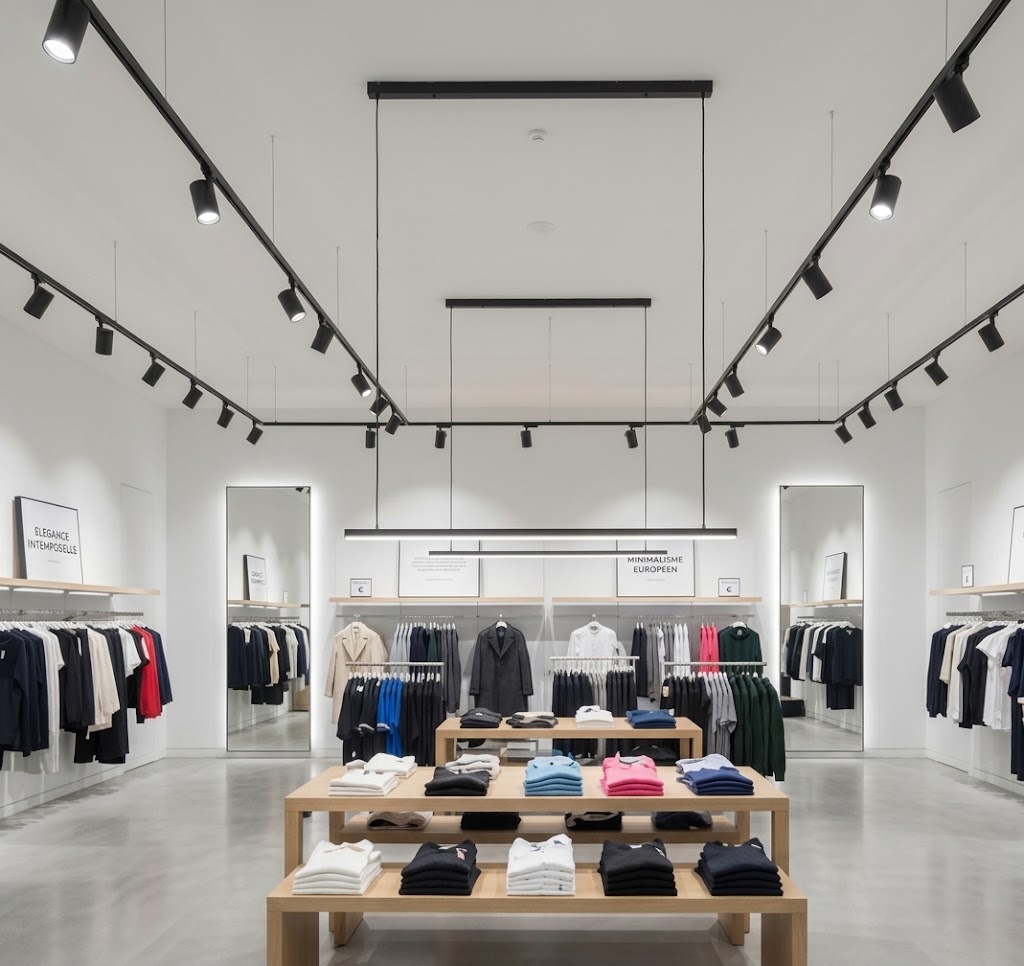
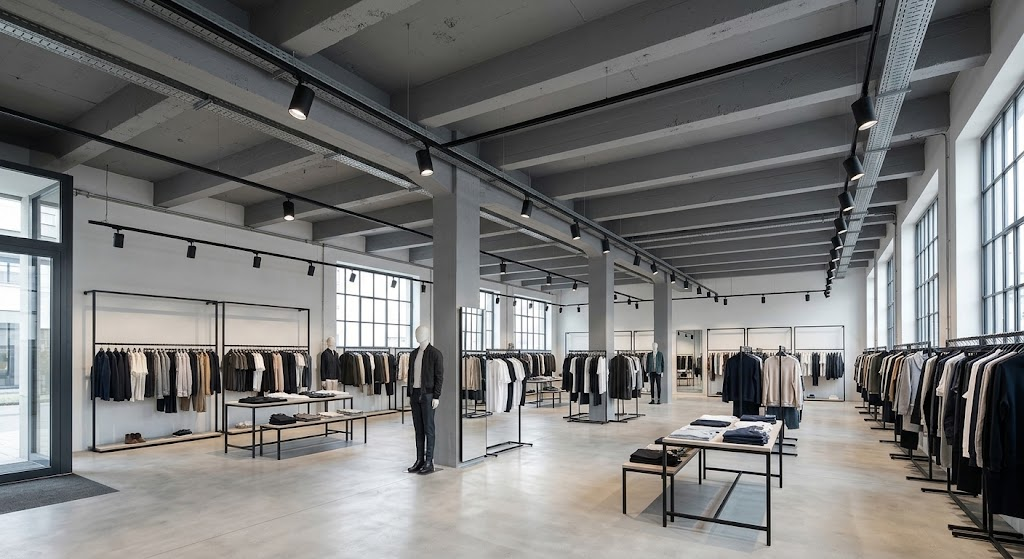
A flagship store may have a high ceiling, large window displays, and feature walls. A shopping-centre unit may have limited ceiling space, while an outlet may require a simpler arrangement.
The lighting design can change to suit these conditions without changing the overall brand experience.
| Store format | Typical lighting requirement | What should remain consistent |
|---|---|---|
| Flagship store | More detailed accent lighting and feature displays | Brand atmosphere, colour quality, and visual hierarchy |
| Standard store | Repeatable fixture layouts and lighting zones | Approved lighting parameters and product presentation |
| Outlet store | Simplified layouts and efficient fixture selection | Core colour standards and visual identity |
| Compact store | Careful placement to avoid glare and uneven illumination | Lighting quality and consistency within each zone |
For each format, prepare a reference layout showing track positions, fixture quantities, beam angles, aiming directions, and lighting zones.
Photometric calculations should be adjusted to the actual ceiling height, display arrangement, surface finishes, and available daylight. Copying the fixture count from another branch without checking these conditions can leave some areas underlit and others unnecessarily bright.
Standardize the lighting result, not necessarily the number of fixtures.
3. Why Do Retail Chains Use Track Lights and Downlights?
Track lights and downlights are useful for multi-store retail projects because they serve different functions and can be combined into repeatable lighting layouts.
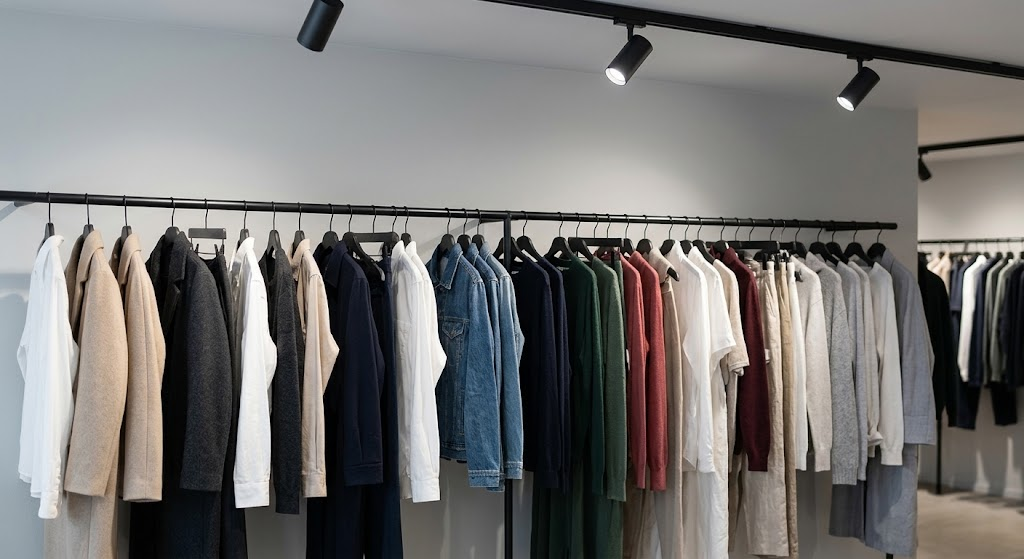
LED track lights are particularly suitable for fashion displays, mannequins, wall-mounted merchandise, promotional tables, and areas where product arrangements change regularly. Adjustable heads allow staff to redirect the light without redesigning the entire ceiling.
LED downlights are commonly used for general illumination in circulation areas, fitting rooms, checkout zones, and other locations where a cleaner, integrated ceiling appearance is required.
Linear luminaires can provide continuous illumination for selected shelving, architectural details, and long retail zones.
The choice should depend on the lighting task, ceiling conditions, and required visual effect. A product that works well in a high-ceiling flagship store may not provide the same result in a smaller branch.
When selecting luminaires for a chain rollout, confirm the following:
- Light output and beam distribution.
- Colour temperature and colour rendering.
- Available optical options and glare control.
- Driver type and dimming compatibility.
- Track or ceiling mounting requirements.
- Replacement availability and product configuration.
Matching the housing colour or wattage does not guarantee matching illumination. The optical and electrical specifications must also be controlled.
4. How Can Retailers Avoid Lighting Differences During Store Rollouts?
Lighting inconsistencies often begin when an approved specification changes during purchasing, production, or installation.
A contractor may replace a luminaire because of a delivery delay. A purchasing team may choose a similar-looking product at a lower price. An installer may adjust the aiming angle to suit local conditions without checking the original design.
Each change can affect the finished result.
A controlled approval process helps prevent these problems.
Step 1: Approve the exact luminaire configuration
Record the model number, wattage, colour temperature, CRI, beam angle, driver, dimming option, and accessories. Avoid specifications that identify a product only by its appearance or general category.
Step 2: Check a sample before bulk production
Review representative luminaires in a mock-up or pilot store. Check product colours, wall illumination, glare, beam distribution, and the overall appearance of the merchandise.
For a large rollout, a sample approval can prevent the same problem from being repeated across dozens of branches.
Step 3: Control substitutions
Require written approval before changing the specified luminaire, LED configuration, driver, optic, or control component.
An alternative should be evaluated against the original technical requirements. Similar wattage, housing dimensions, or colour temperature alone is not sufficient.
Step 4: Keep product and batch records
Maintain the approved model numbers, technical datasheets, order records, and relevant production or inspection records.
For phased projects, confirm that the same configuration can be supplied for later openings. If a product must be changed, assess the impact before introducing it into the rollout.
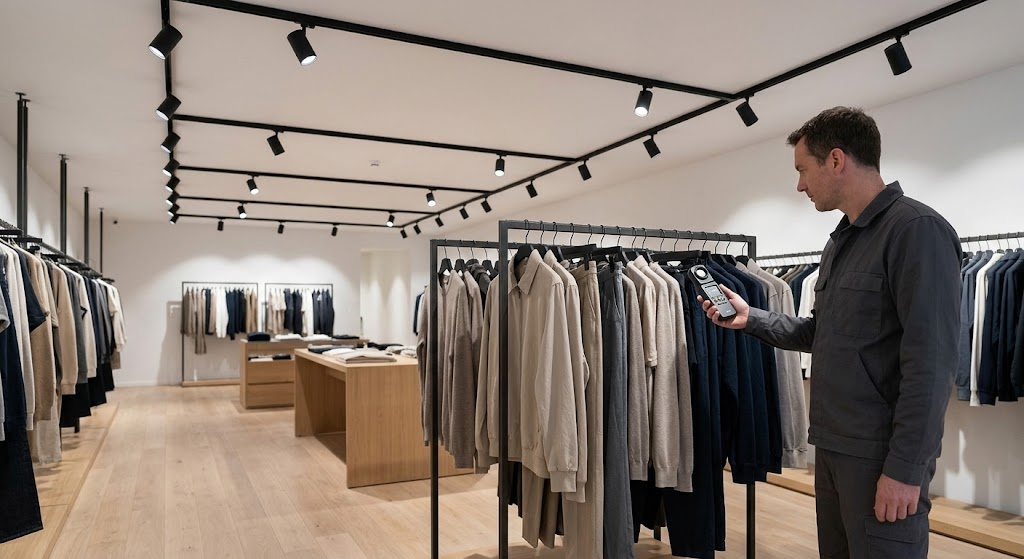
Step 5: Check the completed installation
Compare the installed products and lighting effect with the approved design. Check fixture positions, aiming angles, representative illuminance, dimming settings, and lighting scenes.
Record deviations and correct them before handover.
This process gives the retailer a clear reference for every new store and reduces the risk of individual branches developing their own lighting standards.
5. How Should Lighting Controls Be Standardized Across Multiple Stores?
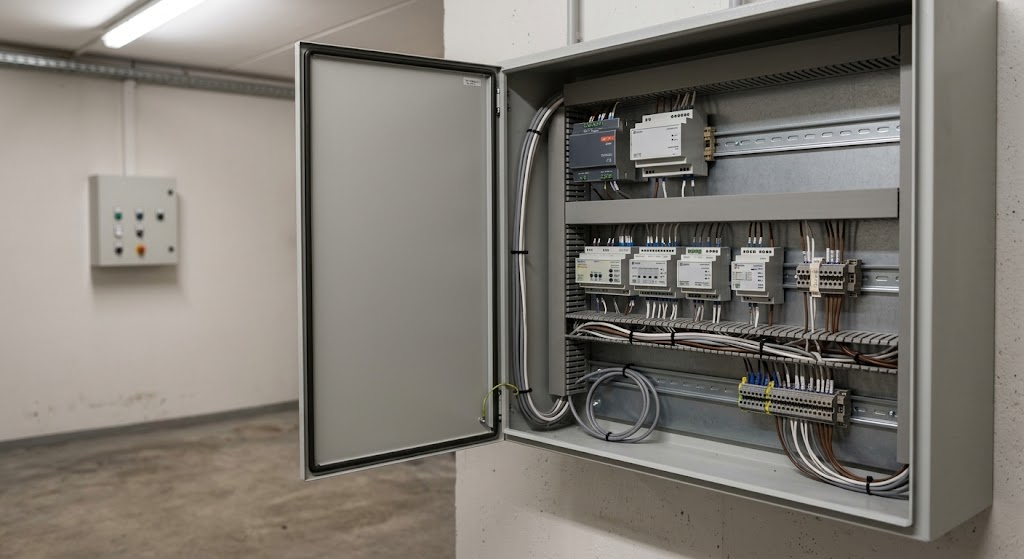
Retail chains should choose a control system according to the required flexibility, project budget, electrical infrastructure, and operating model.
Different control systems can produce different results even when the installed luminaires are identical. Driver compatibility, dimming curves, scene settings, and commissioning procedures all affect the final light output.
| Control method | Suitable applications | What to check |
|---|---|---|
| On/off switching | Stores with straightforward operating requirements | Switching zones and operating schedules |
| 0–10V dimming | Projects using compatible analogue dimming equipment | Driver compatibility and dimming range |
| DALI or DALI-2 | Projects requiring addressable lighting and repeatable scenes | Device compatibility, addressing, and commissioning |
| Wireless control | Projects requiring flexible zoning or reduced control wiring | System compatibility, connectivity, and local operation |
For a multi-store project, the specification should define the lighting zones, approved scene levels, opening and closing schedules, and who can change the settings.
If the chain uses central lighting management, each branch should also have a documented local operating strategy. Essential lighting should not become unnecessarily dependent on a remote connection.
DALI and DALI-2 equipment should be selected according to the applicable device requirements and system design. The protocol name alone does not guarantee that every driver, controller, and luminaire will work together as intended.
6. How Can Retailers Reduce Lighting Energy Consumption Without Changing the Store Experience?
Retailers should evaluate energy consumption alongside lighting performance. Reducing wattage is useful only if the store continues to meet its lighting requirements.
The main factors are luminaire efficacy, installed power, operating hours, dimming, daylight availability, maintenance, and the required light levels.
A useful energy review includes:
- Luminaire efficacy, measured in lumens per watt.
- Total installed lighting power.
- Lighting power per square metre.
- Daily operating hours and annual opening days.
- Dimming schedules and daylight controls, where applicable.
- Maintenance requirements and expected light output over time.
How do you calculate annual lighting energy use?
The basic calculation is:
Annual lighting energy (kWh) = Installed lighting power (kW) × Operating hours per year
For example, a store with 8 kW of installed lighting operating for 12 hours per day over 360 days uses:
8 kW × 12 hours × 360 days = 34,560 kWh per year.
This estimate assumes that the full installed load operates continuously at rated power. Actual consumption may be lower when dimming or automatic controls reduce the average load.
To estimate annual electricity costs, multiply consumption by the applicable electricity tariff.
For a retrofit project, compare the existing and proposed systems using the same operating hours and equivalent lighting requirements. This gives the retailer a more meaningful comparison than looking at wattage alone.
7. What Should Retailers Ask a Lighting Manufacturer Before a Chain Rollout?
For a multi-store project, a lighting manufacturer needs to do more than offer a suitable product. The buyer should understand how the supplier manages technical specifications, repeat orders, quality checks, and product changes.
Before approving a supplier, ask these questions.
| Evaluation area | Questions to ask |
|---|---|
| Product consistency | Can the approved configuration be maintained across repeat orders? |
| Technical documentation | Are datasheets, dimensions, driver details, and photometric files available? |
| Optical options | Can the required beam angles and light distributions be supplied? |
| Customization | Can the supplier assess custom finishes, housing details, or branding requirements? |
| Quality control | How are product specifications and inspections documented? |
| Production planning | Can production and delivery schedules be coordinated with store openings? |
| Replacement support | Can compatible replacement luminaires, drivers, and accessories be identified? |
| Change management | Is there a clear approval process for technical or product changes? |
International retailers should also confirm the applicable safety, electrical, and regulatory requirements for each destination market. Compliance should be verified for the actual product configuration and intended application.
Price remains important, but the lowest initial unit cost may not produce the best result if replacement products differ, control compatibility is poor, or the specification has to be redesigned for every branch.
8. How BREE LIGHTING Approaches Multi-Store Retail Lighting Projects
BREE LIGHTING manufactures commercial lighting products for applications including fashion stores, boutiques, and other retail environments.
For a chain rollout, the first step is to establish what the store needs from its lighting. The next is to select suitable luminaires and document the exact configuration so that the same requirements can be followed across future orders.
Depending on the project, the specification may include LED track lights, downlights, different beam angles, colour temperatures, driver options, and other configuration requirements.
For buyers planning multiple openings, the following information should be agreed before production:
- Approved luminaire models and configurations.
- Required light output, colour temperature, and colour rendering.
- Beam angles and optical requirements for each application.
- Driver and dimming specifications.
- Available technical and photometric documentation.
- Approved samples and customization details, where applicable.
- Order quantities, delivery schedules, and repeat-order requirements.
- Inspection procedures and replacement-part requirements.
These details should be confirmed against the actual product documentation and project requirements. They should not be assumed from a general catalogue description.
For BREE LIGHTING, the objective is to help retail buyers identify suitable commercial lighting products for their projects and establish a clear technical basis for repeat orders.
The lighting designer, retailer, contractor, and manufacturer should work from the same approved specification. This is particularly important when a project involves several store formats, multiple installation teams, or phased openings.
9. What Is the Best Way to Standardize Lighting Across 10, 50, or 100 Stores?
The process is essentially the same whether a retailer is opening ten branches or planning a much larger network. The difference is the amount of coordination and documentation required.
A practical rollout follows eight steps.
- Audit existing stores. Record the current luminaires, controls, lighting levels, maintenance issues, and operating schedules.
- Define store formats. Identify the differences between flagship, standard, outlet, and compact stores.
- Create a master specification. Establish lighting targets, approved luminaires, control requirements, and permitted alternatives.
- Validate a pilot store. Test the proposed products, lighting effect, installation details, and commissioning process.
- Approve the purchasing schedule. Confirm product codes, quantities, configurations, and delivery plans.
- Apply the standard to each site. Adapt layouts where necessary, but document and approve deviations.
- Commission and record. Keep the final lighting settings, inspection records, and as-built layouts.
- Review after opening. Track energy consumption, failures, customer-facing issues, and replacement needs.
A pilot store is particularly useful when the rollout involves a new lighting concept or a change of supplier. It gives the project team a chance to resolve technical and installation problems before they affect multiple locations.
Once the standard is approved, future stores can work from an established reference instead of starting the lighting design from scratch.
Frequently Asked Questions
They use a central lighting specification, approved luminaires, installation guidelines, and documented commissioning procedures. Local layouts and electrical requirements may differ, but the intended lighting quality and brand appearance remain controlled.
No. Different store formats may need different fixture quantities, outputs, or mounting arrangements. Retailers should standardize approved product families and performance requirements rather than require an identical ceiling layout everywhere.
Common causes include unauthorized product substitutions, differences in LED colour, different beam angles, incorrect aiming, inconsistent dimming settings, and changes in ceiling or display layouts.
Colour temperature, colour rendering, LED colour consistency, beam angle, light output, glare control, and aiming direction are particularly important. Their relative importance depends on the merchandise and the lighting design.
Keep an approved replacement schedule with exact model numbers, optical specifications, colour requirements, driver details, and control compatibility. Check the replacement against these requirements before ordering.
DALI-2 can be suitable when the project needs addressable lighting, dimming, and repeatable lighting scenes. The system should be specified and commissioned as a whole, with compatible components and documented settings.
Start by recording installed power, operating hours, and actual energy consumption. Then evaluate higher-efficacy luminaires, appropriate dimming, scheduling, and daylight controls while maintaining the required lighting performance.
Keep the approved lighting specification, fixture schedule, product datasheets, photometric files, lighting layouts, control settings, commissioning records, approved substitutions, and replacement-part details.
Review it when the store concept changes, a product becomes unavailable, the control system is upgraded, regulations change, or recurring maintenance issues reveal weaknesses in the existing specification.
Conclusion
Retail lighting stays consistent when the specification, purchasing process, installation, and maintenance plan all work together.
For multi-store retailers, the priority is to establish a clear lighting standard, approve the actual products before rollout, control substitutions, and check every completed installation against the agreed requirements.
BREE LIGHTING works with commercial lighting requirements for retail environments, including projects using track lights and downlights. The appropriate product configuration should always be confirmed against the project’s lighting design, technical specifications, and local requirements.
A well-managed lighting standard gives retailers a reliable starting point for every new branch while allowing each store to work within its own physical constraints.