Electricity bills don’t lie.
A clothing store running 100,000 kWh of lighting per year is paying €22,000 annually — just to keep the lights on. At 2026 European commercial electricity rates of around €0.22/kWh, that number isn’t going down on its own.
The question isn’t whether retail lighting needs to change. It’s which system delivers real savings without compromising what actually matters: how the store looks, how the product presents, and how long customers stay.
The Problem With Traditional Track Lighting in Large Retail Spaces
Most commercial track lighting operates on a simple principle: lights on when the store is open, lights off when it closes. That logic made sense when electricity was cheap. It doesn’t anymore.
In a typical apparel or home goods store, large sections of the floor are unoccupied for significant portions of the trading day. Stockrooms, fitting room corridors, side aisles, back-of-store displays — these areas consume full-power lighting whether anyone is there or not. With EU commercial electricity averaging around €0.258/kWh in early 2026 in key retail cities, and Berlin, Brussels and Dublin exceeding €0.36/kWh Euronews, that waste has a real price tag.
BREE LIGHTING’s response to this isn’t a dimmer switch. It’s a system that thinks.
Lighting running at full power to 100% for any time,(say 1minute) upon arrival,lower to 50%-70%(setable) during active browsing,and resting at a 10%-30% ambient glow when no activities-it proves that intelligent automation doesn’t require a compromise between operational excellence and aggressive energy conservation.
The Numbers: What This Actually Saves in 2026
Start with a single store. 100,000 kWh annual lighting consumption. European commercial rate of €0.22/kWh.
That’s a €22,000 annual lighting bill.
Apply BREE’s three-phase system. Conservative real-world savings run at 50% minimum — derived from the proportion of store operating hours where zones are genuinely unoccupied or at reduced activity. Some stores see 45-60%, depending on floor plan and trading patterns.
At 50%:
- Annual saving: €11,000
- Year 3 cumulative: €33,000
- Year 5 cumulative: €55,000
- Year 10 cumulative: €110,000 — and 500,000 kWh of electricity not consumed
Now scale that across a chain.
| Chain Size | Annual Saving | Over 10 Years |
|---|---|---|
| 10 stores | €110,000 / yr | €1.1 million |
| 30 stores | €330,000 / yr | €3.3 million |
| 50 stores | €550,000 / yr | €5.5 million |
| 100 stores | €1,100,000 / yr | €11 million |
These aren’t projections built on optimistic assumptions. They’re based on a 50% saving rate, a conservative EU commercial electricity price, and nothing more exotic than the store switching off energy it was previously wasting.
What the Numbers Look Like by Market?
European electricity prices vary significantly by country — in early 2026, the EU residential average stood at €0.258/kWh, with substantial variation between markets. Euronews Commercial rates follow a similar pattern. For retail chains operating across multiple European countries, the savings profile shifts accordingly:
| Market | Est. Commercial Rate 2026 | Annual Saving per Store | 10-Year per Store |
|---|---|---|---|
| 🇩🇪 Germany | ~€0.32/kWh | €16,000 | €160,000 |
| 🇧🇪 Belgium | ~€0.30/kWh | €15,000 | €150,000 |
| 🇮🇪 Ireland | ~€0.28/kWh | €14,000 | €140,000 |
| 🇫🇷 France | ~€0.22/kWh | €11,000 | €110,000 |
| 🇪🇸 Spain | ~€0.18/kWh | €9,000 | €90,000 |
| 🇵🇱 Poland | ~€0.16/kWh | €8,000 | €80,000 |
A German fashion chain with 20 stores isn’t looking at a modest efficiency upgrade. It’s looking at €3.2 million over a decade — recovered from an operating cost that was already being paid, without touching revenue, headcount, or store format.
Beyond the Bill: What the Software Platform Shows You
Every BREE LIGHTING Smart Sensor Track installation connects to a cloud-based energy dashboard. Not because it’s a selling point — but because the data it surfaces is genuinely useful for retail operations.
Zone-by-zone consumption figures reveal which parts of the store are driving energy cost. Occupancy pattern data across a week or a month shows traffic density by hour and day — information that feeds directly into staffing decisions and merchandising placement. Cross-site comparison lets a facilities manager see at a glance which stores are performing efficiently and which aren’t.
Practical Questions, Answered Plainly
Does the dimming affect how products look?
at 50–70% is the level most customers won’t register as different from full brightness. The transition is gradual. Nobody looks up and thinks the lights changed. Phase 3 at 30% is background — it’s not a shopping environment, it’s an empty zone being kept alive, not fully illuminated.
What about slow-moving or stationary customers?
This is where microwave sensing outperforms PIR. A customer standing still in front of a display, a fitting room attendant at a station, a stockroom operative at a bench — all register as occupied to the microwave sensor. The system stays in Phase 1 or Phase 2. It doesn’t dim on people.
How long before the system pays for itself?
At €11,000 annual savings per store, a typical installation recovers its cost in two to three years. From year three onward, those savings go straight to the bottom line.
Does it work with existing BREE Lighting track installations?
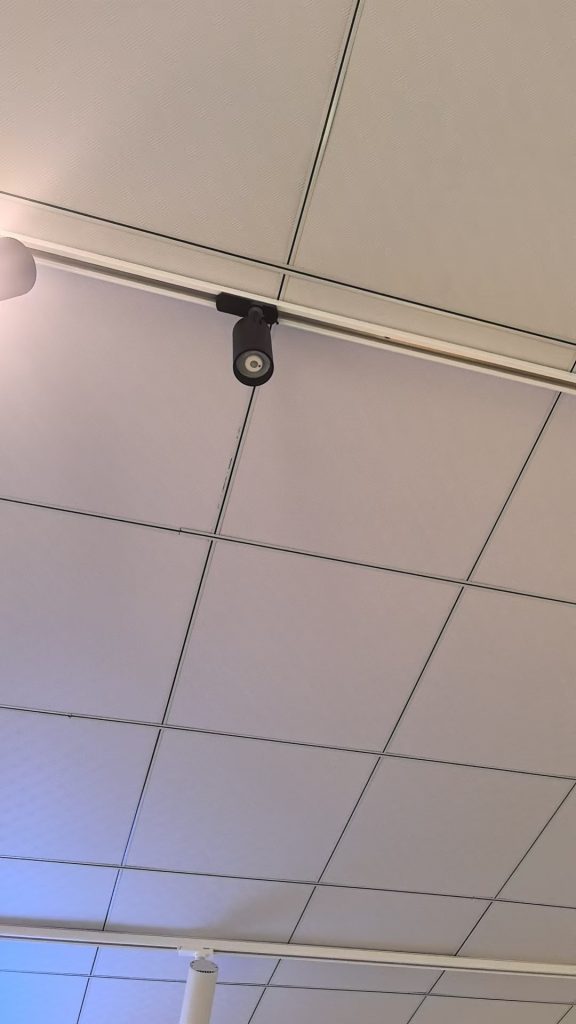
Yes. The smart sensor track heads fit standard Euro-track rail. Upgrading an existing installation means replacing heads — no rewiring, no structural work, no ceiling modifications.
System Specifications
| Sensing | Microwave radar + photosensor |
| Phase 1 | 100% / anytime post last motion |
| Phase 2 | 50–70% adjustable / (anytime) |
| Phase 3 | 30% background / freely configurable |
| Recovery | Instant return to 100% on detection |
| Track | Global/Euro Track compatible |
| Power | 10W/15W/18W/20W/25W |
| CCT | 2700K–6500K, 5-step selectable |
| CRI | 90+ / 97+ premium |
| Control | DALI-2, Zigbee, Bluetooth Mesh |
| Lifespan | 50,000 hours |
| Certifications | CE, RoHS |
The Short Version
European retail lighting is expensive. Stores run at full brightness through hours and zones that don’t need it. BREE’s three-phase sensor system fixes that automatically — no manual controls, no behavioral change from staff, no impact on the shopping environment.
One store. One year. €11,000 back.
Ten years. €110,000 and half a million kilowatt-hours not purchased.
Fifty stores. Ten years. €5.5 million.