Good lighting for fashion stores makes clothing colours easier to judge, brings out fabric details, and helps customers navigate the store. A well-planned system combines general lighting, adjustable LED track lights, accurate colour rendering, and comfortable fitting-room illumination.
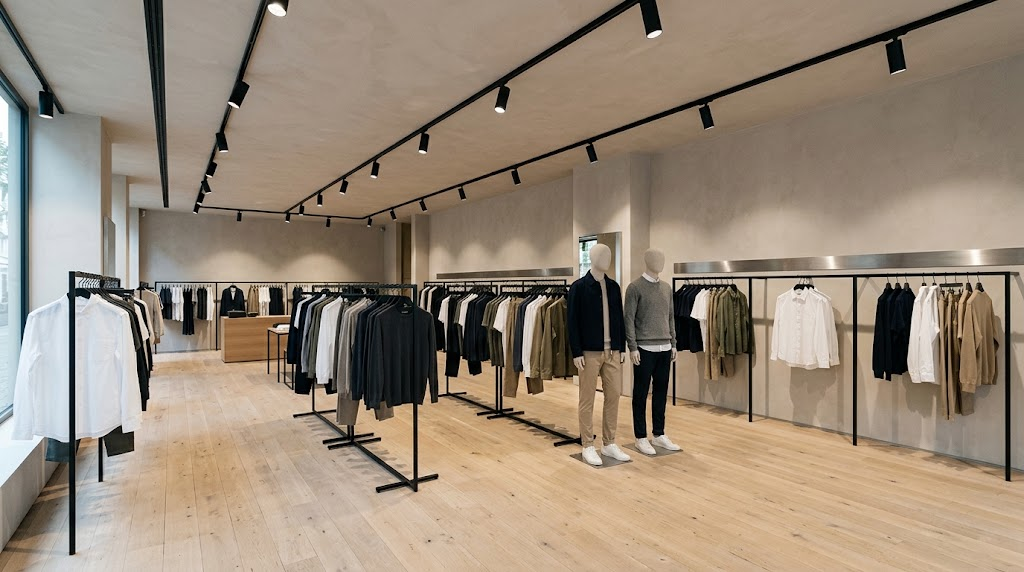
1. What Makes Good Lighting for a Fashion Store?
Fashion retail lighting needs to do more than brighten the sales floor. It must show the merchandise clearly while creating an atmosphere that fits the brand.
A luxury boutique, a denim store, and a sportswear shop have different lighting requirements. Some need warm, intimate lighting; others need a clean, neutral appearance that makes colours and fabric details easier to see.
In most projects, the key considerations are:
- Colour accuracy: Clothing should look natural under artificial light, particularly when customers compare similar shades.
- Product presentation: Mannequins, new arrivals, and feature displays need enough contrast to attract attention.
- Visual comfort: Customers should not have to look into exposed, high-intensity light sources while browsing or checking a mirror.
- Flexibility: Track-mounted spotlights make it easier to adapt lighting when displays and collections change.
- Energy efficiency: Efficient LED fixtures and suitable controls help reduce operating costs without sacrificing the shopping experience.
The best design balances these requirements instead of simply increasing the brightness throughout the store.
2. Which Types of Lighting Do Clothing Stores Need?
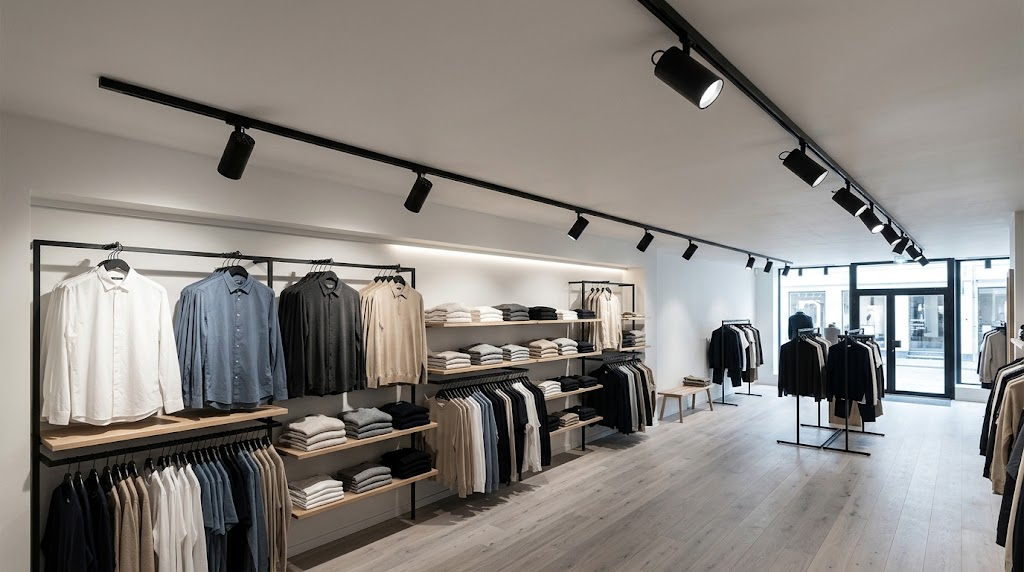
Most fashion stores use a combination of ambient lighting, accent lighting, and dedicated lighting for mirrors, fitting rooms, and display windows.
| Lighting type | What it does | Common fixture choices |
|---|---|---|
| Ambient lighting | Provides general illumination across the sales floor | LED downlights, linear lights, track-mounted luminaires |
| Accent lighting | Draws attention to selected garments and displays | Adjustable LED track spotlights |
| Wall lighting | Makes clothing rails and wall displays easier to see | Track spotlights, wall washers, linear luminaires |
| Fitting-room lighting | Helps customers assess clothing and appearance | Diffused mirror lights, vertical luminaires, carefully positioned downlights |
| Window lighting | Makes mannequins and promotional displays stand out | Adjustable spotlights with suitable beam angles |
| Decorative lighting | Adds character to the interior | Pendant lights, concealed linear LEDs, architectural lighting |
These lighting layers should be planned together. Strong accent lighting against an excessively dark background can create harsh contrast, while uniform lighting across every surface can make the merchandise look flat.
Start with comfortable general illumination, then direct additional light towards the products that deserve attention.
3. What Colour Temperature Works Best for Fashion Retail Lighting?
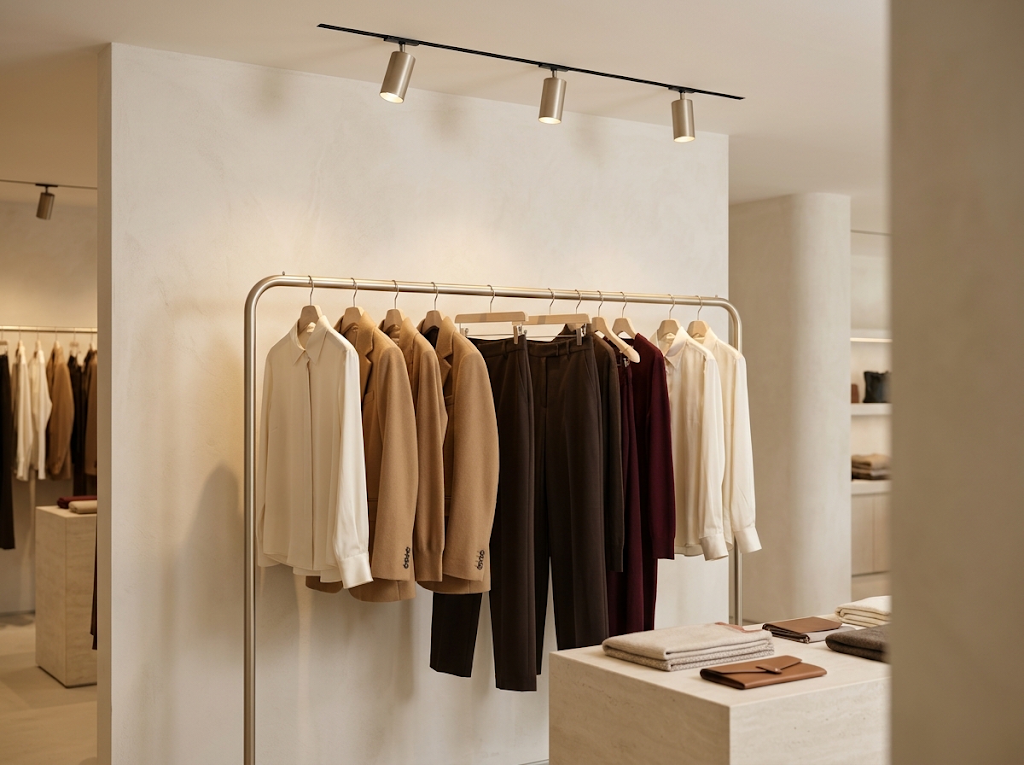
For many fashion stores, 3000K to 4000K is a useful starting range. The right choice depends on the brand’s visual identity, the clothing collection, and the materials used inside the store.
| Colour temperature | Appearance | Typical application |
|---|---|---|
| 2700K–3000K | Warm and intimate | Luxury boutiques, accessories, warm-toned interiors |
| 3000K–3500K | Warm-neutral and balanced | Contemporary fashion stores and lifestyle boutiques |
| 3500K–4000K | Clean and neutral | General clothing retail, minimalist interiors, denim and mixed collections |
| 4000K–5000K | Cooler and crisper | Selected sportswear or technical retail concepts |
These are starting points rather than fixed rules. A premium boutique can work well at 3000K, while a contemporary clothing store may prefer 4000K for a cleaner appearance.
The important question is how the garments look under the chosen light. Beige, grey, navy, black, and white fabrics can appear noticeably different under different LED sources, even when their nominal colour temperatures are the same.
For new stores or major refurbishments, test the proposed fixtures with actual garments and interior finishes before finalising the specification. For retail chains, keep the approved colour temperature consistent across locations unless the store concept intentionally varies.
4. Why Does CRI Matter in Fashion Store Lighting?
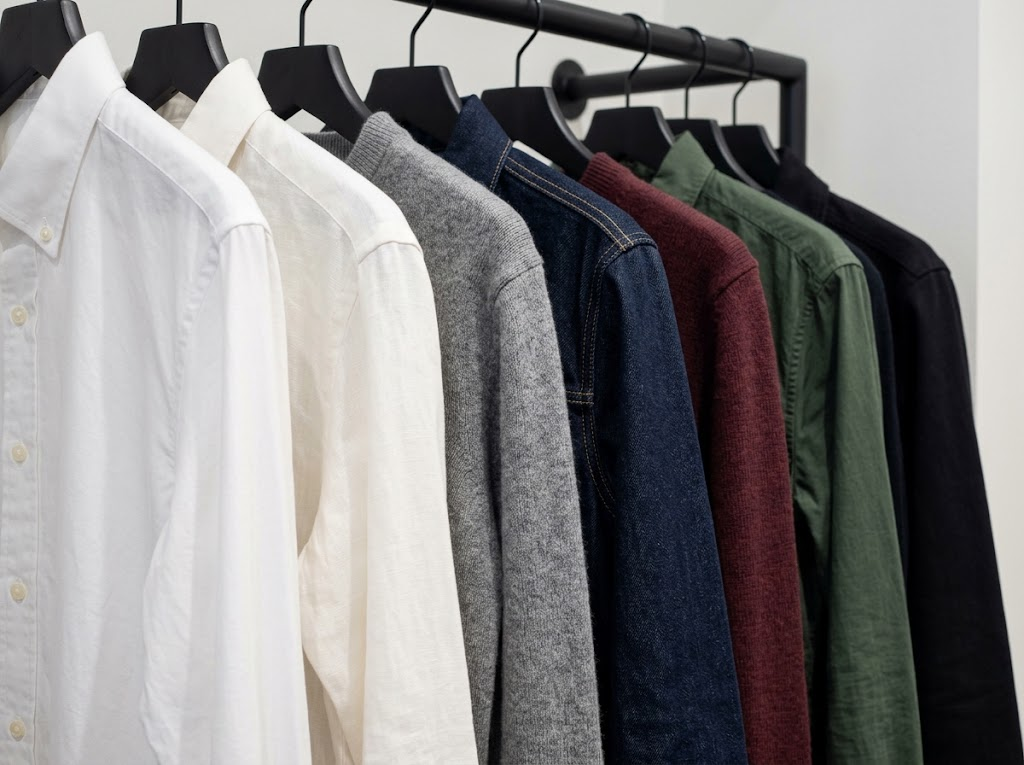
For most fashion retail applications, CRI Ra 90 or higher is a sensible starting point when colour appearance matters. It helps reveal garment colours and material details more faithfully than many lower-CRI alternatives.
However, CRI alone does not guarantee that every colour will look natural.
When comparing LED track lights and downlights, check the following:
- CRI Ra: The basic colour-rendering specification.
- R9: Useful additional information for saturated red colours and certain skin-tone details.
- IES TM-30: Colour fidelity (Rf) and colour gamut (Rg) provide a more detailed view of colour-rendering behaviour.
- SDCM: Helps assess colour consistency between fixtures, which is particularly important in large stores and multi-location projects.
- Spectral performance: The light spectrum affects how individual fabrics and dyes appear.
For example, two black garments with different undertones may look almost identical under one light source but noticeably different under another. A high CRI rating is helpful, but the final result still depends on the light spectrum and the viewing environment.
For fashion retailers, it is worth checking actual fabric samples under the proposed lighting rather than choosing fixtures based on CRI alone.
5. How Many Lux Does a Fashion Store Need?
The required illuminance depends on the store layout, merchandise, ceiling height, surrounding daylight, and lighting concept.
The following values are preliminary design ranges for discussion. They are not universal legal requirements, and the final design should be checked against the applicable standards and project conditions.
| Area | Preliminary illuminance range | Main objective |
|---|---|---|
| General sales floor | 200–500 lux | Comfortable browsing and navigation |
| Selected clothing displays | 500–1,000 lux | Bring attention to featured merchandise |
| Shop windows | 500–1,500 lux or higher where needed | Maintain display visibility against outdoor light |
| Fitting rooms | 300–750 lux as an initial reference | Support comfortable viewing and mirror use |
| Checkout counters | 300–500 lux as an initial reference | Provide clear visibility for transactions |
| Stockrooms | According to the task and applicable standards | Support safe handling and stock inspection |
Lux measures the illuminance reaching a surface. It does not, by itself, tell you whether a store looks attractive or whether clothing is properly illuminated.
For example, the floor may receive sufficient light while garments hanging against a wall remain too dark. A fitting room may also have adequate floor illuminance but still produce unflattering facial shadows.
A proper lighting plan should consider vertical illuminance, uniformity, contrast, glare, beam direction, and the actual viewing positions of customers.
6. How to Choose LED Track Lights for Clothing Displays
LED track lights are widely used in fashion stores because displays change frequently. Fixtures can be repositioned and redirected when new collections arrive, mannequins move, or promotional areas are updated.
The right track light depends on more than its wattage.
Choose the right beam angle
The beam angle determines how concentrated or wide the light distribution is.
| Beam angle | Typical use | What to check |
|---|---|---|
| 15°–24° | Focused highlights on mannequins or selected products | Avoid overly bright hotspots |
| 24°–36° | Clothing rails, wall displays, and feature tables | Check overlap and display coverage |
| 36°–60° or wider | Broader merchandise areas | Check spill light and unwanted glare |
These ranges are practical starting points, not rigid categories. Mounting height, aiming angle, distance to the merchandise, and the size of the target surface all affect the result.
A narrow beam can make a mannequin stand out, but it may leave adjacent garments unevenly illuminated. A wider beam can cover more merchandise, but may reduce contrast if too much light spills onto surrounding surfaces.
Check light output and optical performance
Compare delivered lumens, beam distribution, and system efficacy rather than wattage alone. Two track lights with the same power consumption can produce very different results on a clothing display.
Pay attention to glare
Deep-set light sources, suitable reflectors, and careful aiming can improve visual comfort. Avoid directing high-intensity beams towards customers’ eyes or into mirrors.
Check track compatibility
Confirm the track type, circuit arrangement, electrical ratings, mechanical connections, and dimming requirements before ordering. Single-circuit and three-circuit systems offer different levels of switching flexibility.
Consider maintenance and future changes
For stores that regularly update their layouts, check whether fixtures can be repositioned easily and whether replacement drivers or luminaires will be available when needed.
7. How Should Different Areas of a Fashion Store Be Lit?
Shop windows: Make the merchandise stand out
The window display has to compete with the brightness of the street, particularly during the day.
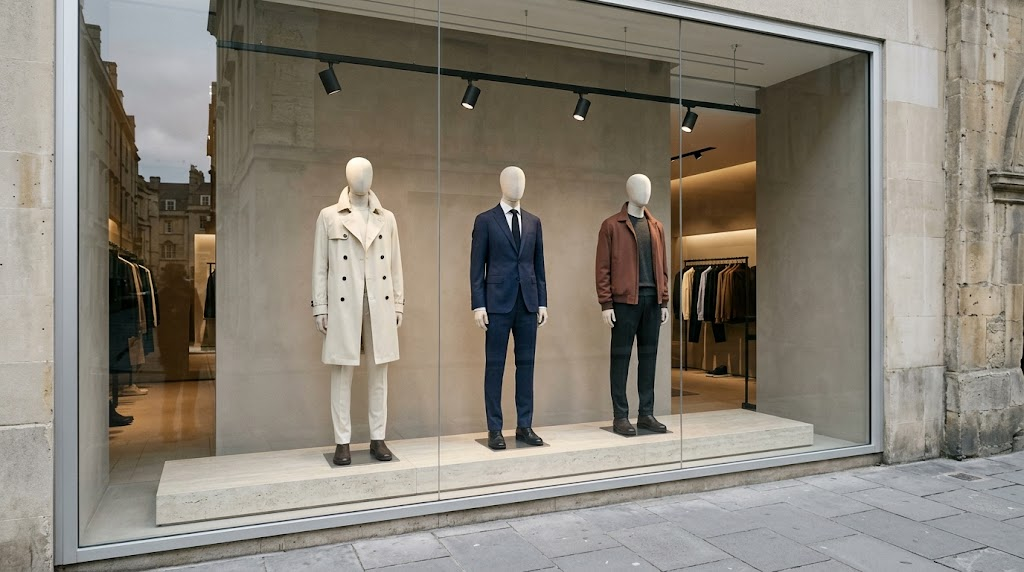
Adjustable spotlights help reveal the shape of garments, the details of mannequins, and the colours of seasonal collections. The lighting should provide enough contrast to attract attention without leaving large parts of the display in shadow.
Use the beam angle and aiming position to suit the size of the window and the distance between the fixtures and the merchandise. For frequently changing campaigns, adjustable track lighting offers useful flexibility.
Entrance: Create a clear transition into the store
The entrance should make the store feel inviting and help customers understand where to go.
Balanced general lighting, combined with selected accents, can highlight new collections without creating an abrupt transition from the street. Avoid an entrance that is so dark that customers struggle to see the merchandise beyond it.
Clothing rails and wall displays: Put light on the garments
A common mistake is to focus on the floor while overlooking the vertical surfaces where most clothing is displayed.
Aim track spotlights towards the front of the garments and check how the light falls across the entire rail. The distance between the track, wall, and display affects whether the clothing receives even coverage or develops distracting bright and dark patches.
For long wall displays, overlapping beams or dedicated wall-washing optics may provide a more consistent result.
Mannequins and feature tables: Give key products priority
Mannequins, new arrivals, and promotional tables often need more visual emphasis than surrounding merchandise.
Directional lighting can reveal the shape of a garment, its folds, and the texture of the material. The aim is to create useful contrast while retaining enough surrounding light for the display to feel connected to the rest of the store.
Keep the spotlights adjustable so the display can change without major electrical work.
Fitting rooms: Make colours and appearance easier to judge
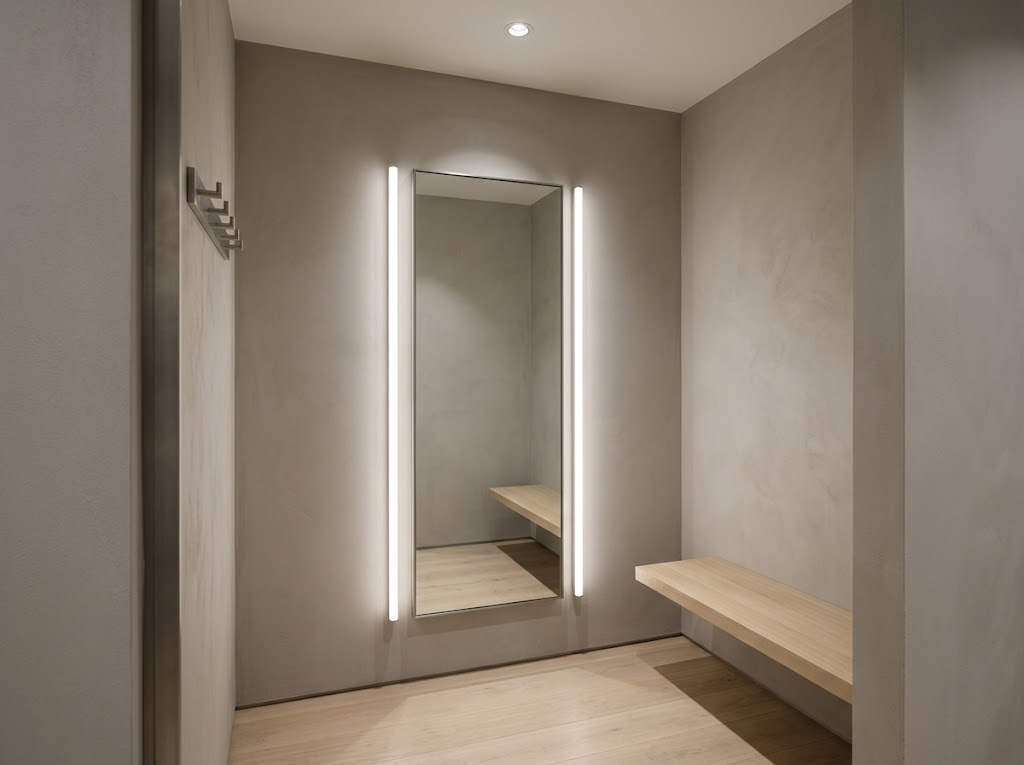
Fitting-room lighting directly affects how customers see clothing on themselves. Harsh overhead lighting can create shadows under the eyes and chin, while poor colour rendering can make garments look different from how they appeared on the sales floor.
A better approach combines diffuse light with carefully positioned front or side lighting.
Pay particular attention to:
- Even illumination around the mirror.
- Reduced shadows on the face and body.
- Good colour rendering.
- Comfortable brightness without exposed, glaring light sources.
- A reasonably consistent colour appearance between the fitting room and the sales floor.
The goal is not to make the fitting room as bright as possible. It is to help customers assess the fit, colour, and appearance of the clothing comfortably.
Checkout and service areas: Keep the lighting practical
Checkout lighting should support payment, packaging, and product inspection without creating distracting reflections on screens or glossy counters.
The area should remain visually consistent with the rest of the store, while providing enough task lighting for staff.
8. How Can Fashion Retailers Reduce Lighting Energy Costs?
Efficient LED fixtures are only part of the solution. The lighting layout, operating hours, control strategy, and maintenance plan also affect energy consumption.
Retailers can reduce lighting costs without compromising product presentation by taking the following steps.
Choose fixtures for the job. Compare useful light output, optical performance, and system efficacy. A fixture that directs light accurately onto merchandise may be more effective than a higher-wattage model with excessive spill.
Use dimming where appropriate. Adjust output to suit the time of day, the display requirements, and the contribution of daylight.
Create practical lighting scenes. Different settings can be used for normal trading hours, window displays, cleaning, and periods when the store is closed.
Make use of daylight. Near shop windows, daylight-responsive controls can reduce artificial lighting when sufficient natural light is available.
Plan maintenance. Keep fixtures clean, check driver performance, and make replacement arrangements before failures disrupt the store.
Measure actual consumption. Compare the connected lighting load and operating hours before and after changes instead of relying on estimated savings alone.
How to estimate annual lighting energy consumption
Use this formula:
Annual lighting energy (kWh) = Lighting load (kW) × Annual operating hours
For example, a store that reduces its connected lighting load from 8 kW to 5 kW and operates for 3,600 hours per year would have the following estimated consumption:
| Item | Annual energy |
|---|---|
| Original lighting load: 8 kW | 28,800 kWh |
| New lighting load: 5 kW | 18,000 kWh |
| Estimated reduction | 10,800 kWh |
| Percentage reduction | 37.5% |
This example assumes the stated loads and operating hours. Actual savings depend on the installed system, dimming schedules, operating conditions, and whether the new design maintains the required lighting performance.
For retailers with multiple locations, standardised fixtures and control settings can make energy monitoring and maintenance easier to manage.
9. What Lighting Works Best for Different Fashion Brands?
Different merchandise and store concepts call for different lighting approaches.
| Store type | Recommended approach | Main priority |
|---|---|---|
| Luxury boutiques | Controlled accent lighting with warm or warm-neutral ambient light | Fabric texture, detail, and atmosphere |
| Contemporary fashion chains | Balanced general lighting with adjustable track spotlights | Consistency and flexibility |
| Denim stores | High-quality colour rendering with carefully aimed accents | Denim washes, stitching, and subtle colour differences |
| Sportswear stores | Clear general illumination and focused product highlights | Product details and an energetic presentation |
| Minimalist fashion stores | Clean ambient lighting with discreet fixtures and controlled wall lighting | Visual simplicity and colour accuracy |
| Children’s clothing stores | Comfortable illumination with good colour rendering and soft shadows | Clear product colours and a welcoming environment |
These are starting points, not fixed specifications. Ceiling height, interior finishes, window orientation, merchandise density, and brand guidelines should all influence the final design.
10. What Should You Check Before Purchasing Fashion Store Lighting?
Before selecting track lights, downlights, or linear LED luminaires, review the following points with the lighting supplier.
- Light output: Does the fixture deliver enough light to the intended surface?
- Colour rendering: Are CRI, R9, and other available colour-quality data appropriate for the merchandise?
- Colour temperature: Have actual garments been tested under the proposed lighting?
- Beam angle: Does the distribution suit the ceiling height and display dimensions?
- Glare control: Are the fixtures comfortable from normal customer viewing positions?
- Flicker performance: Is the driver suitable for the application and any relevant camera use?
- Dimming compatibility: Does the driver work with the intended control system?
- Track system: Are the electrical and mechanical specifications compatible?
- Energy efficiency: Is system efficacy supported by reliable technical data?
- Maintenance: Can fixtures and drivers be replaced without unnecessary disruption?
- Consistency: Can the same lighting effect be reproduced across different stores and future orders?
For a new store or a large refurbishment, request a sample fixture or arrange a lighting mock-up before approving the full order. This is especially useful when the brand has strict requirements for garment colours, display contrast, and ceiling appearance.
11. Fashion Store Lighting Solutions from BREE LIGHTING
BREE LIGHTING provides commercial LED lighting solutions for retail environments, including track lights and downlights for clothing stores, fashion boutiques, and product displays.
Every fashion retail project has its own requirements. The right fixture selection depends on the ceiling height, display layout, merchandise, desired colour appearance, lighting controls, and budget.
For a new store or refurbishment, BREE LIGHTING can discuss the following project requirements:
- LED track lights for mannequins, clothing rails, and feature displays.
- Downlights for general illumination.
- Beam-angle selection based on mounting height and target area.
- Colour temperature and colour-rendering requirements.
- Dimming and control-system compatibility.
- Fixture consistency for multi-store projects.
Rather than selecting fixtures by wattage alone, retailers should compare light output, optical performance, colour quality, and installation requirements.
A sample installation or lighting mock-up can help confirm the effect on real garments before the specification is finalised.
12. Frequently Asked Questions About Lighting for Fashion Stores
A combination of general lighting, adjustable LED track spotlights, and carefully designed fitting-room lighting works well for many fashion stores. The final specification should reflect the brand, merchandise, ceiling height, and desired atmosphere.
3000K creates a warmer appearance, while 4000K generally looks cleaner and more neutral. Neither is automatically better. Test the proposed lighting with actual garments and interior finishes before making a decision.
CRI Ra 90 or higher is a useful starting point when accurate clothing colours matter. R9, TM-30 data, spectral performance, and colour consistency can provide additional information.
Yes. LED track lights are particularly useful for highlighting mannequins, clothing rails, wall displays, and new collections. Their adjustable position and aiming direction make them practical for stores where layouts change regularly.
Narrow beams can highlight individual products, medium beams suit many standard displays, and wider beams can illuminate larger areas. The correct choice depends on mounting height, target size, aiming angle, and fixture spacing.
Use diffuse light and carefully positioned front or side lighting to reduce harsh shadows. Good colour rendering and comfortable mirror illumination help customers judge clothing more realistically.
Standardise colour temperature, colour-rendering requirements, beam angles, fixture specifications, and control settings. Test the approved solution in a representative store and document the installation and commissioning requirements.
Choose efficient luminaires, avoid unnecessary overlighting, use suitable dimming and lighting scenes, take advantage of daylight where practical, and monitor actual energy consumption.
Provide the floor plan, ceiling height, display layout, interior finishes, preferred colour temperature, target illuminance, control requirements, and approximate project quantity. These details help the supplier recommend fixtures that suit the actual store rather than relying on general assumptions.
Final Thoughts
Good fashion store lighting helps customers see the merchandise as intended. It combines accurate colour rendering, comfortable general illumination, controlled accent lighting, and well-planned fitting-room lighting.
For retailers, the most effective approach is to start with the products and the customer journey, select fixtures according to their actual optical performance, and test the proposed design before a full installation.
With the right lighting plan, a fashion store can present its collection more clearly, adapt to changing displays, and manage energy and maintenance costs more effectively.