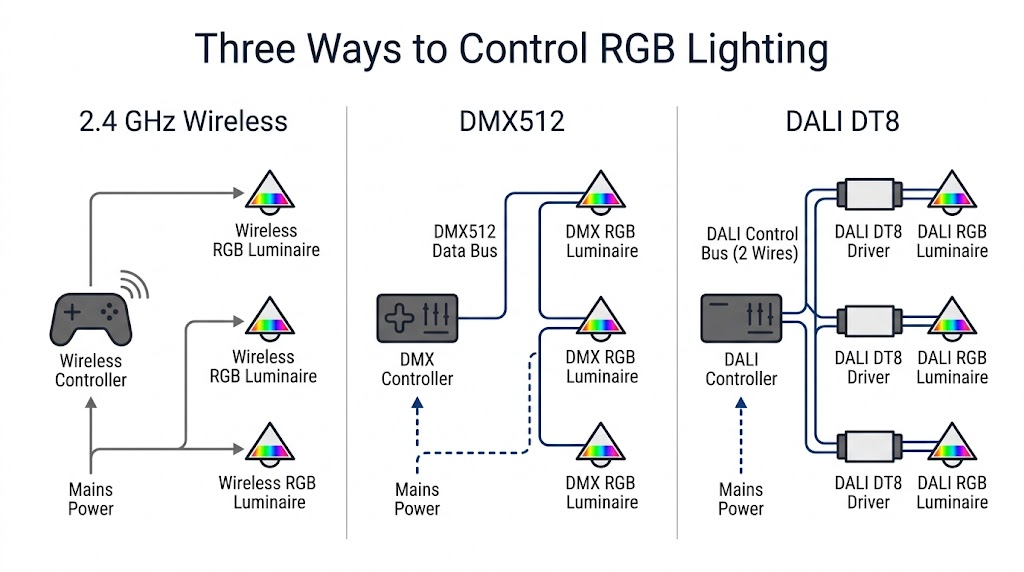
2.4 GHz wireless is often the simplest option for retrofits, DMX512 is better suited to fast, synchronized RGB effects, and DALI DT8 works well for addressable commercial lighting. The right choice depends on wiring, response requirements, driver compatibility and total installation cost.
For a lighting project, the control protocol should be selected before the luminaires and drivers are finalized. Changing the control system later can mean replacing drivers, adding receivers or running new cables through an already finished ceiling.
1. 2.4 GHz vs DMX512 vs DALI DT8: What Is the Difference?
The three systems transmit lighting commands in different ways, which affects installation, programming and maintenance.
| Feature | 2.4 GHz wireless | DMX512 | DALI DT8 RGB |
|---|---|---|---|
| Signal transmission | Radio frequency | Wired digital data bus | Wired digital control bus |
| Separate control cable | Usually not required | Required | Required |
| Installation in existing ceilings | Generally straightforward | May require additional cabling | May require additional cabling |
| Response to control commands | Depends on the wireless system | Suited to frequent, rapid updates | Suited to lighting commands and scene control |
| RGB colour effects | Depends on controller and receiver | Strong support for dynamic effects | Supports standardized colour control on compatible drivers |
| Individual luminaire addressing | System-dependent | Yes | Yes, through DALI short addresses |
| Group control | System-dependent | Configured through the control system | Supported through DALI groups |
| Feedback and diagnostics | Product-dependent | Depends on the equipment | Supported functions depend on the control gear and system |
| Initial equipment cost | Low to medium in simple systems | Medium; can rise with complex programming | Medium; requires compatible DT8 control gear |
| Installation and commissioning | Often simpler for small retrofits | Requires data wiring and addressing | Requires bus wiring, addressing and configuration |
| Typical application | Existing stores and flexible installations | Dynamic architectural and decorative lighting | Integrated commercial lighting control |
These cost descriptions are relative, not fixed price rankings. A wireless receiver for every luminaire can increase hardware costs, while the labour required to install wired controls can make DMX512 or DALI more expensive in a finished building.
One distinction matters from the start: 2.4 GHz is a radio-frequency band, not a single universal lighting protocol. Two wireless lighting products operating at the same frequency are not necessarily compatible.

2. Which System Is Easiest to Wire?
For a shop that is already open or undergoing refurbishment, 2.4 GHz wireless can reduce the need for additional control cabling. DMX512 and DALI DT8 are more suitable when the project can accommodate a planned wired control infrastructure.
2.4 GHz wireless: Fewer control cables
Wireless systems send commands from a compatible controller to receivers or luminaires. If the receiver is integrated into the fixture, installation may involve little more than connecting the required power supply and commissioning the wireless network.
This is useful when:
- A boutique needs new lighting scenes without major ceiling work.
- Track lights may be repositioned as merchandise displays change.
- The building has limited access for new control cables.
- The project uses a relatively small number of lighting zones.
Wireless does not remove the need for electrical power. It also introduces other considerations, including radio interference, signal coverage, network capacity and the replacement of failed receivers.
For larger stores, test the actual system with the ceiling, metalwork and other radio equipment in place. A signal that works well in an empty showroom may behave differently in a completed retail environment.
DMX512: More wiring, greater control over effects
DMX512 uses a wired digital data connection, commonly based on an RS-485 electrical interface. Conventional installations use a daisy-chain arrangement with appropriate termination and distribution equipment.
The additional cable installation is worthwhile when the lighting design calls for frequent colour changes, synchronized effects or independent control of multiple RGB fixtures.
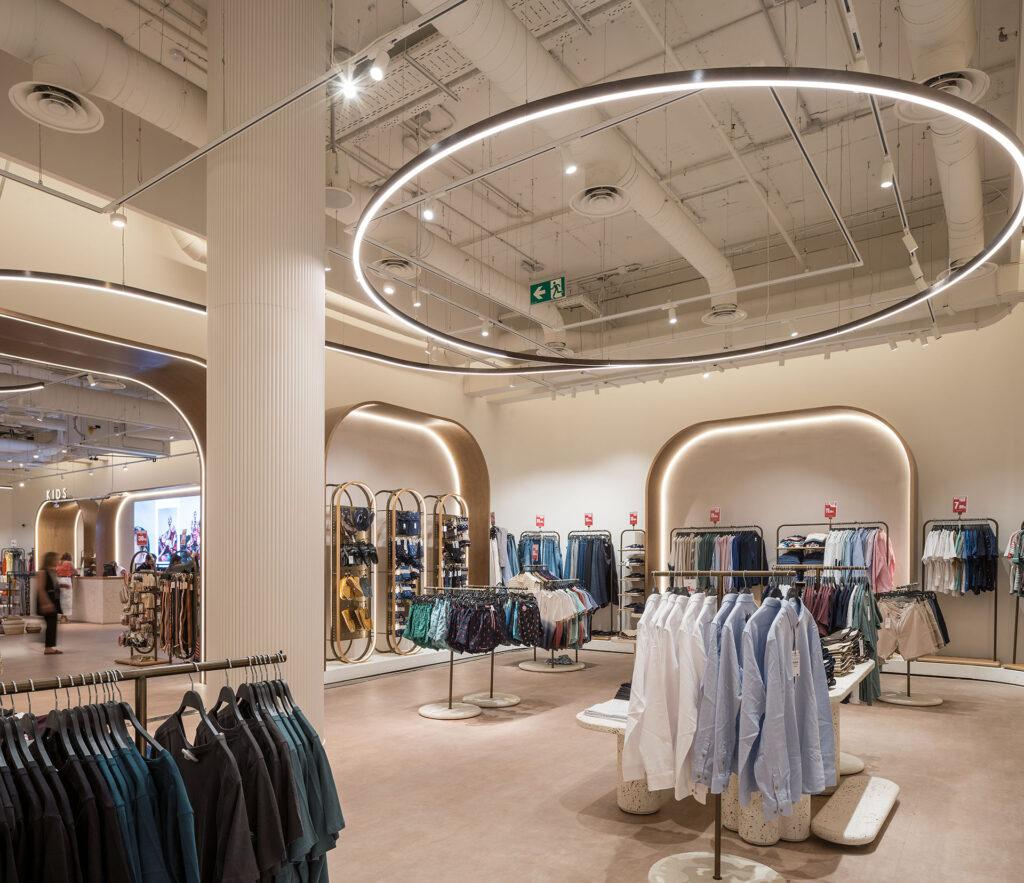
For example, a flagship fashion store might use DMX512 to coordinate suspended circle luminaires with coloured display lighting. Each fixture can be assigned the required control channels, allowing the controller to run programmed sequences.
The main trade-off is commissioning effort. Addressing, channel allocation, cable routing and controller programming need to be documented, particularly when a project contains many luminaires.
DALI DT8: A structured control bus for commercial buildings
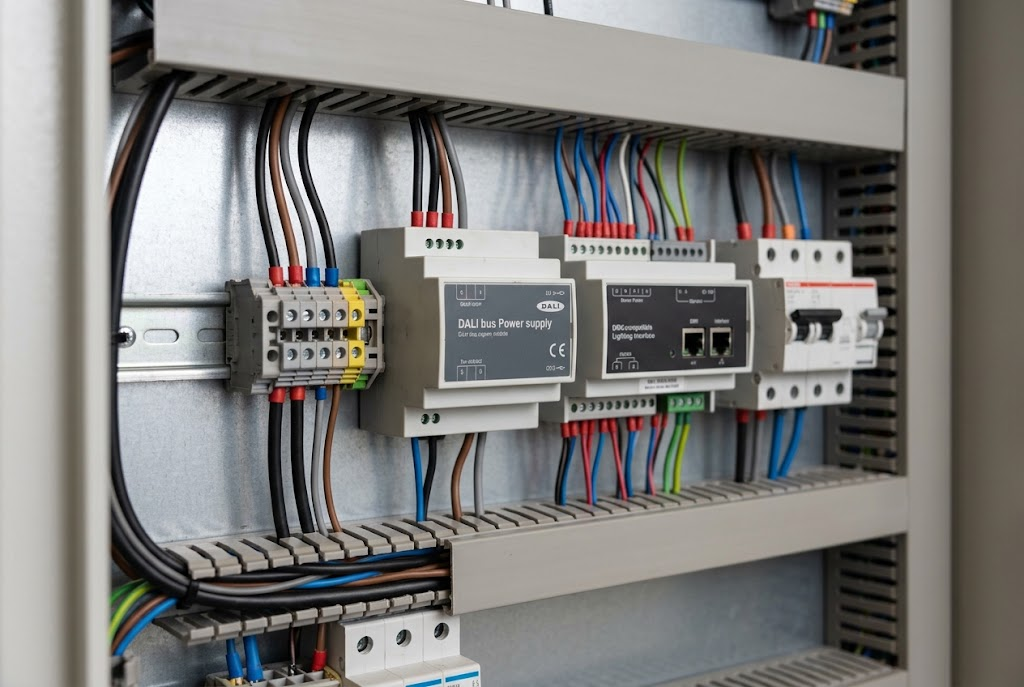
DALI uses a separate two-wire control bus alongside the luminaire’s power supply. Compatible control gear can be addressed individually or organized into groups.
DT8 colour control allows supported colour parameters to be managed through one DALI short address per control gear, rather than allocating a separate DALI address to each colour channel.
This is useful for commercial projects that combine dimming, colour selection, scheduled scenes and centralized lighting management. However, a DT8 driver must support the specific colour type required by the project.
Practical choice: For a simple retrofit, wireless may save installation time. For a new commercial building, the decision between DMX512 and DALI DT8 should be based on the required lighting effects and the wider control system.
3. Which Protocol Responds Faster?
DMX512 is generally the better choice for rapidly changing RGB effects. Wireless response varies by system, while DALI DT8 is primarily intended for addressable lighting control rather than high-refresh-rate visual effects.
Actual latency is the time between a control command being issued and the light responding. It includes controller processing, signal transmission, receiver or driver processing and the luminaire’s own response.
| Protocol | Response characteristics | What to check |
|---|---|---|
| 2.4 GHz wireless | Can respond quickly to ordinary scene commands | Interference, network traffic, retransmissions and receiver processing |
| DMX512 | Supports frequent, predictable updates | Frame rate, fixture refresh behaviour and controller configuration |
| DALI DT8 | Well suited to colour selection, dimming and scene changes | Command processing, device response and transition settings |
A full DMX512 data frame containing 512 slots takes approximately 23 ms under standard timing. This is a transmission figure, not a guarantee that every connected luminaire will visibly respond within 23 ms.
Likewise, there is no single latency figure that applies to all 2.4 GHz systems or DALI DT8 installations. Hardware, software and the type of command all affect the result.
Does the difference matter in a retail store?
For a clothing shop using a fixed accent colour or slowly changing scenes, the difference may have little practical effect on the customer experience.
For a flagship store where multiple luminaires change colour together during a launch event, synchronized updates and predictable timing become more important. DMX512 is usually the stronger starting point for this type of installation.
For a store that mainly needs scheduled scenes, adjustable brightness and controlled colour changes, DALI DT8 may provide the required functionality without the complexity of an effects-oriented system.
Before specifying a large installation, ask the supplier to demonstrate the actual fixtures and controllers working together. If synchronization is critical, test several luminaires simultaneously rather than judging performance from a single sample.
4. Which RGB Control System Costs Less?
The cheapest system is not necessarily the one with the lowest driver price. Total project cost includes control hardware, installation, commissioning and future maintenance.
For a small retrofit, 2.4 GHz wireless may reduce labour because fewer control cables need to be installed. In a new building, wired infrastructure may be easier to include during construction. DMX512 and DALI DT8 can also avoid unnecessary complexity when they match the control requirements from the outset.
| Project situation | Option worth evaluating first | Main cost consideration |
|---|---|---|
| Small boutique retrofit | 2.4 GHz wireless | Receiver price versus saved cabling and labour |
| Existing store with difficult ceiling access | 2.4 GHz wireless | Power access, signal coverage and commissioning |
| Flagship store with dynamic RGB effects | DMX512 | Data cabling, programming and synchronization |
| Commercial building with multiple lighting zones | DALI DT8 | Compatible drivers, bus infrastructure and system integration |
| Suspended RGB circle luminaires | DMX512 or wireless | Required effects, wiring access and number of independently controlled sections |
| Retail chain with a standardized lighting specification | Depends on the approved architecture | Repeatable commissioning, maintenance and replacement parts |
What should be included in the quotation?
Ask the supplier to separate the following costs:
- Luminaires and drivers: RGB capability, driver type, dimming performance and control interface.
- Control equipment: Receivers, decoders, controllers, DALI bus power supplies, gateways and other required accessories.
- Installation: Power cables, control cables, containment, access equipment and ceiling reinstatement.
- Commissioning: Addressing, grouping, scene programming, testing and handover documentation.
- Maintenance: Replacement components, troubleshooting, staff training and future changes.
Consider a store with 40 RGB luminaires. Wireless may save control-cable installation, but the savings could disappear if 40 separate receivers are expensive. Conversely, a wired system may have a higher initial installation cost but be easier to maintain if the building already has suitable infrastructure.
There is no reliable universal percentage by which one protocol is cheaper than another. A meaningful comparison requires the same number of luminaires, control zones, scenes and installation assumptions.
5. Which Protocol Works Best for RGB Track Lights?
<AsyncImage query=”realistic architectural photograph of premium contemporary fashion boutique with black ceiling track rails and cylindrical track spotlights illuminating clothing rails, subtle blue RGB accent lighting on rear wall, neutral white main illumination, no people, no signage” aspectRatio=”16:9″ width=”100%”/>
RGB track lights need a control arrangement that suits both the track system and the individual fixture.
2.4 GHz wireless is worth considering when the store needs flexible scene adjustment and minimal additional control wiring. DMX512 is more suitable when individual spotlights need to follow programmed colour sequences. DALI DT8 can work well when compatible track luminaires need to be incorporated into the building’s addressable lighting system.
Before choosing a track-light system, confirm:
- Whether the driver supports RGB, RGBW or another required colour type.
- Whether the receiver is integrated into the luminaire.
- Whether individual spotlights can be controlled separately.
- Whether the control connection remains available when the spotlight is repositioned.
- Whether the dimming range, colour consistency and scene recall meet the project requirements.
A three-phase track provides electrical distribution options; it does not automatically provide RGB control. The track, luminaire, driver and control system must be compatible.
For fashion retail, also specify the white-light mode separately from RGB effects. Merchandise illumination still needs appropriate colour rendering and consistent white light. RGB capability alone does not guarantee good colour rendering for clothing.
6. Which Protocol Works Best for RGB Downlights?
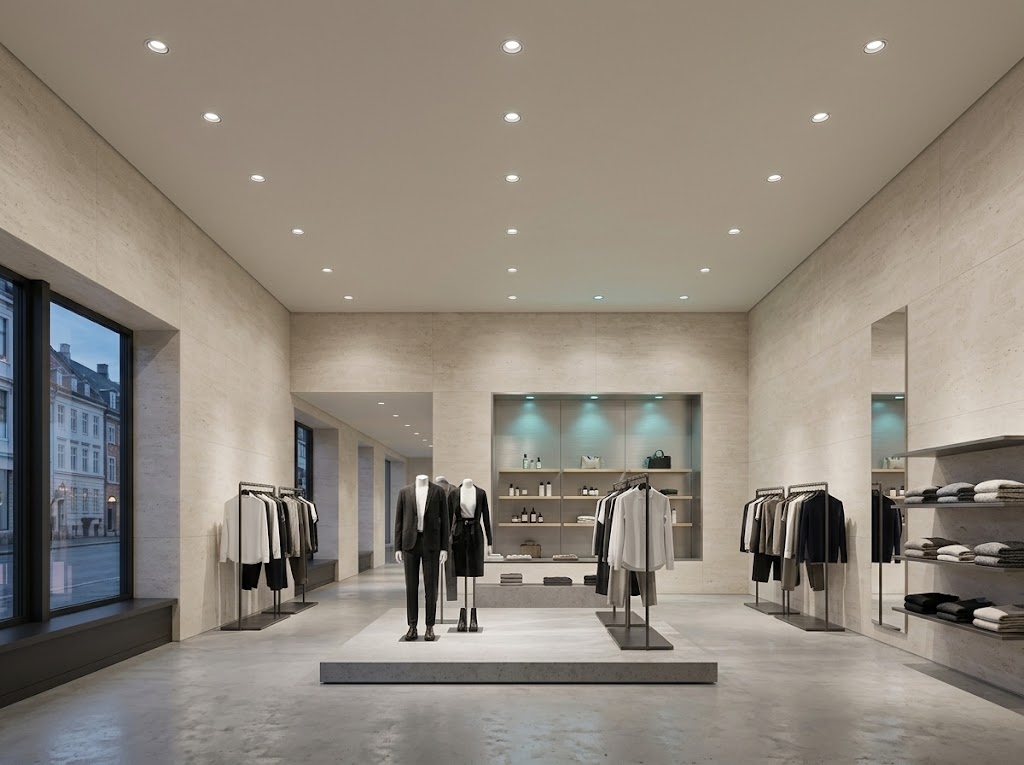
<AsyncImage query=”photorealistic contemporary clothing store interior with recessed circular ceiling downlights, clean white ceiling, neutral white merchandise lighting and restrained blue accent illumination on architectural wall, no people, realistic commercial photography” aspectRatio=”16:9″ width=”100%”/>
For RGB downlights, DALI DT8 is a strong option when the project needs centralized dimming, colour selection and repeatable lighting scenes. Wireless can be practical in existing ceilings where adding a control bus is difficult. DMX512 is useful when downlights are part of a coordinated dynamic lighting design.
The driver specification is critical. A standard white LED downlight is not automatically capable of RGB colour mixing. A tunable-white DT8 driver is also not necessarily an RGB-capable driver.
Check the following before ordering:
- Supported colour type and LED channel configuration.
- Compatibility with the proposed controller.
- Minimum dimming level and transition behaviour.
- Individual addressing and group-control requirements.
- Emergency-lighting and power-restoration behaviour where applicable.
In most everyday retail environments, downlights provide the main illumination while RGB lighting adds visual emphasis. Separating these functions in the specification helps maintain useful, consistent light for merchandise and staff.
7. Which Protocol Works Best for RGB Circle Luminaires?
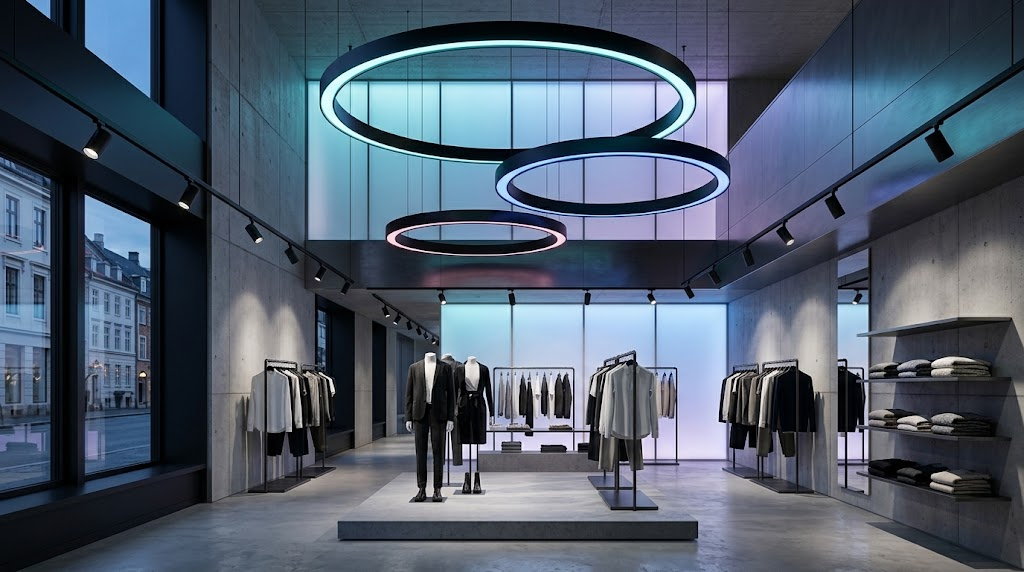
<AsyncImage query=”photorealistic modern flagship boutique with suspended circular LED ring luminaires, elegant architectural ceiling, restrained cyan and violet ring accents against neutral white retail lighting, realistic camera photograph, no people or signage” aspectRatio=”16:9″ width=”100%”/>
Circle luminaires are often prominent architectural features, so the control decision depends on whether they need simple colour selection or more elaborate effects.
Choose DMX512 when multiple rings must change colour together or follow programmed sequences. It is particularly useful when the lighting design requires frequent updates and coordinated effects.
Consider 2.4 GHz wireless when the installation is a retrofit and running control cables to suspended rings would be difficult. Confirm receiver placement, radio coverage and the availability of suitable power connections.
Choose DALI DT8 when the rings mainly require addressable colour settings, dimming and scene control within a commercial building.
One detail is easy to overlook: a circle luminaire with several LED segments does not necessarily offer independent segment control. If each segment must display a different colour, the driver and control architecture must support that requirement. A single address controlling the entire ring will not provide independent segment effects by itself.
8. Can These Three Control Systems Work Together?
Yes, but only when the interfaces and system architecture are designed for interoperability.
A commercial project might use DALI DT8 for general colour-capable lighting and DMX512 for decorative rings that require dynamic effects. A compatible wireless interface could provide local control in an area where new bus wiring is impractical.
A gateway or central controller can coordinate these systems, but it introduces additional hardware and commissioning work. The integration must define how commands, colours, scenes and faults are handled across the different systems.
Before approving a mixed installation, check:
- Whether the gateway supports the exact devices and colour modes.
- Whether scene recall behaves consistently across systems.
- Whether response times are acceptable when systems are linked.
- How the system behaves if communication fails.
- Who is responsible for programming, documentation and future maintenance.
For a straightforward store, one control architecture is often easier to manage. A mixed system makes sense when each protocol has a clearly defined role.
9. How Should You Select an RGB Control Protocol for a Commercial Project?
Use the following checklist when preparing a lighting specification or requesting quotations.
1. Define the lighting effect. Is the requirement a fixed accent colour, a few preset scenes, gradual transitions or fast synchronized effects?
2. Check the building infrastructure. Determine whether control cables can be installed and whether the project is a new build or a retrofit.
3. Decide the control level. Establish whether each luminaire, each group or each LED segment requires independent control.
4. Confirm driver compatibility. Specify the required RGB or RGBW configuration and verify that the driver supports the selected protocol.
5. Set performance requirements. If timing matters, define acceptable response and synchronization behaviour and test it using the proposed hardware.
6. Compare installed costs. Include wiring, receivers, drivers, controllers, commissioning and maintenance rather than comparing component prices alone.
7. Test before rollout. For a chain of stores, approve a sample installation and document the driver models, controller settings, addressing and scene configuration.
This last step is particularly important for multi-store projects. A repeatable specification makes it easier to replace luminaires, commission new branches and maintain consistent lighting across locations.
10. Frequently Asked Questions
It can be, but performance depends on the wireless system and the devices involved. Wireless may respond quickly to ordinary scene commands, while interference and network traffic can introduce delays. DALI DT8 is designed for standardized lighting control rather than high-refresh-rate effects.
DMX512 is generally better for fast colour sequences and synchronized effects. DALI DT8 is generally better for addressable lighting, dimming, colour selection and integration into commercial lighting-control systems.
A suitable 2.4 GHz wireless system is often easiest when additional control wiring is difficult to install. However, every luminaire still needs power, and the wireless signal must be reliable in the completed space.
Yes, when the selected DT8 driver supports the appropriate RGBWAF colour type. Support varies by product, so confirm the driver specification rather than assuming every DT8 device can control RGB.
Yes, provided the luminaires, drivers or compatible decoders support DMX512. The system also needs appropriate data wiring, addressing and controller programming.
It can be, depending on the system’s network capacity, device addressing, commissioning tools and interference management. A pilot installation should be tested before the system is standardized across multiple stores.
Wireless may be cheaper for a small retrofit, DMX512 may be justified for complex effects, and DALI DT8 may offer good lifecycle value in integrated commercial buildings. The result depends on hardware prices, labour, control requirements and maintenance.
No. Different fixture types can use different protocols if the control architecture supports them. A consistent protocol can simplify commissioning, but compatibility and the required lighting effects should determine the final choice.
Request the driver model, supported colour type, control interface, addressing method, dimming range, wiring requirements, compatible controllers and any limitations on independent control. For a large project, request a sample test before final approval.
Conclusion
For commercial RGB lighting, 2.4 GHz wireless reduces the need for additional control cables, DMX512 handles dynamic colour effects well, and DALI DT8 provides standardized colour control for compatible addressable luminaires.
For track lights, downlights and circle luminaires, the best choice depends on how the lights will be used, how the building is wired and how much independent control the project requires. Confirm the driver and controller compatibility before placing the order, and compare the full installed cost.
BREE LIGHTING recommends defining the luminaire, driver and control protocol together at the specification stage. This reduces compatibility issues and helps make installation, commissioning and long-term maintenance more predictable.