Track lighting is usually better for flexible displays and accent lighting, while downlights suit stable areas that need even illumination. For many retail stores, combining both gives the best balance of flexibility, comfort and energy efficiency.
Track Lighting vs Downlights: What Is the Real Difference?
The difference is not simply the shape of the fitting.
It is mainly about how the light is used.
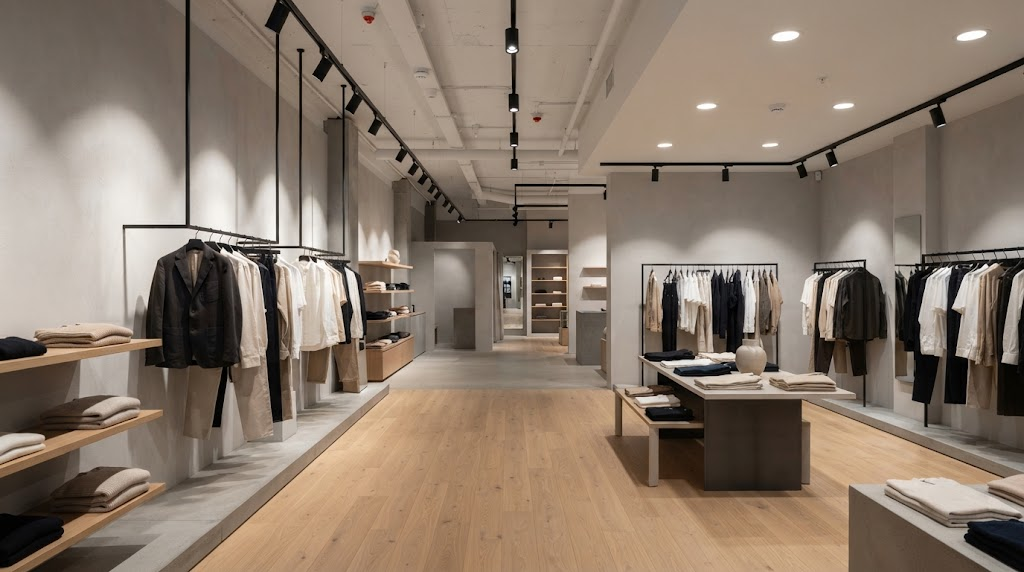
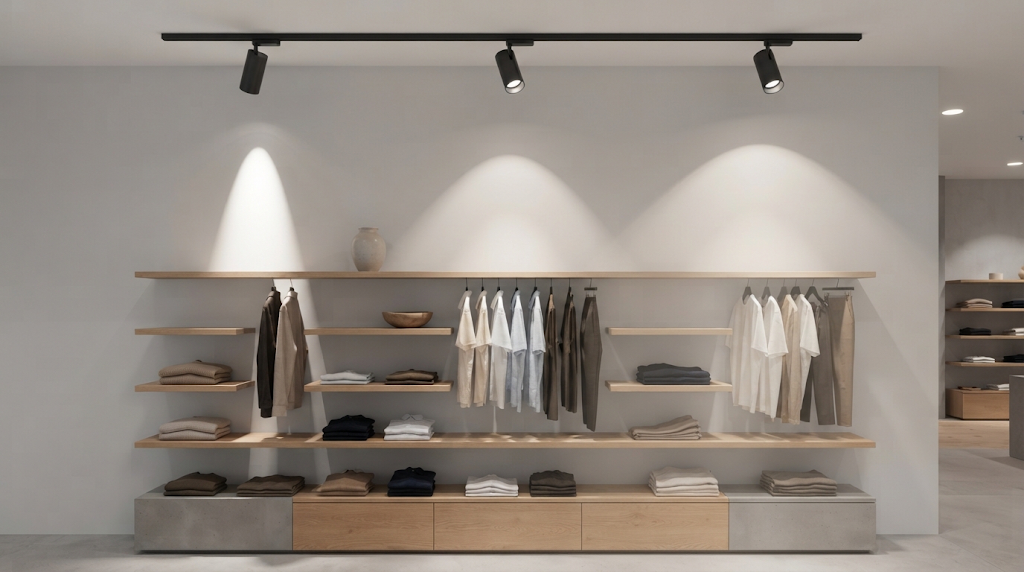
Track spotlights can be moved along the track and aimed at different products. A recessed downlight normally stays in one position and provides light around that fixed point.
That makes track lighting useful when the merchandise changes regularly.
Downlights make more sense when the ceiling layout and the purpose of the space are unlikely to change.
A fashion store, for example, may rearrange its displays several times during a season. A circulation area may stay almost exactly the same for years.
There is no reason to light both areas in exactly the same way.
Which Is Better for a Retail Store?
There is no single answer.
The better choice depends on what the lighting needs to do.
Choose track lighting when:
- Product displays change frequently
- Accent lighting is important
- Spotlights need to be redirected
- The store uses visual merchandising heavily
- Seasonal collections change the layout
- Flexibility is more important than a completely concealed ceiling
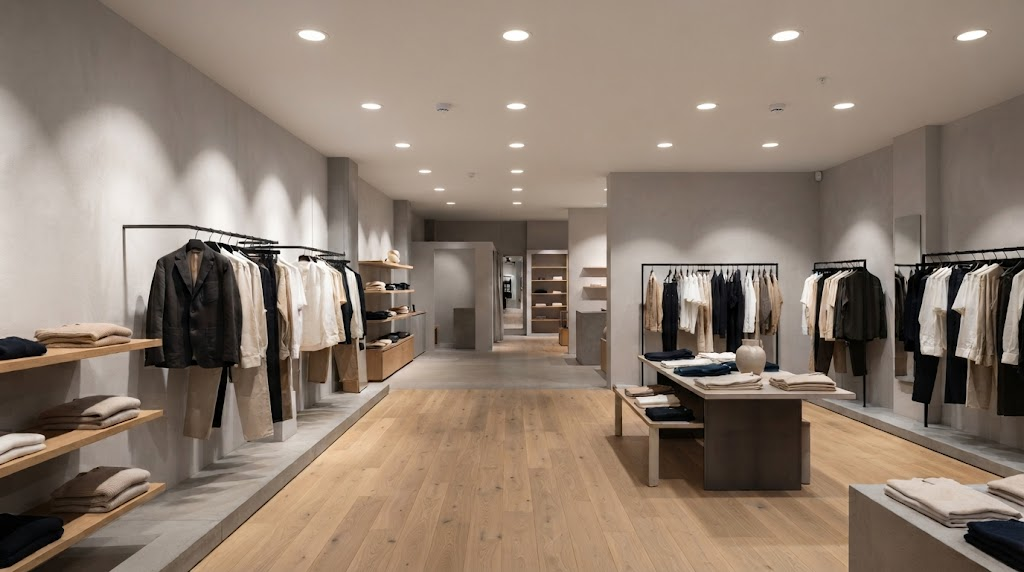
Choose downlights when:
- General illumination is the priority
- The layout is relatively fixed
- A clean ceiling is important
- Even illumination is required
- The lighting positions can be planned accurately
Use both when:
- The store needs general and accent lighting
- Some areas are fixed while others change
- Product presentation is important
- Different lighting layers are required
For many modern retail interiors, this last option is the most practical.
Track Lighting Is More Flexible
This is the biggest advantage of track lighting.
A spotlight can be moved when a display moves.
Imagine a clothing store where a new collection is placed on a different wall.
With track lighting, the fitting can be repositioned and redirected towards the new display.
With a recessed downlight, the fitting remains where it was installed.
The difference may not seem important on opening day.
It becomes much more obvious after the store has been operating for a year or two.
Retailers regularly change:
- Product ranges
- Window displays
- Promotional areas
- Shelving
- Mannequin positions
- Seasonal collections
A lighting system that can follow those changes can be easier to manage over the long term.
Downlights Give a Cleaner Ceiling
5
There is one area where downlights clearly have an aesthetic advantage.
They can almost disappear into the ceiling.
For stores with a minimalist architectural concept, this can be important.
Recessed downlights work well for:
- General sales areas
- Entrance zones
- Corridors
- Checkout areas
- Circulation spaces
- Back-of-house areas
They create a quieter ceiling compared with visible track rails.
The trade-off is that the lighting position is fixed.
If the layout changes significantly later, the ceiling and lighting positions may no longer work as well together.
Track Lighting vs Downlights for Energy Efficiency
This is one of the most common questions, but there is no simple winner.
Track lighting is not automatically more energy efficient than downlights.
And the same is true in reverse.
Energy consumption depends on the complete lighting design.
Important factors include:
- LED efficacy
- Luminaire output
- Beam distribution
- Lighting levels
- Number of fixtures
- Operating hours
- Dimming
- Sensors
- Control strategy
For example, a highly efficient downlight can still waste energy if too many fittings are installed.
Likewise, an efficient track spotlight can be a good choice when its beam is carefully directed at the merchandise instead of lighting unnecessary areas.
The useful question is therefore not:
Which fixture uses fewer watts?
It is:
Which system can deliver the required light with less unnecessary output?
That is a much better way to compare retail lighting.
Why Beam Angle Matters
6
Track spotlights are particularly useful because their optics can be matched to the display.
A narrow beam can put strong emphasis on a small product.
A wider beam can cover a shelf, clothing rack or feature wall.
Typical starting points are:
| Beam angle | Common application |
|---|---|
| 15° | Small feature displays and focal products |
| 24° | Shelves and individual merchandise areas |
| 36° | Clothing displays and medium-sized surfaces |
| 60° | Wider surfaces and broader illumination |
These are not fixed rules.
The correct beam depends on the ceiling height, distance to the merchandise and size of the area being illuminated.
A 15° beam can be excellent for a small display but too narrow for a large wall.
A 60° beam can cover a large surface but may reduce the contrast needed to make a product stand out.
Good retail lighting is about matching the optics to the job.
Can Downlights Be Used for Product Lighting?
Yes.
Modern LED downlights are available with different beam distributions and adjustable versions.
They can work well when the location of the merchandise is predictable.
The limitation is flexibility.
A fixed downlight can provide very good illumination at its intended position, but it cannot simply be moved when a display is relocated.
That is why downlights are often better suited to general lighting, while adjustable track spotlights are used for accent and merchandise lighting.
What About Glare?
Glare deserves more attention than it sometimes gets in retail projects.
Customers may spend a long time inside a store, and employees can spend an entire working day under the lighting.
Both track lights and downlights can create glare if the optical design is poor.
For track spotlights, look at:
- Shielding
- LED position
- Reflector or lens design
- Beam control
- Aiming angle
- Viewing direction
For downlights, pay attention to:
- Cut-off angle
- Recess depth
- Lens or reflector design
- Beam distribution
- Ceiling position
High lumen output is not automatically better.
A comfortable store with controlled contrast usually feels better than a space where every surface is simply made brighter.
Track Lighting vs Downlights for Fashion Retail
6
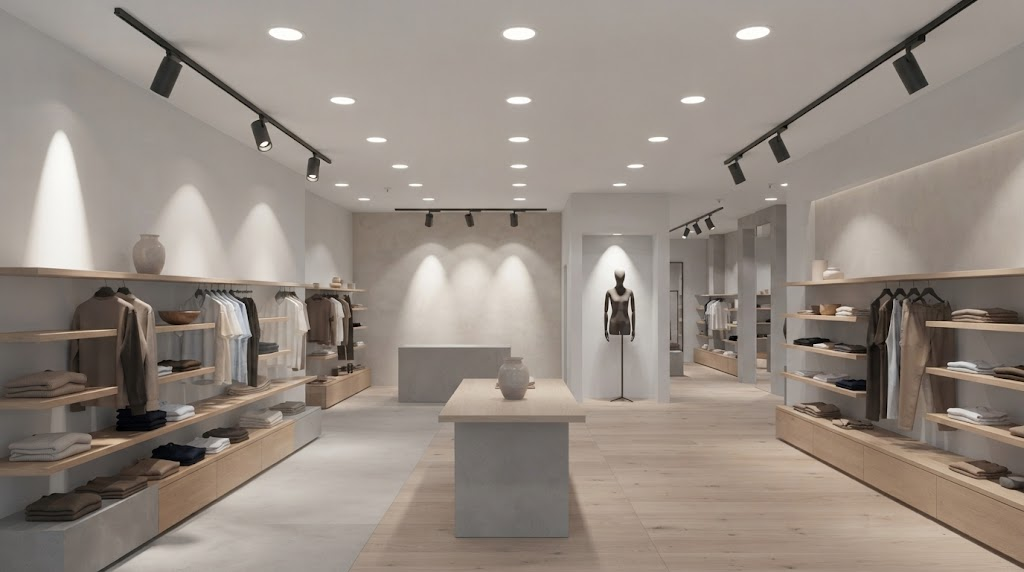
Fashion retail is one of the strongest applications for track lighting.
The reason is simple: the merchandise moves.
A store may change its main collection, window display or feature wall several times throughout the year.
Adjustable spotlights can follow those changes.
A practical lighting layout might use:
Track spotlights for mannequins, feature walls and selected products.
Downlights for general illumination and circulation.
Dedicated fitting-room lighting where appearance and colour quality need additional attention.
This creates different levels of visual emphasis instead of treating every part of the store equally.
What About Supermarkets?
Supermarkets have different priorities.
Large sales floors usually need consistent illumination across aisles and circulation areas.
At the same time, promotional displays and selected product areas may need more directional lighting.
That makes a combination of general lighting and adjustable accent lighting useful.
For a supermarket, the priority is usually:
Consistency → efficiency → visibility → flexibility
For a fashion boutique, it may be:
Product presentation → atmosphere → flexibility → efficiency
The lighting solution should follow the retail format rather than forcing every type of store into the same specification.
Track Lighting vs Downlights for Retail Refurbishment
6
Refurbishment projects have another consideration: the ceiling already exists.
The existing electrical layout may limit where new downlights can be installed.
Track lighting can sometimes provide more flexibility because a rail can serve several fittings without creating a large number of new ceiling positions.
Existing track systems may also be suitable for upgrading, depending on their condition and electrical configuration.
A refurbishment should therefore start with an assessment of:
- Existing wiring
- Ceiling construction
- Current lighting positions
- Track condition
- Existing drivers
- Control system
- Future store layout
Replacing every fixture is not always necessary.
Sometimes a more targeted upgrade makes more sense.
Does Smart Control Change the Choice?
It can.
Both track lighting and downlights can be integrated into modern lighting control systems when compatible drivers and equipment are used.
That can allow:
- Dimming
- Zoning
- Scheduling
- Scene control
- Sensor integration
- Daylight response
But there is still a physical difference.
A controlled downlight can change its output.
A controlled track spotlight can change its output and be redirected.
That extra physical flexibility is one of the main reasons track lighting remains attractive for retail.
Which Is Easier to Maintain?
Neither system is automatically easier in every project.
With track lighting, an individual spotlight can generally be accessed and replaced without opening the ceiling.
With recessed downlights, maintenance can depend on the fitting design and ceiling construction.
This becomes more important in large stores.
If a retailer operates hundreds of locations, small maintenance differences can become significant over time.
When comparing systems, consider:
- Access to fittings
- Driver replacement
- Spare parts
- LED lifetime
- Installation method
- Compatibility with future replacements
Maintenance should be considered at the specification stage rather than after the first failure.
Track Lighting vs Downlights: Cost
The purchase price of one fixture does not tell you which system costs less.
A realistic comparison should include:
Fixture + installation + controls + maintenance + energy + future changes
Track lighting may require the additional cost of the rail and accessories.
Downlights may have a simpler visual appearance but can involve more ceiling work, especially when many fixed positions are required.
There is also the cost of future changes.
If displays move regularly, the ability to reposition track spotlights may save installation work later.
That is why the cheapest fixture is not necessarily the lowest-cost lighting solution over the life of the store.
A Simple Way to Choose
If you are still deciding between the two, start with these questions:
Will the merchandise move?
Yes → Track lighting has an advantage.
Is uniform general lighting the priority?
Yes → Downlights may be more suitable.
Is accent lighting important?
Yes → Track spotlights are usually more flexible.
Is a completely clean ceiling important?
Yes → Recessed downlights may be preferable.
Will the store layout change regularly?
Yes → Track lighting becomes more attractive.
Do you need both general and accent lighting?
Yes → Consider using both.
This approach is more useful than choosing based only on fixture appearance or initial price.
Track Lighting vs Downlights: Quick Comparison
| Factor | Track Lighting | Downlights |
|---|---|---|
| Product highlighting | Excellent | Good |
| Flexibility | Excellent | Limited |
| General illumination | Good | Excellent |
| Changing displays | Excellent | Limited |
| Clean ceiling | Good | Excellent |
| Beam direction | Adjustable | Mostly fixed |
| Accent lighting | Excellent | Good |
| Smart control | Available | Available |
| Maintenance access | Generally easy | Depends on installation |
| Best for | Flexible retail layouts | Stable layouts |
| Hybrid application | Excellent | Excellent |
Track lighting is generally better when displays change frequently or product accent lighting is important. Downlights are often better for stable areas that need consistent general illumination.
Not automatically. Energy efficiency depends on the LED performance, optics, lighting levels, controls and operating hours.
They can be. Recessed downlights are well suited to areas where consistent illumination and a clean ceiling are priorities.
Often, yes. Fashion displays change frequently, so adjustable spotlights can follow mannequins, shelves and feature displays.
Yes. In fact, combining them is often a practical solution. Downlights can provide general illumination while track spotlights highlight products and displays.
Track lighting. The spotlight can normally be moved along the rail and redirected without changing the ceiling
Recessed downlights generally create a quieter ceiling. Track lighting is more visible but can also become part of the interior design.
It depends on the existing ceiling and electrical installation. Track lighting can offer more flexibility where the existing layout does not match the new merchandise plan.
The Practical Answer
The choice between track lighting and downlights does not need to be a competition.
They solve different problems.
Downlights are good at providing a clean, consistent base layer of light.
Track spotlights are good at putting attention exactly where the retailer wants it.
For a store with a fixed layout, downlights may be enough.
For a store where merchandise changes regularly, track lighting provides more freedom.
And for many modern retail projects, the most sensible answer is to use both — general illumination where it is needed, directional light where it adds value, and controls to avoid running either system harder than necessary.
That is also a better fit for the direction of European retail lighting in 2026: less wasted light, more control, better flexibility and lighting that can adapt to the way the store actually operates.