A high-efficiency LED for retail needs more than high lm/W. Efficiency, colour quality, optical control, glare, consistency and thermal performance all affect whether a luminaire works well in a real store. A 170 lm/W figure is useful, but it is only one part of the specification.
What does high-efficiency LED mean in commercial lighting?
For a commercial luminaire, efficacy should be evaluated at the complete-fixture level, not from the LED chip alone.
Luminaire efficacy is normally expressed in lumens per watt (lm/W). It is the light output of the complete luminaire divided by its electrical input power.
For example:
| Luminaire | Output | Input | Luminaire efficacy |
|---|---|---|---|
| A | 3,000 lm | 30 W | 100 lm/W |
| B | 4,200 lm | 30 W | 140 lm/W |
| C | 5,100 lm | 30 W | 170 lm/W |
On paper, C is the most efficient of the three. In an actual retail project, however, the comparison cannot stop there.
The beam distribution may be different. The colour quality may be different. The driver losses may be different. One fixture may put substantially more of its light onto the merchandise.
That is why luminaire efficacy is a starting point, not the complete definition of lighting performance.
ENERGY STAR also evaluates light fixtures at the product level, including light output and electrical input rather than relying only on LED-source specifications.
Is 170 lm/W enough to specify a retail LED?
No. A 170 lm/W luminaire can be highly efficient, but that number does not tell you whether it will produce good retail lighting.
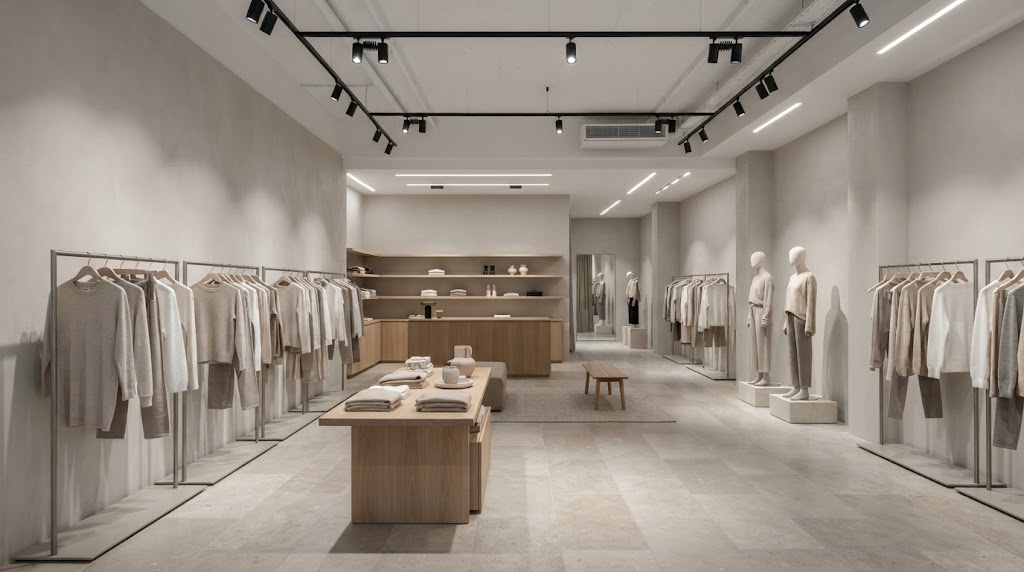
Retail stores have a different requirement from warehouses or simple circulation spaces. The lighting has to reveal colour, texture and material while directing attention to products.
A useful specification should therefore cover several parameters:
| Parameter | What to check | Retail relevance |
|---|---|---|
| Luminaire efficacy | lm/W | Energy consumption |
| CRI / Ra | General colour rendering | Product appearance |
| R9 | Saturated red rendering | Fashion, food, skin tones |
| TM-30 | Fidelity and gamut information | Detailed colour evaluation |
| SDCM | Colour consistency | Fixture-to-fixture uniformity |
| Beam angle | Distribution | Product highlighting |
| Glare | UGR / optical shielding / application | Customer and staff comfort |
| CCT | 3000K / 3500K / 4000K etc. | Store atmosphere |
| Thermal performance | Operating temperature and design | Output and reliability |
| Lumen maintenance | Output over time | Long-term performance |
The IES TM-30 method is useful here because it describes colour rendition in greater detail than a single CRI value, including fidelity, gamut and hue-specific information.
Why can a 150 lm/W spotlight work better than a 170 lm/W fixture?
Because retail lighting is concerned with where the light goes, not just how much light the LED produces.
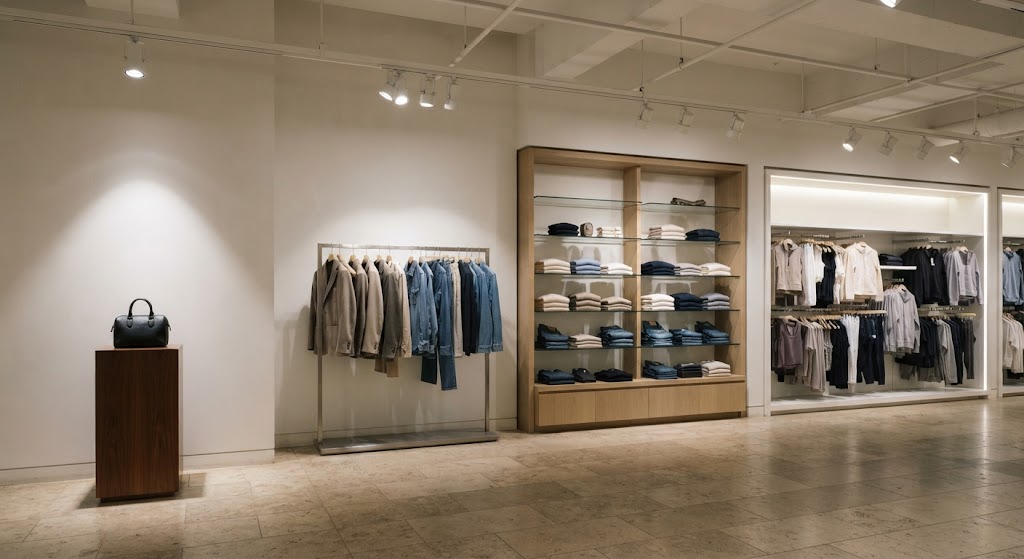
Consider a clothing store with a 4 m ceiling.
A narrow-beam spotlight may be designed to put light precisely onto a mannequin or feature display. A higher-output fixture with a wider distribution may produce more total lumens but spread more light onto the floor and surrounding surfaces.
The first fixture could therefore create the visual emphasis the designer needs with less installed power.
This is why two figures should be separated:
Electrical efficiency:
How much light does the luminaire produce per watt?
Optical effectiveness:
How effectively does the luminaire place that light on the intended surface?
For retail projects, both matter.
Does higher colour quality reduce LED efficiency?
There can be an efficacy trade-off when the LED spectrum is engineered for stronger colour rendering, but there is no single efficiency penalty that applies to every CRI 90+ product.
LED manufacturers balance several variables when developing a source:
- luminous efficacy
- spectral distribution
- colour fidelity
- colour gamut
- CCT
- thermal performance
- lifetime
- cost
A high-efficiency LED designed for a warehouse and a high-colour-quality LED designed for fashion retail may therefore have different performance priorities.
For a store, the relevant question is not simply:
“Which LED has the highest lm/W?”
It is:
“What combination of efficiency and colour performance does this application actually require?”
That distinction becomes particularly important in fashion, beauty, food and premium retail.
Is R9 important for clothing stores?
Yes, R9 can be particularly useful in fashion retail because saturated red information is relevant to many fabrics, skin tones and warm-coloured materials.
Traditional CRI does not include saturated red R9 in its general Ra calculation. Looking at R9 separately can therefore provide additional information about how a light source handles red content.
Typical applications include:
- Fashion stores — red, burgundy, orange and warm-coloured garments.
- Beauty stores — skin tones and cosmetics.
- Food stores — meat, fruit and other products where red appearance matters.
- Lifestyle stores — leather, timber and warm decorative materials.
But R9 should not become another single-number shortcut.
A light source can have a strong R9 value and still have other spectral characteristics that are worth examining. For higher-specification projects, TM-30 can provide additional information about colour fidelity and gamut. The IES TM-30 framework is specifically intended to give a broader description of colour rendition.
What is TM-30 and why should retail designers care?
TM-30 gives a more detailed picture of colour rendition than CRI alone.
The framework includes:
- Rf — colour fidelity
- Rg — gamut
- hue-specific fidelity
- colour shifts
- graphical information about colour performance
This is useful when the lighting brief goes beyond “CRI 90+” and the appearance of merchandise is an important part of the project.
For example, two LEDs can both be labelled CRI 90+ while producing noticeably different results with certain colours.
That does not mean one automatically suits every store better. It means the specification needs more information when colour appearance is critical.
What beam angle should be used for retail LED track lighting?
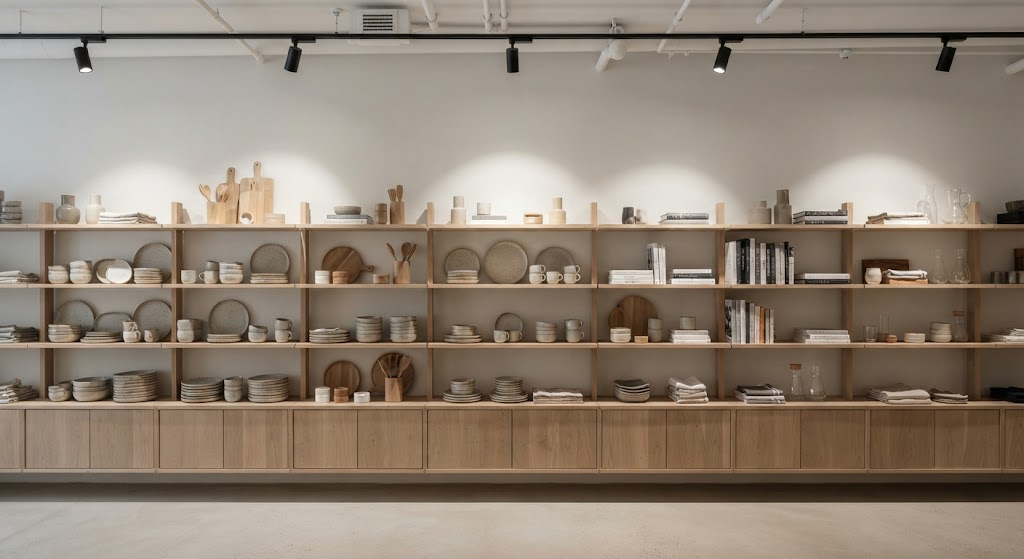
The correct beam angle depends on mounting height, target size, spacing and the intended contrast.
Common starting points include:
| Beam angle | Typical use |
|---|---|
| 15° | Small focal displays, mannequins, hero products |
| 24° | Shelves and medium-size merchandise |
| 36° | General accent lighting |
| 60° | Larger display areas |
| Asymmetric | Vertical walls and wall-mounted merchandise |
These are application examples rather than fixed standards.
A 15° beam can create strong emphasis on a small target but may produce uneven illumination if used across a large merchandise wall. A 60° beam covers more area but produces less concentrated accenting.
The right choice depends on the distance between the luminaire and the target, target dimensions and required illuminance distribution.
Does a higher lumen output always mean better retail lighting?
No. Excess light outside the target area does not automatically improve product presentation.
Retail lighting often relies on controlled contrast.
A display wall may need relatively even illumination. A mannequin or promotional product may need stronger accent lighting. A circulation area may require a different distribution again.
The objective is therefore not simply to maximise lumens.
It is to control:
light level + distribution + contrast + colour + glare.
This is one reason photometric data is important when selecting commercial LED fixtures.
How should contractors compare two high-efficiency LED fixtures?
Compare the complete luminaire configuration under comparable conditions rather than comparing isolated headline figures.
A useful technical comparison should include:
- Luminaire wattage
- Delivered lumens
- Luminaire efficacy
- CRI
- R9
- TM-30 data where relevant
- CCT
- SDCM
- Beam angle
- Photometric distribution
- Driver efficiency
- Power factor
- Dimming compatibility
- Thermal performance
- Lumen maintenance
- Lifetime information
- Warranty
This matters because changing the CCT, CRI, optics, driver or power configuration can change the final performance of the same basic luminaire family.
ENERGY STAR’s luminaire criteria similarly look beyond efficacy and include areas such as power factor, thermal performance, colour maintenance and other product characteristics.
How do you specify high-efficiency LED lighting for a retail project?
Start with the lighting requirement, then select the luminaire that can meet it efficiently.
1. Define what needs to be illuminated
First identify the merchandise and surfaces that matter.
For example:
- hanging garments
- mannequins
- shelving
- display tables
- feature walls
- checkout areas
- circulation zones
A fashion boutique and a supermarket may both use LED track lighting, but their colour, distribution and maintenance requirements can be quite different.
2. Establish the technical minimums
A project specification can set minimum performance requirements before manufacturers are compared.
For example:
| Parameter | Example target |
|---|---|
| Luminaire efficacy | ≥140 lm/W where appropriate |
| High-efficiency configuration | Up to around 170 lm/W depending on product |
| CRI | ≥90 for colour-critical retail |
| R9 | Define according to merchandise |
| CCT | Project-specific |
| Colour consistency | Tight SDCM requirement where needed |
| Beam angle | Based on target and mounting height |
| Dimming | DALI-2 / 1–10 V / other project requirement |
| Glare | Evaluate for actual installation |
| Photometry | Required for lighting calculations |
These are project examples rather than universal standards. The final values should follow the lighting design, applicable regulations and project brief.
3. Check the actual luminaire
Finally, verify the configuration that will actually be supplied.
Check:
- LED package
- driver
- optical system
- reflector or lens
- CCT
- CRI
- power
- beam angle
- dimming
- thermal design
- photometric data
This step prevents a common procurement problem: approving a product based on one configuration and receiving another.
What are the main benefits of high-efficiency LED lighting in retail?
The practical benefit is the ability to reduce lighting power while maintaining the visual performance required by the store.
1. Lower connected load
If the same required lighting result can be achieved with lower fixture wattage, the installed lighting load falls.
For example, 100 fixtures operating at 40 W represent:
100 × 40 W = 4.0 kW
At 30 W per fixture:
100 × 30 W = 3.0 kW
That is a 25% reduction in connected lighting power before considering dimming, occupancy controls or daylight harvesting.
Actual energy savings will depend on operating hours and control strategy.
2. Better product presentation
Good colour rendering and appropriate optics help merchandise appear closer to the intended visual result.
This matters particularly for:
- fashion
- beauty
- food
- jewellery
- furniture
- premium lifestyle products
3. Lower maintenance pressure
LED systems with appropriate thermal management and verified lumen-maintenance performance can support longer maintenance intervals.
However, lifetime figures should be checked carefully. A manufacturer’s stated LED lifetime is not automatically the same as the guaranteed life of the complete luminaire.
Where does high-efficiency LED lighting make the most sense?
It is particularly valuable in stores with long operating hours, large installed lighting loads or demanding product presentation requirements.
1. Fashion retail
Colour rendering, beam control and visual contrast are usually more important than simply achieving maximum lumen output.
2. Supermarkets
Long operating hours make energy efficiency important, while shelves and fresh-product displays require controlled and consistent illumination.
3. Beauty and cosmetics
Skin tones and product colours make spectral quality particularly relevant.
4. Department stores
Different departments can require different CCTs, beam angles and lighting levels.
5. Shopping centres and commercial interiors
Energy, glare, maintenance access and lighting controls often need to be considered together.
6. Multi-store rollouts
Consistency becomes a major issue. The same specification needs to perform predictably across different stores.
What mistakes should you avoid when buying high-efficiency LED lighting?
The most common mistake is treating lm/W as the complete definition of LED quality.
Watch for these issues:
- Comparing LED-chip efficacy with luminaire efficacy.
- Accepting a high lm/W figure without checking test conditions.
- Looking at CRI but ignoring R9 where it matters.
- Using R9 as the only measure of colour quality.
- Ignoring SDCM in multi-fixture installations.
- Choosing beam angles without reviewing photometric files.
- Ignoring glare.
- Comparing fixtures with different CCT or CRI configurations.
- Ignoring driver losses.
- Treating LED lifetime as identical to complete-luminaire lifetime.
- Forgetting dimming compatibility.
- Selecting a fixture without checking actual thermal conditions.
A good datasheet should make the measurement conditions clear enough for two products to be compared fairly.
Is 170 lm/W the future of commercial LED lighting?
Higher efficacy will remain important, but 2026 retail lighting is moving toward a broader definition of performance.
The direction seen in the 2026 retail and lighting exhibition landscape is not simply “more lumens from fewer watts.” Energy efficiency is being considered alongside lighting quality, smart controls, sustainability and the customer experience.
That changes the way commercial LED products should be evaluated.
The next generation of retail lighting specifications is likely to put more attention on the combination of:
efficacy + colour quality + optical precision + visual comfort + controls + reliability.
EuroShop 2026’s lighting programme similarly connected energy-efficient lighting with smart lighting, sustainability and the retail experience.
The IES has also continued to develop practical guidance around colour rendition, including its 2026 lighting-practice publication addressing how colour-rendition concepts can be applied during lighting design and specification.
Quick FAQ
Yes, 170 lm/W is a high efficacy figure when it refers to complete-luminaire performance under clearly defined conditions. It should still be considered alongside colour, optics, glare and reliability.
They can be combined in some LED products, but the actual result depends on the LED spectrum, CCT, optics, driver and thermal design. The product’s measured luminaire data matters more than a general assumption.
Yes, particularly when garments contain saturated reds or warm colours. R9 is useful information, but it should be considered with the broader colour specification.
Neither is universally better. The choice depends on the merchandise, architecture, materials, brand concept and desired visual appearance.
No. Total energy consumption also depends on fixture quantity, wattage, operating hours, dimming and lighting controls.
Ask for complete luminaire data: wattage, delivered lumens, efficacy, CRI, R9, CCT, SDCM, TM-30 where relevant, beam angle, photometry, driver information, thermal data, lumen-maintenance information and warranty.
There is no single number that works for every store. The specification should match the merchandise, mounting conditions, visual objectives, energy target and control strategy.
What should a 2026 retail LED specification ultimately optimise?
The goal is not the highest possible lm/W; it is the required retail lighting result at the lowest practical energy and operating cost.
A useful specification can be reduced to five questions:
1. Efficiency
How much light does the complete luminaire deliver per watt?
2. Colour
Does the spectrum reproduce the merchandise appropriately?
3. Optics
Does the light go where the designer needs it?
4. Visual comfort
Can customers and staff use the space comfortably?
5. Reliability
Will the output, colour and electrical performance remain stable over the intended service period?
A 170 lm/W fixture that fails these basic application requirements is not necessarily a good retail luminaire.
A slightly lower-efficacy fixture with better colour, optics and control may deliver the required result with fewer fixtures or lower operating power.
For commercial and retail lighting in 2026, high efficiency is no longer just a question of lm/W. The stronger specification is the one that balances energy, light quality, optical control and long-term performance.